Description
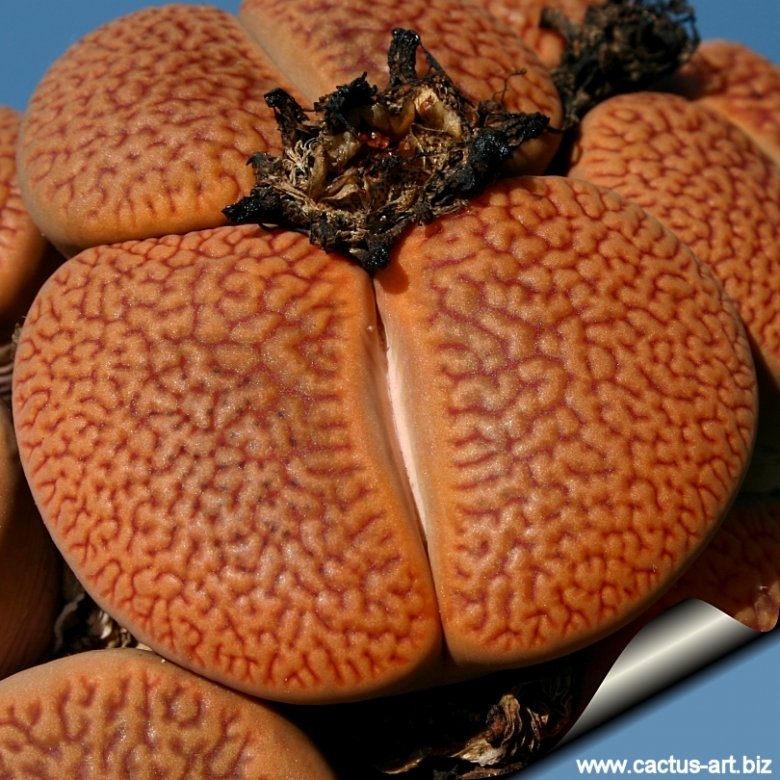
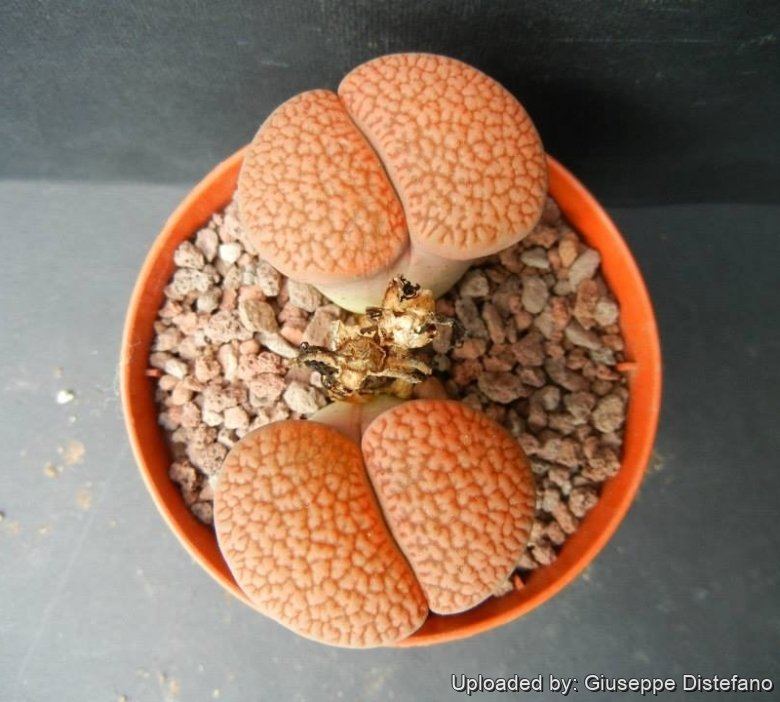
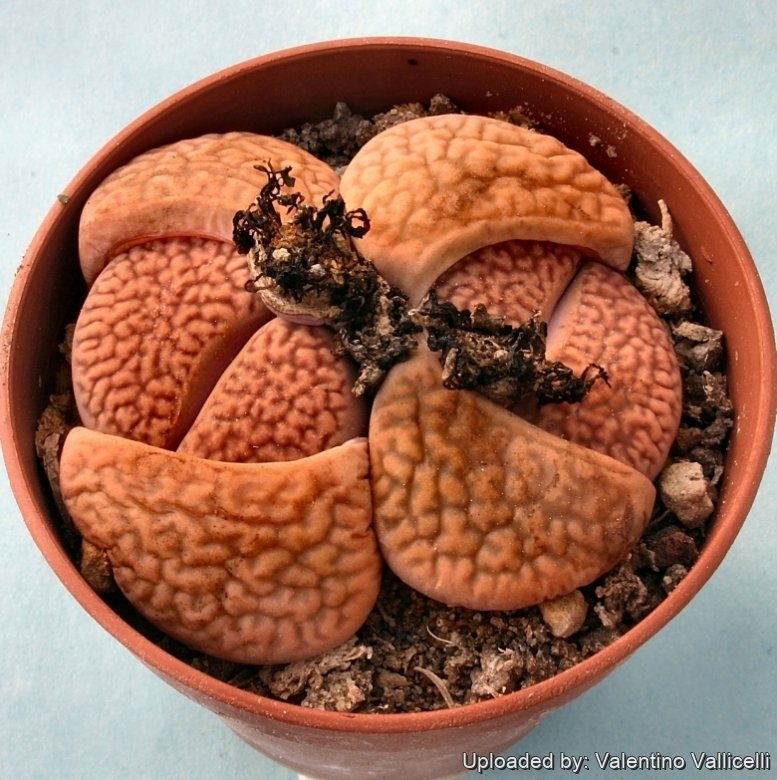
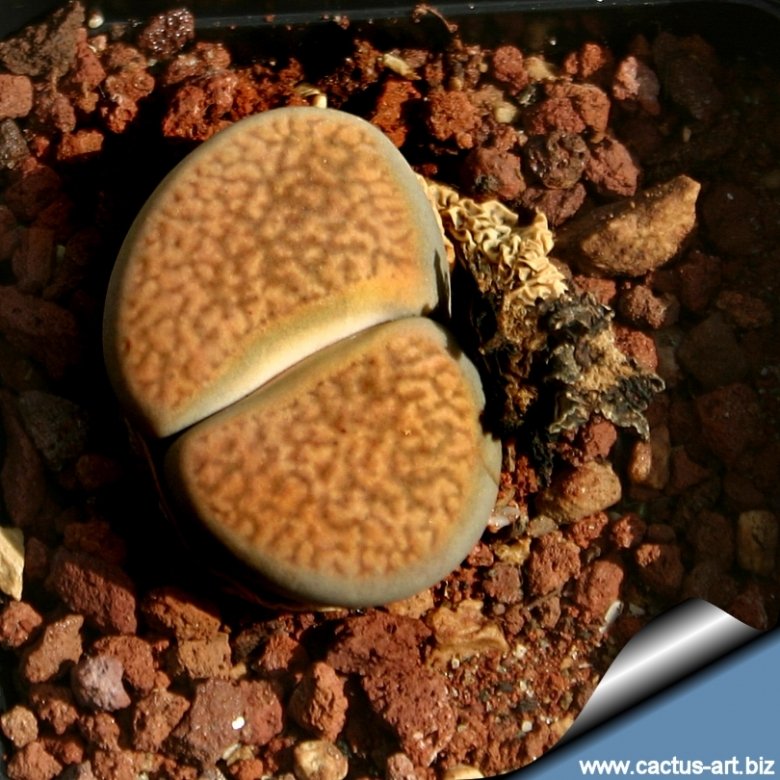
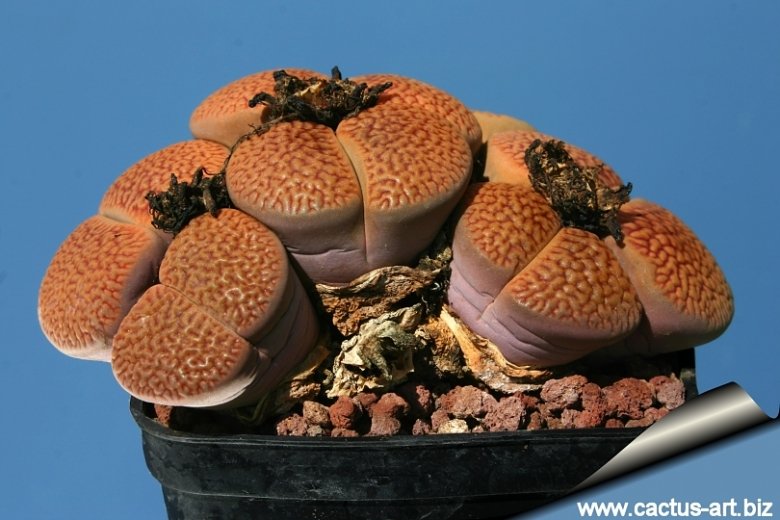
Lithops hookeri var. marginata is one of the many a controversial varieties of Lithops hookeri, but its varietal status is uncertain and some consider it only a form of the latter. It is distinguished from Lithops hookeri for the upper surface usually rust-brown, with
olive-green windows and top part of surface slightly rugulose. However it is the more variable variety for face colours with a tendency to broader grooves which often widen into channels and open windows occasionally even into partially open windows.
Habit: Growth solitary or forming clumps of 2 or more.
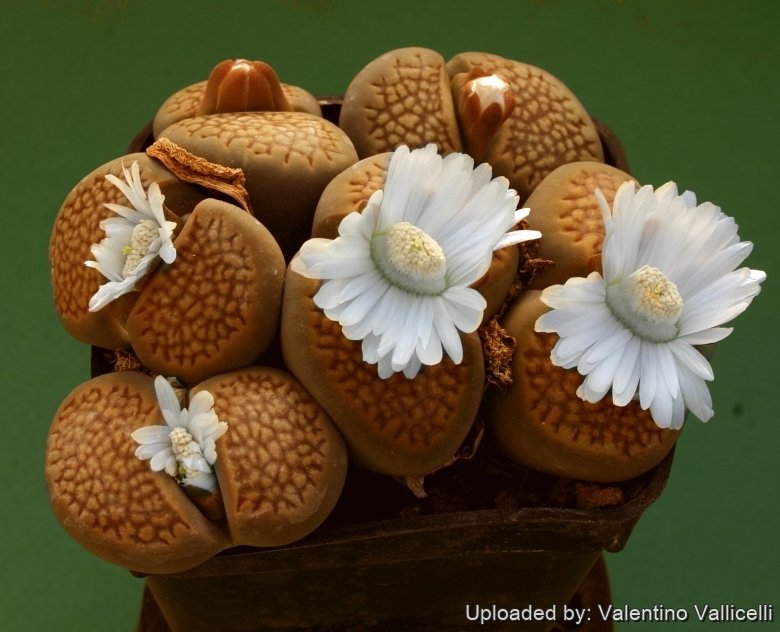
Bodies (paired leaves): Medium to small, turbinate, rounded from above, profile truncated, top of lobes elliptic subequal, slightly convex, slightly rugulose. Shoulders, face margins and islands, violaceous, opaque yellowish, greenish, pinkish or brownish grey, yellow or pink beige, reddish grey, the margins often obscurely banded with more intense colour. Windows and channels large, obscurely transparent, various shades of dark olivaceous green, greyish or brownish green, greenish brown, greyish red or dark grey. In the window numerous islands of irregular shape; impressed in the plane and in the slight undulations are numerous dark blood-red or orange-red dots and lines, scarcely visible with the naked eye. Dusky dots dull dark greyish green. Outer margin laciniated, laciniae very irregular and between them dark blood-red dots and lines; inner margin slightly denticulate or nearly straight. The islands in the window are formed from the projecting laciniae.
Flowers: Yellow, often small.
Blooming season: Autumn (in habitat blooms in April)
Fruits: Mostly 6-cambered.
Seeds: Large, reddish.
Origin and Habitat
20 km East-North-Eeast of Hopetown, South Africa
Habitat: They grows on different kind of stony and gravelly grounds where are very difficult to spot. Substrata mainly composed by yellow-brown fine-grained sandy shale; red-stained quartzite; brown amygdaloidal lava; dark brown dolerite. They closely resemble the surrounding pebbles of their natural habitat, either in colouration and shape, this camouflage allows them to escape detection and is a very effective strategy for escaping predation. They are pollinated by bees, flies, wasps, gnats, bugs and other insects that are common in the area.
Cultivation and Propagation
They need an open mineral, fast draining mix and the maximum amount of light you are able to give them.
The basic cultivation routine is: Stop watering after flowering. Start watering after the old leaves completely dry. (Usually late March or Early April) Water freely during the growing season, soak the compost fully but allow it to dry out between waterings. Some growers fertilize frequently, some hardly ever. Keep them dry during the winter. Nearly all problems occur as a result of overwatering and poor ventilation especially when weather conditions are dull and cool or very humid.
Bibliography
Major refences and further lectures
-
Heidrun E. K. Hartmann (2002) “Aizoaceae F – Z” Springer
-
Achim Hecktheuer (2008) “Mesembs, mehr als nur Lithops” Books on Demand GmbH Norderstedt. ISBN-13 978-3-8370-1724-3
-
Desmond T. Cole & Naureen A. Cole, Uwe Beyer, Yves Delange (2008) “Les Lithops” SUCCULENTES Spécial 2008 AIAPS (now Terra seca). ISSN 0258-5359
-
Desmond T. Cole & Naureen A. Cole (2005) “LITHOPS Flowering Stones” Cactus & Co. Libri. ISBN 88-900511-7-5 ISBN-13 978-88-900511-7-3
-
Yasuhiko Shimada (2001) “The Genus Lithops” Dobun Shoin. ISBN 4-8103-4066-X
-
Rudolf Heine (1986) “Lithops - Lebende Steine” Neumann Verlag. ISBN 3-7402-0000-6; ISBN-13 978-3-7402-0000-8
-
Bernd Schlösser (2000) “Lithops – Lebende Steine” Praktische Anleitung für die Zimmerkultur. BussinessPoint MEDIA. ISBN 3-934945-01-5; ISBN-13 978-3-934945-01-2
-
Steven A. Hammer (1999) “Lithops – Treasures of the veld” British Cactus and Succulent Society. ISBN 0-902-099-64-7; ISBN-13 978-0-902099-64-7
-
Desmond T. Cole (1988) “Lithops – Flowering Stones” Acorn Books CC. ISBN 0-620-09678-0; ISBN-13 978-0-620-09678-2
-
Rudolf Heine (1986) “Lithops – lebende Steine” Neumann Verlag. ISBN 3-7402-0000-6; ISBN-13 978-3-7402-0000-8
-
David L. Sprechman (1970) “Lithops” Associated University Presses, Inc. SBN 8386-6902-6
-
Gert Cornelius Nel (1946) “Lithops” Hortors Limited, South Africa
Gallery