Description
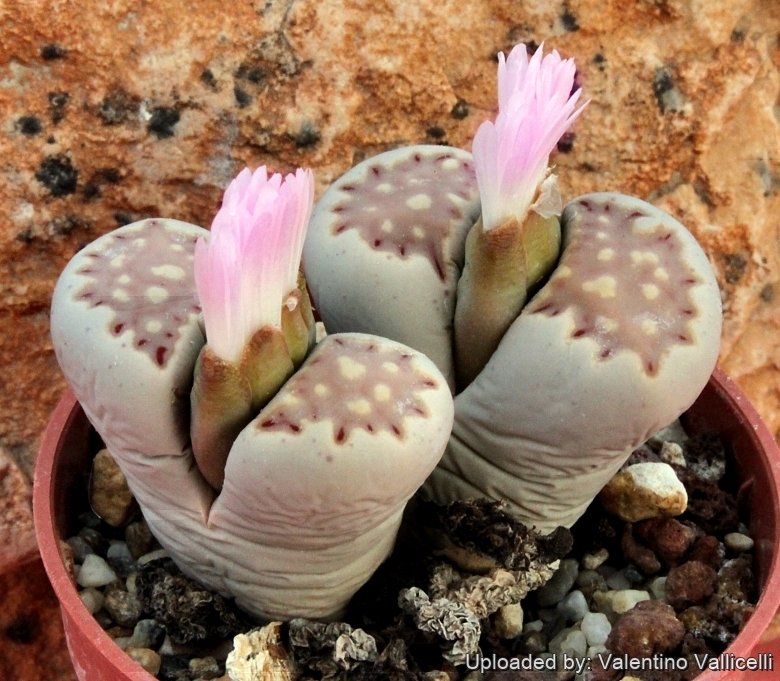
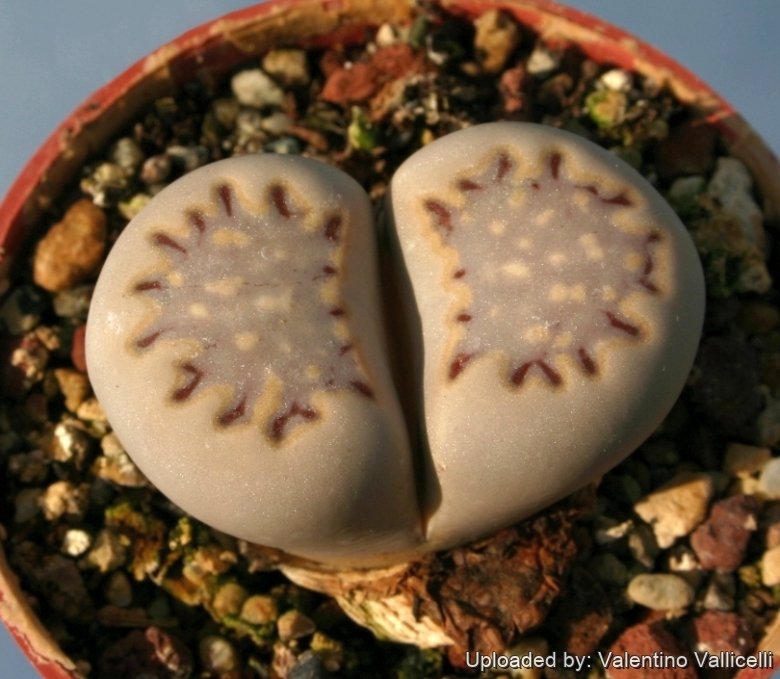
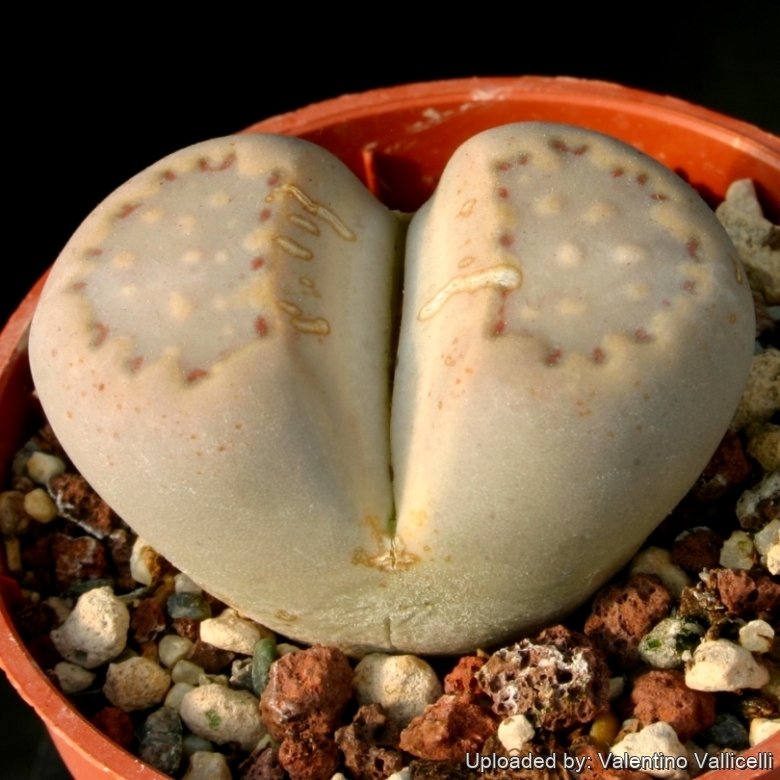
Lithops julii subs. fulleri is a very pretty distinct subspecies of the variable Lithops julii sometime regarded as a separate species. It has shoulders, margins and islands light creamy greenish grey, margins edged with a light brownish-green, especially in the indentations. Windows and channels opaque greyish blue-green. Rubrications obscure dark red-brown. The rust-brown lines mainly between the lobes of the margin is a specific characteristic of this subspecies. Moreover subs. fulleri lacks the “lip-smears” which is a typical feature of the other subspecies.
Habit: It is a stemless small to medium sized species that grows solitary or forming clumps of 2 or up to 15 8or more) bodies.
Body (paired leaves): Cone-shaped, or obconic, elliptic in outline 25 mm high, 20-30 mm broad, and 16-20 mm thick, separated by a 5-12 mm deep fissure, dividing it into two contiguous, (usually) conjunct lobes; Faces slightly reniform usually flat, at times scarcely convex often rough from being covered with small bumps caused by numerous impressed dendritic markings. Margin smooth, light dove-grey with a slight violaceous tint; window large, dark-green; projections from margins into window raised above the level of the window surface and giving the top a rough appearance; projections forming at times numerous small islands of the same colour as sides, thereby dividing the window into small, more or less confluent areas; sometimes depressions between the ridges with interconnected impressed bright rust-brown lines making a very pleasing contrast, or at times the lines only to be seen between the short lobes of the inner and outer margins; inner and outer margins at times deeply lobed, lobes irregularly shaped. It is however very variable in colour, some specimens being opaque whitish-grey and almost uniform in colour, others opaque but strongly reticulated with fine impressed brown markings, yet others with largely open obscurely translucent windows.
Flowers: Single, white, daisy-like, emerging from the fissure and as large as the pair of fleshy leaves below.
Blooming season: From mid-summer through fall.
Fruit: Seed capsules-loculed, top flatted or slightly convex, faces elliptic.
Seeds: Yellow-brown to light yellow-brown.
Similar species: It is vaguely similar to Lithops karasmontana, but is readily distinguished from that species by its more crowded dendritic markings, rougher top, and different colouration, and these two species have nothing in common with one another.
Origin and Habitat
Locality 65 km North West Springbok, South Africa.
Cultivation and Propagation
In the winter season the plant doesn’t need watering, the plant in this time extracts water from the outer succulent leaves, allowing them to shrivel away, relocating water to the rest of the plant and to the new leaves that form during this period. This plant is best for a well lit area (Bright shade to full sun). Water sparingly only when warm, no water when cold.
Bibliography
Major refences and further lectures
-
Heidrun E. K. Hartmann “Aizoaceae F – Z” Springer 2002
-
Achim Hecktheuer “Mesembs, mehr als nur Lithops” Books on Demand GmbH Norderstedt. 2008
-
Desmond T. Cole & Naureen A. Cole, Uwe Beyer, Yves Delange “Les Lithops” SUCCULENTES Spécial 2008 AIAPS (now Terra seca). 2008
-
Desmond T. Cole & Naureen A. Cole “LITHOPS Flowering Stones” Cactus & Co. Libri. 2005
-
Yasuhiko Shimada “The Genus Lithops” Dobun Shoin. 2001
-
Rudolf Heine “Lithops - Lebende Steine” Neumann Verlag. 1986
-
Bernd Schlösser “Lithops – Lebende Steine” Praktische Anleitung für die Zimmerkultur. BussinessPoint MEDIA. 2000
-
Steven A. Hammer “Lithops – Treasures of the veld” British Cactus and Succulent Society. 1999
-
Desmond T. Cole “Lithops – Flowering Stones” Acorn Books 1988
-
Rudolf Heine “Lithops – lebende Steine” Neumann Verlag. 1986
-
David L. Sprechman “Lithops” Associated University Presses, Inc. 1970
-
Gert Cornelius Nel “Lithops” Hortors Limited, South Africa 1946
-
Edgar Lamb “The illustrated reference on cacti and other succulents” Blandford Press. 1978
-
Christopher Brickell, Royal Horticultural Society “RHS A-Z Encyclopedia of Garden Plants: K-Z., Volume 2” Kindersley, 2008
-
G. C . Nel “Lithops: Plantae succulantae, rarissimae, in terra obscuratae, e famailia Aizoaceae, ex Africa australi” Hortors Limited, Cape Town, South Africa 1946
-
Heidrun E. K. Hartmann “Illustrated Handbook of Succulent Plants: Aizoaceae F-Z” Springer, 2002
-
Steven A. Hammer “Lithops: Joyaux du veld” Editions Quae, 25/nov/2010
Gallery