Description
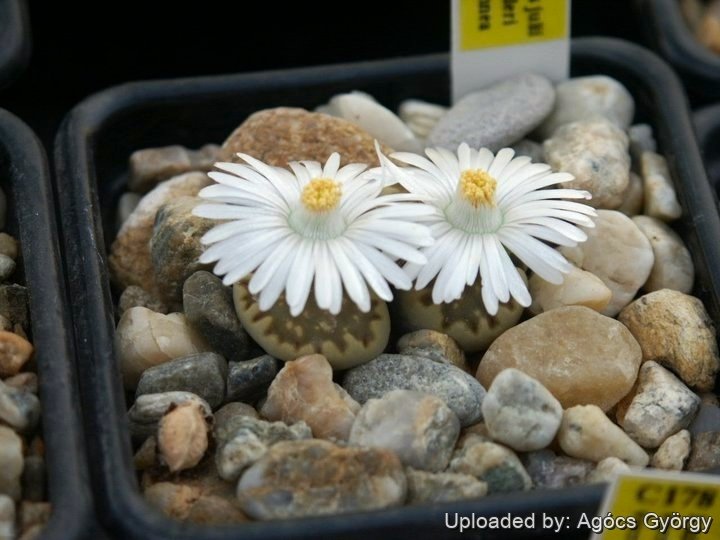
Lithops julii subs. fulleri is a very pretty distinct subspecies of the variable Lithops julii sometime regarded as a separate species. The rust-brown lines mainly between the lobes of the margin is a specific characteristic of this subspecies. Moreover subs. fulleri lacks the “lip-smears” which is a typical feature of the other subspecies. Lithops julii subs. fulleri var. brunnea is very similar to var. fulleri, but browner in colour.
Habit: It is a stemless small to medium sized species that grows solitary or forming clumps of 2 or up to 15 8or more) bodies.
Body (paired leaves): Cone-shaped, or obconic, elliptic in outline 25 mm high, 20-30 mm broad, and 16-20 mm thick, separated by a 5-12 mm deep fissure, dividing it into two contiguous, (usually) conjunct lobes; Faces slightly reniform usually flat, at times scarcely convex often rough from being covered with small bumps caused by numerous impressed dendritic markings.
Colours: Shoulders, margins and islands pale creamy, pinkish or bluish grey, or beige. Windows and channels greyish, reddish or greenish brown, or grey. Rubrications red.
Flowers: Single, white, daisy-like, emerging from the fissure and as large as the pair of fleshy leaves below.
Blooming season: From mid-summer through fall.
Fruit: Seed capsules-loculed, top flatted or slightly convex, faces elliptic.
Seeds: Yellow-brown to light yellow-brown.
Similar species: It is vaguely similar to Lithops karasmontana, but is readily distinguished from that species by its more crowded dendritic markings, rougher top, and different colouration, and these two species have nothing in common with one another.
Origin and Habitat
TL: 10 km NE of Pofadder, South Africa
Cultivation and Propagation
It is a summer growing species with dry rest period over winter. Easy to grow it tolerates a degree more excess water than some particular hydrophobic species, even so it must have a very open mineral, fast draining mix with little compost and a high degree of grit, coarse sand, small lava gravel or pebbles. Give them the maximum amount of light you are able to give them, but care should be taken about exposing them to the full blast of the sun rays in summer. Such tiny plants can easily get scorched or broiled and their appearance spoiled (this may not matter in the wild, where the Lithops have probably shrunk into the ground and becomes covered with sands).
The basic cultivation routine is: Stop watering after flowering. Start watering after the old leaves completely dry. (Usually late March or Early April) Water freely during the growing season, soak the compost fully but allow it to dry out between waterings, no water when cold. Some growers fertilize frequently, some hardly ever. Keep them dry during the winter. Nearly all problems occur as a result of overwatering and poor ventilation especially when weather conditions are dull and cool or very humid. If too much water is supplied the plants will grow out of character, bloat, split and rot. Keep them in small pots as solitary clumps or as colonies in large, shallow terracotta seed pans.
Bibliography
Major refences and further lectures
-
Heidrun E. K. Hartmann “Aizoaceae F – Z” Springer 2002
-
Achim Hecktheuer “Mesembs, mehr als nur Lithops” Books on Demand GmbH Norderstedt. 2008
-
Desmond T. Cole & Naureen A. Cole, Uwe Beyer, Yves Delange “Les Lithops” SUCCULENTES Spécial 2008 AIAPS (now Terra seca). 2008
-
Desmond T. Cole & Naureen A. Cole “LITHOPS Flowering Stones” Cactus & Co. Libri. 2005
-
Yasuhiko Shimada “The Genus Lithops” Dobun Shoin. 2001
-
Rudolf Heine “Lithops - Lebende Steine” Neumann Verlag. 1986
-
Bernd Schlösser “Lithops – Lebende Steine” Praktische Anleitung für die Zimmerkultur. BussinessPoint MEDIA. 2000
-
Steven A. Hammer “Lithops – Treasures of the veld” British Cactus and Succulent Society. 1999
-
Desmond T. Cole “Lithops – Flowering Stones” Acorn Books 1988
-
Rudolf Heine “Lithops – lebende Steine” Neumann Verlag. 1986
-
David L. Sprechman “Lithops” Associated University Presses, Inc. 1970
-
Gert Cornelius Nel “Lithops” Hortors Limited, South Africa 1946
-
Edgar Lamb “The illustrated reference on cacti and other succulents” Blandford Press. 1978
-
Christopher Brickell, Royal Horticultural Society “RHS A-Z Encyclopedia of Garden Plants: K-Z., Volume 2” Kindersley, 2008
-
G. C . Nel “Lithops: Plantae succulantae, rarissimae, in terra obscuratae, e famailia Aizoaceae, ex Africa australi” Hortors Limited, Cape Town, South Africa 1946
-
Heidrun E. K. Hartmann “Illustrated Handbook of Succulent Plants: Aizoaceae F-Z” Springer, 2002
-
Steven A. Hammer “Lithops: Joyaux du veld” Editions Quae, 25/nov/2010
Gallery