Publication: Aloe 22 (3) 58-59, 62 (1985)
Description
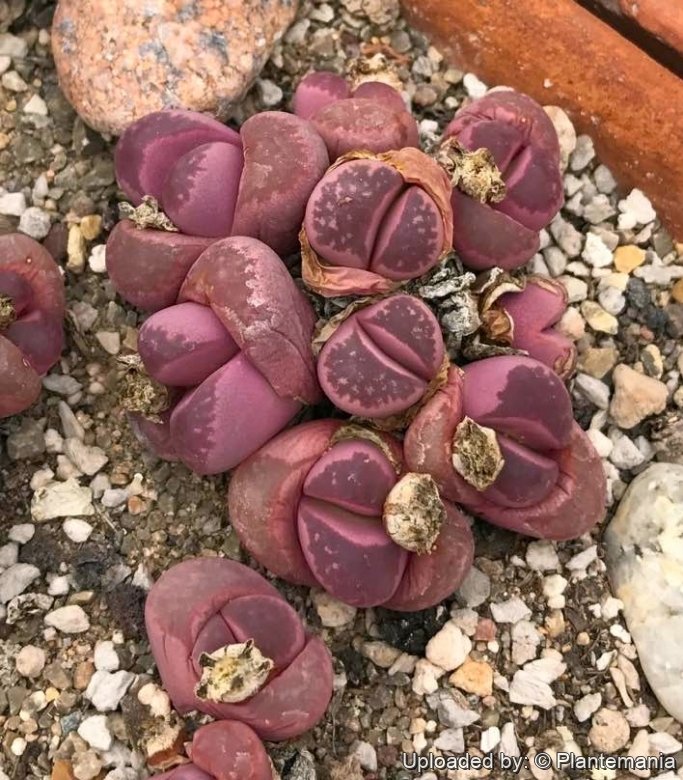
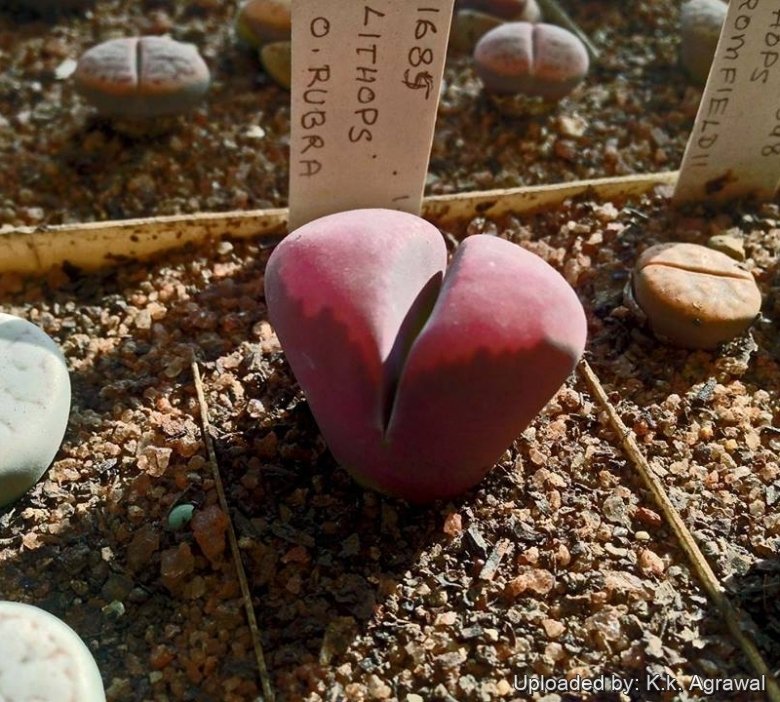
Lithops optica cv. rubra is almost identical to the species, but the body is milky pink to reddish-purple with dark purple windowed tops and it is definitively of the better looking Lithops. It is a tiny caespitose succulent forming with age small clusters of up to 20 bodies. Similar red forms now exist for several Lithops species.
Stem: Very reduced and not visible.
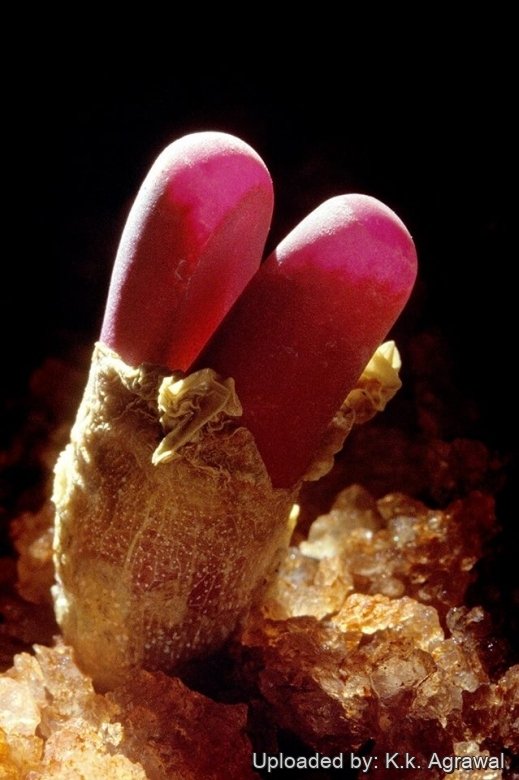
Bodies (Paired leaves pairs): Up to 15 x 12 mm and up to 20 mm long in diameter. The leaf pairs are often unequal, oblong obconical (upside down cone-shaped) almost club-shaped, leaf tips convex with pronounced fissure making cleft, and windowed at their tops and with a smooth texture, ruby milky pink or magenta sides with ruby-red transparent windows. Margins usually regular. The bodies become wrinkled during the dry summers.
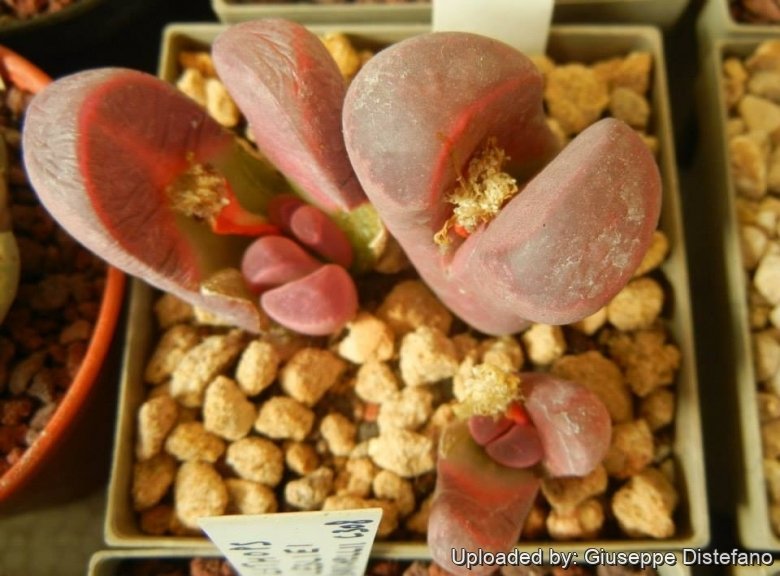
Flowers: Daisy-like white, sometimes with pink tips, 12-25 mm in diameter and self-sterile
Blooming season: Flowers are diurnal and appear during autumn. They open late in the day and close up again at dusk.
Fruit: Capsule mostly 5-chambered. This capsule only opens when moistened, exposing the tiny seeds. In nature, falling rain drops splash out the seeds to a distance of a few centimetres to up to a metre or more from the parent plant. After the capsule dries up it closes again, protecting any seeds left behind.
Remarks: Lithops optica is dominant, and the forma rubra is recessive. Plants can be hand pollinated, using a small paint brush. Remember always to cross different clones as the plants are self-sterile. The seed will remain viable for many years provided it is stored in a cool dry place.
Origin and Habitat
West of Lüderitz, Namibia.
Cultivation and Propagation
Lithops optica cv. rubra is not the easiest to grow Lithops and great care needs to be taken with soil, temperature, time and amount of watering. It is a winter growing species and heads for dormancy in summer.
Growth rate: It is slow growing but clustering in cultivation, if grown correctly, it will reward the grower with generous displays of flowers.
Soil: Since roots are quite shallow, use a sandy gravel mixture (e.g. 2 parts sand : 1 part clay loam : 1 part gravel) or a cactus mix with extra perlite or pumice. For best results, use a shallow pot, and only use the smallest diameter pot that will accommodate the plant. Clay pots help the plants to dry out between watering.
Waterings: Requires little water, otherwise its epidermis breaks (resulting in unsightly scars). Watering should be very sparing and regular only during the late autumn and early winter months, e.g. no more frequently than once in two weeks, but when watered, they should be drenched so that the water reaches the bottom of the container. Only water in growing season, because watering in spring will usually rot them. It is also best to water in the mornings so that the excess water evaporates and the upper layers of soil dry out fairly quickly. No water should ever be allowed to stand around the roots.
Exposure: Keep cool and shaded in summer, needs full sun or light shade in the other seasons. High levels of light are needed in autumn to flower and for good plant development. The low intensity of sun light during the growing season of this species generally prevents the white flower flowers from opening.
Special Advice: Lithops are best planted in a sunny and airy part of the greenhouse, and not too close to the glass roof or sides of the house as the plants can overheat during hot spells.
Fertilization: Need a perfect fertilizer diet during the growing season. Feed them once during the growing season with a fertilizer specifically formulated for cactus and succulents (high potash fertilizer with a dilute low nitrogen), including all micro nutrients and trace elements diluted to ½ the strength recommended on the label. They thrive in poor soils and need a limited supplies of fertilizer to avoid the plants developing excess vegetation, which is easily attacked by fungal diseases. Some growers fertilize frequently, some hardly ever. However, for the highly succulent mesembs, fertilization is not really necessary.
Hardiness: Although the plant will survive mild frost if kept dry (hardy as low as -5° C) it should be protected from severe cold and prolonged frost conditions.
Rot: Rot is only a minor problem with mesembs if the plants are watered and “aired” correctly. If they are not, fungicides won’t help all that much. The plant turns immediately to mush when over watered, or watered out of season. Care must be given in watering, keeping them warm and wet while growing, and cooler and dry when dormant.
Reproduction: Seeds, cuttings or division. Sow them in spring or autumn. Germination usually occurs within about a week or two. Seed germinate at 15-21 °C. Cover the seeds with a very fine layer of grit and water from below with a fungicide to prevent damping off. For the first 3-4 days cover the pots with a sheet of glass/clear perspex to keep the humidity levels high. Remove the glass and replace it with light shadecloth and mist once or twice a day for the next two weeks after which most seeds should have germinated. From then on mistings can be reduced to every second and then every third day as the little plants grow. The young plants can be transplanted after a year, and flowering can be achieved within 3-4 years. The seed will remain viable for many years provided it is stored in a cool dry place. It is also possible to divide a multiheaded plant, but lithops prefer to grow clustered together and many growers prefer to leave them undisturbed to see how large a cluster can get. To separate a cutting from a grown-up mother, lift the plant, carefully cut through the rootstock. Each cutting must contain one or more heads along with a fraction of root and permit them to dry out a couple of days, lay the cuttings on the soil and insert the stem end partially into the soil. Try to keep the cutting somewhat upright so that the roots are able to grow downward.
Bibliography
Major refences and further lectures
-
H. E. K. Hartmann “Illustrated Handbook of Succulent Plants: Aizoaceae F-Z” Springer, 2002
-
S. M Walters “The European Garden Flora Flowering Plants: Casuarinaceae to Aristolochiaceae” Cambridge University Press, 1989
-
Gardeners Chronicle Purnell and Sons 164: 14 (1968)
-
Clive Innes “Complete Handbook of Cacti and Succulents” Van Nostrand Reinhold Company, 01/Dec/1981
-
Cole, D. T. 1988. “Flowering stones” Acorn Books, Randburg. 1988
-
Smith et al. “Mesembs of the World.” Briza.Pretoria 1998
-
Leistner, O.A. (ed.), “Seed plants of southern Africa: families and genera” Strelitzia 10., National Botanical Institute, Pretoria 2000
-
Achim Hecktheuer “Mesembs, mehr als nur Lithops” Books on Demand GmbH Norderstedt. 2008
-
Desmond T. Cole & Naureen A. Cole, Uwe Beyer, Yves Delange “Les Lithops” SUCCULENTES Spécial 2008 AIAPS (now Terra seca). 2008
-
Desmond T. Cole & Naureen A. Cole “LITHOPS Flowering Stones” Cactus & Co. Libri. 2005
-
Yasuhiko Shimada “The Genus Lithops” Dobun Shoin. 2001
-
Rudolf Heine “Lithops - Lebende Steine” Neumann Verlag. 1986
-
Bernd Schlösser “Lithops – Lebende Steine” Praktische Anleitung für die Zimmerkultur. BussinessPoint MEDIA. 2000
-
Steven A. Hammer “Lithops – Treasures of the veld” British Cactus and Succulent Society. 1999
-
Desmond T. Cole “Lithops – Flowering Stones” Acorn Books CC. 1988
-
Gert Cornelius Nel “Lithops” Hortors Limited, South Africa 1946
-
David L. Sprechman “Lithops” Associated University Presses, Inc. 1970