Description
Lithops pseudotruncatella was one of first plant of this genus discovered and for a long time one of the first representative in European collections. Generally this Lithops is characterized by greyish colour with darker ramosely branched marbling on the upper surfaces, but it is also a very variable taxon in which a number of variety and forms has been described. The status of these is uncertain.
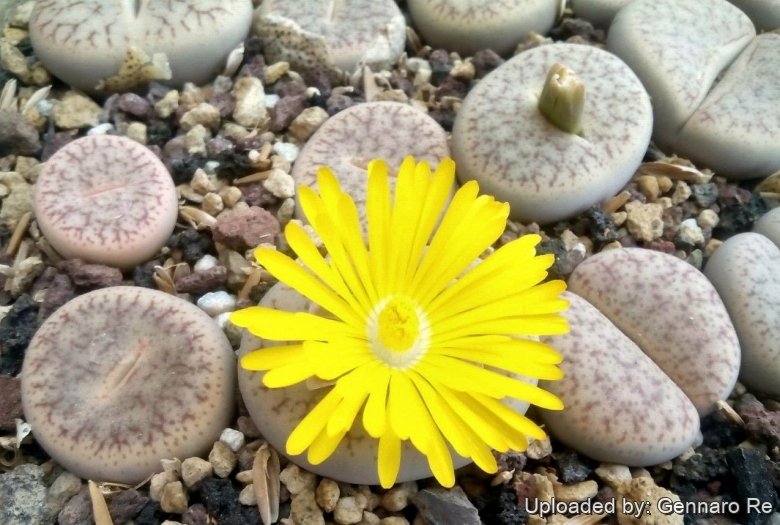
Habit: It is a very free- growing species, solitary or forming clumps of 2 or more heads each consisting of a pair of succulent leaves.
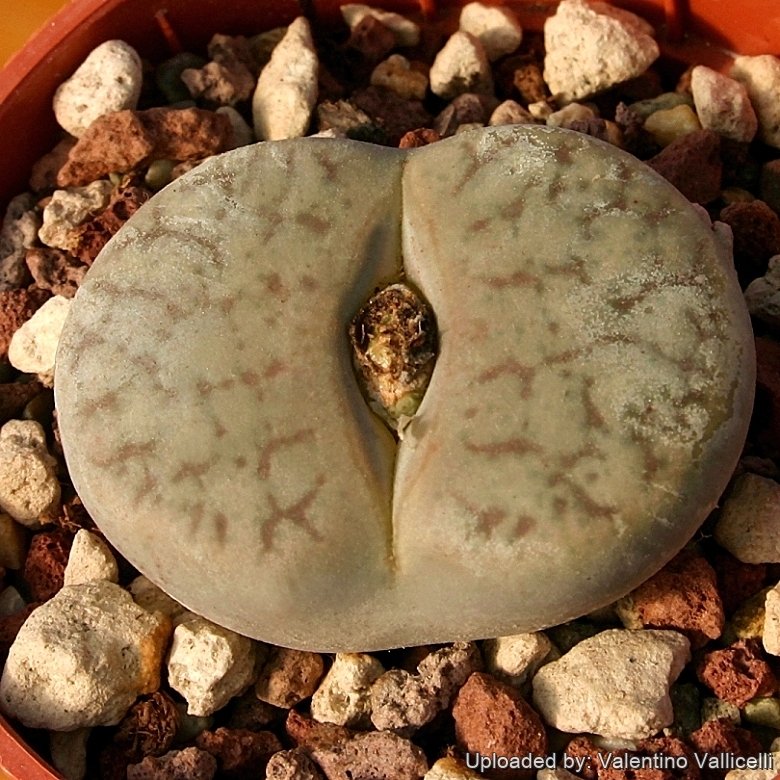
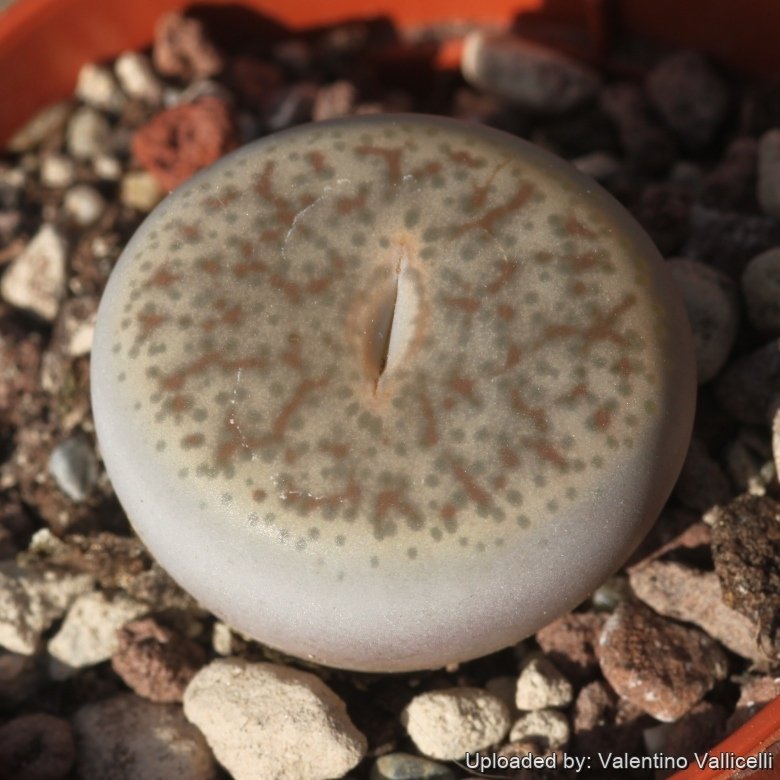
Body (paired leaves): The body is medium to very large, solitary or variously branched with more of 20 heads. Facial diameters 25-50 X 20-35 mm and up to 4 cm tall. Top of lobe flat or slightly convex; sides grey with a tinge of purple; top of lobe varying from pale grey to brownish-grey with a slight pinkish tinge sometimes; windows numerous, consisting of round green dots (miniature windows); top of lobe divided into many irregular areas by branching lines or dendritic markings, which are more or less confluent, forming grooves, coloured rust-brown, brownish-red with a touch of purple-blue along the edges of the grooves; top of lobes slightly rugulose (uneven); in areas a very large number of very minute white dots. The miniature windows either small, round to irregular shaped, or windows confluent from larger windows, which now and then occupy the whole upper surface and in that case the miniature windows on the margin.
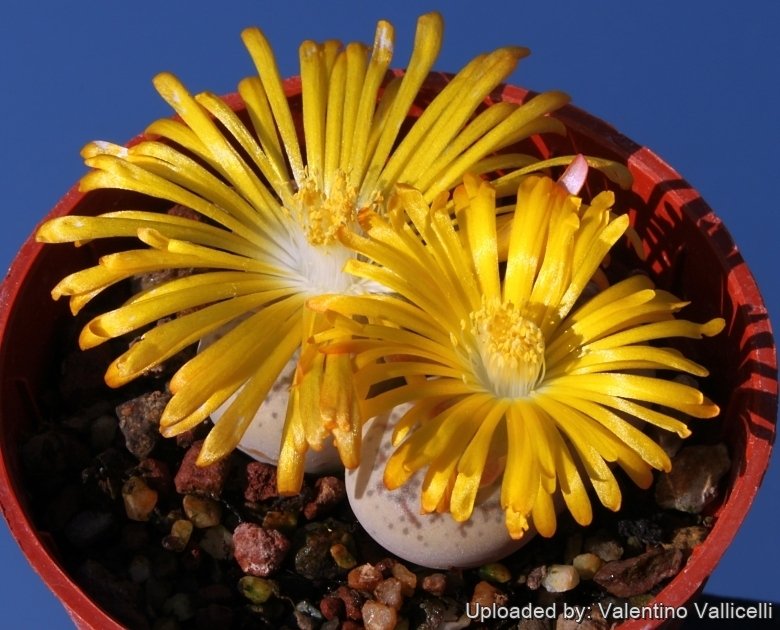
Flowers: Yellow (occasionally white), medium to very large, up to 50 mm in diameter.
Fruits: Seed capsules mostly 6-chambered.
Seeds: Light brown to brown.
Origin and Habitat
30 km South.
Habitat: They grow sunken in rocky environments and closely mimics the quartzite pebbles on which they grow and are lost to sight in this environment, this camouflage allows them to escape detection and is a very effective strategy for escaping predation. When they are found, it is usually due to their large and brightly coloured flowers. They are pollinated by bees, flies, wasps, gnats, bugs and other insects that are common in the area. of Windhoek, Namibia
Cultivation and Propagation
In the winter season the plant doesn’t need watering, but they will still be growing, the new bodies will be increasing in size as the old outer leaves begin to shrivel. In fact the plant in this time extracts water and nutrient stored in the outer succulent leaves, allowing them to dehydrate relocating the water to the rest of the plant and to the new leaves that form during this period until the old leaves are reduced to nothing more than “thin papery shells”.
Bibliography
Major refences and further lectures
-
Heidrun E. K. Hartmann “Aizoaceae F – Z” Springer 2002
-
Achim Hecktheuer “Mesembs, mehr als nur Lithops” Books on Demand GmbH Norderstedt. 2008
-
Desmond T. Cole & Naureen A. Cole, Uwe Beyer, Yves Delange “Les Lithops” SUCCULENTES Spécial 2008 AIAPS (now Terra seca). 2008
-
Desmond T. Cole & Naureen A. Cole “LITHOPS Flowering Stones” Cactus & Co. Libri. 2005
-
Yasuhiko Shimada “The Genus Lithops” Dobun Shoin. 2001
-
Rudolf Heine “Lithops - Lebende Steine” Neumann Verlag. 1986
-
Bernd Schlösser “Lithops – Lebende Steine” Praktische Anleitung für die Zimmerkultur. BussinessPoint MEDIA. 2000
-
Steven A. Hammer “Lithops – Treasures of the veld” British Cactus and Succulent Society. 1999
-
Desmond T. Cole “Lithops – Flowering Stones” Acorn Books 1988
-
Rudolf Heine “Lithops – lebende Steine” Neumann Verlag. 1986
-
David L. Sprechman “Lithops” Associated University Presses, Inc. 1970
-
Gert Cornelius Nel “Lithops” Hortors Limited, South Africa 1946
-
Edgar Lamb “The illustrated reference on cacti and other succulents” Blandford Press. 1978
-
Christopher Brickell, Royal Horticultural Society “RHS A-Z Encyclopedia of Garden Plants: K-Z., Volume 2” Kindersley, 2008
-
G. C . Nel “Lithops: Plantae succulantae, rarissimae, in terra obscuratae, e famailia Aizoaceae, ex Africa australi” Hortors Limited, Cape Town, South Africa 1946
-
Heidrun E. K. Hartmann “Illustrated Handbook of Succulent Plants: Aizoaceae F-Z” Springer, 2002
-
Steven A. Hammer “Lithops: Joyaux du veld” Editions Quae, 25/nov/2010
Gallery