Description
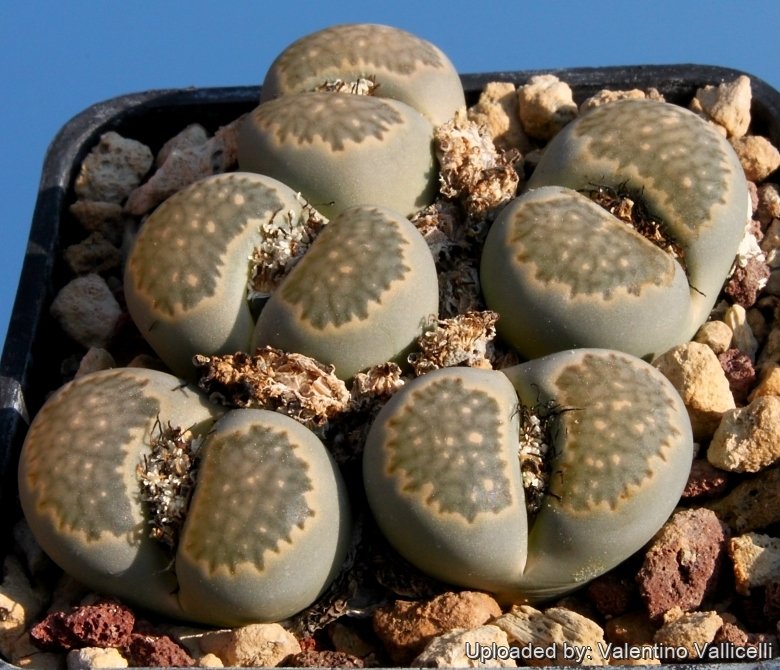
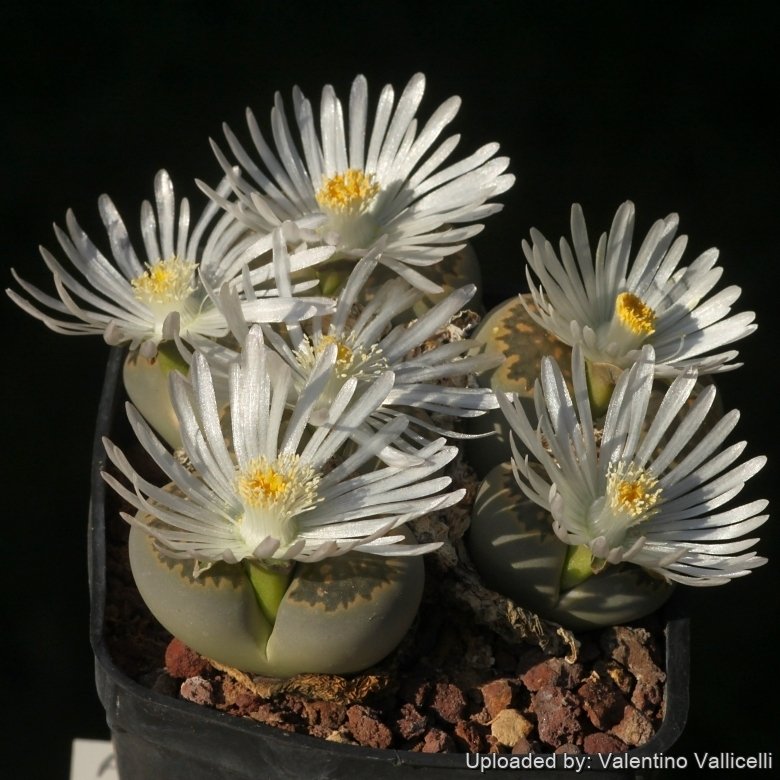
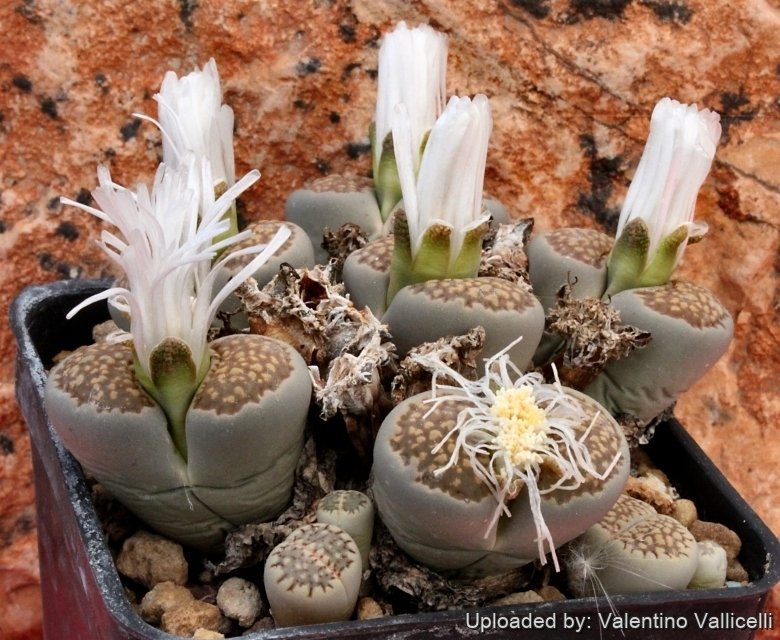
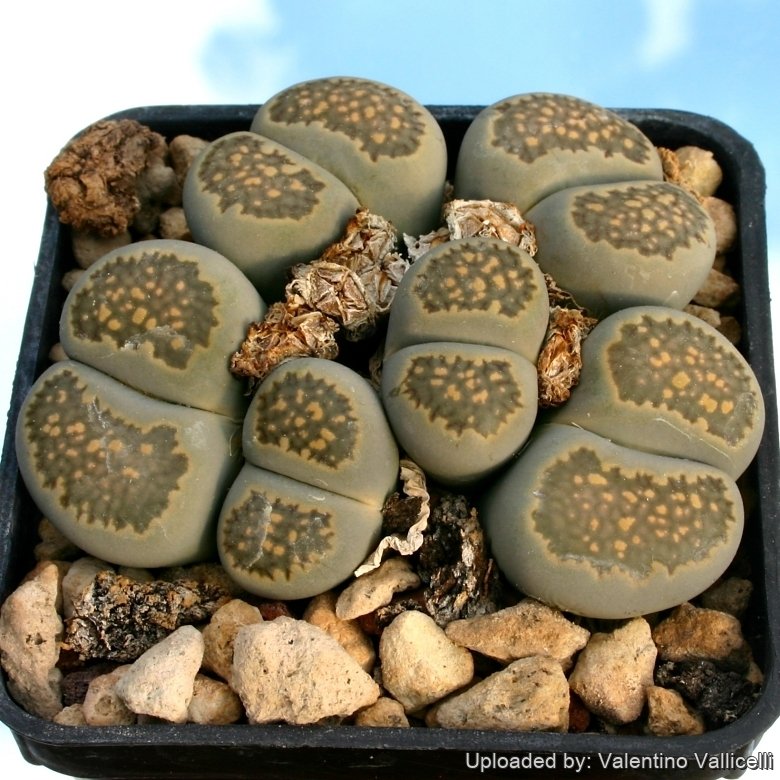
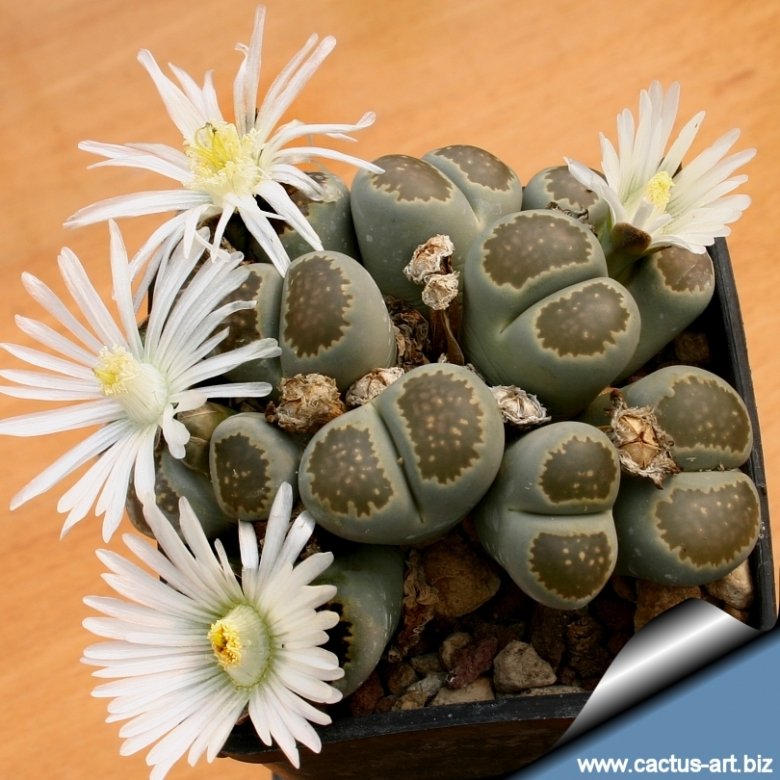
Lithops salicola is a tiny succulent with swollen paired leaves the size of pebbles and beautiful white flowers in autumn. This plant clumps up quickly and forms matted groups with usually 2 to 50 heads (Desmond Cole recorded a plant with more than 350 heads), and they can get to be up to 25 cm across (takes decades). This Lithops is one of the taller species, and its slate grey leaf heads stand above the soil surface.
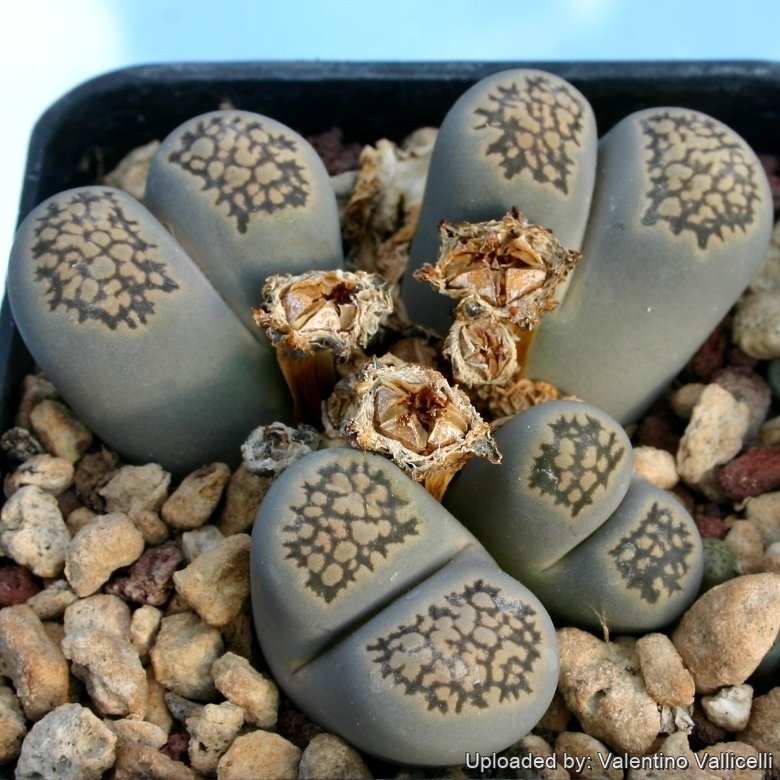
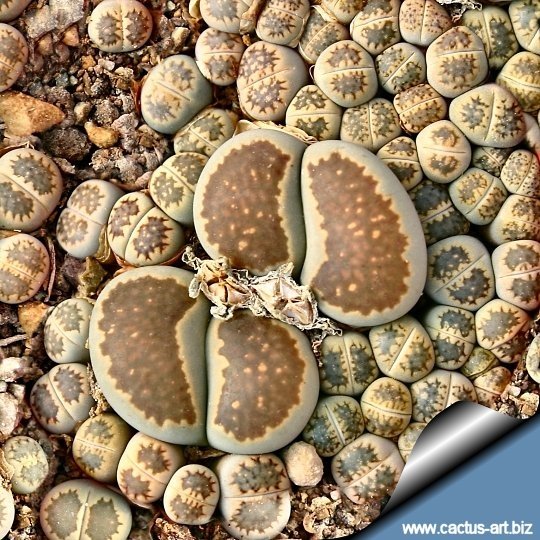
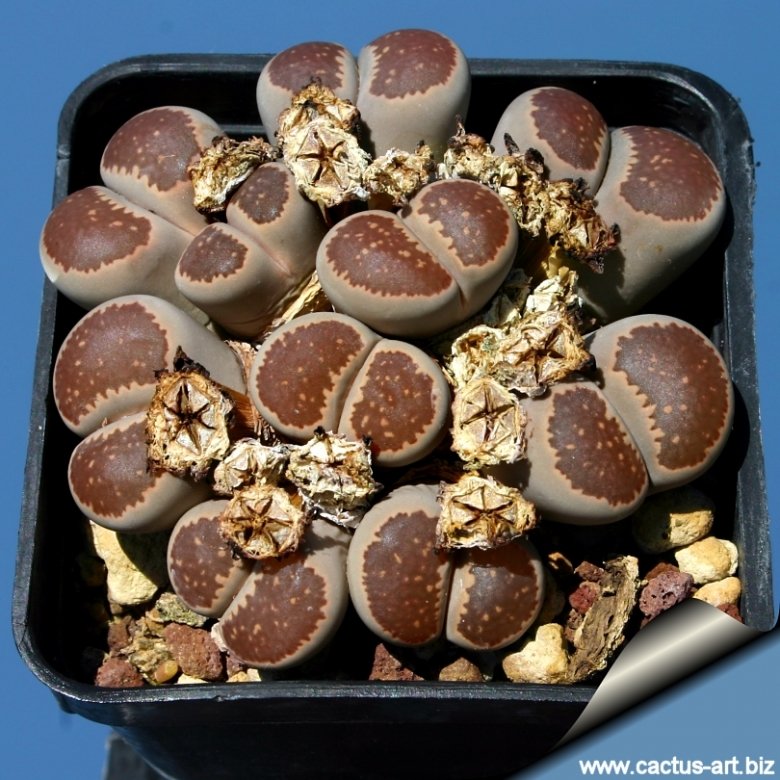
Bodies (paired leaves): Truncate in profile with elliptic-reniform faces, flattened or (usually) slightly convex, 17-35 mm tall, 11-26 mm broad. Fissure shallow. Surface smooth, obscurely translucent broad jagged or finely netted with confluent areas to almost uniform. Sides grey. Windows translucent, large, normally completely open, olive, greyish green, dark green, reddish, brown or dark brown/violet. Island absent or small, slightly raised opaque greenish, whitish, yellowish, pinkish or lilac grey. Margins usually very distinct and regular, seldom dentate or sinuate. Channels seldom present, in various shades of grey, greenish or bluish grey or greyish green or lilac. Rubrication usually lacking or, if present, as dots and dashes in the marginal indentations.
Flowers: White 20-50 mm in diameter.
Fruits: 5(-6)-chambered.
Blooming season: Autumn.
Remarks: The plants described under the name Lithops salicola var. reticulata are a hybrid population between Lithops salicola and Lithops hallii.
Origin and Habitat
From a salt pan in Orange Free State, South Africa
Cultivation and Propagation
This plant is among the easiest to grow Lithops species and clumps readily forming a beautiful succulent mat. Needs moderate water when growing in late fall and early spring. Keep somewhat dry the rest of the time, but tolerate ample water supplies ( no so root rot prone). Like all living rocks, it thrives in porous soils with excellent drainage. It can tolerates high heat and heavy frost (hardy to -10° C). It is a very rewarding succulent and can be cultivated in desert garden in warm climates even with intense winter rain or in greenhouses or windowsills in the home where too hardy. Enjoy bright shade in summer and full sun on the other seasons. Some people consider it one of the most tolerant of overwatering. It is not infrequent that seedlings germinate spontaneously in the potting container at the base of the mother plant.
Propagation: Seeds or division of larger clumps.
Notes
After flowering in the autumn and extending through winter season the plant doesn’t need watering, but they will still be growing, the new bodies will be increasing in size extracting water from the outer succulent leaves, allowing them to shrivel away. In fact the plant in this time extracts water and nutrient stored in the outer succulent leaves, allowing them to dehydrate relocating the water to the rest of the plant and to the new leaves that form during this period until the old leaves are reduced to nothing more than “thin papery shells”.
Bibliography
Major refences and further lectures
-
Heidrun E. K. Hartmann (2002) “Aizoaceae F – Z” Springer
-
Achim Hecktheuer (2008) “Mesembs, mehr als nur Lithops” Books on Demand GmbH Norderstedt. ISBN-13 978-3-8370-1724-3
-
Desmond T. Cole & Naureen A. Cole, Uwe Beyer, Yves Delange (2008) “Les Lithops” SUCCULENTES Spécial 2008 AIAPS (now Terra seca). ISSN 0258-5359
-
Desmond T. Cole & Naureen A. Cole (2005) “LITHOPS Flowering Stones” Cactus & Co. Libri. ISBN 88-900511-7-5 ISBN-13 978-88-900511-7-3
-
Yasuhiko Shimada (2001) “The Genus Lithops” Dobun Shoin. ISBN 4-8103-4066-X
-
Rudolf Heine (1986) “Lithops - Lebende Steine” Neumann Verlag. ISBN 3-7402-0000-6; ISBN-13 978-3-7402-0000-8
-
Bernd Schlösser (2000) “Lithops – Lebende Steine” Praktische Anleitung für die Zimmerkultur. BussinessPoint MEDIA. ISBN 3-934945-01-5; ISBN-13 978-3-934945-01-2
-
Steven A. Hammer (1999) “Lithops – Treasures of the veld” British Cactus and Succulent Society. ISBN 0-902-099-64-7; ISBN-13 978-0-902099-64-7
-
Desmond T. Cole (1988) “Lithops – Flowering Stones” Acorn Books CC. ISBN 0-620-09678-0; ISBN-13 978-0-620-09678-2
-
Rudolf Heine (1986) “Lithops – lebende Steine” Neumann Verlag. ISBN 3-7402-0000-6; ISBN-13 978-3-7402-0000-8
-
David L. Sprechman (1970) “Lithops” Associated University Presses, Inc. SBN 8386-6902-6
-
Gert Cornelius Nel (1946) “Lithops” Hortors Limited, South Africa
-
Edgar Lamb (1978) “The illustrated reference on cacti and other succulents” Blandford Press.
-
Mesa garden seed list. Belen. New mexico. USA
-
Linda R. Berg “Introductory Botany: Plants, People, and the Environment” Cengage Learning, 02/Mar/2007
-
Dieter J. Von Willert “Life strategies of succulents in deserts: with special reference to the Namib desert” CUP Archive, 1992
-
Paul Keddy “Plants and Vegetation: Origins, Processes, Consequences” Cambridge University Press, 07/Jun/2007
-
Werner Rauh “Die grossartige Welt der Sukkulenten” Hamburg and Berlin: Verlag Paul Parey, 1966
-
Terry Hewitt “Cacti and Succulents” Dk Pub, 01/Nov/1996
-
George Willard Brown “Desert Biology: Special Topics on the Physical and Biological Aspects of Arid Regions” Volume 2 Academic Press, 01/Jun/1974
Gallery