Publication: Kakteen (Berger) 308 (1929)
Description
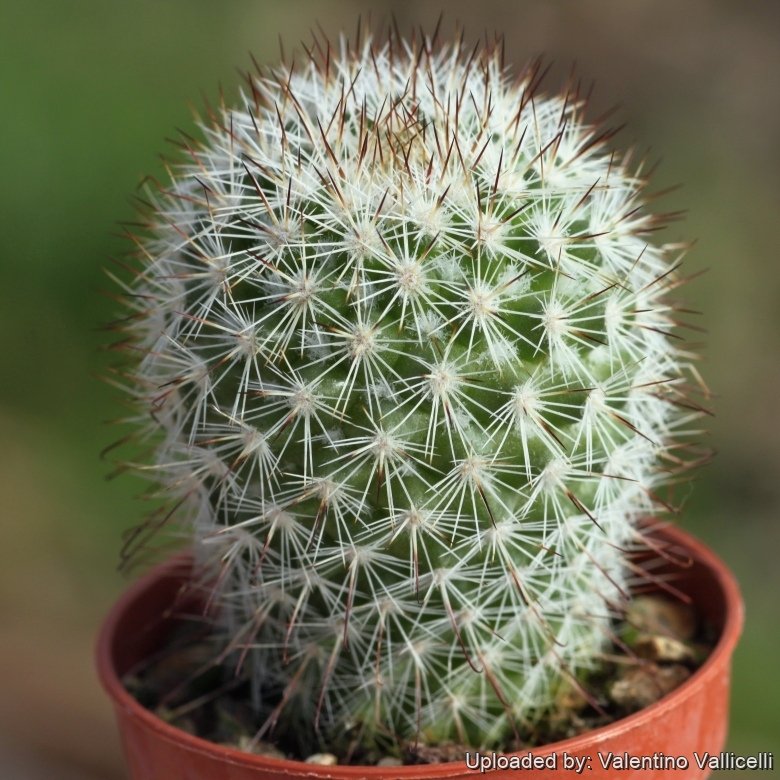
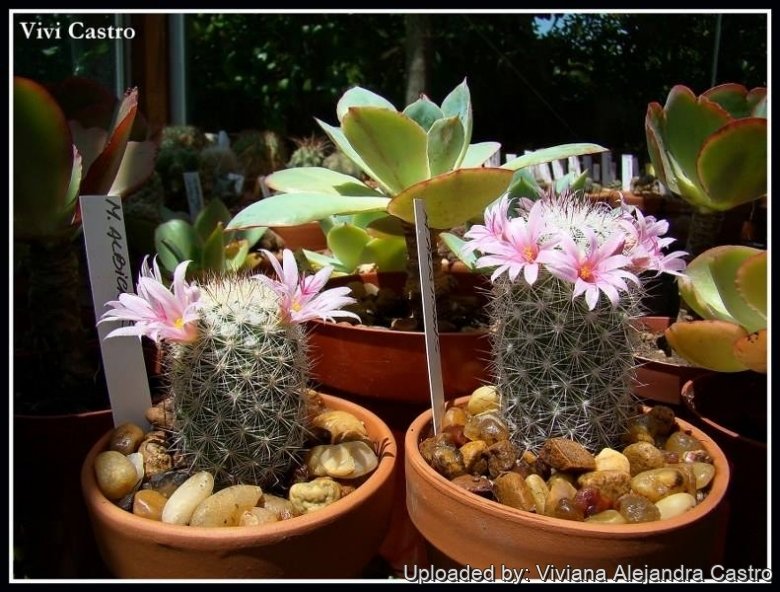
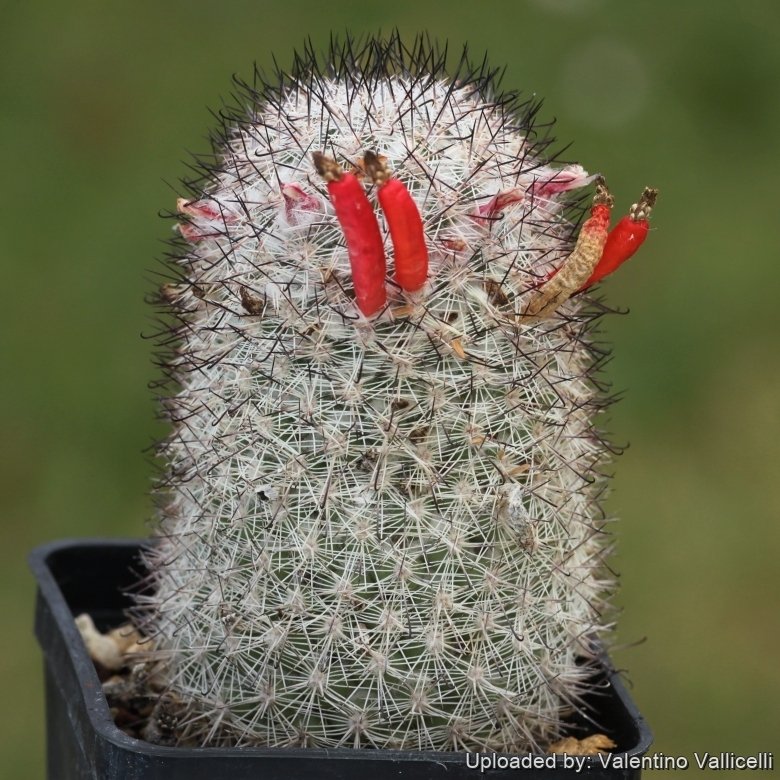
Mammillaria albicans ia a clustering cylindrical cactus which arc densely covered with short white spines nearly obscuring the stem and often pure white. The plant can produce clumps of 5-15 branches.
Stem: At first globose but becoming cylindrical and then pale green, 10-20 cm tall, 3-6 cm in diameter branching basally.
Tubercles: Broadly conical, pale green, without latex, 5-6 mm broad at base, 4-5 mm long, closely crowded and obscured by spines. The axil is woolly, especially in the flowering zone and bears few bristles, white with dark brown tips.
Areoles: Densely white-woolly in youth.
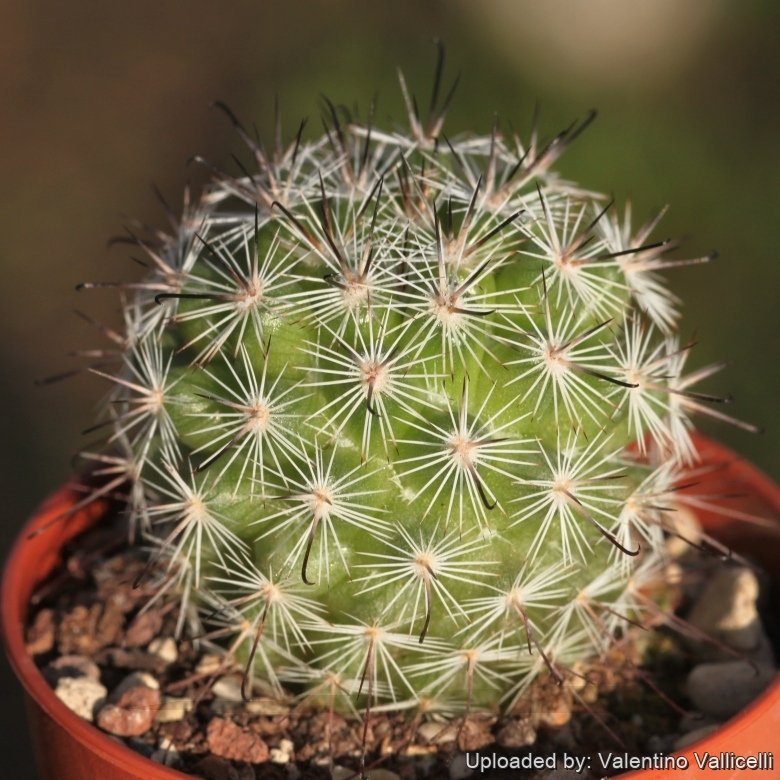
Central spines: 3-4 (sometimes to 8), acicular, straight, stiff (sometimes one of the central spines is hooked), white pinkish to brownish with brown tips, 8-10 mm long.
Radial spines: 14-18(-21), slender, acicular, straight, stiff, widely spreading, closely interlaced, white, pinkish or pale brown, slightly darker to nearly black at tips 5 - 8 mm long.
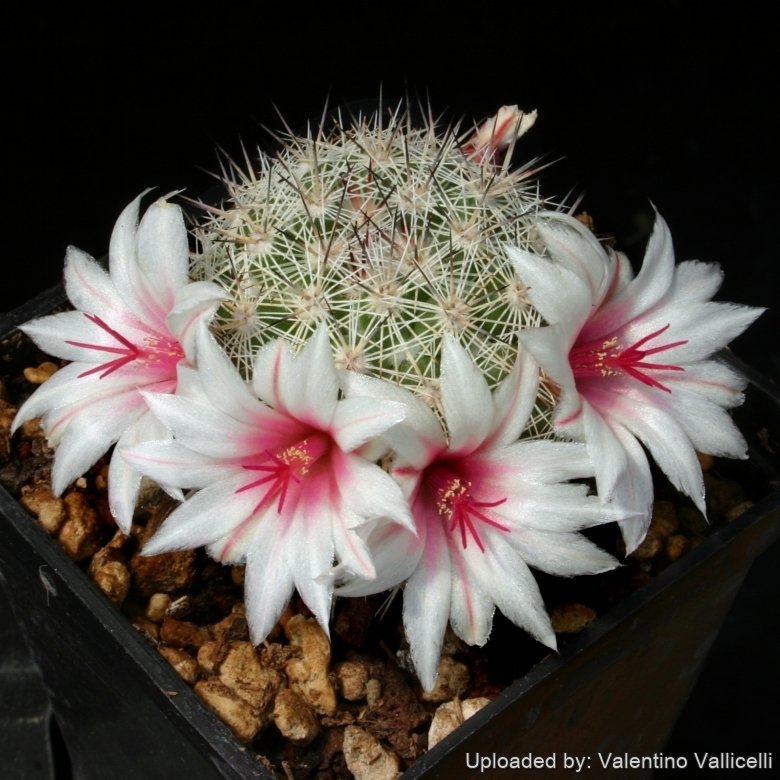
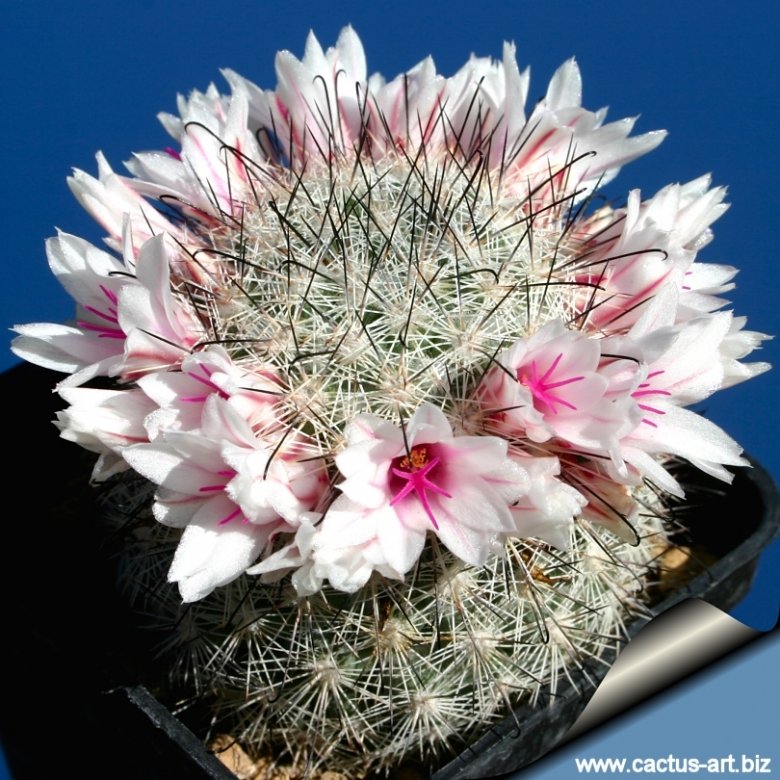
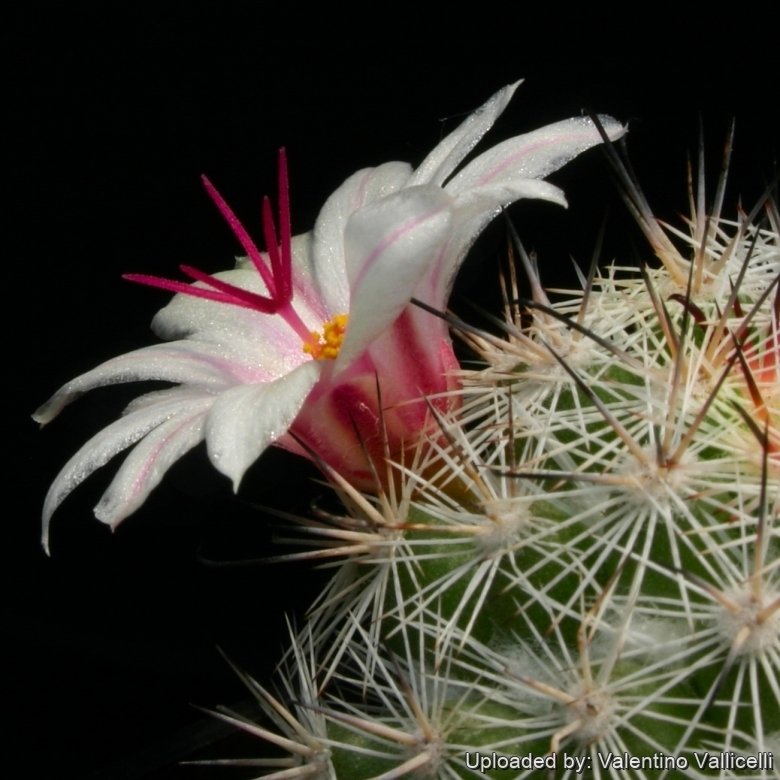
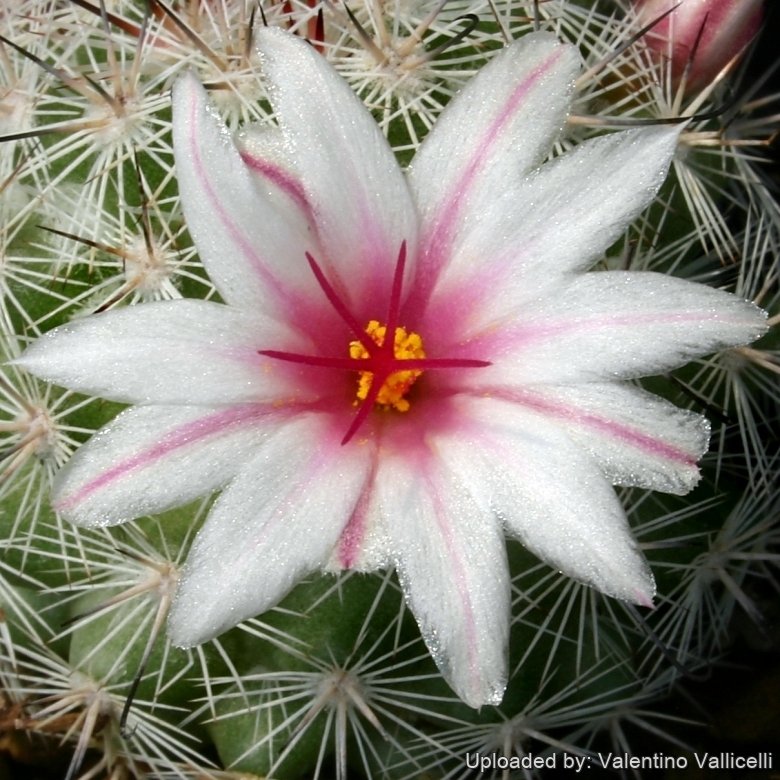
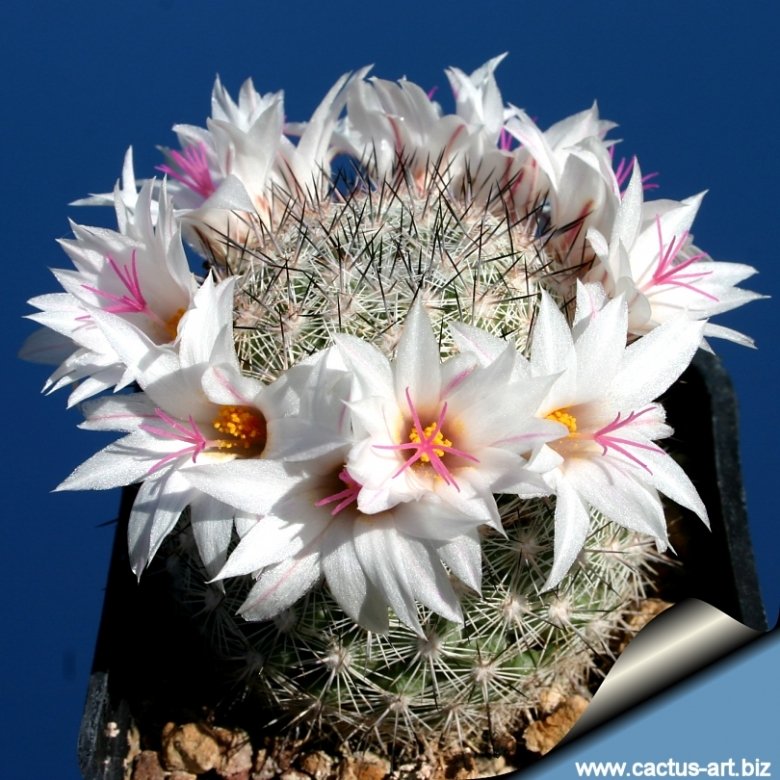
Flowers: Around the top, white to pale pink, with pinkish mid-veins, up to 20 mm in diameter. Outer perianth segments pinkish. Stigma lobes pink to purplish.
Blooming season: Summer (June to August).
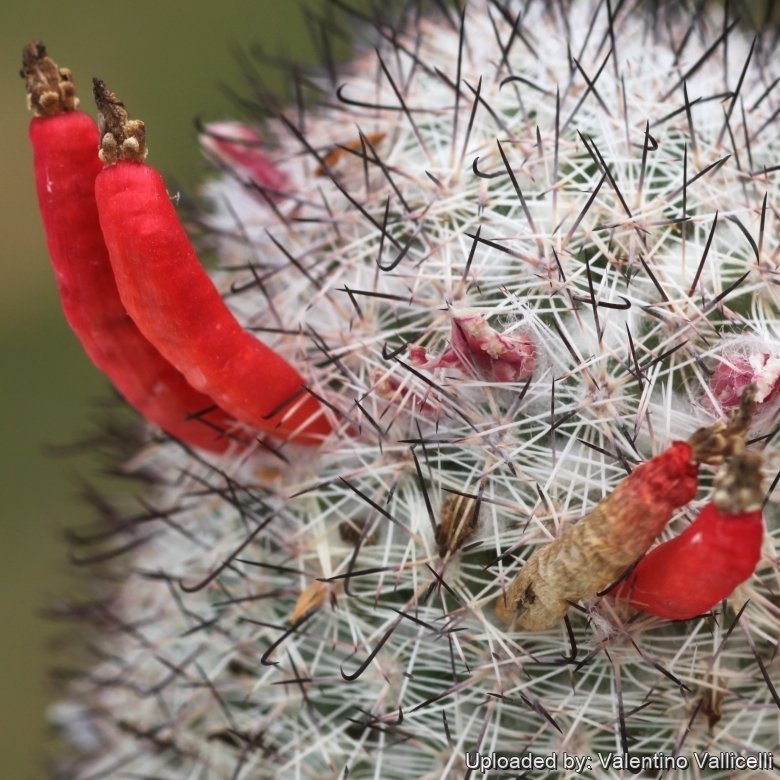
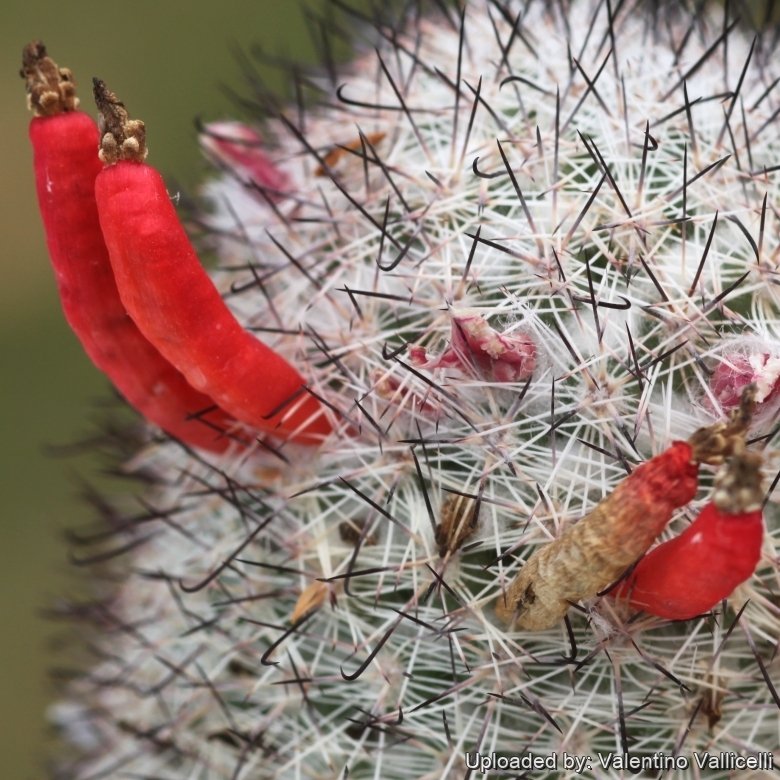
Fruits: Club-shaped, orange to red, 10-18 mm long.
Seeds: Nearly round, dull black with basal hilum.
Taxonomy note: Mammillaria slevinii is synonymous of Mammillaria albicans, they are are very similar, namely size and form of stems, shape of spines, flowers, etc. and the two plants are not readily distinguishable if not for the stems, simple or few branched (1-10 compared to 5-15 branched in M. albicans) moreover it has darker spines and the spine-areoles are not densely lanate.
Origin and Habitat
Mammillaria albicans has a very restricted range in the Baja California Peninsula on the mainland and various islands (San Francisco, San José, San Diego and Santa Cruz islands), Mexico. Its extent of occurrence is less than 500 km2.
Altitude: 10 to 200 metres above sea level.
Habitat: It grows on arid granite-based soils and rocky hillsides, in desert scrub (Lower Sonoran Zone) along with Mammillaria dioica, Mammillaria fraileana, Pachycereus pringlei and is very abundant on the islands where it occurs, but it tends to be scarce on the mainland. There are no known major threats for Mammillaria albicans.
Cultivation and Propagation
Mammillaria albicans is slow-growing, and not especially easy to grow. Use pot with good drainage and a very porous mineral-based potting mix. Potted plants are quite wet-sensitive, especially in light of its small root system. Water sparingly during the growing season, keep very dry in winter. Feed with a high potassium fertilizer in summer.
Usually it is recommended to overwinter this plant in a bright and warm greenhouse with at least 8-10° C, but it has proved to be quite frost resistant (if kept dry, it’s hardy as low as -5° C). Strong light is required for flowering.
Some plants will offset readily, and clumps can be produced in a very few years.
Propagation: Direct sow after last frost, or use cuttings.
Bibliography
Major references and further lectures
-
Edward Anderson “The Cactus family” Timber Press, Incorporated, 2001
-
James Cullen, Sabina G. Knees, H. Suzanne Cubey “The European Garden Flora Flowering Plants: A Manual for the Identification of Plants Cultivated in Europe, Both Out-of-Doors and Under Glass” Cambridge University Press, 11/Aug/2011
-
David R Hunt; Nigel P Taylor; Graham Charles; International Cactaceae Systematics Group. “The New Cactus Lexicon” dh books, 2006
-
John Pilbeam “Mammillaria: the cactus file handbook” Cirio Publishing Services Ltd Dec/30,/1999
-
León de la Luz, J.L., Hernández, H.M. & Gómez-Hinostrosa, C. 2013. Mammillaria albicans. In: IUCN 2013. “IUCN Red List of Threatened Species.” Version 2013.2. <www.iucnredlist.org>. Downloaded on 03 January 2014.
-
Nathaniel Lord Britton, Joseph Nelson Rose “Cactaceae: Descriptions and Illustrations of Plants of the Cactus Family” vol. 4 The Carnegie Institution of Washington, Washington 1923
-
Forrest Shreve, Ira Loren Wiggins “Vegetation and Flora of the Sonoran Desert” Volume 1 Stanford University Press, 1964
From llifle page Chilita slevinii
Description
Mammillaria slevinii is synonymous of Mammillaria albicans, they are are very similar, namely size and form of stems, shape of spines, flowers, etc. and the two plants are not readily distinguishable if not for the stems, simple or few branched (1-10 compared to 5-15 branched in M. albicans) moreover it has darker spines and the spine-areoles are not densely lanate.
Habit: Solitary or clustering cylindrical cactus entirely hidden under the many closely set spines.
Stem: Columnar, pale green, up to 10 or more cm tall, 5-6 cm in diameter branching basally
Tubercles: Broadly conical, without latex. The axil is woolly, especially in the flowering zone and bears few bristles, white with dark brown tips.
Spines: At top of plant pinkish below, with brown to blackish tips, on lower part of plant bleaching white.
Central spines: About 6, , a little longer and stouter than the radials, slightly spreading, white with brown tips, 8-10 mm long.
Radial spines: 14-21, white, 5 - 8 mm long.
Flowers: Around the top, white to pale pink, with pinkish mid-veins, up to 20 mm in diameter. Outer perianth-segments with a pinkish mid-rib. Inner perianth-segments white. Filaments pinkish. Style nearly white; stigma-lobes nearly white to purplish.
Blooming season: Summer (June to August).
Fruits: Club-shaped, red, 10-18 mm long.
Seeds: Nearly round, black, with a projection at base and a large basal hilum.
Origin and Habitat
Baja California Peninsula and various islands, Mexico.
Altitude: 10 to 200 metres above sea level.
Habitat: It grows on arid granite-based soils and rocky hillsides.
Cultivation and Propagation
It is slow-growing, and not especially easy to grow. Use pot with good drainage and a very porous mineral-based potting mix. Potted plants are quite wet-sensitive, especially in light of its small root system. Water sparingly during the growing season, keep very dry in winter. Feed with a high potassium fertilizer in summer.
Usually it is recommended to overwinter this plant in a bright and warm greenhouse with at least 8-10° C, but it has proved to be quite frost resistant (if kept dry, it’s hardy as low as -5° C). Strong light is required for flowering.
Some plants will offset readily, and clumps can be produced in a very few years.
Propagation: Direct sow after last frost, or use cuttings.
Bibliography
Major references and further lectures
-
Edward Anderson “The Cactus family” Timber Press, Incorporated, 2001
-
James Cullen, Sabina G. Knees, H. Suzanne Cubey “The European Garden Flora Flowering Plants: A Manual for the Identification of Plants Cultivated in Europe, Both Out-of-Doors and Under Glass” Cambridge University Press, 11/Aug/2011
-
David R Hunt; Nigel P Taylor; Graham Charles; International Cactaceae Systematics Group. “The New Cactus Lexicon” dh books, 2006
-
John Pilbeam “Mammillaria: the cactus file handbook” Cirio Publishing Services Ltd Dec/30,/1999
-
Nathaniel Lord Britton, Joseph Nelson Rose “Cactaceae: Descriptions and Illustrations of Plants of the Cactus Family” vol. 4 The Carnegie Institution of Washington, Washington 1923
-
León de la Luz, J.L., Hernández, H.M. & Gómez-Hinostrosa, C. 2013. Mammillaria albicans. In: IUCN 2013. “IUCN Red List of Threatened Species.” Version 2013.2. <www.iucnredlist.org>. Downloaded on 19 January 2014.
6 )Reppenhagen, W. “Die Gattung Mammillaria nach dem heutigen Stand meines Wissens” Frankenthal 1988 (1989).
-
Li Zhenyu. “Cactaceae.” In: Ku Tsuechih, ed., Fl. Reipubl. Popularis Sin. 52(1): 272-285 1999.
-
Craig, R. T. “The Mammillaria Handbook…” Pasadena 1945
-
Hunt, D. R. “A New Review of Mammillaria Names.” Botley. [Reprinted from Bradleya 1-5, 1983-1987.]
Source: Chilita slevinii, LLIFLE - Encyclopedia of living forms, CC-BY-SA, retrieved 2026-10-25.
Cultivars and forms (1)
Forms (1)
Gallery