Publication: Natl. Cact. Succ. J. xxi. 47, 90 in adnot. (1966).
Description
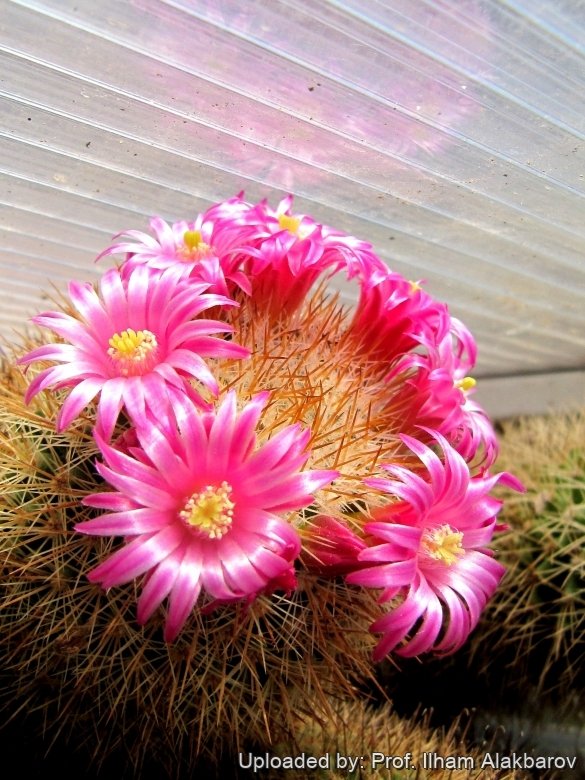
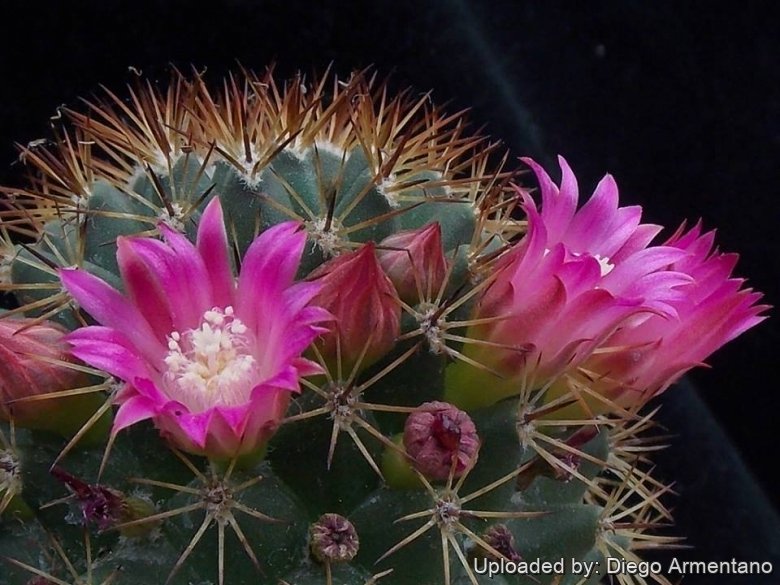
Mammillaria backebergiana is an attractive slender columnar cactus with yellowy or brownish-yellow spines and great purplish red flowers circling near the top of the plant during growing season. Two subspecies are recognized, the nominate and subsp. ernestii (Fittkau) Glass & R.A.Foster.
Similar species: Mammillaria backebergiana is related and similar to Mammillaria spinosissima and its allies, but its stems are more slender.
Habit: Plants usually solitary occasionally clumping.
Stem: Globose becoming cylindrical, to 30 cm high, 5-6 cm in diameter, clear green, waxy.
Tubercles: Short pyramidal, not angled, with latex, axils naked or with a few bristles.
Central spines: 1-3, straight, needle-like, yellowish brown to brown, 7-8 mm long.
Radial spines: (8-)10-12, yellowish white with brown tips, becoming darker with age, 8-10 mm long.
Flowers: Freely produced in several rings in the crown. Purplish red, 18-20 mm long, 10-13 mm in diameter. Stigmas green.
Fruits: Dull green above, whitish below, tinting purplish red in maturity.
Seeds: Brown.
Origin and Habitat
Distribution: Guerrero, Michoacan, and Mexico, Mexico.
Altitude: Around 1400-1900 metres above sea level.
Habitat and Ecology: The species grows hanging on cliffs together with Agave brevifolia and Selaginella lepidophylla. Very little is know about this species.
Cultivation and Propagation
Mammillaria backegeriana is easily grown into clumps, but it does often have an irregular pattern of offsetting. Probably the greatest problem with growing this species is that it will become a tall column with age, and tend to lean or tip over its pot.
Growing rate: It is a relatively rapid growing and easily flowering species, it doesn’t present any special challenges. Most plants will offset readily, and clumps can be produced in a few years.
Watering: Water regularly in summer, but do not overwater (Rot prone), keep dry in winter
Soil: Use pot with good drainage and a very porous potting media.
Fertilization: Feed with a high potassium fertilizer in summer.
Hardiness:* It is quite frost resistant if kept dry, hardy as low as -5° C.
Exposure: Outside full sun or afternoon shade, inside needs bright light, and some direct sun.
Propagation: Division, direct sow after last frost.
Bibliography
Major references and further lectures.
-
Robert T. Craig “The Mammillaria handbook: with descriptions, illustrations, and key to the species of the genus Mammillaria of the Cactaceae” E P Publishing, 1945
-
John Pilbeam “Mammillaria The Cactus File Handbook” Cirio Pub. Services, 01/Dec/1999
-
Edward Anderson “The Cactus family” Timber Press, Incorporated, 2001
-
James Cullen, Sabina G. Knees, H. Suzanne Cubey “The European Garden Flora Flowering Plants: A Manual for the Identification of Plants Cultivated in Europe, Both Out-of-Doors and Under Glass” Cambridge University Press, 11/Aug/2011
-
David R Hunt; Nigel P Taylor; Graham Charles; International Cactaceae Systematics Group. “The New Cactus Lexicon” dh books, 2006
-
Terrazas, T., Arias, S. & Arreola, H. 2013. Mammillaria backebergiana. In: IUCN 2013. “IUCN Red List of Threatened Species.” Version 2013.2. <www.iucnredlist.org>. Downloaded on 07 March 2014.
-
H. W. Fittkau, “Mammillaria ernestii H.W. Fittkau, spec. nov.”, in: Cactaceas Suculentas Mexicanas. N°16, 1971, p.36.
-
Ulises Guzmán, Salvador Arias, Patricia Dávila, “Catálogo de cactáceas mexicanas” Universidad Nacional Autónoma de México, Mexico 2003, p.114.
-
Urs Eggli, Leonard E. Newton: “Etymological Dictionary of Succulent Plant Names” Birkhäuser 2004
-
FG Buchenau: “Mammillaria backebergiana spec. nov.” In: The National Cactus and Succulent Journal . 21: 47 1966