Publication: J. Mammillaria Soc. 35(2): 17 (1995) (also spelled: “eschanzieri” or “eschausieri”)
Description
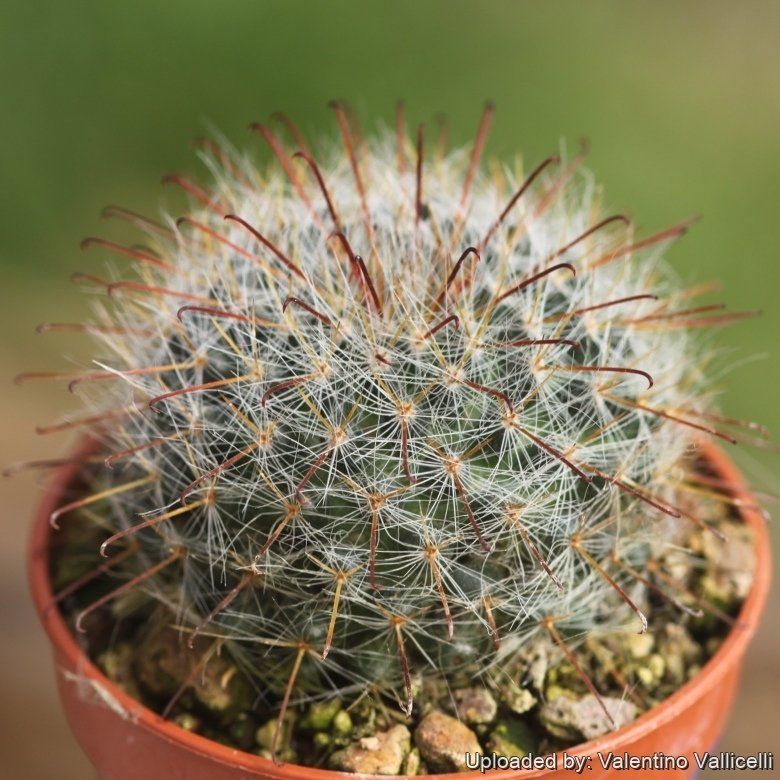
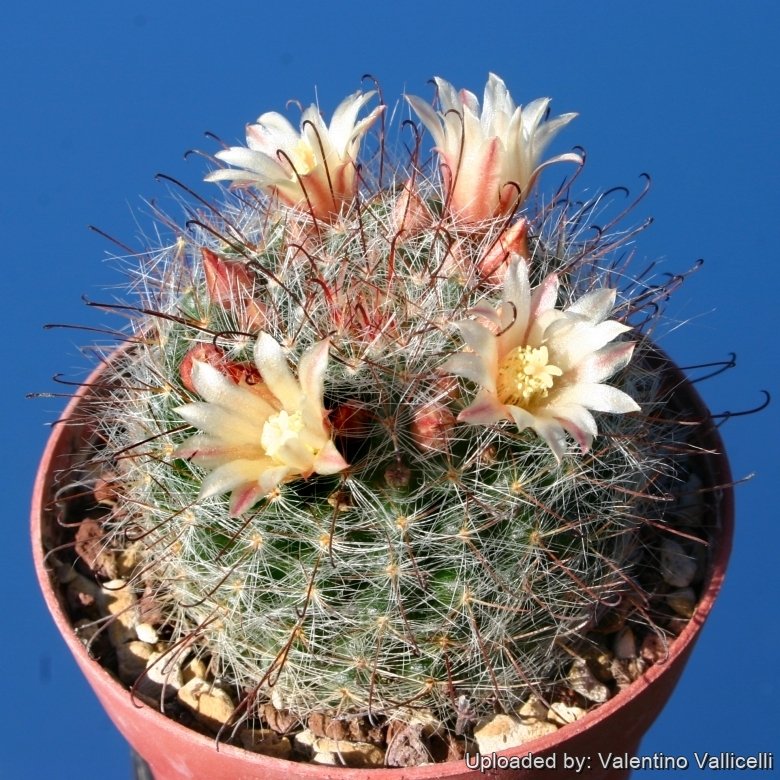
Mammillaria bocasana ssp eschauzieri ( syn: Mammillaria bocasana f. hirsuta) distinguish from standard Mammillaria bocasana for having 20-30 longer, radial bristle-hair-spines per areole, pale yellow flowers and Pink fruit.
Habit: Solitary, or later becoming branched from the base or higher.
Stem: Spherical to short cylindrical, to 12 cm tall, 8 cm in diameter.
Axil: With fine white bristles.
Radial spine: 20-30, 4 to 15 mm long, white, slightly brown at tips, smooth.
Central spine: 1 to7, one hooked, 15 to 25 mm long, the straight spines somewhat shorter and slightly, dark reddish brown, paler at the base, minutely pubescent.
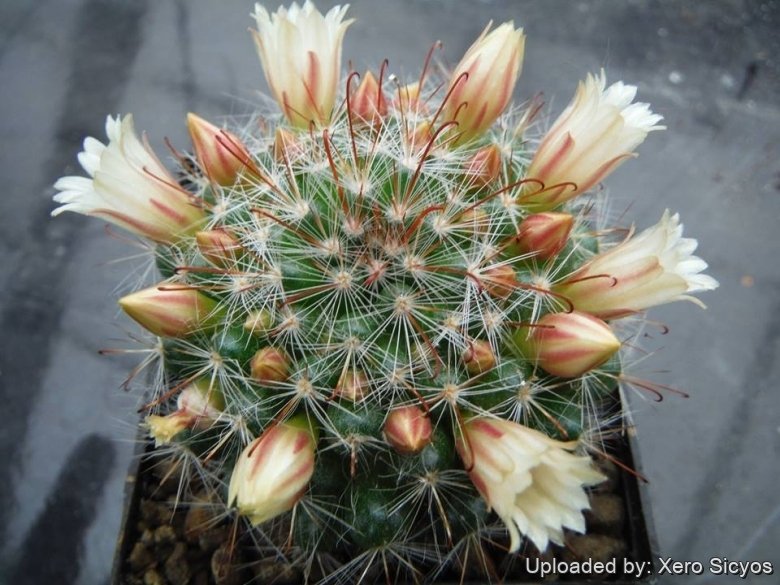
Flower: Yellowish white with variable pink midstripe, 1,5 cm long, 1,5 -2 cm wide. Stigmas yellow.
Fruit: Long, clavate,pink or red, about 20 mm long, 5 mm wide.
Seed: Light reddish brown.
Origin and Habitat
San Luis Potosi and Zacatecas, Mexico.
Altitude: 1900 to 2550 metres above sea level.
Cultivation and Propagation
Mammillaria bocasana subs. eschauzieri is a freely clustering species that reproduces easily by cutting. It is a great starter plant for the cactus grower, that readily builds up into a dense cluster of stems smothered by white hairs, further decorated by rings of cream or pale pink blooms.
Growth rate: It is a rapidly growing species. It offset from the base and can fill a 25 cm pot in just a few years given the best conditions.
Soils: It likes very porous standard cactus mix soil with little organic matter (peat, humus).
Repotting: Repotting every 2-3 years. As it is prone to rot under-pot in a smaller container filled with very porous compost. Use pot with good drainage.
Watering: Water regularly in summer, but do not overwater (very wet-sensitively, especially in light of its succulent root system). Its roots are easily lost in pots that stay damp for any length of time. Keep dry with ample airflow in winter. In the rest period no high atmospheric humidity!! Care must be taken with watering as they tends to become swollen and untidy in growth habit if given too much water and shade.
Fertilization: During the growing season enrich the soil using a fertilizer rich in potassium and phosphorous, but poor in nitrogen, because this chemical element doesn’t help the development of succulent plants, making them too soft and full of water.
Hardiness: It is quite frost resistant if kept dry, hardy as low as -5° C (some reports give it hardy to -12°C). However some warmth throughout the year will increase the grower’s success (minimum 5° to 8°C during rest season).
Exposition: Outside bright sun, filtered sunlight or afternoon shade, inside it needs bright light, and some direct sun. Subject to sunburn if exposed to direct sun for too long. Tends to bronze in strong light, which encourages flowering and heavy wool and spine production.
Uses: It is an excellent plant for container growing. It always looks good and stays small. It look fine in a cold greenhouse and frame.
Traditional uses: The white, hooked spines of this spherical cactus were used as fish hooks in its native Mexico.
Pests & diseases: It may be attractive to a variety of insects, but plants in good condition should be nearly pest-free, particularly if they are grown in a mineral potting-mix, with good exposure and ventilation. Nonetheless, there are several pests to watch for:
- Red spiders: Sensitive to red spider mite. Overhead watering is helpful in controlling mites.
- Mealy bugs: Occasionally mealy bugs they develop aerial into the new growth among the wool with disfiguring results, but the worst types develop underground on the roots and are invisible except by their effects.
- Scales: Scales are rarely a problem.
- Rot: Rot it is only a minor problem with cacti if the plants are watered and “aired” correctly. If they are not, fungicides won’t help all that much.
Propagation: Direct sow after last frost or (usually) or division . Seeds germinate in 7-14 days at 21-27° C in spring, remove the glass cover gradually as the plants develops and keep ventilated, no full sun for young plants! The seedlings should not be disturbed until they are well rooted, after which they can be planted separately in small pots. Cuttings: wait until the offsets that appear at the base of old clustered specimens are 1/3 the size of the parent and then detach and plant. Cuttings will take root in a minimum temperature of 20° C (but better in hot weather). Cuttings of healthy shoots can be taken in the spring and summer. Cut the stem with a sharp, sterile knife, leave the cutting in a warm, dry place for a week or weeks (depending on how thick the cutting is) until a callus forms over the wound. Once the callus forms, the cutting may be inserted in a container filled with firmed cactus potting mix topped with a surface layer of coarse grit. They should be placed in the coarse grit only; this prevents the cut end from becoming too wet and allows the roots to penetrate the rich compost underneath. The cuttings should root in 2 to 6 weeks.
Bibliography
Major references and further lectures
-
Pilbeam J., “The Cactus file, Mammillaria” 6: 120, Cirio Pub. Services, 01/Dec/1999
-
James Cullen, Sabina G. Knees, H. Suzanne Cubey “The European Garden Flora Flowering Plants: A Manual for the Identification of Plants Cultivated in Europe, Both Out-of-Doors and Under Glass” Cambridge University Press, 11/Aug/2011
-
David R Hunt; Nigel P Taylor; Graham Charles; International Cactaceae Systematics Group. “The New Cactus Lexicon” dh books, 2006
-
Edward Anderson “The Cactus family” Timber Press, Incorporated, 2001
From llifle page Chilita knebeliana
Description
Mammillaria knebeliana is one of the many geographical form of Mammillaria bocasana. Many of its morphological and geographical variant was early classified as different independent species, but nowadays all this plant are considered part of a multiform species, where each form is linked to others by populations of plants with intermediate characteristics. Mammillaria knebeliana has distinctive pale creamy-yellow flowers with a reddish tint in outer tepals. Central spines are dark brown and contrast nicely with the silky white radials. Mammillaria knebeliana is often referred to Mammillaria bocasana ssp eschauzieri, but its true classification is still controversial and Reppenhagen placed this plant as a synonym of Mammillaria crinitaall of which goes to show just how confused the naming of this plant has been.
Habit: It is a low growing clumping cactus, often forming large mounds.
Stems: Individual stems spherical, sometimes becoming somewhat cylindrical. light green to bluish-green, 5-8 cm tall and 3-6 cm in diameter.
Tubercles: Slender, soft, cylindrical, terete. Without latex.
Radial spines: 20-30, white, hair-like, silky, 8-20 mm long.
Central spines: Reddish brown, 5-10 mm long, of which one (occasionally two) hooked, brown, but paler at base.
Flower: Funnel-form, creamy-white, creamy-yellow with a reddish tint in outer tepals; perianth-segments lanceolate-linear, acute, spreading. Flower-buds rose-coloured.
Blooming season: Spring and summer.
Fruits: Cylindrical, rosy-pink to red, 2,5 cm long in summer.
Origin and Habitat
Ahualulco to Tinaja, and adjacent areas, San Luis Potosí, Mexico
Altitude: Around 2000 metres above sea level.
Habitat: Grows along with Myrtillocactus geometrizans, Ferocactus histrix, Echinocereus cinerascens and Agave salmiana.
Cultivation and Propagation
Mammillaria knebeliana is a freely clustering species that reproduces easily by cutting. It is a great starter plant for the cactus grower, that readily builds up into a dense cluster of stems smothered by white hairs, further decorated by rings of cream or pale pink blooms.
Growth rate: It is a rapidly growing species. It offset from the base and can fill a 25 cm pot in just a few years given the best conditions.
Soils: It likes very porous standard cactus mix soil with little organic matter (peat, humus).
Repotting: Repotting every 2-3 years. As it is prone to rot under-pot in a smaller container filled with very porous compost. Use pot with good drainage.
Watering: Water regularly in summer, but do not overwater (very wet-sensitively, especially in light of its succulent root system). Its roots are easily lost in pots that stay damp for any length of time. Keep dry with ample airflow in winter. In the rest period no high atmospheric humidity!! Care must be taken with watering as they tends to become swollen and untidy in growth habit if given too much water and shade.
Fertilization: During the growing season enrich the soil using a fertilizer rich in potassium and phosphorous, but poor in nitrogen, because this chemical element doesn’t help the development of succulent plants, making them too soft and full of water.
Hardiness: It is quite frost resistant if kept dry, hardy as low as -5° C (some reports give it hardy to -12°C). However some warmth throughout the year will increase the grower’s success (minimum 5° to 8°C during rest season).
Exposition: Outside bright sun, filtered sunlight or afternoon shade, inside it needs bright light, and some direct sun. Subject to sunburn if exposed to direct sun for too long. Tends to bronze in strong light, which encourages flowering and heavy wool and spine production.
Uses: It is an excellent plant for container growing. It always looks good and stays small. It look fine in a cold greenhouse and frame.
Traditional uses: The white, hooked spines of this spherical cactus were used as fish hooks in its native Mexico.
Pests & diseases: It may be attractive to a variety of insects, but plants in good condition should be nearly pest-free, particularly if they are grown in a mineral potting-mix, with good exposure and ventilation. Nonetheless, there are several pests to watch for:
- Red spiders: Sensitive to red spider mite. Overhead watering is helpful in controlling mites.
- Mealy bugs: Occasionally mealy bugs they develop aerial into the new growth among the wool with disfiguring results, but the worst types develop underground on the roots and are invisible except by their effects.
- Scales: Scales are rarely a problem.
- Rot: Rot it is only a minor problem with cacti if the plants are watered and “aired” correctly. If they are not, fungicides won’t help all that much.
Propagation: Direct sow after last frost or (usually) or division . Seeds germinate in 7-14 days at 21-27° C in spring, remove the glass cover gradually as the plants develops and keep ventilated, no full sun for young plants! The seedlings should not be disturbed until they are well rooted, after which they can be planted separately in small pots. Cuttings: wait until the offsets that appear at the base of old clustered specimens are 1/3 the size of the parent and then detach and plant. Cuttings will take root in a minimum temperature of 20° C (but better in hot weather). Cuttings of healthy shoots can be taken in the spring and summer. Cut the stem with a sharp, sterile knife, leave the cutting in a warm, dry place for a week or weeks (depending on how thick the cutting is) until a callus forms over the wound. Once the callus forms, the cutting may be inserted in a container filled with firmed cactus potting mix topped with a surface layer of coarse grit. They should be placed in the coarse grit only; this prevents the cut end from becoming too wet and allows the roots to penetrate the rich compost underneath. The cuttings should root in 2 to 6 weeks.
Bibliography
Major references and further lectures.
-
Robert T. Craig “The Mammillaria handbook: with descriptions, illustrations, and key to the species of the genus Mammillaria of the Cactaceae” E P Publishing, 1945
-
John Pilbeam “Mammillaria The Cactus File Handbook” Cirio Pub. Services, 01/Dec/1999
-
Edward Anderson “The Cactus family” Timber Press, Incorporated, 2001
-
James Cullen, Sabina G. Knees, H. Suzanne Cubey “The European Garden Flora Flowering Plants: A Manual for the Identification of Plants Cultivated in Europe, Both Out-of-Doors and Under Glass” Cambridge University Press, 11/Aug/2011
-
David R Hunt; Nigel P Taylor; Graham Charles; International Cactaceae Systematics Group. “The New Cactus Lexicon” dh books, 2006
-
Clive Innes, Charles Glass “Cacti” Portland House, 01/May/1991
-
N. L. Britton, J. N. Rose “The Cactaceae. Descriptions and Illustrations of Plants of the Cactus Family.” Volume 4, The Carnegie Institution of Washington, Washington 1923
-
Gurcharan Singh Randhawa, Amitabha Mukhopadhyay “Floriculture in India” Allied Publishers, 01/Jan/1986
-
Anne Swithinbank “The Greenhouse Gardener” frances lincoln ltd, 2006
Source: Chilita knebeliana, LLIFLE - Encyclopedia of living forms, CC-BY-SA, retrieved 2026-10-25.
From llifle page Mammillaria hirsuta var. grandis
Origin and Habitat
Pinos, Zacatecas (Mexico, Northern America)
Source: Mammillaria hirsuta var. grandis, LLIFLE - Encyclopedia of living forms, CC-BY-SA, retrieved 2026-10-25.