Publication: Allan Hancock Found. Publ. Occas. Pap. no. 2: 59, tab. 18, fig. 4. 1948
Description
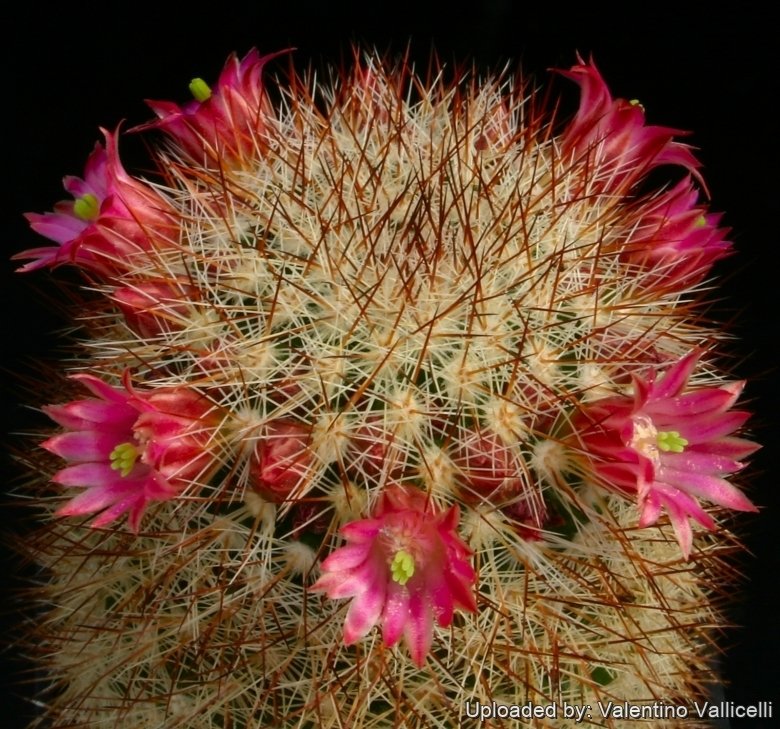
Slowly clumping columnar cactus.
Stem: Cylindrical bluish green up to 10 cm tall, 3-4 cm in diameter. Tubercles without latex, but latex present in the stem. Axil with bristles.
Radial spines: 18 - 20, slender, needle-like, straight, chalky white to pale yellow above, orange brown below, 5 - 7 mm long.
Central spines: 4, pinkish tan below, blackish brown above, 8 - 12 mm long (or more), lowermost one red to blackish hooked and longer.
Flowers: Bell shaped in apical rings, bright pink to light carmine, to 15 mm long and 12 mm in diameter.
Fruits: Pale brownish pink.
Seeds: Brown.
Origin and Habitat
Puebla, Oaxacana and Morelos, Mexico. Altitude 1.000 - 2.400 m.
Cultivation and Propagation
They are easy to culture and make interesting specimens for any collection. It grows by producing offsets and will form large clumps with time and doesn’t require any special treatment, but some forms can be fast growers, while others are average in speed. It needs as much light as possible to keep the stems compact, but care must be taken to avoid sun scorch. Need a well-drained soil mix. Water well and then allows to dry thoroughly before watering again during the growing season. It doesn’t like much, if any, winter water, it can survive short exposures to freezing temperatures (-4° C.) if properly hardened off and kept dry.
Propagation:Mammillaria duoformiss is best propagated from seed. Seed readily germinates at 20°-22°C, or by offsets if available.
From llifle page Mammillaria claviformis
Origin and Habitat
Tecocoyuca, Puebla (Mexico, Northern America)
Source: Mammillaria claviformis, LLIFLE - Encyclopedia of living forms, CC-BY-SA, retrieved 2026-10-25.
From llifle page Mammillaria erythrocalix
Origin and Habitat
Puebla (Mexico, Northern America)
Source: Mammillaria erythrocalix, LLIFLE - Encyclopedia of living forms, CC-BY-SA, retrieved 2026-10-25.
Cultivars and forms (2)
Gallery