Description
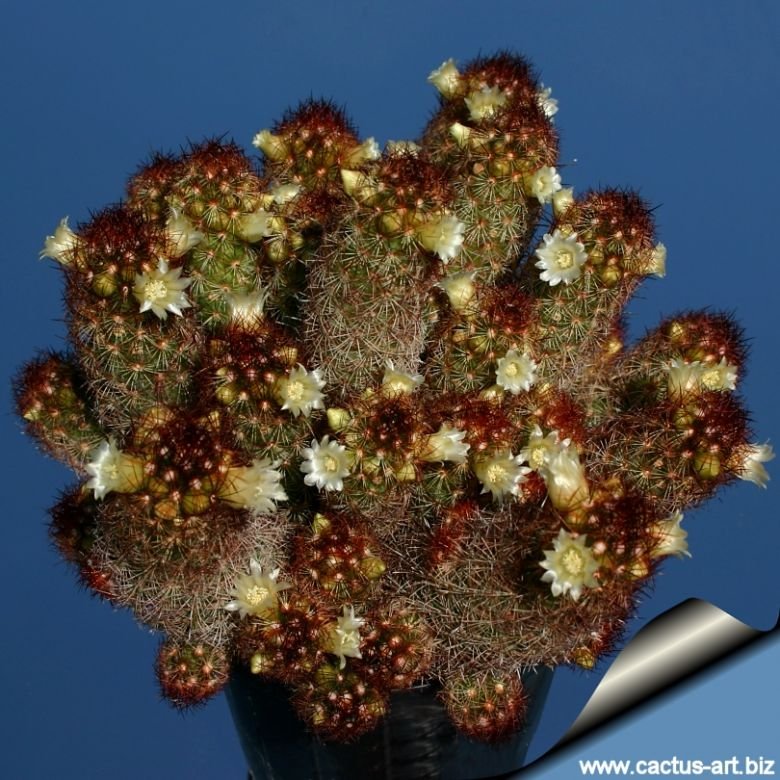
Mammillaria elongata cv. Kopper King is a succulent ground cover, forming with time a tight clumps of erect, ascending, prostrate or recumbent stems. This may be the most common Mammillaria to be found and occurs in more variations than any other Mammillaria species. It commonly comes in many colour and spine variations.
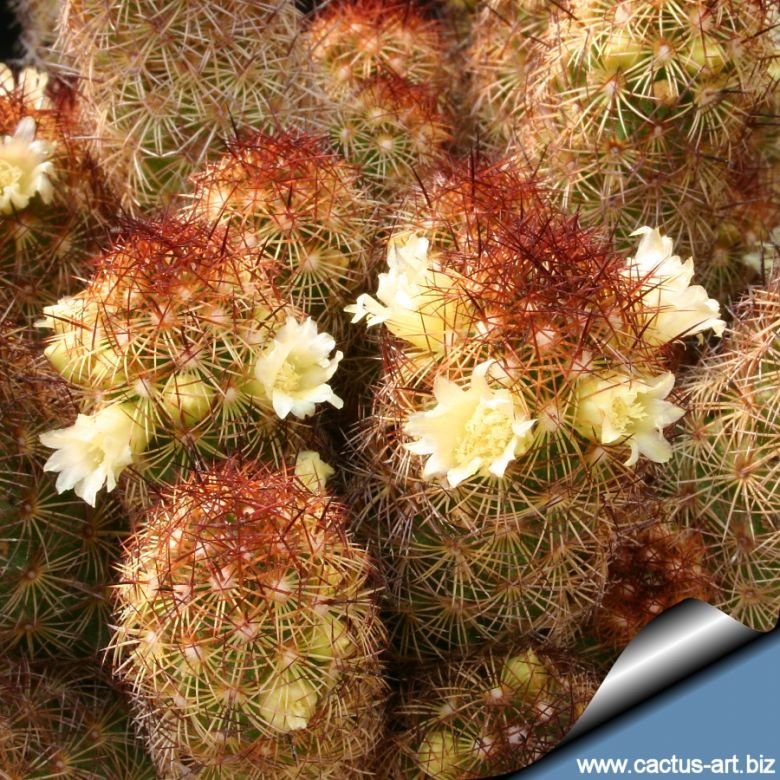
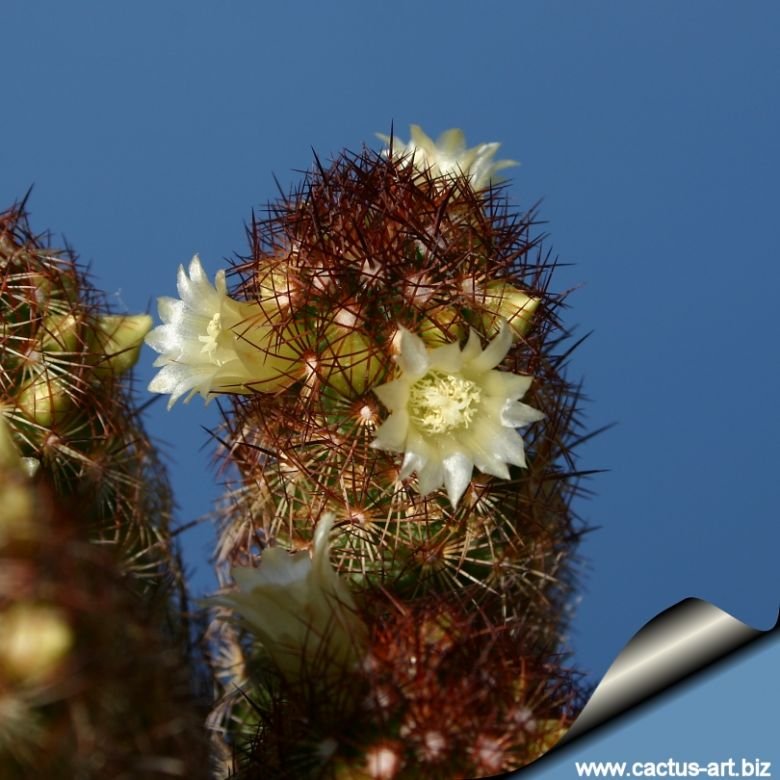
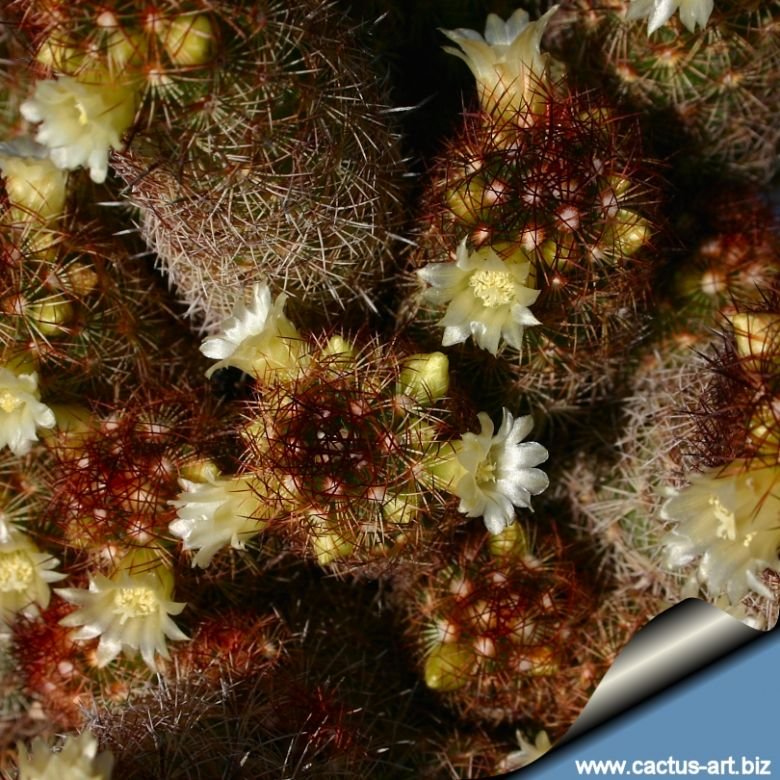
Mammillaria elongata cv. Kopper King: This is a selected form with darck coppery-red spines. In all other characteristics, namely size and shape, flowers, fruits, roots etc. it is very similar to the standard species.
Stems: Elongated cylindrical, finger-like, 1 - 3 cm in diameter3-10 cm long.
Roots: Fibrous.
Tubercle: Tubercles slender conical arranged in perfect spiral in a few rows. The axil is naked or nearly so.
Areoles: Pubescent when young.
Radial spines: 14 - 25 interlocking, arranged as a star, variable in number, white amber to coppery-red, the degree of brown colouring varying from plant to plant, slender, needle-like, more or less recurved 4-12 mm long.
Central spines: Usually absent, sometimes 2, coppery-red with dark tips, 10 - 15 mm long.
Flower: At the upper part of the plant, whitish or pale yellow. Perianth segments about 12, rather broad, obtuse or sometimes apiculate sometimes flushed pink or with pink midstripes, to 10 mm long and in diameter.
Blooming season: Spring, but can bloom for a second time later in the year.
Fruit: Pink, becoming red.
Seed: Brown.
Origin and Habitat
“Copper King” is a nursery produced cultivar. The natural Mammillaria elongata is a native of Central Mexico (Hidalgo, Guanajuato, and Queretaro).
Cultivation and Propagation
This is a popular and easy cactus species. It will form quite large clumps with hundreds of offsets if given time and grown properly. It is especially suited for window sill and dish gardens. Water regularly from spring through fall, but do not overwater (Rot prone) Let soil become moderately dry between thorough watering. In winter, keep dry or water only enough to keep the plants from shrivelling. Use pot with good drainage and a very porous potting media. Newly potted plants should not be fertilized for a year; established plants should be fertilized once each spring with a high potassium fertilizer.
It is quite frost resistant if kept dry, hardy as low as -4° C. Outside full sun or afternoon shade, inside needs bright light, and some direct sun, but high levels of light will encourage tight growth and flowering. Easily flowered.
Propagation: This species produce clumps of young plants at the base of the main stem, these can be removed at any time of the year. It can also be grown from seed.
Bibliography
Major references and further lectures.
-
Robert T. Craig “The Mammillaria handbook: with descriptions, illustrations, and key to the species of the genus Mammillaria of the Cactaceae” E P Publishing, 1945
-
John Pilbeam “Mammillaria The Cactus File Handbook” Cirio Pub. Services, 01/Dec/1999Edward Anderson “The Cactus family” Timber Press, Incorporated, 2001
-
James Cullen, Sabina G. Knees, H. Suzanne Cubey “The European Garden Flora Flowering Plants: A Manual for the Identification of Plants Cultivated in Europe, Both Out-of-Doors and Under Glass” Cambridge University Press, 11/Aug/2011
-
David R Hunt; Nigel P Taylor; Graham Charles; International Cactaceae Systematics Group. “The New Cactus Lexicon” dh books, 2006
-
Gómez-Hinostrosa, C., Sánchez , E., Guadalupe Martínez, J. & Bárcenas Luna, R. 2013. Mammillaria elongata. The “IUCN Red List of Threatened Species.” Version 2014.2. <www.iucnredlist.org>. Downloaded on 27 July 2014.
-
Ulises Guzmán, Salvador Arias, Patricia DávilaA, “Catálogo de cactáceas mexicanas” Universidad Nacional Autónoma de México, Mexico 2003, p.114.
-
Urs Eggli, Leonard E. Newton: “Etymological Dictionary of Succulent Plant Names” Birkhäuser 2004
-
Christopher Brickell “RHS Encyclopedia of Plants and Flowers” Dorling Kindersley Ltd, 01/Sep/2010
-
Haustein, Erik. “Der Kosmos-Kakteenführer.” Kosmos / Gesellschaft der Naturfreunde., Stuttgart, 1983
-
Alfred Byrd Graf “Exotica, series 4 international: pictorial cyclopedia of exotic plants from tropical and near-tropic regions” Roehrs Co. Publishers, 1983