Publication: Gartenflora xxxviii. (1889) 105. fig. 20. ( “grusoni” )
Description
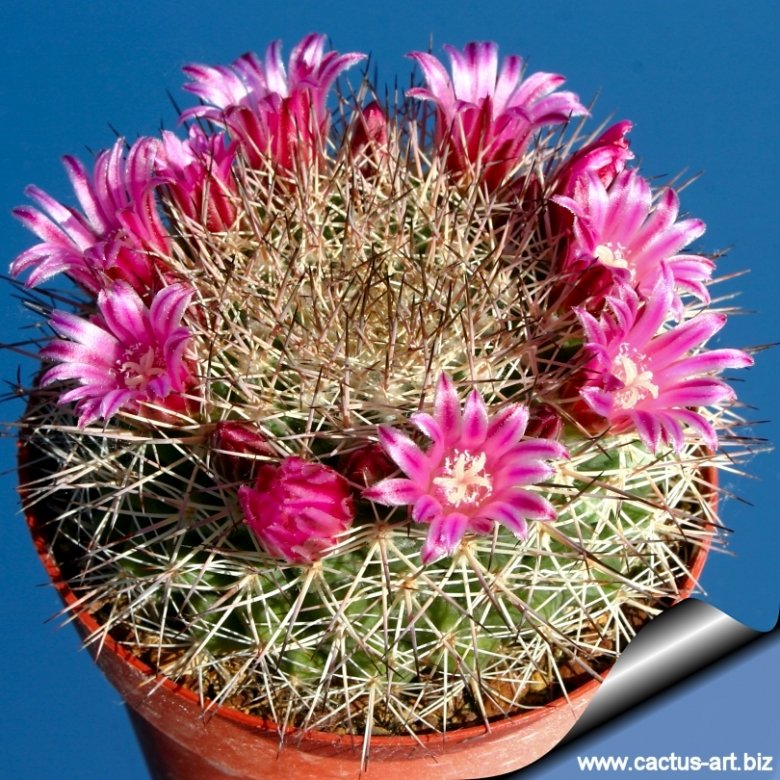
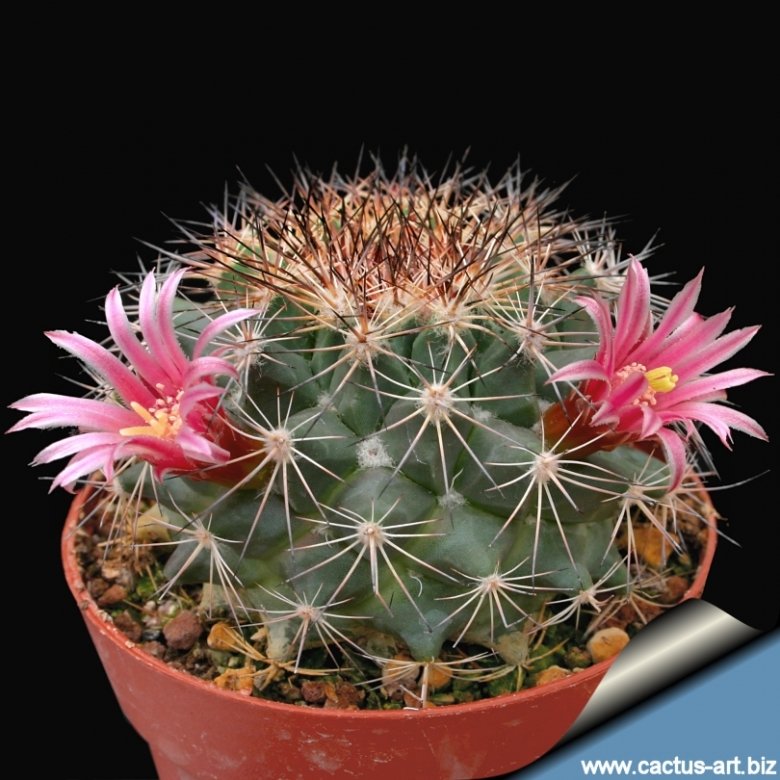
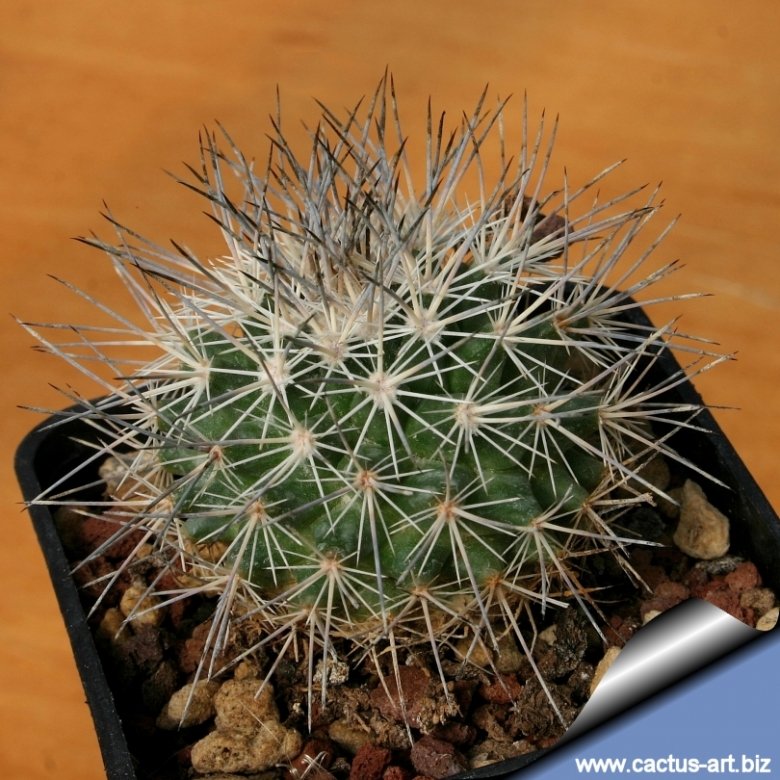
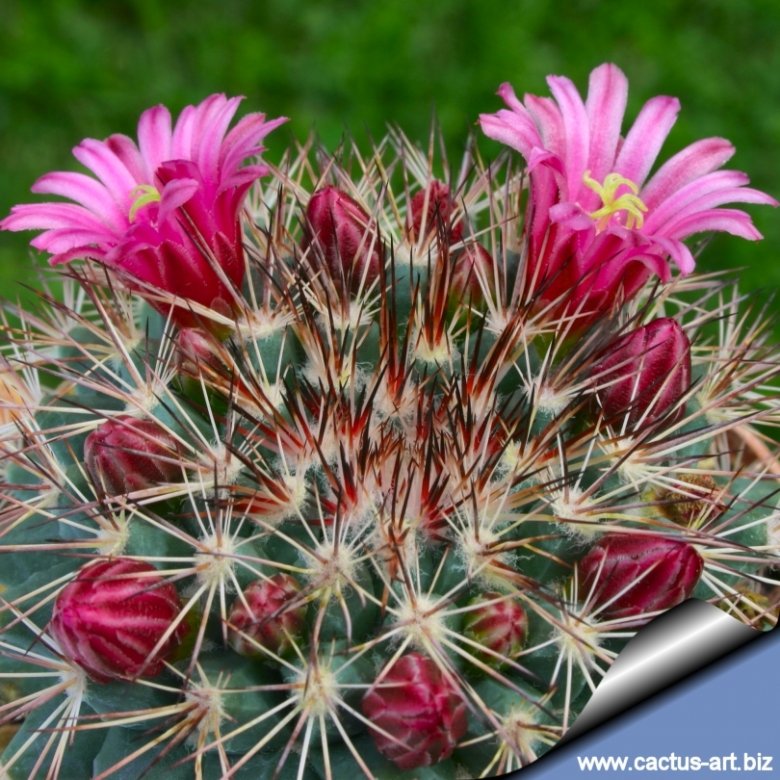
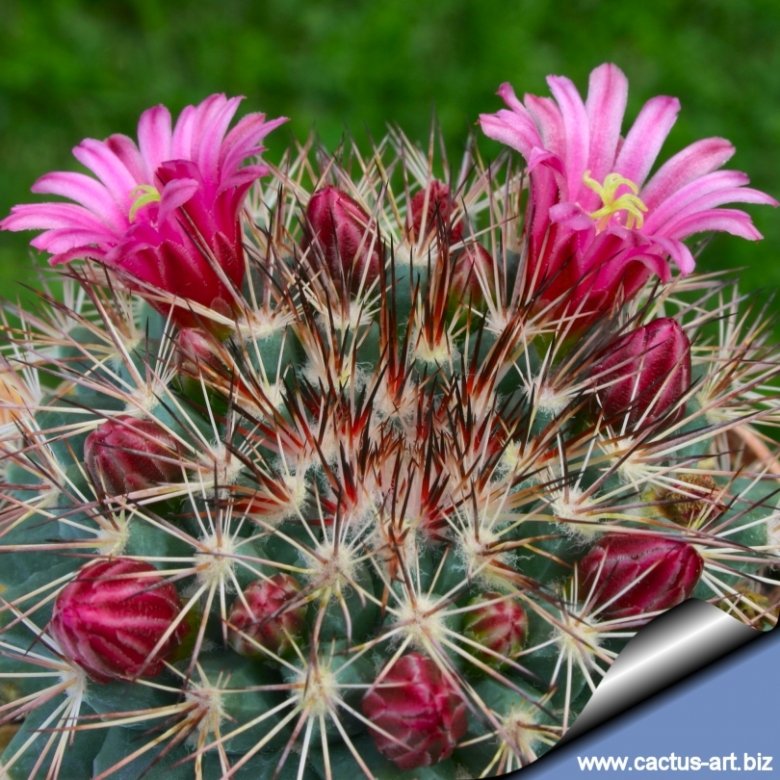
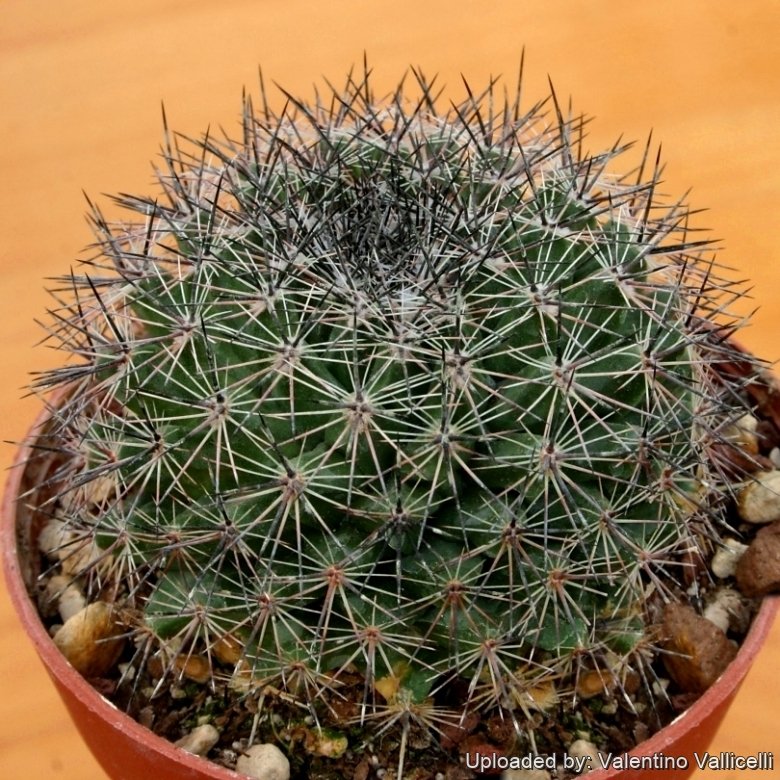
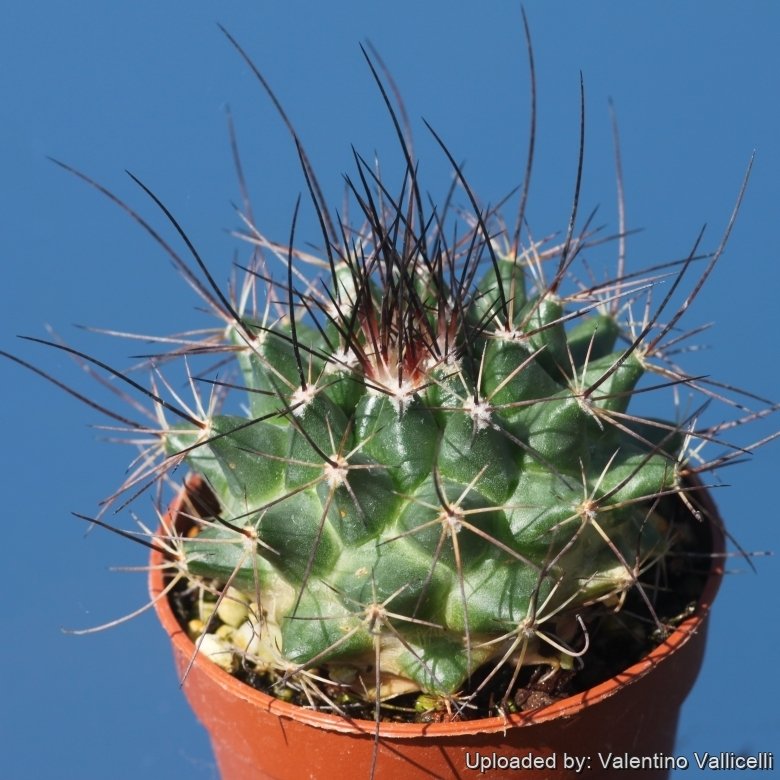
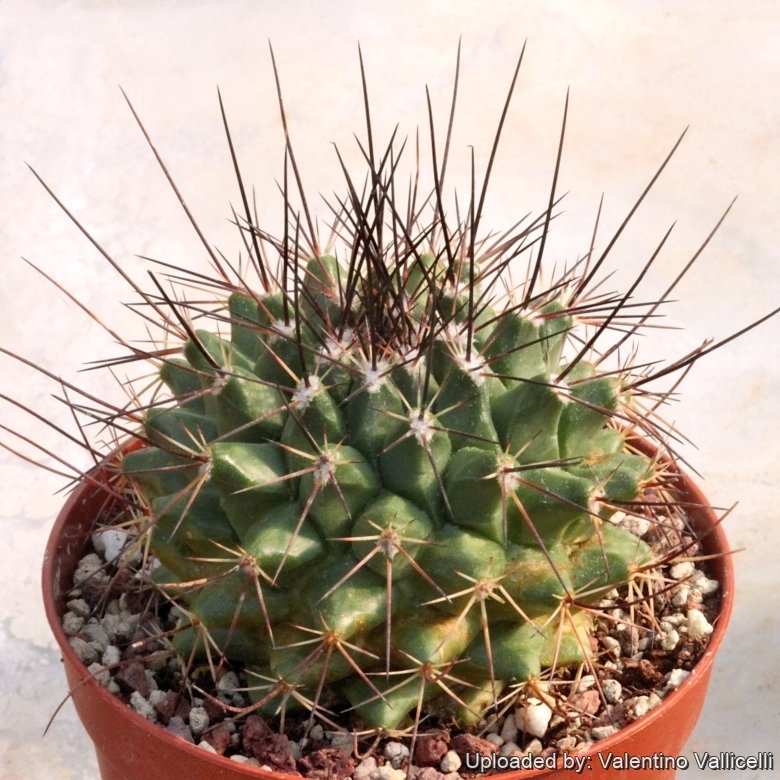
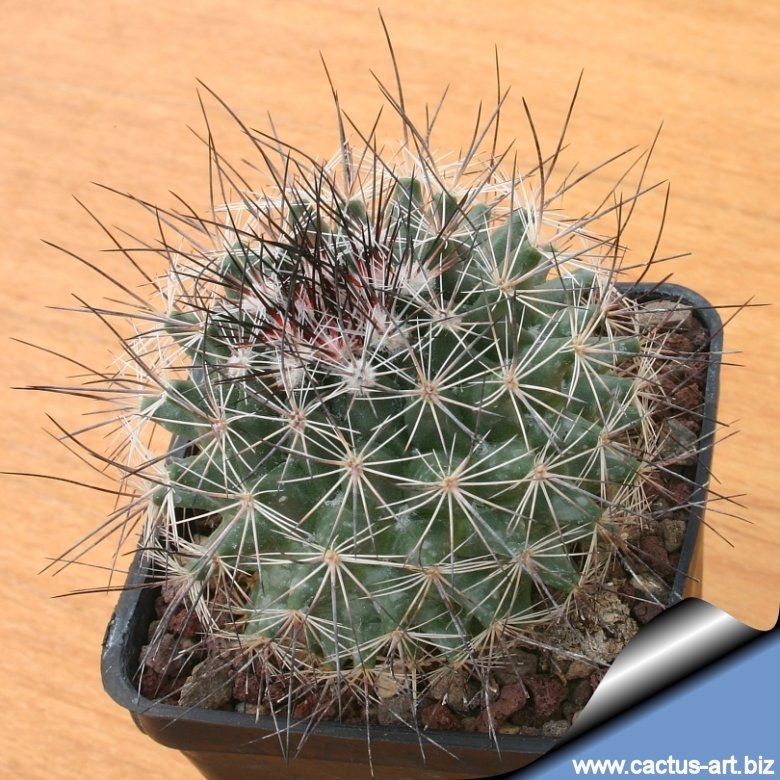
Mammillaria grusonii is undoubtedly one of the largest species in the genus and usually solitary (it has a tendency to remain the same in the culture). It reveals its true beauty only as it becomes 6 -10 years old, and reaches 30 cm or more in diameter. This species shows a considerable variation in the spination, from quite short spines to very long, the latter named as Mammillaria tesopacensis var. papasquiarensis at one time.
Stems: globose to thick cylindrical, light blue-green, up to 30 cm and 25 cm in diameter.
Tubercles: Basally four-angled, carinate, without latex, the axil is woolly at first, later naked.
Radial spines: 12-14, straight, needle-like, upper ones shorter, 6-8 mm long, at first reddish, tipped brown, later grey or snowy- white.
Central spines: Usually 2 (or rarely 3), straight, stronger than the radial, one ascending, one descending, 4-6 mm long.
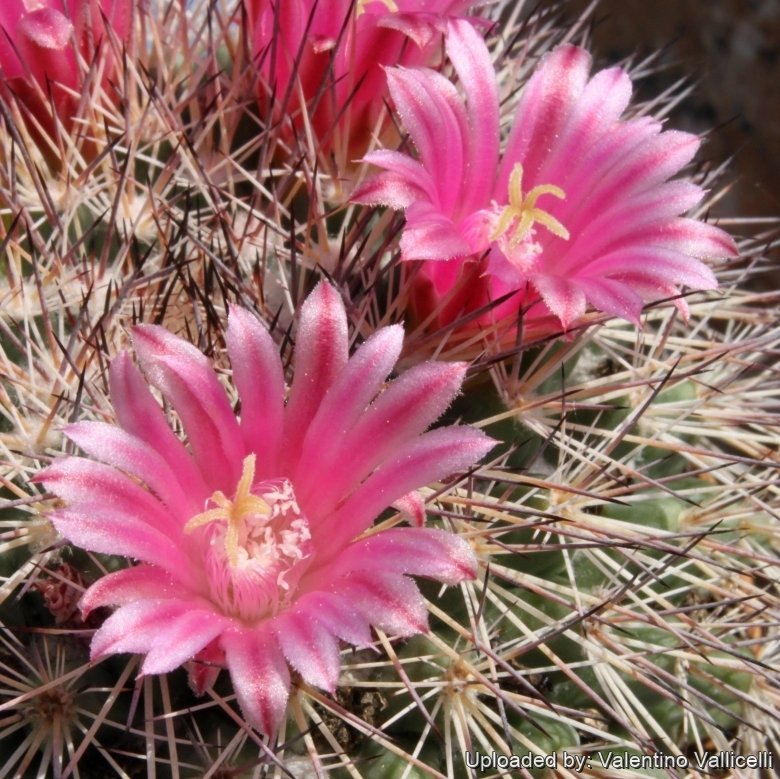
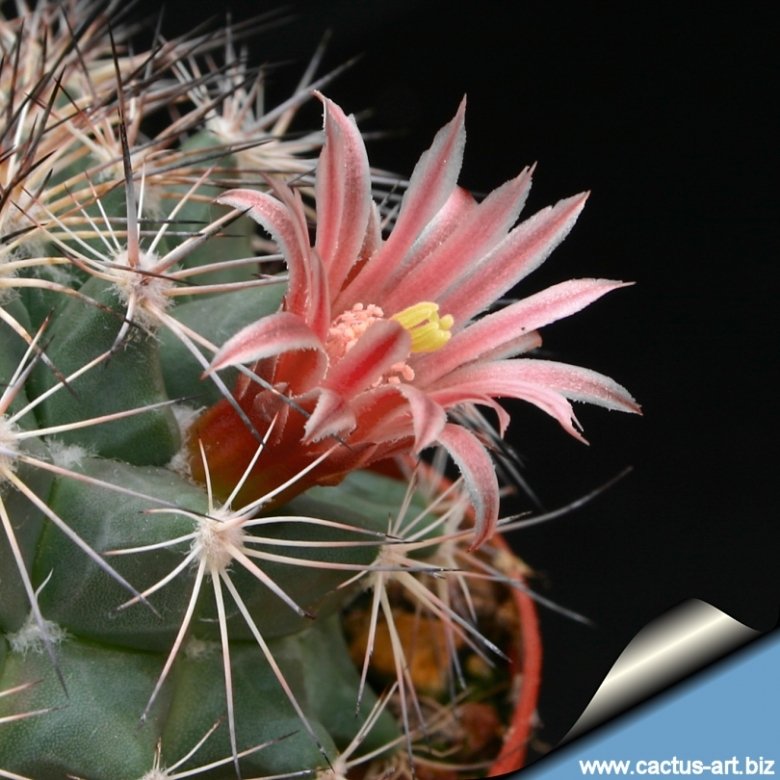
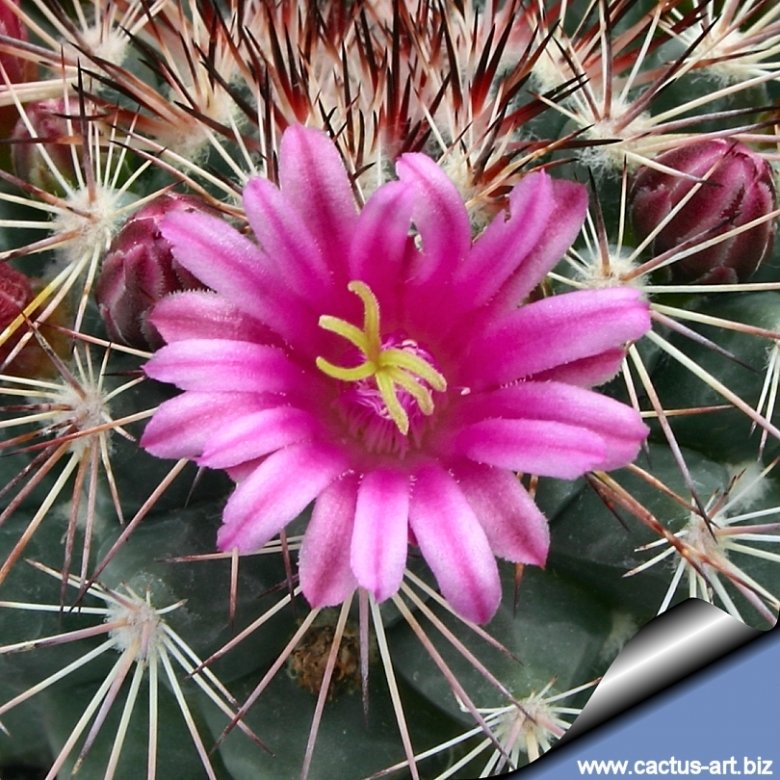
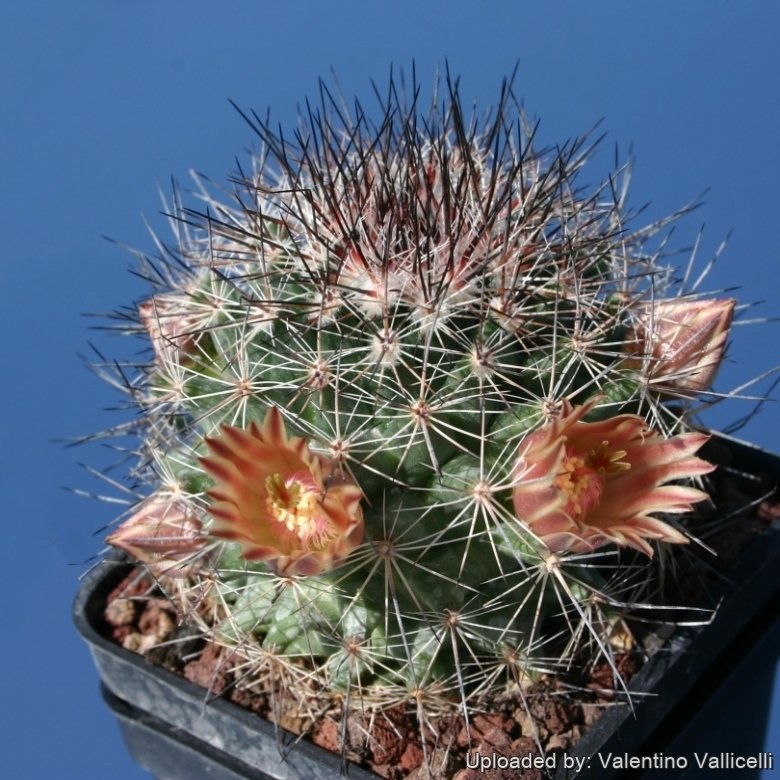
Flowers: Bell shaped, funnel-form, diurnal, light yellow-cream or pinkish with darker (brown or purple) midstripe with a yellowish throat, up to 25 mm long and in diameter.
Blooming season: Spring, and flowers remain open for about three or four days.
Fruits: Scarlet, club shaped.
Seeds: Brown.
Origin and Habitat
Mammillaria grusonii is endemic to Mexico, where it can be found in the states of Coahuila (Sierra Bola, Cerro Bola, Viesca, Puerto de Ventanillas, San Pedro de las Colonias, Cuatrocienegas, Cerro Zavaleta, El Carmen, San Rafael, Pinaje de Leone, Pomona/Paile, La Pena, Tacubaya, Torreon - Cuencame, San Antonio, El Amparo, La Cuchilla), and Durango (Penon Blanco, Nazas - Rodeo, Belem, La Concha, Cuencame, San Bartolo, Cerro Visnaga, Lerdo, Santiago Papasquiaro). It may possibly occur in Sinaloa.
Altitude range: at about 800 - 1.850 m of altitude
Habitat and ecology: This cactus appears to occur in a variety of habitats, from xerophytic shrubland to grassland and woodland. It often grows on the top and slope of hills, or in flat areas on rocky limestone and on volcanic soils in the Sierra Madre. Mammillaria grusonii is a widespread species, and although it is not abundant or common, more as scattered individuals, there are no threats to cause any concern.
Cultivation and Propagation
This plant blooms easily and needs lots of light. Use a pot with good drainage and a very porous mineral-based potting mix. Potted plants are quite wet-sensitive, especially in light of its small root system. Water sparingly during the growing season, let soil dry in between to prevent root rot, keep very dry in winter. Feed with a high potassium fertilizer in summer.
Usually it is recommended to over-winter this plant in a bright and warm greenhouse with at least 8-10° C , but it has proven to be quite frost resistant (if kept dry it is hardy as low as -7° C). A resting period in winter and strong light are necessary so that it can flower properly. Plants will offset readily, and dense clumps can be produced in a very few years.
Propagation: Through seeds and cuttings.
Bibliography
Major references and further lectures
-
John Borg “Cacti: a gardener’s handbook for their identification and cultivation” Blandford P., 1970
-
Nathaniel L. Britton, J. N. Rose “Cactaceae: Descriptions and Illustrations of Plants of the Cactus” Volume IV. The Carnegie Institution of Washington Washington, 24/Dec/1923
-
Edward Anderson “The Cactus family” Timber Press, Incorporated, 2001
-
James Cullen, Sabina G. Knees, H. Suzanne Cubey “The European Garden Flora Flowering Plants: A Manual for the Identification of Plants Cultivated in Europe, Both Out-of-Doors and Under Glass” Cambridge University Press, 11/Aug/2011
-
David R Hunt; Nigel P Taylor; Graham Charles; International Cactaceae Systematics Group. “The New Cactus Lexicon” dh books, 2006
-
John Pilbeam “Mammillaria: the cactus file handbook” Cirio Publishing Services Ltd Dec/30,/1999
-
Fitz Maurice, B, Fitz Maurice, W.A., Hernández, H.M., Sotomayor, M. & Smith, M. 2013. Mammillaria grusonii. The IUCN Red List of Threatened Species. Version 2014.3. <www.iucnredlist.org>. Downloaded on 23 April 2015.
From llifle page Mammillaria durangicola
Origin and Habitat
Cuencame, Durango (Mexico, Northern America)
Source: Mammillaria durangicola, LLIFLE - Encyclopedia of living forms, CC-BY-SA, retrieved 2026-10-25.
From llifle page Mammillaria pachycylindrica
Description
Mammillaria pachycylindrica is one of the largest species in the genus and usually solitary. It is also known by many to be synonymous with Mammillaria grusonii ,but Reppennhagen considered it a separate form with, darker body, more spines, (20–23 radials and about 6 centrals), different colour of flowers and more cylindrical growth than grusonii.
Habit: It is usually solitary (it has a tendency to remain the same in the culture). It reveals its true beauty only as it becomes 10 or more years old, and reaches 35 cm in height.
Roots: Fibrous.
Stems: Cylindrical, dull green, up to 35 cm tall and 14 cm in diameter.
Tubercles: Pyramidal, terete, basally four-angled, slightly carinate, up to 12 mm tall, 10 mm wide, firm, with latex. The axil is naked or felty.
Areoles: Elliptic, 3 mm long.
Radial spines: 20-23, straight, needle-like, thicker at base, upper ones shorter, 4-8 mm long, at first greyish brown, brown to black with darker tips, later becoming grey.
Central spines: Usually 4 to 7 (but sometime up to 10), straight, stronger than the radial, 8 mm long.
Flowers: Diurnal, bell shaped, dull pink to yellowish brown with a wide brownish-pink midstrip, up to 20 mm long and in diameter.
Blooming season: Spring, and flowers remain open for about three or four days.
Fruits: Scarlet, club shaped, up to25 mm long and 8 mm wide.
Seeds: Brown, club-shaped, 1,2 mm long and 0,6 mm wide. Hilum small and basal.
Origin and Habitat
Durango and adiacent area in Coahuila and Zacatecas (and Baja California?) Mexico
Altitude: 1000 1850 meters above sea level.
Habitat: It grows under brushwood, in stony and sandy soil with lots of humus, together with Coryphantha durangensis, Coryphantha durangensis, Ferocactus hamatacanthus, Thelocactus bicolor, Mammillaria lenta, Echinocereus conglomeratus, and Mammillaria viescensis.
Bibliography
Major references and further lectures
-
John Borg “Cacti: a gardener’s handbook for their identification and cultivation” Blandford P., 1970
-
Nathaniel L. Britton, J. N. Rose “Cactaceae: Descriptions and Illustrations of Plants of the Cactus” Volume IV. The Carnegie Institution of Washington Washington, 24/Dec/1923
-
Edward Anderson “The Cactus family” Timber Press, Incorporated, 2001
-
James Cullen, Sabina G. Knees, H. Suzanne Cubey “The European Garden Flora Flowering Plants: A Manual for the Identification of Plants Cultivated in Europe, Both Out-of-Doors and Under Glass” Cambridge University Press, 11/Aug/2011
-
David R Hunt; Nigel P Taylor; Graham Charles; International Cactaceae Systematics Group. “The New Cactus Lexicon” dh books, 2006
-
John Pilbeam “Mammillaria: the cactus file handbook” Cirio Publishing Services Ltd Dec/30,/1999
Source: Mammillaria pachycylindrica, LLIFLE - Encyclopedia of living forms, CC-BY-SA, retrieved 2026-10-25.
From llifle page Mammillaria papasquiarensis
Description
Mammillaria papasquiarensis (firstly described as Mammillaria tesopacensis v. papasquiarensis by Bravo & Alt. in 1992 ) is a local or morphological form of the widespread and variable Mammillaria grusonii. It has generally longer spines than the Mammillaria grusonii.
Stem: Handsome, large, solitary to about 25 cm in diameter (or more), flat-globular if grown in plenty of sunshine, which it relishes, and which helps produce the strong spination it is noted for.
Radial spines: 8 to 10, grey 5 to 40 mm in length.
Central spines: 1 to 3, dark-brown to almost black, becoming grey whit age, 40 to 100 mm in length.
Flowers: Dull white to pinkish with darker central veins.
The distinguishing long spines of Mammillaria papasquiarensis, appear to fall within the natural variation of Mammillaria grusonii and it should be synonymized with the latter.
Origin and Habitat
Mammillaria papasquiarensis is endemic to Mexico, where it can be found in the states of Durango (Santiago Papasquiaro, Guatimape, Laguna Morcillo, La Concha, Nazas, Cerro Blanco, San Juan del Rio)
Altitude range: 1700-2200 metres above sea level.
Habitat and ecology: This species grows on low hills together with Echinocereus pectinatus, Mammillaria chionocephala, Opuntia robusta, Opuntia violacea, Opuntia herrfeldtii, Agave americana, Yucca filifera, and Dasylirion sp.
Bibliography
Major references and further lectures
- British Cactus & Succulent Journal, Volume 23 Page 75 Cactus & Succulent Society, 2005
Source: Mammillaria papasquiarensis, LLIFLE - Encyclopedia of living forms, CC-BY-SA, retrieved 2026-10-25.
From llifle page Mammillaria zeyeriana
Description
Mammillaria zeyeriana is one of the largest species in the genus and usually solitary. It is also known by many to be synonymous with Mammillaria grusonii, but not sufficiently differentiated and considered merely a local variant of the latter (if not the same). It has spines of intermediate measurement, of which the radials are 10 to 15, 8-15 mm long, and the centrals are usually 4 stronger than the radial, 12-25 mm long. The flowers are similar to the type species.
Habit: It is usually solitary (it has a tendency to remain the same in the culture). It reveals its true beauty only as it becomes 6-10 years old, and reaches 20 cm or more in diameter.
Stems: Hemispherical or conical to short cylindrical, pale greyish green, up to 15(-30) cm tall and 10-25 cm in diameter.
Tubercles: Conical, terete, in 13 or 21 spirals, basally four-angled, slightly carinate, 10 to 12 mm tall, without latex, the axil is naked or sparingly woolly.
Areoles: Elliptic, 3 mm long.
Radial spines: 10-15, straight, needle-like, upper ones shorter, 8-15 mm long, at whitish to reddish, tipped brown, later grey or snowy- white.
Central spines: Usually 4 (but sometime up to 6), straight, stronger than the radial, brownish, the uppermost one curved, one descending, 12 - 25 mm long.
Flowers: Bell shaped, funnel-form, diurnal, light yellow-cream or pinkish with darker (brown or purple) midstripe with a yellowish throat, up to 25 mm long and in diameter.
Blooming season: Spring, and flowers remain open for about three or four days.
Fruits: Scarlet, club shaped.
Seeds: Brown.
Origin and Habitat
Coahuila and Durango, Mexico
Altitude: 1250-1500 m
Habitat: together with Coryphantha durangensis, Ferocactus hamatacanthus and Thelocactus bicolor, Echinocereus stramineus, Opuntia kleiniae, Opuntia violacea, Opuntia herrfeldtii, Opuntia imbricata, Euphorbia antisyphilitica, Yucca thompsoniana, Larrea tridentata, and Jatropha dioica.
Source: Mammillaria zeyeriana, LLIFLE - Encyclopedia of living forms, CC-BY-SA, retrieved 2026-10-25.
Gallery