Publication: Allg. Gartenzeitung (Otto & Dietrich) 4: 257. 1836
Description
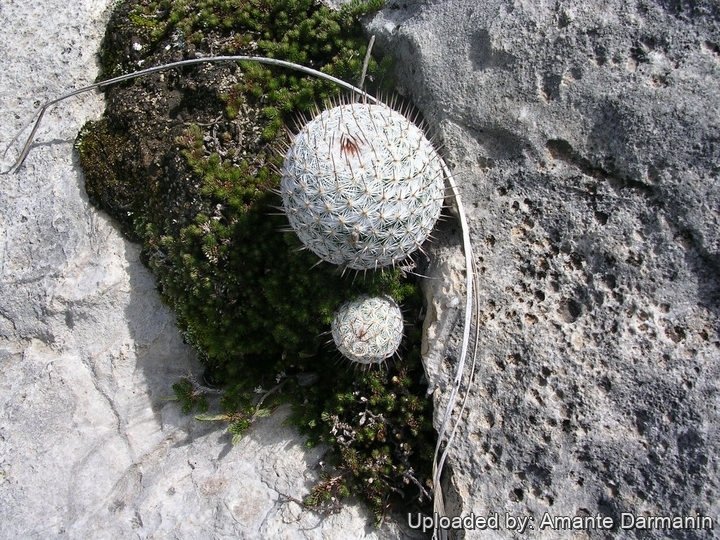
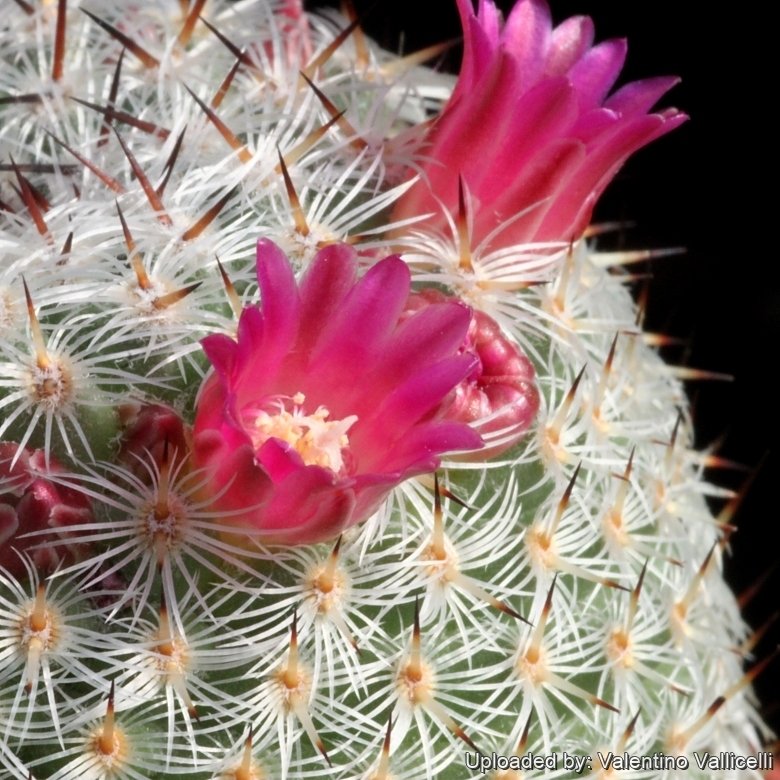
Plants usually solitary, sometimes sprouting at the base or sides when old. Each head is surrounded by a complete ring of starlike pink flowers. There are ample variations among plants from different origin.
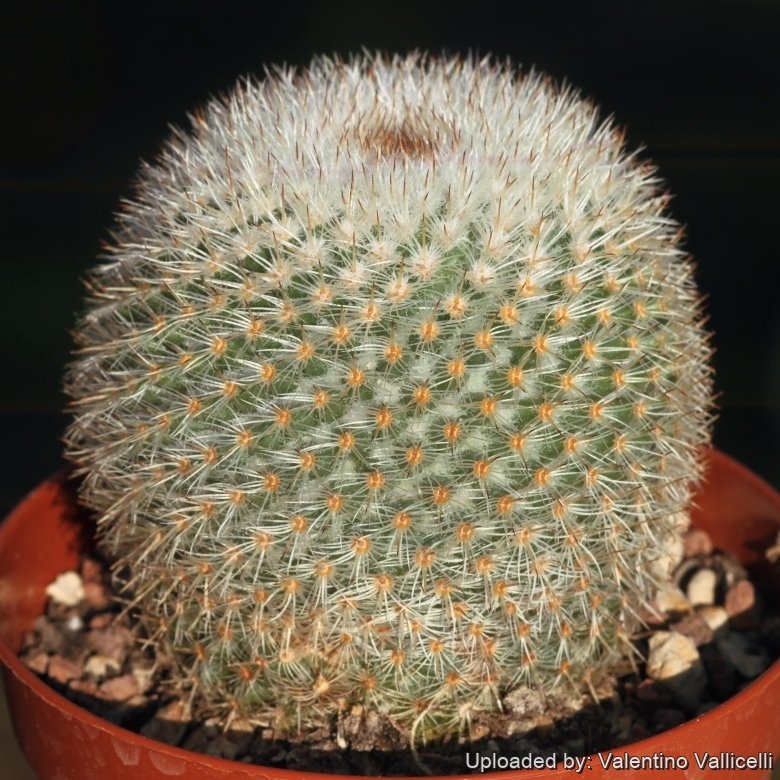
Stem: Globularor somewhat elongate in age, glaucous green, up to 15 cm high, (3-)5-10 cm in diameter, apex wolly.
Sap: Without latex (or vaguely milky, whitish-yellowish, but not slimy)
Tubercles: Small, (3-)5-6 mm hight, crowded, conical/pyramidal, four-angled basally.
Axil: Slightly woolly only on new growth, later naked.
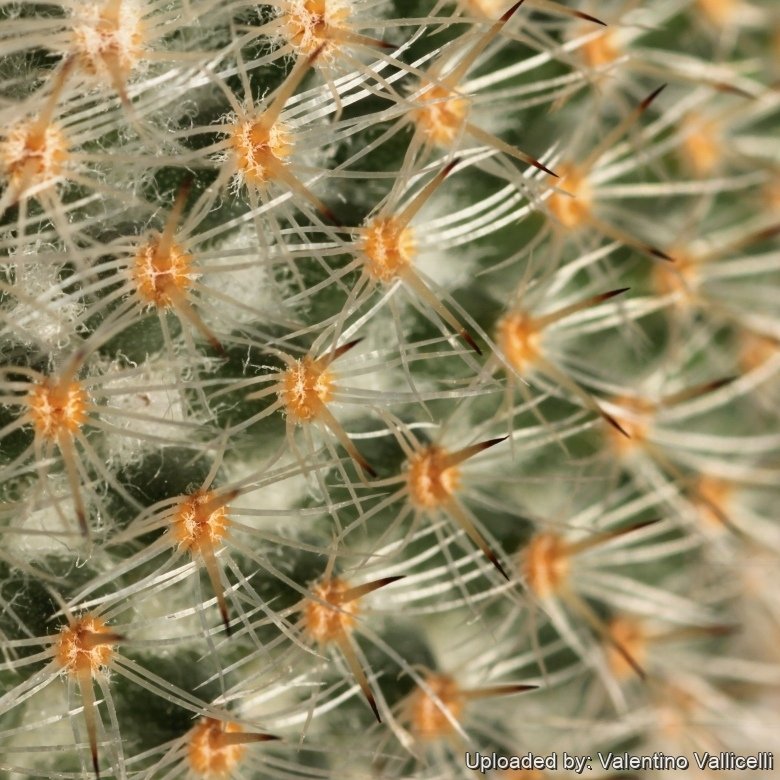
Areoles: 2-3 mm, oval, whith white wool when young.
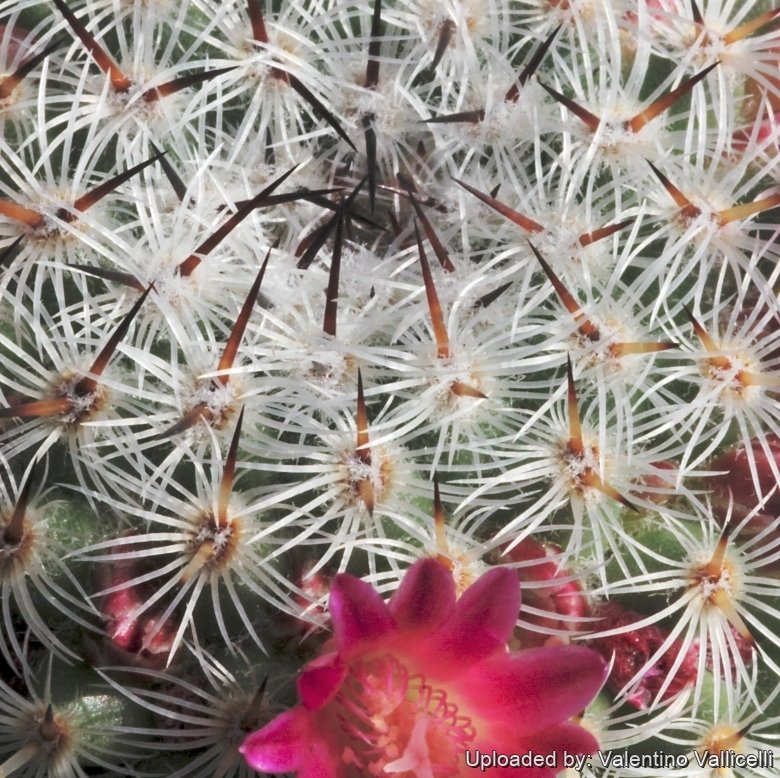
Radial spine: (14-)8-30(-38), smooth, acicular, straight or slightly curved, white, radiating, bristly, 3-6 mm long.
Central spine: usually 2 (but variable from 0 to 6), slender, rigid, straight, not hooked, erect, divergent, black to reddish, turning grey as the ages (3-)6-10(15) mm long. The lower one usually longer
Flower: Deep magenta-pink to pale pink, funnel-shaped, up to 10 mm long, 8-15(-20) mm in diameter. Pericarpel 1,3-2,5 mm long, receptacle-tube 1,3-2,9 mm long, external tepals 2-10 mm long, 1-2 mm wide, linear-lanceolate purple red with a greenish base, internal tepals 6-11 mm long pink to purple with a darker midvein. Filaments whitish or pinkish.
Blooming season: February to April.
Fruit: Red, pinkish at the base, about 1 cm long.
Seed: Brownish.
Origin and Habitat
Mammillaria haageana is widespread and endemic to Mexico, occurring in the States of Puebla, Mexico, Veracruz, Morelos, Tlaxcala, and Oaxaca.
Altitude: 450-2600 metres above sea level.
Habitat and Ecology: The elevation range where this species occurs is wide, therefore it is found in many different vegetation types such as deciduous tropical forest, xerophyllous scrub, oak forest and secondary vegetation, juniper forest, pine forest, lava flows, and often in disturbed areas. It occurs in Cardonal-tetechera. The plants are commonly associated with nurse plants, but can also occur in bare areas. This species is locally threatened by the overcollection of wild populations for use as an ornamental.
Cultivation and Propagation
It is a free-flowering and relatively easy plant to grow.
Exposition: Full sun to light shade.
Watering: Water regularly in summer but do not over-water. Keep dry in winter. Hardy down to -4°C.
Growing tips: It is better that they be repotted regularly. Repotting will increase the number and size of stems, and will increase the number of flowers produced. Repot yearly until it reaches about 3 cm in size, then every two or three years will suffice. Repotting is best done at the end of winter, but it can be done at other time, too. Do not water for a couple of weeks after repotting, in order to reduce risk of root rot via broken roots.
Propagation: Seeds or offsets if available.
Bibliography
-
David Hunt, Nigel Taylor “The New Cactus Lexicon” DH Books, 2006
-
John Pilbeam (1999) “Mammillaria The Cactus File Handbook” Nuffield Press.
-
Edward F. Anderson “The Cactus Family” Timber Press, 2001
-
James Cullen, Sabina G. Knees, H. Suzanne Cubey “The European Garden Flora Flowering Plants: A Manual for the Identification of Plants Cultivated in Europe, Both Out-of-Doors and Under Glass”Cambridge University Press, 11/ago/2011
-
Nathaniel Lord Britton, Joseph Nelson Rose “Cactaceae: Descriptions and Illustrations of Plants of the Cactus Family” vol. 4 The Carnegie Institution of Washington, Washington 1923
-
Ulises Guzmán, Salvador Arias, Patricia Dávila: “Catálogo de cactáceas mexicanas.” Universidad Nacional Autónoma de México, Mexiko-State 20038)
-
Florencia Briones, Guadalupe Palomino & Armando Garcia “Chromosome analysis of Mammillaria supertexta, M. crucigera and M. haageana and their comparison with M. san-angelensis (Cactaceae)” in Caryologia: International Journal of Cytology, Cytosystematics and Cytogenetics Volume 57, Issue 3, 2004
-
Hernández, H.M., Cházaro, M. & Gómez-Hinostrosa, C. 2013. Mammillaria haageana. In: IUCN 2013. “IUCN Red List of Threatened Species.” Version 2013.2. <www.iucnredlist.org>. Downloaded on 12 January 2014.
From llifle page Cactus dealbatus
Description
Mammillaria dealbata is a controversial name for a plant generically reported from Valley of Mexico and elsewhere in Central Mexico. Britton and Rose give a description of this plant which is evocative of a Mammillaria elegans while Helia Bravo spoke about Mammillaria dealbata near Mammillaria parkinsonii, especially considering the central spine configuration. The plant described by Britton and Rose might correspond to Mammillaria haageana ssp. Angelensis. Sanchez-Mejorada and other authors give more different descriptions creating a taxonomic nightmare.
With descriptions that vary significantly, we cannot sensibly keep the name dealbata as a recognised name. It has, in any case, now been subsumed into the species, Mammillaria haageana, as have all previous varieties and subspecies. And easily in habitat population of plants with 1 central spine; 2 central spines; 4 central spines; some all white spined, some white with dark tips; some with almost totally dark central spines; some with centrals that were smooth and glossy; some with centrals dull and rough looking and so on are often found growing together in the same locality. And is almost impossible to identifying cultivated plants without a known habitat location.
Description from “The Cactaceae” Britton & Rose 1923:
Globose to short-cylindric, glaucous, more or less depressed at apex but almost hidden by the many closely appressed spine-clusters ; axils of tubercles and young spine-areoles densely lanate but in age glabrate; radial spines about 20, white, short, appressed; central spines 2, much stouter and longer than the radials, sometimes 1 cm long, the upper ones often erect, white below, brown or black at tip; flowers small, carmine; fruit clavate, red; seeds brown.
Type locality: Mexico.
Distribution: Central Mexico, especially on the pedregal about the City of Mexico.
We have referred to this species a plant which is very common in the Valley of Mexico
and which is known in collections as Mammillaria peacockii. The name, first used by Riimpler (Forster, Handb. Cact. ed. 2. 286. 1885), was given as a synonym of Mammillaria dealbata. It was offered for sale by Grassner as M. elegans dealbata (Monatsschr. Kakteenk. February 1920).
Illustration: Grassner, Haupt-Verz. Kakteen 1912: 23, as Mammillaria peacockii.
Plate XII, figure 3, shows a plant from Mexico, sent to the New York Botanical Garden
in 1911. Figure III is from a photograph of a plant sent by Dr. Reiche from the Valley of Mexico in 1922.
Description from “El Interesante Mundo de las Cactáceas” Helia Bravo Hollis, Léia Scheinvar Fondo De Cultura Economica USA, 1999:
Tallo robusto, cilindrico. Tuberculos fuertemente subcomprimidos, obliquamente truncados, verde-grisaceus. Axilas subnudas, Areolas blancas, tomentosas, despuedes desnudas. Espinas radiales 24 a 26, muy tenues, suberecto-radiantes, niveas. Espinas centrales 2, muy robustas, blancas, pardas, esfaceladas, la superior mas corta, erecta; la inferior mas larga, aplanada, deflexa.
Localidad tipo: desconocida.
La descripcion anterior esta tomada da Salm-Dyck (Cact.Hort.Dyck. 1849 89, 1850). quien agrega: “Tallo, hasta ahora, simple. Muy cercana a Mammillaria parkinsonii de cual defiere por tener 2 espinas centrales”. La breve incompleta descripcion no nos permite identificar plenamente esta especie, pero, a juzgar por el comentario de Salm-Dyck, la planta de su colecion, que el identificò como Mammillaria dealbata, partenecia, sin duda, al complejo de Mammillaria parkinsonii.
Description by Sanchez-Mejorada reported at pag.125 by Pilbeam in “Mammillaria The Cactus File Handbook” Nuffield Press. 1999
Solitary, globose or shotly columnar, 6 to 12cm tall, 4 to 7cm in diameter, axils wolly in youth.
Radial spines 18/20, needle-like, white 5 to 7mm long.
Central spines usually 2, or 1, awl shaped, white, darker at the tip, 5 to 6mm long.
Origin and Habitat
Valley of Mexico and elsewhere in Central Mexico.
Bibliography
Major references and further lectures
-
Pilbeam J., “The Cactus file, Mammillaria” 6: 120, Cirio Pub. Services, 01/Dec/1999
-
Helia Bravo Hollis, Léia Scheinvar “El Interesante Mundo de las Cactáceas ” Fondo De Cultura Economica USA, 1999
-
James Cullen, Sabina G. Knees, H. Suzanne Cubey “The European Garden Flora Flowering Plants: A Manual for the Identification of Plants Cultivated in Europe, Both Out-of-Doors and Under Glass” Cambridge University Press, 11/Aug/2011
-
David R Hunt; Nigel P Taylor; Graham Charles; International Cactaceae Systematics Group. “The New Cactus Lexicon” dh books, 2006
-
Edward Anderson “The Cactus family” Timber Press, Incorporated, 2001
Source: Cactus dealbatus, LLIFLE - Encyclopedia of living forms, CC-BY-SA, retrieved 2026-10-25.
From llifle page Mammillaria albidula
Origin and Habitat
Colonia San Martin, Puebla (Mexico, Northern America)
Source: Mammillaria albidula, LLIFLE - Encyclopedia of living forms, CC-BY-SA, retrieved 2026-10-25.
Cultivars and forms (6)
Gallery