Publication: Monatsschr. Deutsch. Kakteen-Ges. 1: 77 77 1929
Description
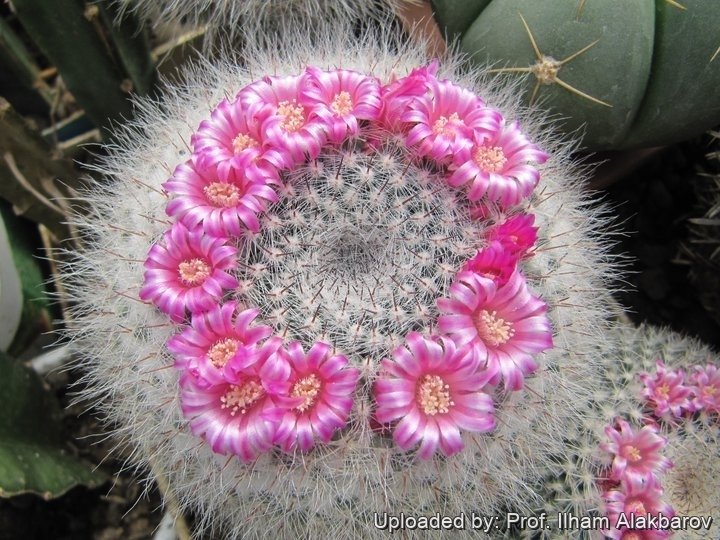
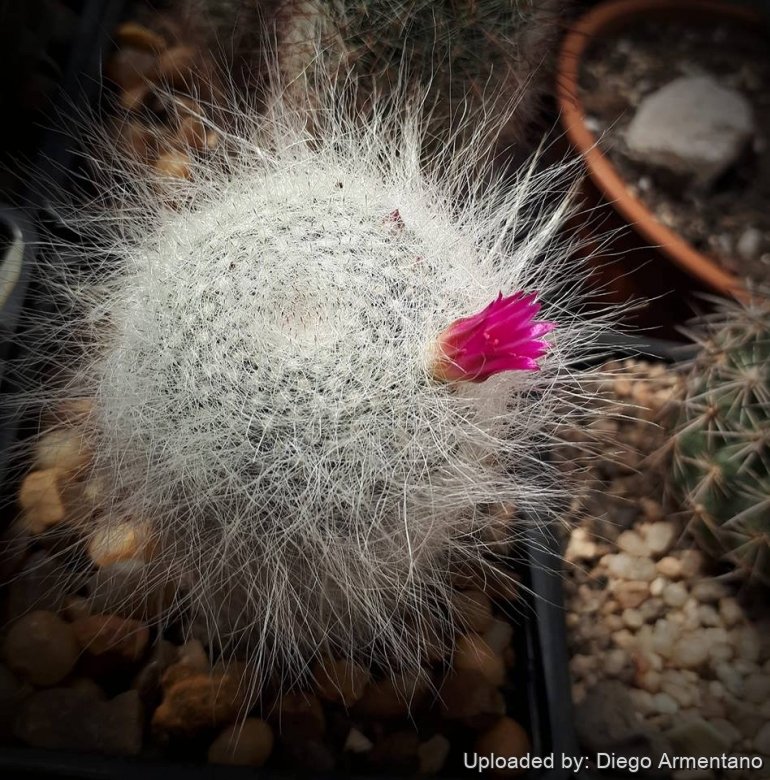
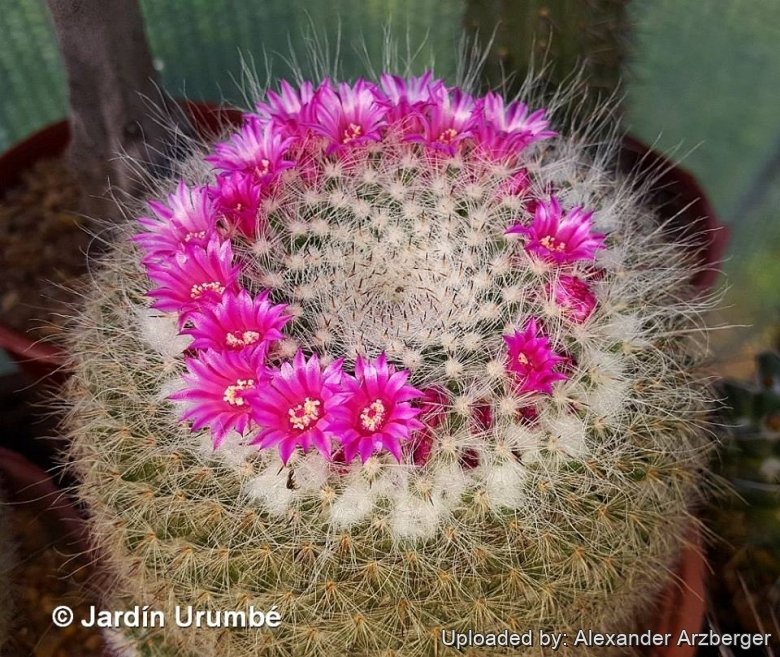
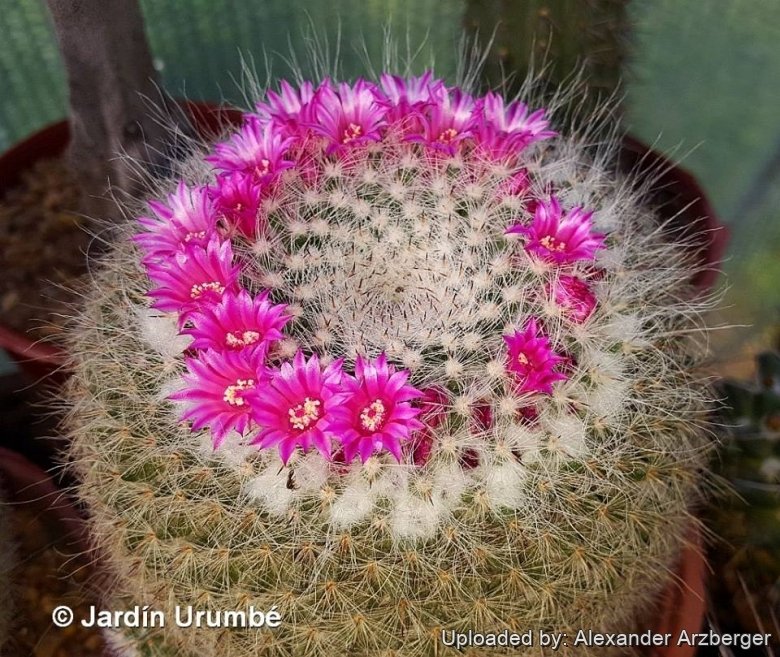
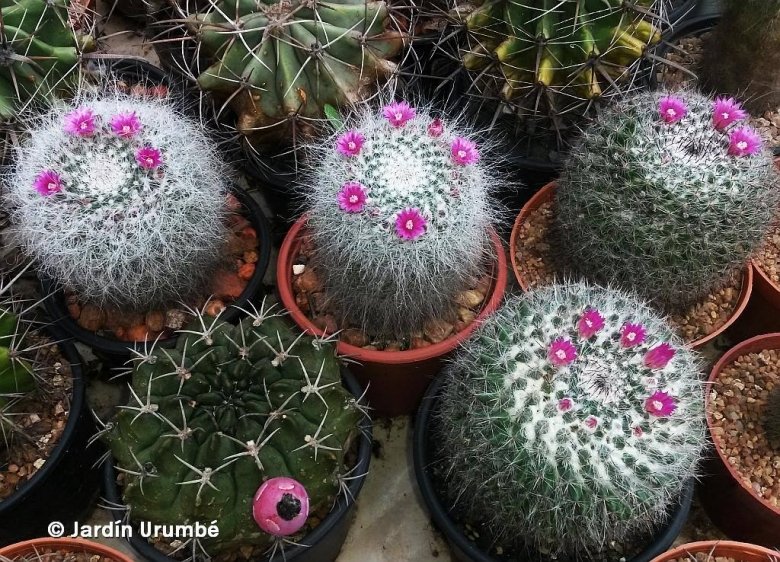
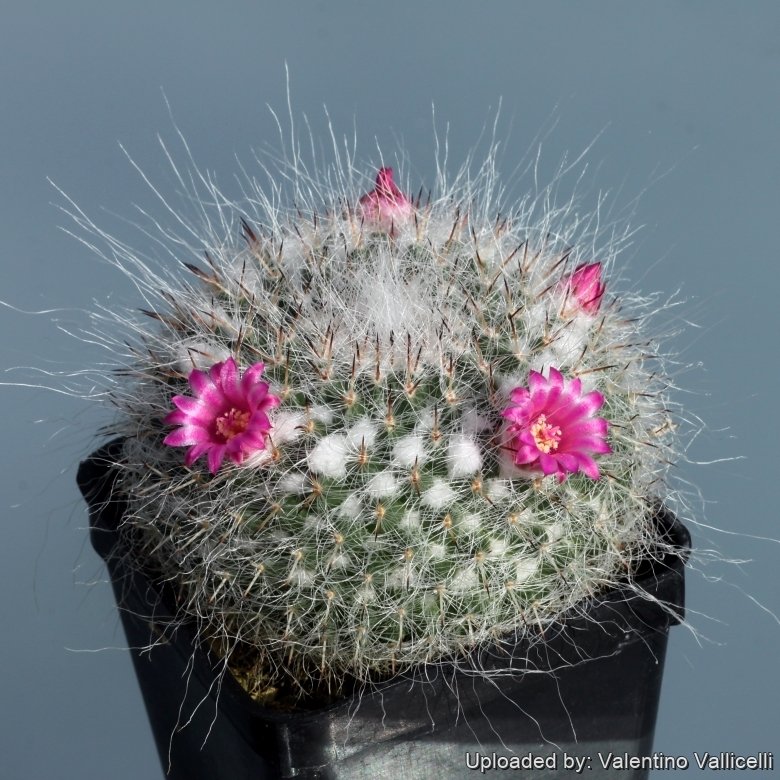
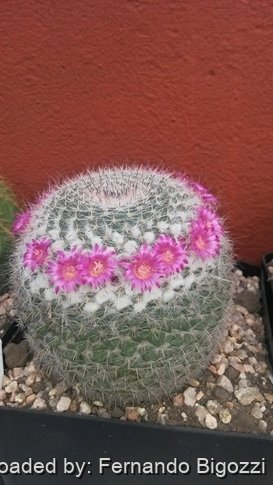
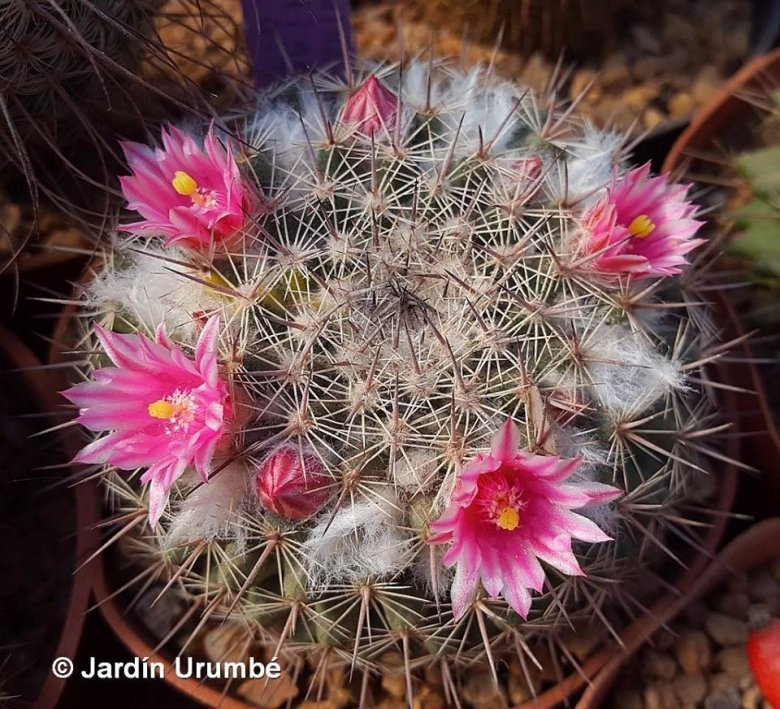
Mammillaria hahniana is a popular sun-loving succulent that forms large groups. It is readily identified by its long, white, thin, flexible hairs which can densely cloak the plant’s body and increase in thickness, richness and length in age. This cactus flowers prolifically, even when young, making it a good species to have in a collection. Includes numerous variations and described subspecies, none of which are currently accepted.
Stem: At first globular, later cylindrical, light green,or greyish-green up to 9 cm high and 10 cm in diameter.
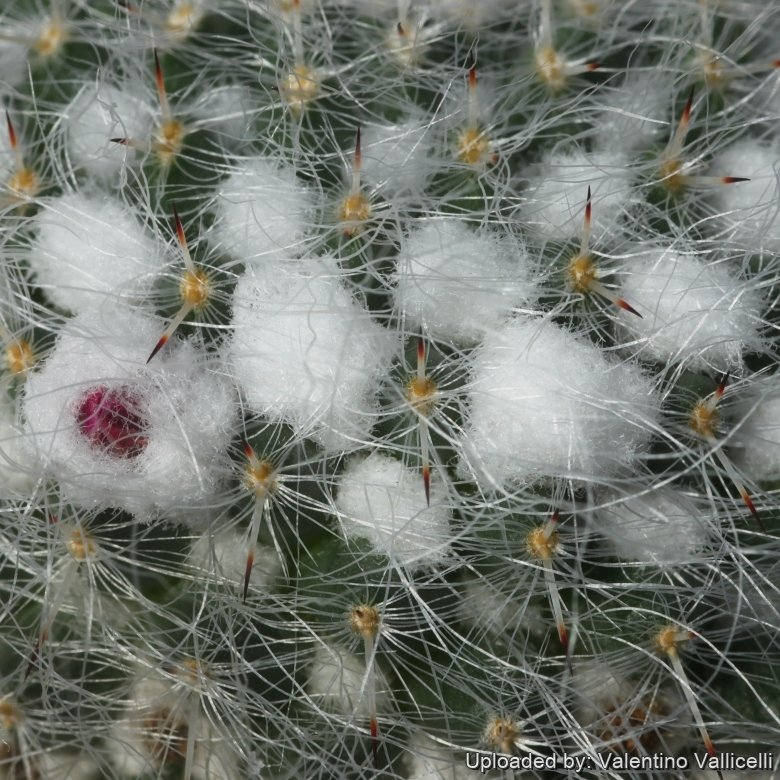
Tubercles: Numerous, small, triangular conical, with latex.
Axils: With 20 or more white hair-like bristles, spreading, curly, which can be, short or, on some plants, up to 5 cm long.
Central spines: 1-4, white with reddish tips up to 4 mm long.
Radial spines: 20-30 pectinate, sometimes absent or nearly so, hairlike, white,
5-15 mm long.
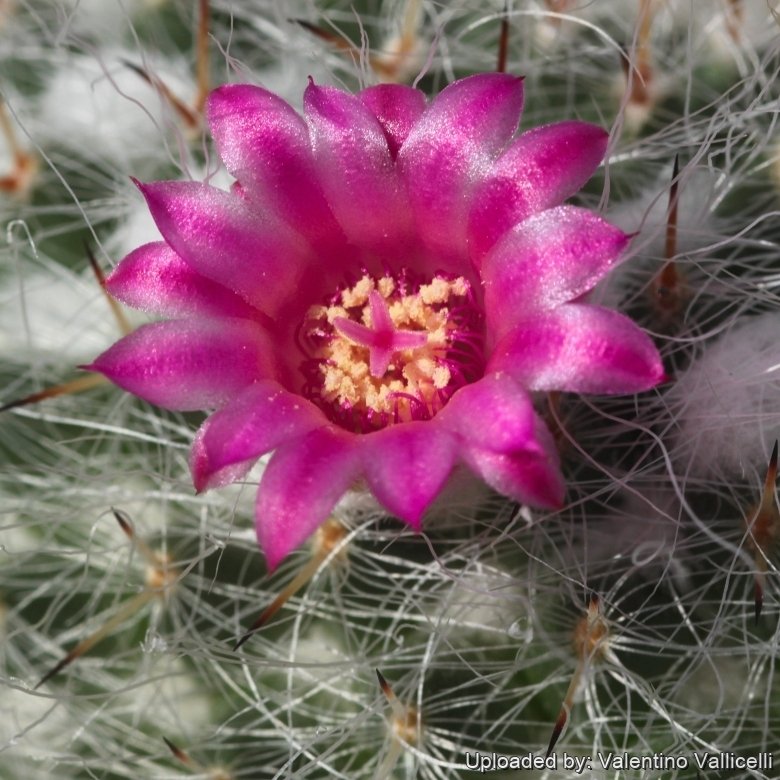
Flowers: M. hahniana produces concentric rings of violet-red to pink about 12-15 mm in diameter.
Blooming season: Late winter to spring.
Fruits: Club shaped, red, 5-7 mm long.
Seeds: Brown.
Origin and Habitat
Guanajuato, San Luis Potosí, and Queretaro, Mexico. It has a very limited range(extent of occurrence ca 1,000 km2) and is known from only two locations.
Altitude range: It occurs at elevations of 750 to 2,200 metres above sea level. It is very likely for the species to be found in Hidalgo.
Habitat and Ecology: The species occurs along relatively steep slopes in submontane matorral and deciduous forests. This cactus is locally common where it occurs, and grows in groups/clusters which are generally rare. Mammillaria hahniana is listed as near threatened due to is very limited range and because it is affected by illegal collection and some subpopulations are impacted by deforestation.
Cultivation and Propagation
It is a rapid growing species that will form large clumps rather rapidly when compared to other Mammillaria species. Needs lots and lots of space to grow. Water regularly in summer, but do not overwater (Rot prone) Use pot with good drainage and a very porous potting media, keep dry in winter. Feed with a high potassium fertilizer in summer. It is quite frost resistant if kept dry, hardy as low as -5° C (some reports give it hardy to -12°C) Outside full sun or afternoon shade, inside needs bright light, and some direct sun.
Use and Trade: This cactus is used as an ornamental, and its fruit are eaten by humans.
Propagation: Division, direct sow after last frost.
Bibliography
Major references and further lectures
-
Edward Anderson “The Cactus family” Timber Press, Incorporated, 2001
-
James Cullen, Sabina G. Knees, H. Suzanne Cubey “The European Garden Flora Flowering Plants: A Manual for the Identification of Plants Cultivated in Europe, Both Out-of-Doors and Under Glass” Cambridge University Press, 11/Aug/2011
-
David R Hunt; Nigel P Taylor; Graham Charles; International Cactaceae Systematics Group. “The New Cactus Lexicon” dh books, 2006
-
John Pilbeam “Mammillaria: the cactus file handbook” Cirio Publishing Services Ltd Dec/30,/1999
-
Bárcenas Luna, R., Gómez-Hinostrosa, C., Guadalupe Martínez, J. & Sánchez , E. 2013. Mammillaria hahniana. The IUCN Red List of Threatened Species. Version 2015.1. <www.iucnredlist.org>. Downloaded on 01 June 2015.
From llifle page Mammillaria saetigera
Description
Mammillaria saetigera is a short haired type of Mammillaria hahniana from Queretraro. It is a medium green globular species characterized by angled tubercles with white wool and bristles. The axillary hairs are up to 2.5 cm in length, the radial spines varies between 15 to 20. The 2 central spines of M. saetigera vary between 8 and 24 mm long, and are whitish tipped brown.
The flowers are purplish-red with outer perianth segments shortly ciliated and the stigma lobes are pinkish-brown There is no geographic isolation between this form and the others, with much longer white hairs. It is at most a variant of Mammillaria hahniana and not a distinct species or subspecies.
Origin and Habitat
Native habitat is the districts of Queretraro (Arroyo Seco and Sierra de Jalpan (and not in Jalapa) and (?)San Luis Potosi, Mexico.
Cultivation and Propagation
It is a rapid growing species that will form large clumps rather rapidly when compared to other Mammillaria species. Needs lots and lots of space to grow. Water regularly in summer, but do not overwater (Rot prone) Use pot with good drainage and a very porous potting media, keep dry in winter. Feed with a high potassium fertilizer in summer. It is quite frost resistant if kept dry, hardy as low as -5
Bibliography
Major references and further lectures
-
Léia Scheinvar “Flora cactológica del estado de Querétaro: diversidad y riqueza” Fondo de Cultura Económica, 2004
-
“The Spine”, Volumes 20-23, 1971
-
Charles H. Potter “Greenhouse, place of magic” Dutton, 1967
Source: Mammillaria saetigera, LLIFLE - Encyclopedia of living forms, CC-BY-SA, retrieved 2026-10-25.
Cultivars and forms (4)
Subspecies (1)
Forms (1)
Gallery