Publication: Z. Sukkulentenk. 3(7): 123-124, unnumbered f. 123 1927-1928
Description
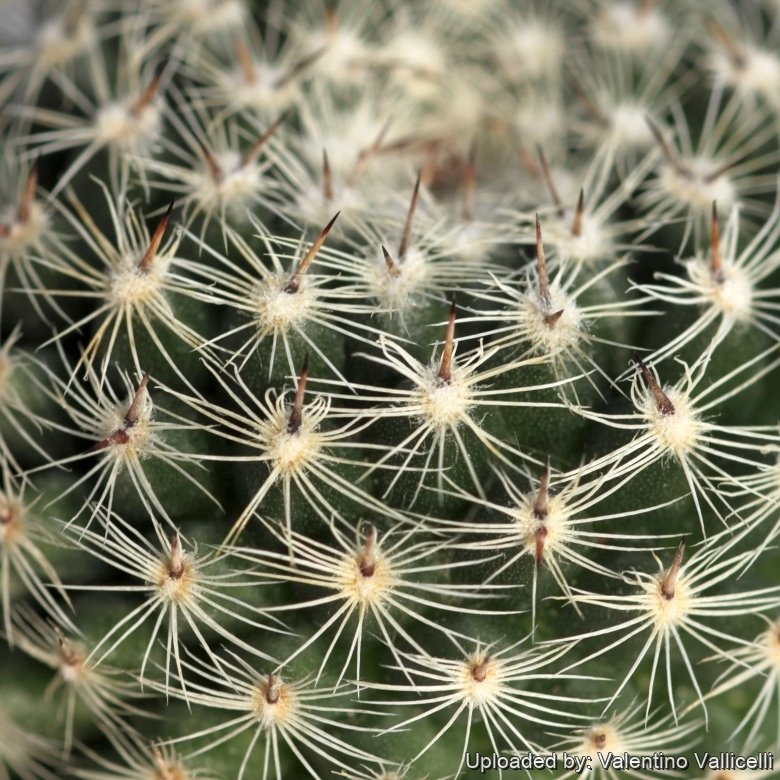
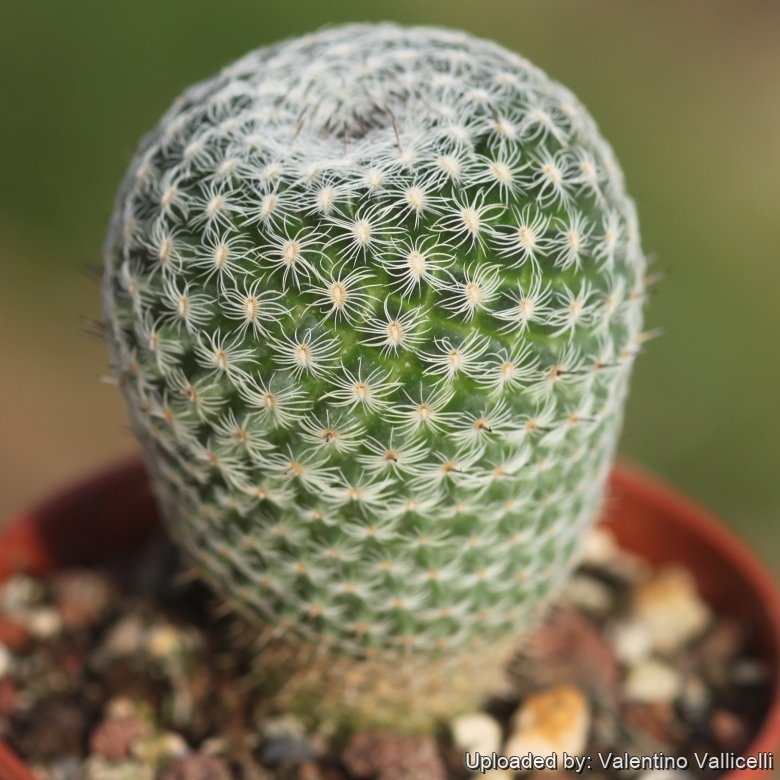
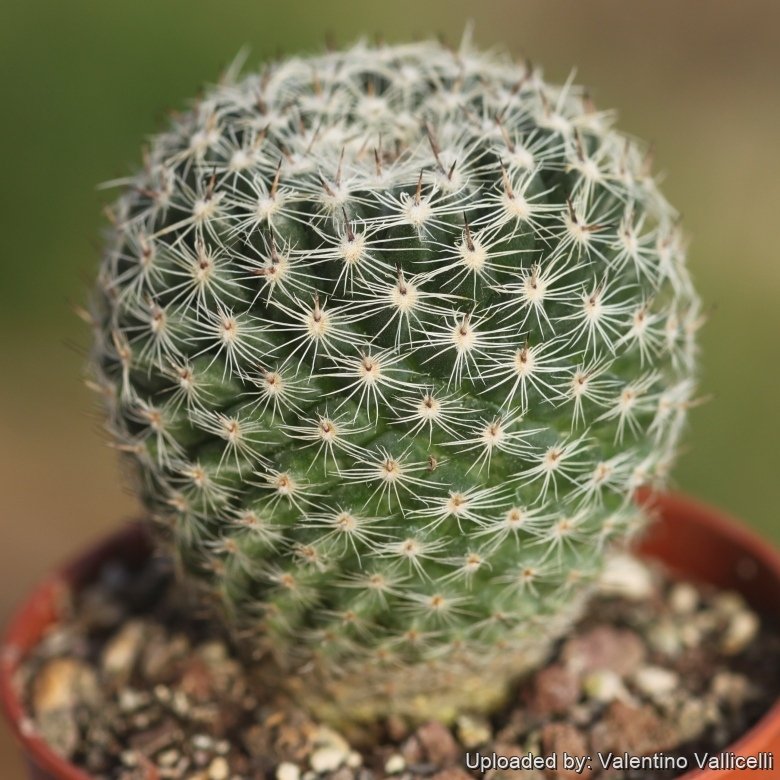
Mammillaria klissingiana is a clumping cactus with snow-coloured spines that completely mask the body. It is less common than other similar species such as the twin-spined Mammillaria geminispina, or the taller Mammillaria lanata, but it is equally deserving of recognition. It is notable for its symmetry and spine formation.
Roots: Has long fibrous roots.
Habit: Plants solitary, or later becoming branched, and forming large mounds up to 40 cm across. Each head is surrounded by a complete ring of star-like pink flowers. There are variations among plants from different origin.
Stems: Globularor somewhat elongate or short cylindrical in age, up to 16 cm high and 9 cm across, dull green, rounded apically.
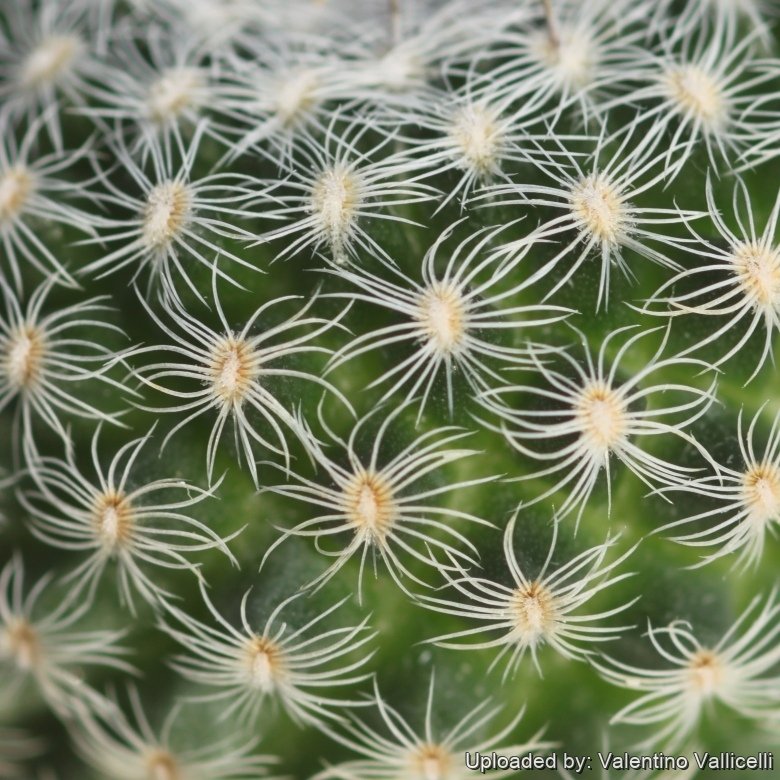
Tubercles: When young pyramidal, then rounded to conical, firm, axils with many white bristles to 10 mm long.
Sap: With latex.
Areoles: Circular, at first white-woolly, soon glabrate.
Central: Spines 2-4, awl-like, white with darker tips, to 2 mm long.
Radial spines: 30-35, spreading, straight, white, to 5 mm long.
Flowers: Funnelform, in a ring around the sides at the top of the stem, typically pink, small, up to 10 mm long and 8 mm in diameter.
Fruits: Borne in a circle near the middle of the plant, club shaped, 5-6 mm long.
Seeds: brown.
Origin and Habitat
Tamaulipas, Nuevo León and San Luis Potosí , Mexico.
Altitude: 630 to 2300 meters above sea level.
Habitat: Mammillaria klissingiana is a widespread and very common species that grows mostly on top of vertical limestone cliffs, in indirect sun and sometimes amongst rocks together with Astrophytum myriostigma, Thelocactus tulensis, Gymnocactus viereckii, Mammillaria candida, Mammillaria picta, Mammillaria melaleuca, Coryphantha vaupeliana, Turbinicarpus pseudopectinatus, Echinocactus platyacanthus, Ferocactus echidne var. victoriensis, Ferocactus hamatacanthus var. sinuatus, Opuntia imbricata, Opuntia lindheimeri, Echinocereus blanckii, Agave lechuguilla and Obregonia denegrii often at the base of shrubs such as Larrea tridentata (creosote bush), Myrtillocactus geometrizans, Dasylirion longissimum, Sabal pumos, Nolina stricta and Dioon edule. It is however adaptable and appears to be tolerant of disturbance as it often grows along the roadsides especially in western Tamaulipas, and often re-establishes itself after road-widening activities. It is also observed on rocks in low deciduous forest.
Cultivation and Propagation
Mammillaria klissingiana is easy to cultivate and make interesting specimens for any collection, and over time (in 12-15 years) it will form large colonies up to 40 cm or more in diameter! It grows by producing offsets, and doesn’t require any special treatment, except for the need for frequent transplanting, in order to manage its exuberance.
Soil: Provide a well-drained soil mix.
Exposure: It needs as much light as possible without burning the plant, to keep the stems compact.
Watering: Water well and then allow to dry thoroughly before watering again during the growing season. It doesn’t like much, if any, winter water.
Hardiness: It can survive short exposures to freezing temperatures (-4° C.) if properly hardened off and kept dry.
Propagation: It is best propagated from seed. Seed readily germinates at 20°-22°C, or by offsets if available. The white wool between the areoles makes this species a pleasure to look at and grow, but the diversity among individual specimens is considerable and the best plants have abundant white axillary wool. Hence, it is worth raising a batch of seedlings and selecting one or two that have the most wool.
Bibliography
Major references and further lectures
-
David Hunt, Nigel Taylor “The New Cactus Lexicon” DH Books, 2006
-
John Pilbeam (1999) “Mammillaria The Cactus File Handbook” Nuffield Press.
-
Nathaniel Lord Britton, Joseph Nelson Rose “Cactaceae: Descriptions and Illustrations of Plants of the Cactus Family” vol. 4 The Carnegie Institution of Washington, Washington 1923
-
Stuart Max Walters “The European Garden Flora: Dicotyledons (Part I)” Cambridge University Press, 1989
-
Edward F. Anderson “The Cactus Family” Timber Press, 2001
-
Hans Hecht “Cacti & succulents” Sterling Pub. Co., 1997
-
William Taylor Marshall, Thor Methven Bock, Nathaniel Lord Britton “Cactaceae, with illustrated keys of all tribes, sub-tribes and genera” Theophrastus Publishers, 1941
-
Scott Calhoun “The Gardener’s Guide to Cactus: The 100 Best Paddles, Barrels, Columns, and Globes” Timber Press, 31/gen/2012
-
“The Greenhouse: A Quarterly Review for All Gardeners”Volume 8 P. Langfield & Company, 1963
-
Fitz Maurice, B, Fitz Maurice, W.A., Hernández, H.M., Sotomayor, M. & Smith, M. 2013. Mammillaria klissingiana. In: IUCN 2013. “IUCN Red List of Threatened Species.” Version 2013.2. <www.iucnredlist.org>. Downloaded on 30 December 2013.
From llifle page Mammillaria brauneana
Description
Mammillaria brauneana is a local or morphological form of Mammillaria klissingiana with white-woolled, bristled axils, violet blossoms, and carmine-red fruit. It is distinguished from Mammillaria klissingiana by the smaller body, less of radial spines, another central spines colouration and darker flower colour. Although Mammillaria brauneana lacks the obvious eye-catching attributes of the related and better known Mammillaria hahniana it is, nevertheless, notable for its symmetry and spine formation.
Habit: Plants solitary to sometimes branching at the base and forming large mounds up to 40 cm across.
Roots: Fibrous.
Stems: Flattened globose to globose, to 12 cm in diameter and 8 cm high, dull green, apex depressed, somewhat woolly and spiny. With latex.
and 9 cm in diameter.
Tubercles: Firm, short and broad pyramidal, 3-4 mm at base.
Axil: With wool and bristles.
Central: Spines 2-4, awl-like, straight, thicker at base, reddish brown with black tip, 5-7 mm long.
Radial spines: 25-30, horizontal radiating, white, bristle like, straight, the uppermost somewhat shorter, to 5 mm long.
Flowers: Reddish violet, purplish-red or deep pink, to 13 mm long and across.
Flowering period: Spring (April-May in Europe)
Fruits: Club shaped, carmine, 5-6 mm long.
Seeds: Yellowish to brown, pear-shaped, 1 mm long and in diameter.
Origin and Habitat
Mexico, Tamaulipas near Jaumave; San Luis Potosi near Cerritos.
Altitude: 1100-2300 meters above sea level.
Habitat: Mammillaria brauneana is a widespread species that grows mostly on forest mountains between limestone rocks filled with humus, in indirect sun together with Coryphantha villarensis, Ferocactus rafaelensis, Agave stricta, Agave deweyana often at the base of shrubs such as Larrea tridentata (creosote bush).
Cultivation and Propagation
Mammillaria brauneana is easy to cultivate and make interesting specimens for any collection, and over time (in 12-15 years) it will form large colonies up to 40 cm or more in diameter! It grows by producing offsets, and doesn’t require any special treatment, except for the need for frequent transplanting, in order to manage its exuberance.
Soil: Provide a well-drained soil mix.
Exposure: It needs as much light as possible without burning the plant, to keep the stems compact.
Watering: Water well and then allow to dry thoroughly before watering again during the growing season. It doesn’t like much, if any, winter water.
Hardiness: It can survive short exposures to freezing temperatures (-4° C.) if properly hardened off and kept dry.
Propagation: It is best propagated from seed. Seed readily germinates at 20°-22°C, or by offsets if available. The white wool between the areoles makes this species a pleasure to look at and grow, but the diversity among individual specimens is considerable and the best plants have abundant white axillary wool. Hence, it is worth raising a batch of seedlings and selecting one or two that have the most wool.
Bibliography
Major references and further lectures
-
David Hunt, Nigel Taylor “The New Cactus Lexicon” DH Books, 2006
-
John Pilbeam (1999) “Mammillaria The Cactus File Handbook” Nuffield Press.
-
Nathaniel Lord Britton, Joseph Nelson Rose “Cactaceae: Descriptions and Illustrations of Plants of the Cactus Family” vol. 4 The Carnegie Institution of Washington, Washington 1923
-
Stuart Max Walters “The European Garden Flora: Dicotyledons (Part I)” Cambridge University Press, 1989
-
Edward F. Anderson “The Cactus Family” Timber Press, 2001
-
Hans Hecht “Cacti & succulents” Sterling Pub. Co., 1997
-
William Taylor Marshall, Thor Methven Bock, Nathaniel Lord Britton “Cactaceae, with illustrated keys of all tribes, sub-tribes and genera” Theophrastus Publishers, 1941
-
Scott Calhoun “The Gardener’s Guide to Cactus: The 100 Best Paddles, Barrels, Columns, and Globes” Timber Press, 31/gen/2012
-
“The Greenhouse: A Quarterly Review for All Gardeners” Volume 8 P. Langfield & Company, 1963
-
Fitz Maurice, B, Fitz Maurice, W.A., Hernández, H.M., Sotomayor, M. & Smith, M. 2013. Mammillaria klissingiana. In: IUCN 2013. “IUCN Red List of Threatened Species.” Version 2013.2. <www.iucnredlist.org>. Downloaded on 30 December 2013.
-
Arbeitskreis für Mammillarienfreunde e.V. jahrgang 14 5/90 183 - 194.
Source: Mammillaria brauneana, LLIFLE - Encyclopedia of living forms, CC-BY-SA, retrieved 2026-10-25.