Publication: Philos. Mag. Ann. Chem. [ Till. ] lxiii. (1824) 14
Description
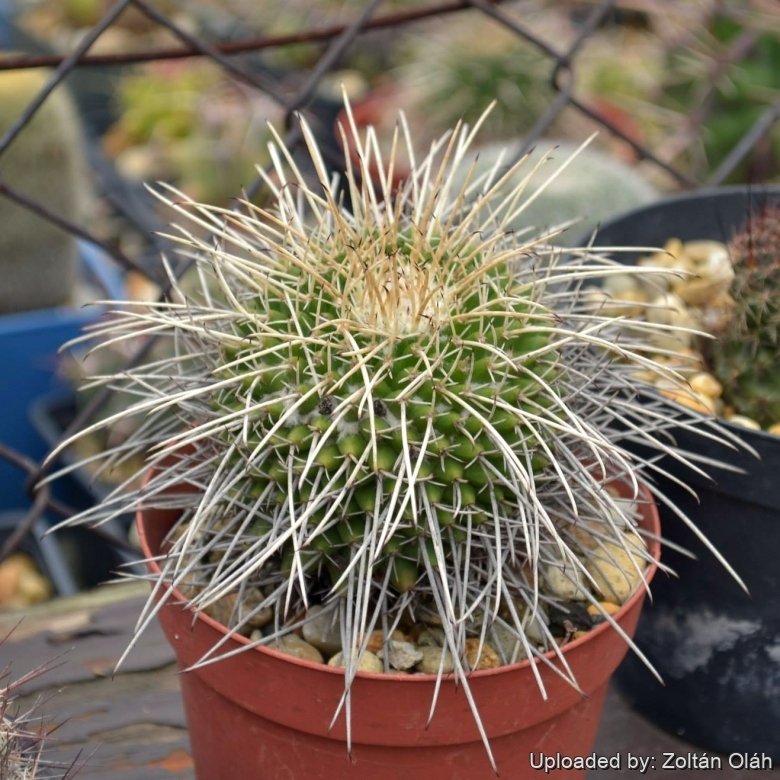
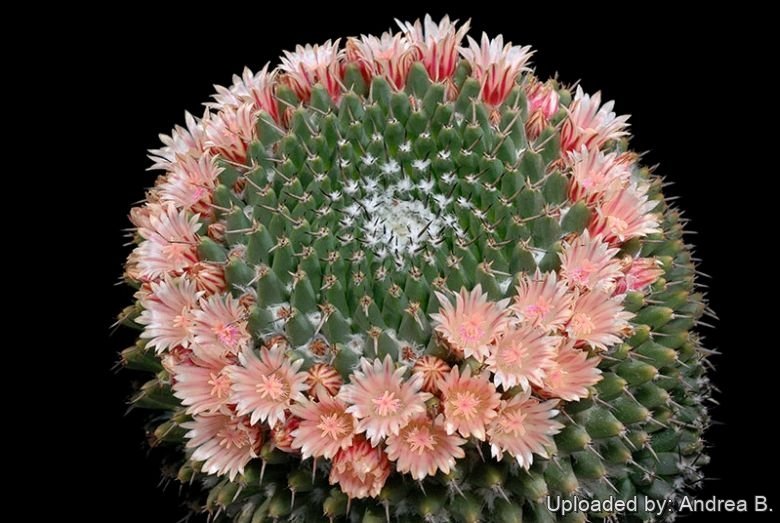
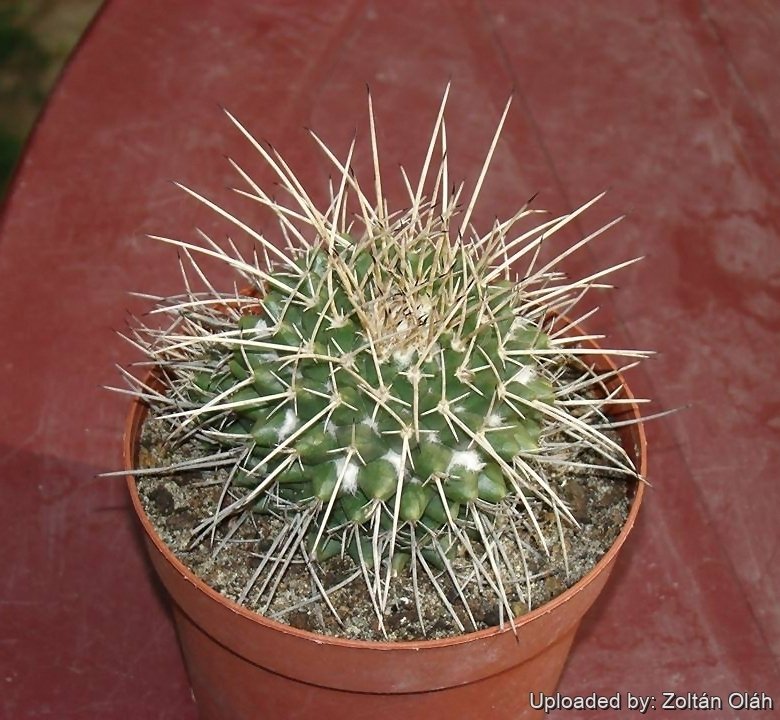
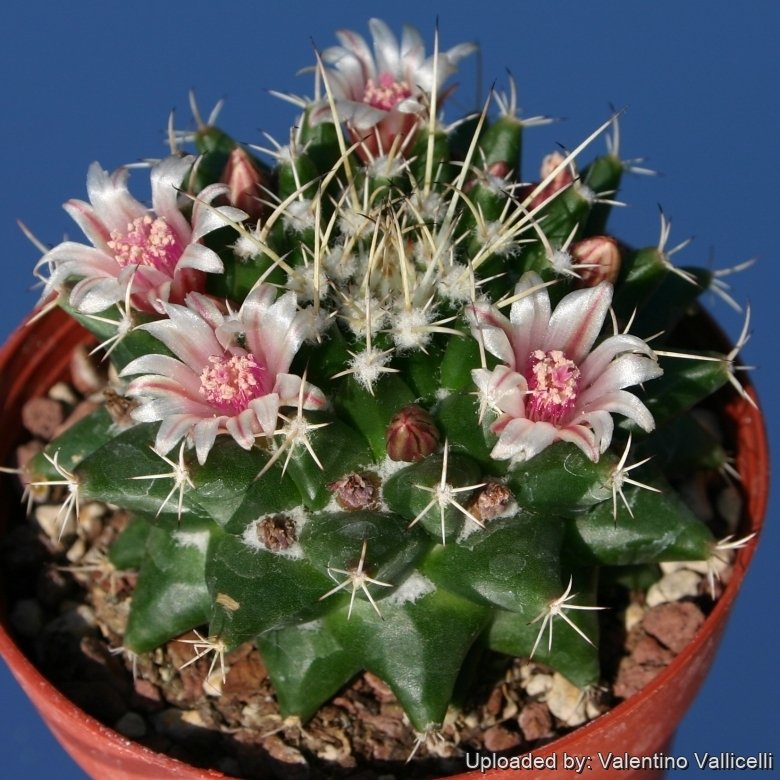
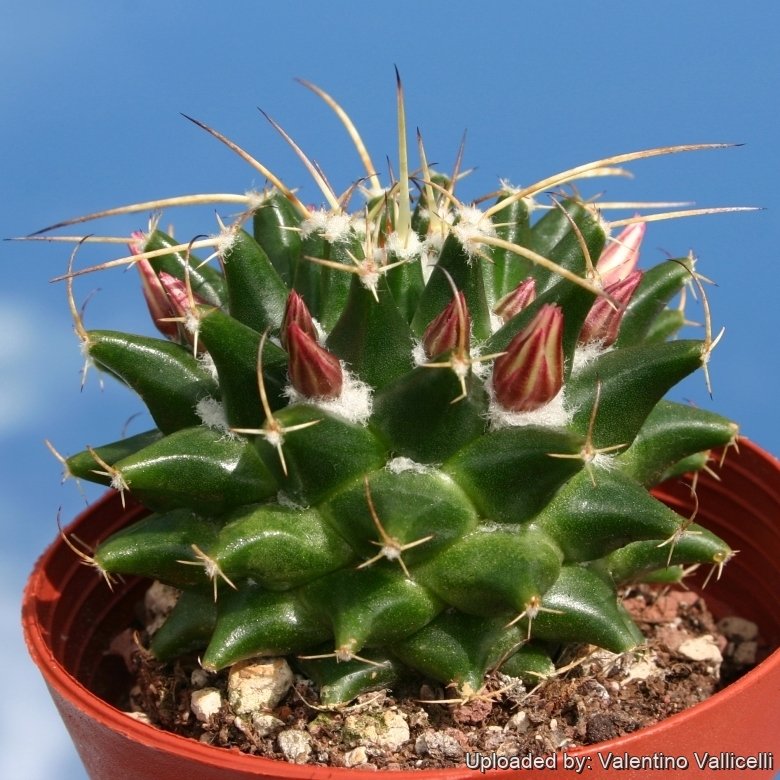
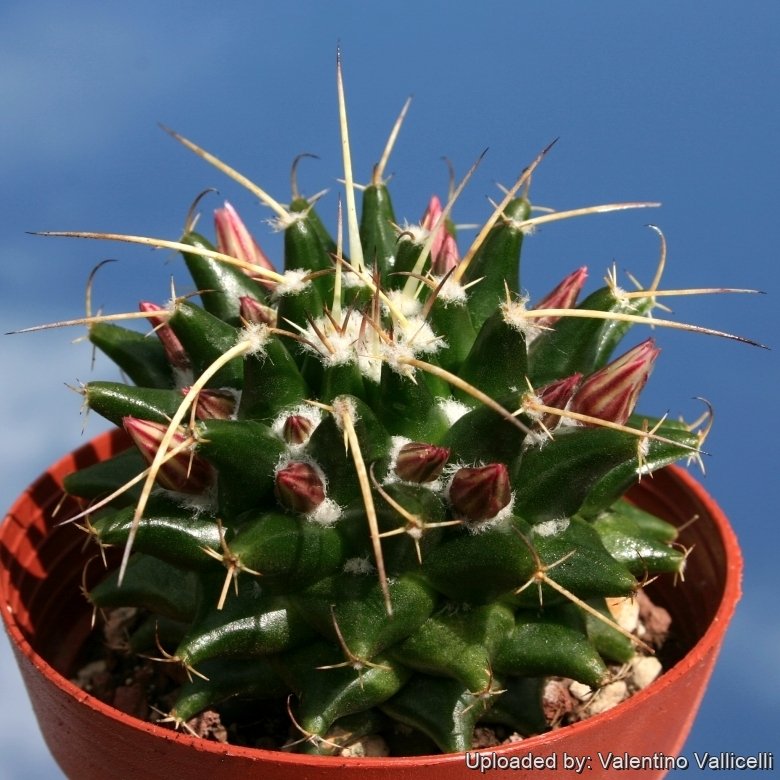
Mammillaria magnimamma is a perennial stem succulent solitary at first, later branching basally (or dichotomously) to form large mounds up to 50 cm in diameter (or more) barely rising above ground level. This species is very variable and has received many names. In particular the spines are of variable shape and length, occasionally they are very long (up to 5 cm long).
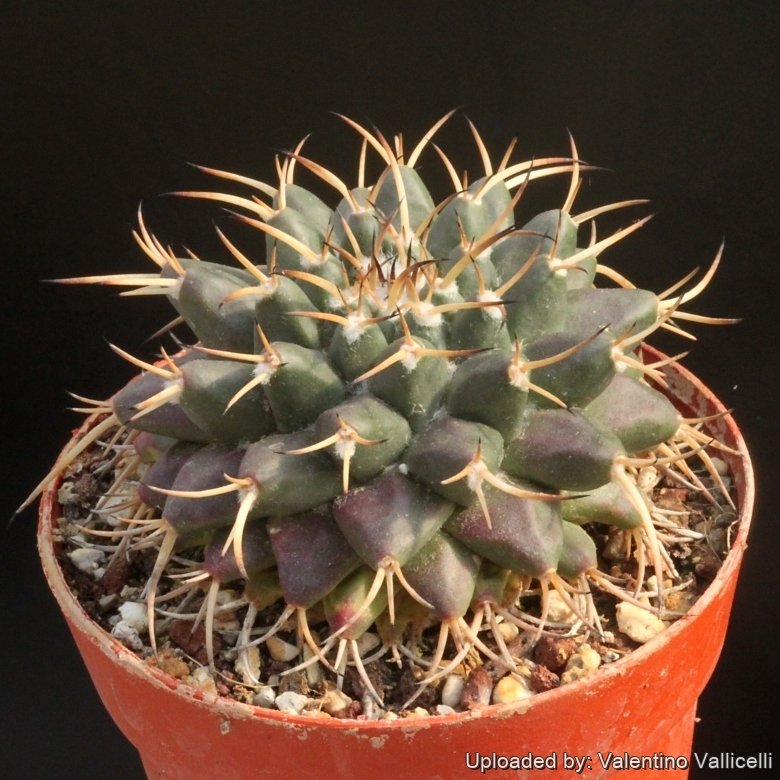
Stems: Flattened globose to globose, grey-green to dark blue-green, 10-13 cm in diameter and up to 30 cm tall.
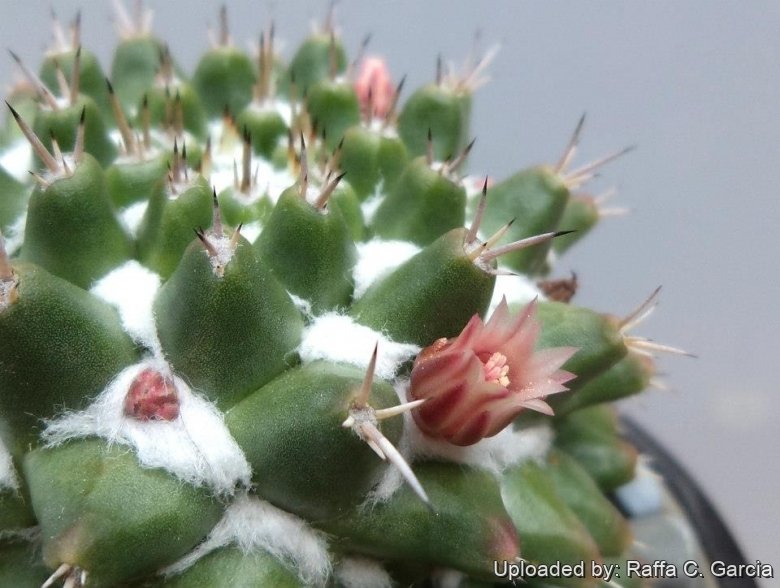
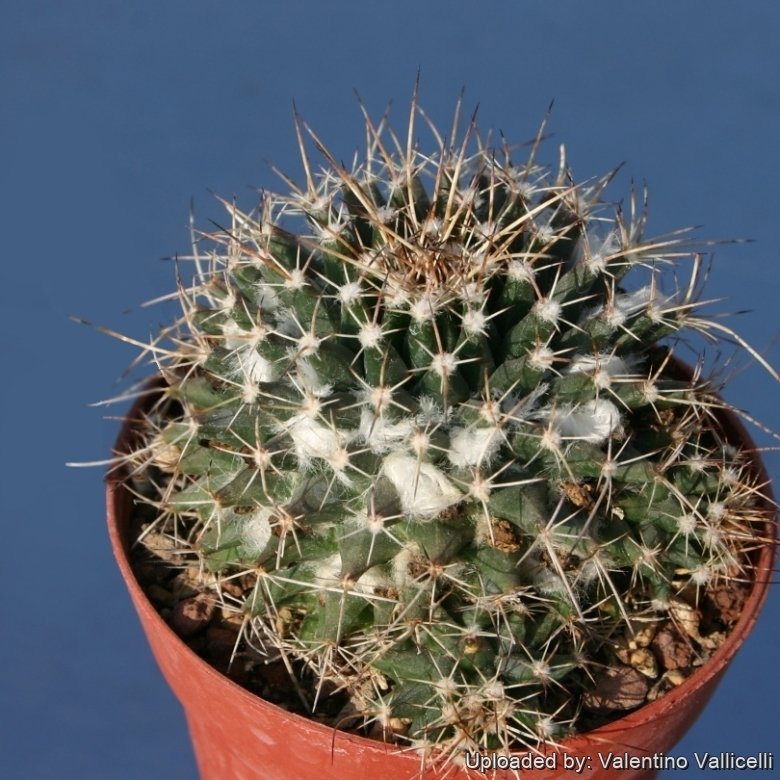
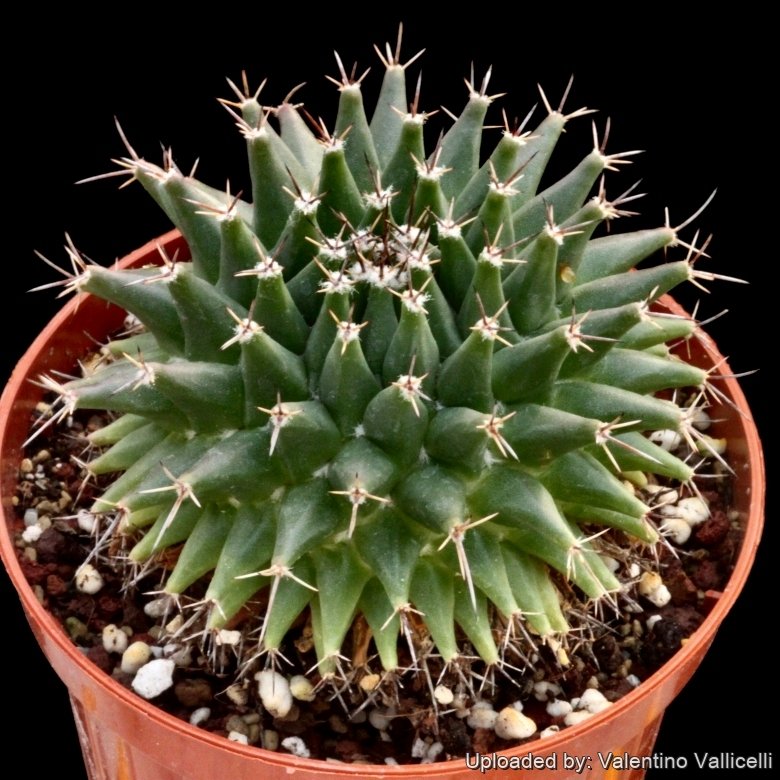
Tubercles: Conic-pyramidal as long or longer than broad, about 10 mm tall, firm, four-sided but not sharply angled, with latex, flowering axils with dense white wool, especially when young.
Central: Spines usually absent.
Radial: (1-)2-5(-6), sometimes more, extremely variable, unequal, awl shaped, whitish to yellowish, with dark tips, 3-45 mm long, lower one longer up to 5 cm long, stronger than the others and more or less curving downward.
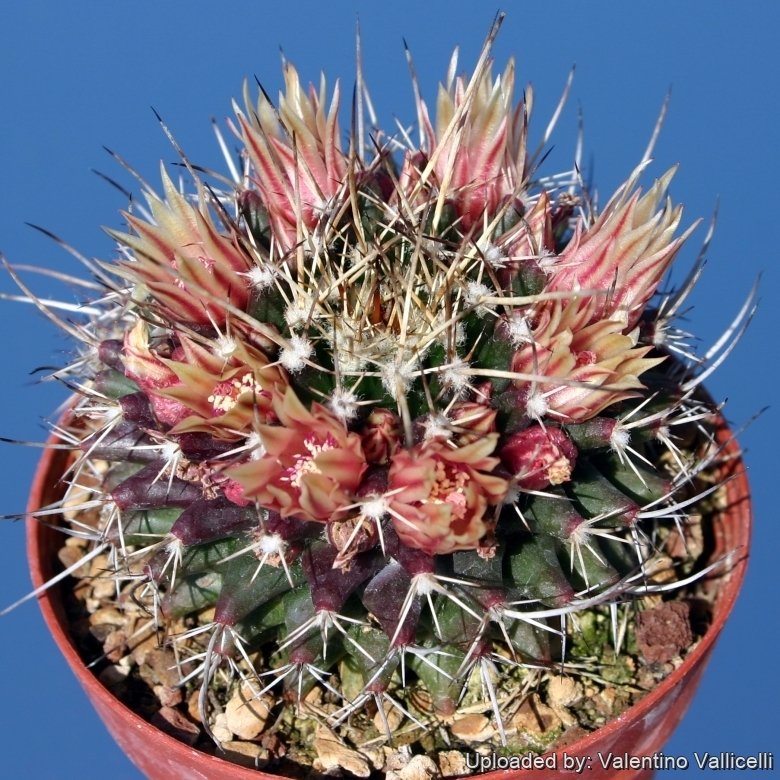
Flowers: Dirty white, creamy-yellow or tinged brown with reddish midveins, to deep purplish pink, 20-25 mm wide and long and in diameter.
Blooming season: Mid spring.
Fruits: Club shaped, dark purplish red, to 20 mm long, sticking straight out from the stem.
Seeds: Small brown.
Origin and Habitat
This species is widespread throughout central Mexico in Hidalgo, Guerrero, Jalisco, México State, Aguascalientes, Tlaxcala, Veracruz, Zacatecas, Queretaro, Guanajuato, Hidalgo, Tamaulipas, Nuevo Leon, Puebla, San Luis Potosi, and México Federal District. Populations of this species are relatively numerous and abundant.
Altitude: 100-2,700 metres above sea level.
Habitat and ecology: It grows in dry rocky places in the open or (mainly) in xerophyllous vegetation. Despite the great abundance and diversity of cacti in Mexico, Mammillaria magnimamma is one of the few cacti species that has colonized barren lava fields. In parts of its range the species is threatened by local extraction for ornamental plant trade and by the expansion of urbanized areas.
Cultivation and Propagation
Mammillaria magnimamma is easy to cultivate, and makes an interesting specimens. Over time it will produce large clumps. It grows by producing offsets, and also by dichotomously dividing and doesn’t require any special treatment, but needs as much light as possible without burning the plant, to keep the stems compact. During the summer it is best to keep the plants outside where the temperature can rise to over 30° C with no harm to the plant, recommended for any collection that needs lots of light with ample airflow.
Growth rate: It is a small growing, but easily flowering species. It takes several years to offset, but once it starts it can fill a 40 cm pot in a few years given the best conditions.
Soils: Use a an open and free draining mineral compost with little organic matter (peat, humus) that allows therefore roots to breath (as it is rot prone).
Repotting: Repotting every 2-3 years. As it is especially prone to rot under-pot in a smaller container filled with very porous compost. Use shallow pot with good drainage.
Watering: It likes a winter’s rest and should be kept almost completely dry during the winter months, If the soil is allowed to be dry for too long root loss could follow but equally the same result would occur if the plants are both wet and cold. From March onwards the plant will begin to grow and watering should be increased gradually until late May when the plant should be in full growth. Water regularly during the summer so long as the plant pot is allowed to drain and not sit in a tray of water. During hot weather you may need to water the plants more frequently so long as the plant is actively growing. From late September watering should be reduced to force the plant to go in to a state of semi dormancy, by October you should be back in to the winter watering regime. Keep dry with ample airflow in winter. In the rest period no high atmospheric humidity!! Care must be taken with watering as they tends to become swollen and untidy in growth habit if given too much water and shade.
Fertilization: Feeding may not be necessary at all if the compost is fresh then, feed in summer only if the plant hasn’t been repotted recently. Do not feed the plants from September onwards as this can cause lush growth which can be fatal during the darker cold months. .
Hardiness: Grown specimens resist to -4°C for a short time, but it is best to keep above 5° C to avoid ugly spots on the plant epidermis. Some warmth throughout the year will increase the grower’s success.
Exposition: Need full sun avoiding only the harshest summer sun, if kept too dark they may become overly lush and greener and could be prone to rotting due to over watering. Tends to bronze in strong light, which encourages flowering and heavy wool and spine production.
Uses: It is an excellent plant for container growing. It look fine in a cold greenhouse and frame.
Pests & diseases: It may be attractive to a variety of insects, but plants in good condition should be nearly pest-free, particularly if they are grown in a mineral potting-mix, with good exposure and ventilation. Nonetheless, there are several pests to watch for:
- Red spiders: Sensitive to red spider mite. Overhead watering is helpful in controlling mites.
- Mealy bugs: Occasionally mealy bugs they develop aerial into the new growth among the wool with disfiguring results, but the worst types develop underground on the roots and are invisible except by their effects.
- Scales: Scales are rarely a problem.
- Rot: Rot it is only a minor problem with cacti if the plants are watered and “aired” correctly. If they are not, fungicides won’t help all that much.
Propagation: Direct sow after last frost or cuttings. Seeds germinate in 7-14 days at 21-27° C in spring, remove the glass cover gradually as the plants develops and keep ventilated, no full sun for young plants! The seedlings should not be disturbed until they are well rooted, after which they can be planted separately in small pots. Cuttings: wait until the offsets that appear at the base of old clustered specimens are 1/3 the size of the parent and then detach and plant. Cuttings will take root in a minimum temperature of 20° C (but better in hot weather). Cuttings of healthy shoots can be taken in the spring and summer. Cut the stem with a sharp, sterile knife, leave the cutting in a warm, dry place for a week or weeks (depending on how thick the cutting is) until a callus forms over the wound. Once the callus forms, the cutting may be inserted in a container filled with firmed cactus potting mix topped with a surface layer of coarse grit. They should be placed in the coarse grit only; this prevents the cut end from becoming too wet and allows the roots to penetrate the rich compost underneath. The cuttings should root in 2 to 6 weeks.
Bibliography
Major references and further lectures
-
Robert T. Craig “The Mammillaria handbook: with descriptions, illustrations, and key to the species of the genus Mammillaria of the Cactaceae” E P Publishing, 1945
-
John Pilbeam “Mammillaria” Cirio Pub. Services, 01/December/1999
-
Cullmann W. Götz E. Gröner G “Kakteen.” Eugen Ulmer Verlag. Stuttgart. 1984
-
Alfred Byrd Graf “Exotica, series 4 international: pictorial cyclopedia of exotic plants from tropical and near-tropic regions” Roehrs Co. Publishers, 1982
-
Arthur Gibson, Park Nobel “The cactus primer” Harvard University Press, 01/October/1990
-
Edward Anderson “The Cactus family” Timber Press, Incorporated, 2001
-
James Cullen, Sabina G. Knees, H. Suzanne Cubey “The European Garden Flora Flowering Plants: A Manual for the Identification of Plants Cultivated in Europe, Both Out-of-Doors and Under Glass” Cambridge University Press, 11/Aug/2011
-
David R Hunt; Nigel P Taylor; Graham Charles; International Cactaceae Systematics Group. “The New Cactus Lexicon” dh books, 2006
-
N. L. Britton, J. N. Rose “The Cactaceae. Descriptions and Illustrations of Plants of the Cactus Family.” Volume 4, The Carnegie Institution of Washington, Washington 1923, page. 41
-
Curt Backeberg: “Die Cactaceae: Handbuch der Kakteenkunde” Volume V, Gustav Fischer Verlag, Stuttgart New York 1982–1985, page. 3131f.
-
Curt Backeberg, Frederik Marcus Knuth: “Kaktus-ABC: En haandbog for fagfolk og amatører.” Kopenhagen 1936, page. 400.
-
Ulises Guzmán, Salvador Arias, Patricia Dávila: “Catálogo de cactáceas mexicanas.” Universidad Nacional Autónoma de México, Mexiko-Stadt 2003
-
“Descriptions of some new Cacti and Mammillariae, recently brought from Mexico by Mr. Bullock of the Egyptian Hall, Piccadilly; and now preserved, with many other very rare Plants in the Nursery of Mr. Tate, in Sloanestreet.” In: Philosophical Magazine. Volume 63, 1824, page. 41
-
Cházaro, M., Hernández, H.M., Gómez-Hinostrosa, C., Guadalupe Martínez, J. & Sánchez , E. 2013. Mammillaria magnimamma. The IUCN Red List of Threatened Species. Version 2014.3. <www.iucnredlist.org>. Downloaded on 01 February 2015.
From llifle page Mammillaria saxicola
Description
Mammillaria saxicola is one of the controversial forms of the very variable Mammillaria magnimamma. It distinguishes from the standard species for the olive green body, whitish flower, more radial spines and the presence of central spines. However it look very similar to other varieties of Mammillaria magnimamma which are linked one to each others by populations of plants with intermediate characteristics. Nowadays all them are thought to belong to a unique polymorphic species. Such variations has led to establishment of several unnecessary names for this species.
Habit: Mammillaria saxicola is a perennial stem succulent solitary at first, later branching basally (or dichotomously) to form large mounds up to 50 cm in diameter (or more) barely rising above ground level.
Roots: Fibrous.
Stems: Flattened globose, globose or cylindrical, olive-green, 5-8 cm in diameter and 4-10 cm tall. The apex sunken and covered with spines
Tubercles: Conic-pyramidal as long or longer than broad, 9-12 mm long and 5-7 mm wide with rounded tip, olive green or reddish, with latex, flowering axils with little white wool, especially when young.
Central: 1-2, needle like, the lowest the longest, straight or curving, 7 - 40 mm long, glassy yellow or brown with long dark tip.
Radial: 6-8, sometimes more, glassy yellow with brown tip, 2 - 5 mm long, stiff bristle like, unequal, the uppermost the shortest, radiating.
Flowers: Bell-shaped, whitish or pale pink with indistinct brownish pink midstripe, 20-22 mm wide and long and in diameter. Self sterile.
Fruits: Club shaped, red, 10-20 mm long, and 5 - 7 mm wide, sticking straight out from the stem.
Seeds: Brown. oblong, 1 mm long and 0,8 mm wide. Hilum subbasal.
Phenology: It flowers in id spring. Fruits ripen 10 months after flowering.
Origin and Habitat
Mexico, Queretaro and the border of San Luis Potosi, near Arroyo Seco.
Altitude: 700-1000 metres above sea level.
Habitat: It grows on pockets filled with black humus in reddish lava rocks along with Mammillaria priessnitzii and Ferocactus echidne. The climate is warm, humid without great changes in temperature.
Bibliography
Major references and further lectures
-
Pilbeam J., “The Cactus file, Mammillaria” 6: 120, Cirio Pub. Services, 01/Dec/1999
-
Reppenhagen, “Die Gattung Mammillaria: volume 2” 1987
-
James Cullen, Sabina G. Knees, H. Suzanne Cubey “The European Garden Flora Flowering Plants: A Manual for the Identification of Plants Cultivated in Europe, Both Out-of-Doors and Under Glass” Cambridge University Press, 11/Aug/2011
-
David R Hunt; Nigel P Taylor; Graham Charles; International Cactaceae Systematics Group. “The New Cactus Lexicon” dh books, 2006
-
Lüthy JM, “Taxonomische Untersuchung der Gattung Mammillaria Haw.” 1995
-
Edward Anderson “The Cactus family” Timber Press, Incorporated, 2001
Source: Mammillaria saxicola, LLIFLE - Encyclopedia of living forms, CC-BY-SA, retrieved 2026-10-25.
From llifle page Mammillaria vagaspina
Description
Mammillaria vagaspina is a low growing globular plant at first solitary, later branching basally (or dichotomously) to form large mounds up to 50 cm in diameter (or more) barely rising above ground level. It has distinguishing long angular tubercles set with short stiff radial spines and curving long straw-white central spines. It will reward the skilled growers with ring of light pink flowers circling the crown of the plant. Mammillaria vagaspina is at most a race of Mammillaria magnimamma. The key difference by which the two were separated, namely the presence of central spines in M. vagaspina, seems entirely spurious, but plants from the central plateau region do differ in various respects from that on the stony ground of Mexico City.
Stems: Simple (or clustering), globose to pumpkin-shaped, 8.5-12 cm in diameter green or greyish blue., with dense white wool especially when young. Axils toward apex filled with white wool.
Tubercles: Pyramidal, more or less four angled and keeled, up to 13 mm long (or longer), 8-11 mm thick at base, dull dark greyish green. Axils toward apex filled with white wool.
Central spines: 2, very irregular, 6-60mm long, divergent, lower longer, very tortuous, somewhat angled, chalky brown to yellowish with dark tips.
Radial spines: 2-5, extremely variable, uneven, 1-10 mm long, acicular, the upper 2 usually deciduous, chalky brownish white, lower one directed downward and longer.
Flowers: c.10 mm in diameter, pink.
Fruits (berries): Curved clavate, 11 mm long, 4 mm in diameter, red.
Origin and Habitat
Central Mexico (states of Hidalgo, Guerrero, Mexico, Aguascalientes, Zacatecas, Queretaro, Guanajuato, Tapaulimas, Nuevo Leon and San Luis Potosi).
Altitude range: 1300-2500 metres above sea level.
Habitat and ecology: Accompanying cactus and succulent species can be Ferocactus latispinus, Myrtillocactus geometrizans, Echinocactus platyacanthus, Ferocactus histrix, Echinocereus pectinatus, Opuntia microdasys, Thelocactus hexaedrophorus, Stenocereus dumortieri, Coryphantha radians, Neolloydia conoidea, Glandulicactus crassihamtaus, Thelocactus bicolor, Agave lechuguilla and Yucca filifera.
Cultivation and Propagation
Mammillaria vagaspina is easy to cultivate, and makes an interesting specimens. Over time it will produce large clumps. It grows by producing offsets, and also by dichotomously dividing and doesn’t require any special treatment, but needs as much light as possible without burning the plant, to keep the stems compact. During the summer it is best to keep the plants outside where the temperature can rise to over 30° C with no harm to the plant, recommended for any collection that needs lots of light with ample airflow.
Growth rate: It is a small growing, but easily flowering species. It takes several years to offset, but once it starts it can fill a 40 cm pot in a few years given the best conditions.
Soils: Use a an open and free draining mineral compost with little organic matter (peat, humus) that allows therefore roots to breath (as it is rot prone).
Repotting: Repotting every 2-3 years. As it is especially prone to rot under-pot in a smaller container filled with very porous compost. Use shallow pot with good drainage.
Watering: It likes a winter’s rest and should be kept almost completely dry during the winter months, If the soil is allowed to be dry for too long root loss could follow but equally the same result would occur if the plants are both wet and cold. From March onwards the plant will begin to grow and watering should be increased gradually until late May when the plant should be in full growth. Water regularly during the summer so long as the plant pot is allowed to drain and not sit in a tray of water. During hot weather you may need to water the plants more frequently so long as the plant is actively growing. From late September watering should be reduced to force the plant to go in to a state of semi dormancy, by October you should be back in to the winter watering regime. Keep dry with ample airflow in winter. In the rest period no high atmospheric humidity!! Care must be taken with watering as they tends to become swollen and untidy in growth habit if given too much water and shade.
Fertilization: Feeding may not be necessary at all if the compost is fresh then, feed in summer only if the plant hasn’t been repotted recently. Do not feed the plants from September onwards as this can cause lush growth which can be fatal during the darker cold months. .
Hardiness: Grown specimens resist to -4°C for a short time, but it is best to keep above 5° C to avoid ugly spots on the plant epidermis. Some warmth throughout the year will increase the grower’s success.
Exposition: Need full sun avoiding only the harshest summer sun, if kept too dark they may become overly lush and greener and could be prone to rotting due to over watering. Tends to bronze in strong light, which encourages flowering and heavy wool and spine production.
Uses: It is an excellent plant for container growing. It look fine in a cold greenhouse and frame.
Pests & diseases: It may be attractive to a variety of insects, but plants in good condition should be nearly pest-free, particularly if they are grown in a mineral potting-mix, with good exposure and ventilation. Nonetheless, there are several pests to watch for:
- Red spiders: Sensitive to red spider mite. Overhead watering is helpful in controlling mites.
- Mealy bugs: Occasionally mealy bugs they develop aerial into the new growth among the wool with disfiguring results, but the worst types develop underground on the roots and are invisible except by their effects.
- Scales: Scales are rarely a problem.
- Rot: Rot it is only a minor problem with cacti if the plants are watered and “aired” correctly. If they are not, fungicides won’t help all that much.
Propagation: Direct sow after last frost or cuttings. Seeds germinate in 7-14 days at 21-27° C in spring, remove the glass cover gradually as the plants develops and keep ventilated, no full sun for young plants! The seedlings should not be disturbed until they are well rooted, after which they can be planted separately in small pots. Cuttings: wait until the offsets that appear at the base of old clustered specimens are 1/3 the size of the parent and then detach and plant. Cuttings will take root in a minimum temperature of 20° C (but better in hot weather). Cuttings of healthy shoots can be taken in the spring and summer. Cut the stem with a sharp, sterile knife, leave the cutting in a warm, dry place for a week or weeks (depending on how thick the cutting is) until a callus forms over the wound. Once the callus forms, the cutting may be inserted in a container filled with firmed cactus potting mix topped with a surface layer of coarse grit. They should be placed in the coarse grit only; this prevents the cut end from becoming too wet and allows the roots to penetrate the rich compost underneath. The cuttings should root in 2 to 6 weeks.
Bibliography
Major references and further lectures
-
Alfred Byrd Graf “Exotica, series 4 international: pictorial cyclopedia of exotic plants from tropical and near-tropic regions” Roehrs Co. Publishers, 1982
-
“Bradleya: Yearbook of the British Cactus and Succulent Society”, Volumi 5-6, page 33, The Society, 1987
Source: Mammillaria vagaspina, LLIFLE - Encyclopedia of living forms, CC-BY-SA, retrieved 2026-10-25.
From llifle page Mammillaria vallensis
Description
Mammillaria vallensis is one of the controversial forms of the very variable Mammillaria magnimamma. However it look similar to other varieties of Mammillaria magnimamma which are linked one to each others by populations of plants with intermediate characteristics. Nowadays all them are thought to belong to a unique polymorphic species. Such variations has led to establishment of several unnecessary names for this species.
Origin and Habitat
Abra Valles, San Luis Potosí, Mexico
Altitude: Around 100 meters above sea level.
Habitat: It grows along with Hylocereus napoleonis.
Cultivation and Propagation
Mammillaria vallensis is easy to cultivate, and makes an interesting specimens. Over time it will produce large clumps. It grows by producing offsets, and also by dichotomously dividing and doesn’t require any special treatment, but needs as much light as possible without burning the plant, to keep the stems compact. During the summer it is best to keep the plants outside where the temperature can rise to over 30° C with no harm to the plant, recommended for any collection that needs lots of light with ample airflow.
Growth rate: It is a small growing, but easily flowering species. It takes several years to offset, but once it starts it can fill a 40 cm pot in a few years given the best conditions.
Soils: Use a an open and free draining mineral compost with little organic matter (peat, humus) that allows therefore roots to breath (as it is rot prone).
Repotting: Repotting every 2-3 years. As it is especially prone to rot under-pot in a smaller container filled with very porous compost. Use shallow pot with good drainage.
Watering: It likes a winter’s rest and should be kept almost completely dry during the winter months, If the soil is allowed to be dry for too long root loss could follow but equally the same result would occur if the plants are both wet and cold. From March onwards the plant will begin to grow and watering should be increased gradually until late May when the plant should be in full growth. Water regularly during the summer so long as the plant pot is allowed to drain and not sit in a tray of water. During hot weather you may need to water the plants more frequently so long as the plant is actively growing. From late September watering should be reduced to force the plant to go in to a state of semi dormancy, by October you should be back in to the winter watering regime. Keep dry with ample airflow in winter. In the rest period no high atmospheric humidity!! Care must be taken with watering as they tends to become swollen and untidy in growth habit if given too much water and shade.
Fertilization: Feeding may not be necessary at all if the compost is fresh then, feed in summer only if the plant hasn’t been repotted recently. Do not feed the plants from September onwards as this can cause lush growth which can be fatal during the darker cold months. .
Hardiness: Grown specimens resist to -4°C for a short time, but it is best to keep above 5° C to avoid ugly spots on the plant epidermis. Some warmth throughout the year will increase the grower’s success.
Exposition: Need full sun avoiding only the harshest summer sun, if kept too dark they may become overly lush and greener and could be prone to rotting due to over watering. Tends to bronze in strong light, which encourages flowering and heavy wool and spine production.
Uses: It is an excellent plant for container growing. It look fine in a cold greenhouse and frame.
Pests & diseases: It may be attractive to a variety of insects, but plants in good condition should be nearly pest-free, particularly if they are grown in a mineral potting-mix, with good exposure and ventilation. Nonetheless, there are several pests to watch for:
- Red spiders: Sensitive to red spider mite. Overhead watering is helpful in controlling mites.
- Mealy bugs: Occasionally mealy bugs they develop aerial into the new growth among the wool with disfiguring results, but the worst types develop underground on the roots and are invisible except by their effects.
- Scales: Scales are rarely a problem.
- Rot: Rot it is only a minor problem with cacti if the plants are watered and “aired” correctly. If they are not, fungicides won’t help all that much.
Propagation: Direct sow after last frost or cuttings. Seeds germinate in 7-14 days at 21-27° C in spring, remove the glass cover gradually as the plants develops and keep ventilated, no full sun for young plants! The seedlings should not be disturbed until they are well rooted, after which they can be planted separately in small pots. Cuttings: wait until the offsets that appear at the base of old clustered specimens are 1/3 the size of the parent and then detach and plant. Cuttings will take root in a minimum temperature of 20° C (but better in hot weather). Cuttings of healthy shoots can be taken in the spring and summer. Cut the stem with a sharp, sterile knife, leave the cutting in a warm, dry place for a week or weeks (depending on how thick the cutting is) until a callus forms over the wound. Once the callus forms, the cutting may be inserted in a container filled with firmed cactus potting mix topped with a surface layer of coarse grit. They should be placed in the coarse grit only; this prevents the cut end from becoming too wet and allows the roots to penetrate the rich compost underneath. The cuttings should root in 2 to 6 weeks.
Source: Mammillaria vallensis, LLIFLE - Encyclopedia of living forms, CC-BY-SA, retrieved 2026-10-25.
From llifle page Mammillaria vallensis var. brevispina
Description
Mammillaria vallensis var. brevispina is one of the controversial forms of the very variable Mammillaria magnimamma. However it look similar to other varieties of Mammillaria magnimamma which are linked one to each others by populations of plants with intermediate characteristics. Nowadays all them are thought to belong to a unique polymorphic species. Such variations has led to establishment of several unnecessary names for this species.
Origin and Habitat
Abra Celaya, Antiguo Morelos to Ciudad Mante, Tamaulipas, Mexico
Altitude: Around 150 metres above sea level.
Habitat: It grows along with Hylocereus sp., Nolina recurvata and Neobuxbaumia euphorbioides.
Cultivation and Propagation
Mammillaria vallensis var. brevispina is easy to cultivate, and makes an interesting specimens. Over time it will produce large clumps. It grows by producing offsets, and also by dichotomously dividing and doesn’t require any special treatment, but needs as much light as possible without burning the plant, to keep the stems compact. During the summer it is best to keep the plants outside where the temperature can rise to over 30° C with no harm to the plant, recommended for any collection that needs lots of light with ample airflow.
Growth rate: It is a small growing, but easily flowering species. It takes several years to offset, but once it starts it can fill a 40 cm pot in a few years given the best conditions.
Soils: Use a an open and free draining mineral compost with little organic matter (peat, humus) that allows therefore roots to breath (as it is rot prone).
Repotting: Repotting every 2-3 years. As it is especially prone to rot under-pot in a smaller container filled with very porous compost. Use shallow pot with good drainage.
Watering: It likes a winter’s rest and should be kept almost completely dry during the winter months, If the soil is allowed to be dry for too long root loss could follow but equally the same result would occur if the plants are both wet and cold. From March onwards the plant will begin to grow and watering should be increased gradually until late May when the plant should be in full growth. Water regularly during the summer so long as the plant pot is allowed to drain and not sit in a tray of water. During hot weather you may need to water the plants more frequently so long as the plant is actively growing. From late September watering should be reduced to force the plant to go in to a state of semi dormancy, by October you should be back in to the winter watering regime. Keep dry with ample airflow in winter. In the rest period no high atmospheric humidity!! Care must be taken with watering as they tends to become swollen and untidy in growth habit if given too much water and shade.
Fertilization: Feeding may not be necessary at all if the compost is fresh then, feed in summer only if the plant hasn’t been repotted recently. Do not feed the plants from September onwards as this can cause lush growth which can be fatal during the darker cold months. .
Hardiness: Grown specimens resist to -4°C for a short time, but it is best to keep above 5° C to avoid ugly spots on the plant epidermis. Some warmth throughout the year will increase the grower’s success.
Exposition: Need full sun avoiding only the harshest summer sun, if kept too dark they may become overly lush and greener and could be prone to rotting due to over watering. Tends to bronze in strong light, which encourages flowering and heavy wool and spine production.
Uses: It is an excellent plant for container growing. It look fine in a cold greenhouse and frame.
Pests & diseases: It may be attractive to a variety of insects, but plants in good condition should be nearly pest-free, particularly if they are grown in a mineral potting-mix, with good exposure and ventilation. Nonetheless, there are several pests to watch for:
- Red spiders: Sensitive to red spider mite. Overhead watering is helpful in controlling mites.
- Mealy bugs: Occasionally mealy bugs they develop aerial into the new growth among the wool with disfiguring results, but the worst types develop underground on the roots and are invisible except by their effects.
- Scales: Scales are rarely a problem.
- Rot: Rot it is only a minor problem with cacti if the plants are watered and “aired” correctly. If they are not, fungicides won’t help all that much.
Propagation: Direct sow after last frost or cuttings. Seeds germinate in 7-14 days at 21-27° C in spring, remove the glass cover gradually as the plants develops and keep ventilated, no full sun for young plants! The seedlings should not be disturbed until they are well rooted, after which they can be planted separately in small pots. Cuttings: wait until the offsets that appear at the base of old clustered specimens are 1/3 the size of the parent and then detach and plant. Cuttings will take root in a minimum temperature of 20° C (but better in hot weather). Cuttings of healthy shoots can be taken in the spring and summer. Cut the stem with a sharp, sterile knife, leave the cutting in a warm, dry place for a week or weeks (depending on how thick the cutting is) until a callus forms over the wound. Once the callus forms, the cutting may be inserted in a container filled with firmed cactus potting mix topped with a surface layer of coarse grit. They should be placed in the coarse grit only; this prevents the cut end from becoming too wet and allows the roots to penetrate the rich compost underneath. The cuttings should root in 2 to 6 weeks.
Source: Mammillaria vallensis var. brevispina, LLIFLE - Encyclopedia of living forms, CC-BY-SA, retrieved 2026-10-25.
Gallery