Publication: Zoe 5: 31. 1900
Description
Small branched or (generally) unbranched in the wild. The branch (if present) are basal and not numerous, seldom rooting.
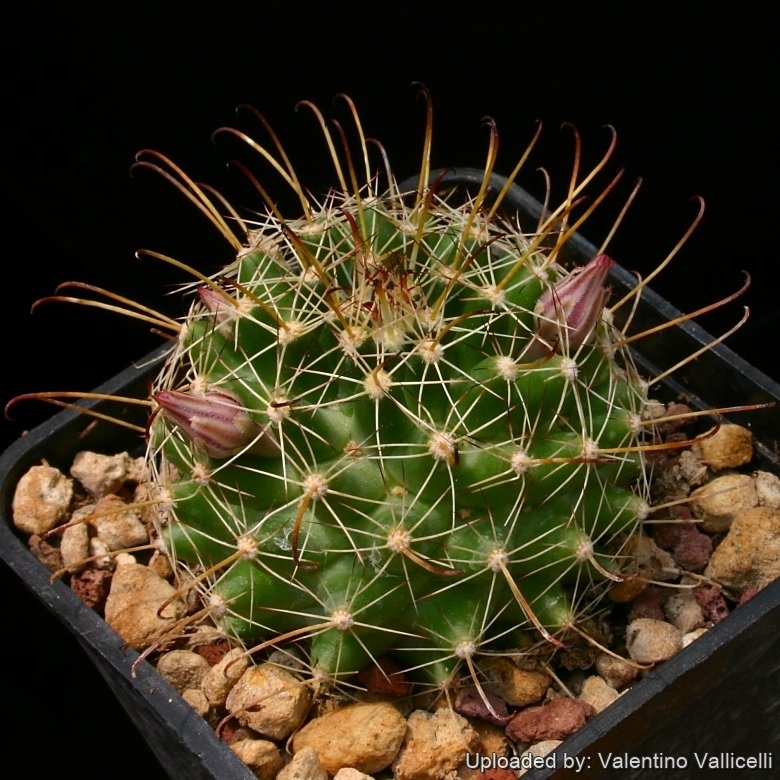
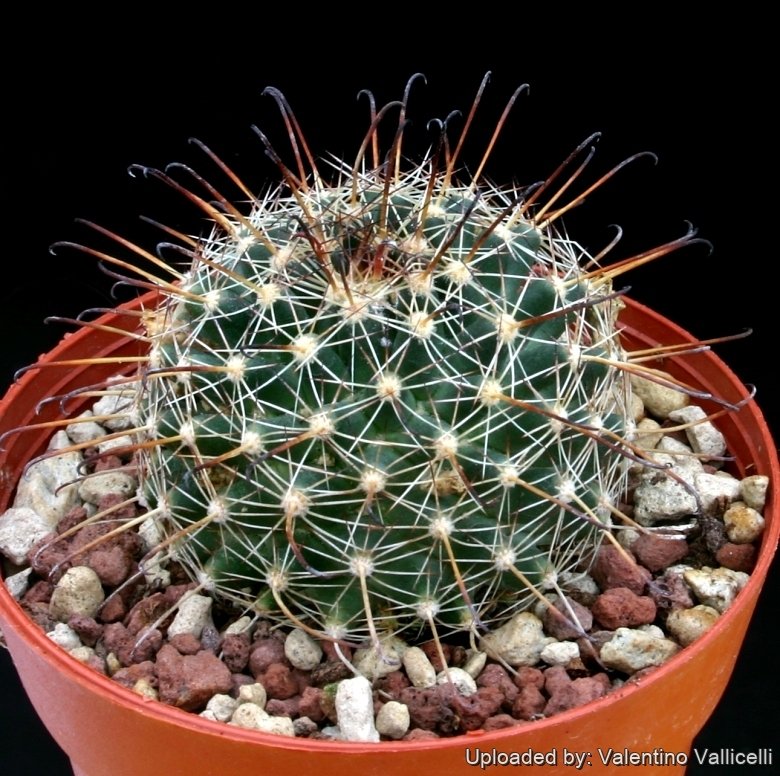
Stems: Globose to ovoid, firm, grey-green or blue-green, sometimes reddish in axils, 6 - 7 cm high, 10 - 12 cm in diameter; cortex and pith not mucilaginous; latex absent.
Tubercles: Cylindrical, becoming conical, somewhat incurved.9-18 × 3-9 mm, arranged in 8 and 13 spirals, protruding 12-15 mm axils appearing naked.
Areoles: 1.5 mm in diameter, and typically 10 mm apart.
Roots: Diffuse, upper portion not enlarged.
Spines: Rather dense, partly obscuring the stem brightly colored than M. grahamii yellowish, pale pinkish tan, or brown (smaller spines paler), tipped dark chestnut brown to blackish, glabrous, sometimes ± pubescent when young.
Radial spines: 8 - 15, yellow becoming white, with dark tips, slender, needle-like, to 12 mm long.
Central spines: 1 - 2, porrect (extended outward or horizontally), hooked, stout, brown or yellow, with dark tips, 11-20 mm long . The hooked central spines are turned counterclockwise in the areoles around the stem.
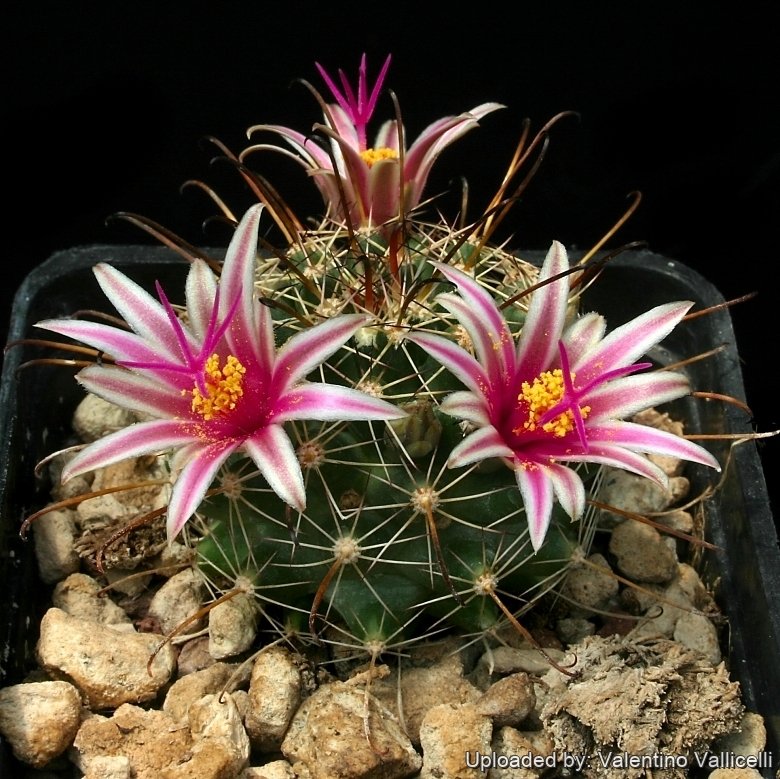
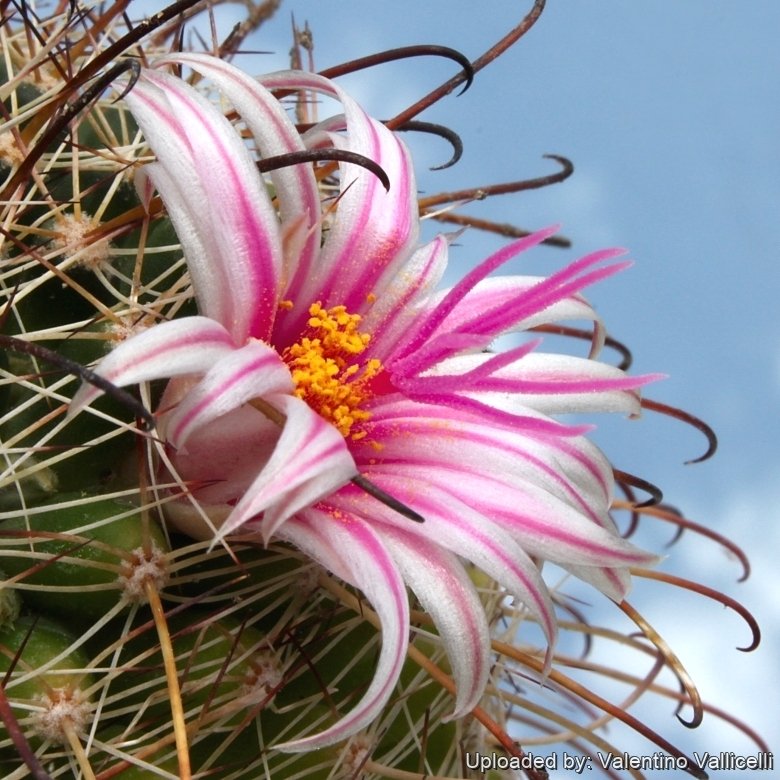
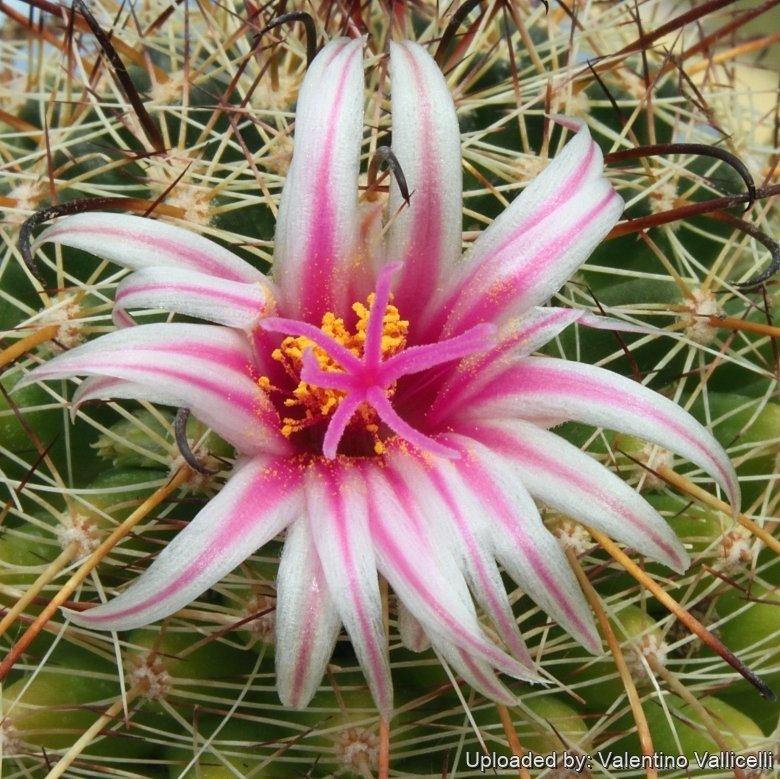
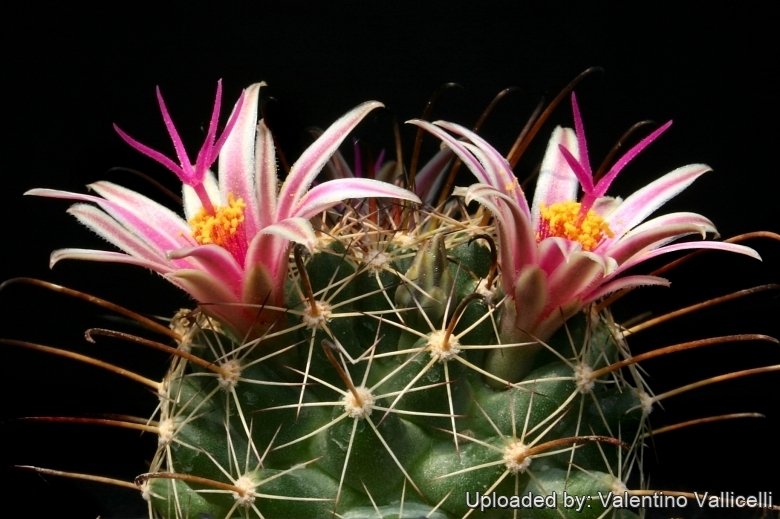
Flowers: Around the apex of the plant 2-3 × 1.5-2 cm; outermost tepal margins densely fringed, inner tepals pinkish white with sharply defined magenta midstripes, with a broad open throat.; style pink, stigma lobes bright red to red-purple, orange, or magenta.
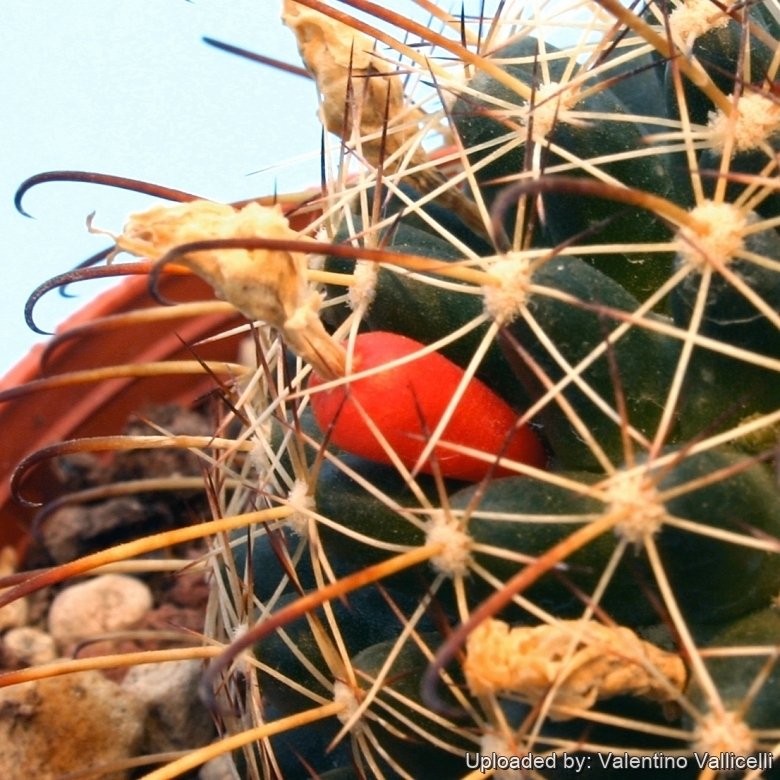
Fruits: Bright orange-red, spheric to obovoid, 5-7 × 4-4.5 mm, filaments are pink, 3 mm long remaining beneath the spines, juicy only in fruit walls; floral remnant weakly persistent.
Seeds: black.
Blooming season: June and July.
Origin and Habitat
USA (Arizona), Mexico (Sonora, northern Sinaloa) Type locality: South of Nogales, Sonora, Mexico.
Habitat: Sonoran desert plains (grasslands, bajadas, valleys, washes, and alluvial fans) or in sand dunes, rocky slopes and hillsides, usually in gravelly soil. More often on plains with Ironwood and Mesquite and Southwestern Oak Woodlands communities, from Mammillaria wrightii var. wilcoxiiSN’>9406], which grows all around Nogales, Arizona, is easily misidentified as M. mainiae.
Cultivation and Propagation
This is very slow growing species that requires the brightest light possible. Water sparingly, needs good drainage as roots are easily lost in pots that stay damp for any length of time. Require a mineral-based potting mix .
They need to be kept dry in winter.
Propagation: Seeds (if available), but usually easily propagated from the offsets.
Notes
The Counterclockwise fishhook cactus is distinguishable by way of the hook that are oriented laterally and their general pattern shows a clear counter-clockwise (anticlockwise) orientation, hence the name. The tendency for all spine hooks on plants to be oriented in same direction is not unique to Mammillaria mainiae.
Gallery