Description
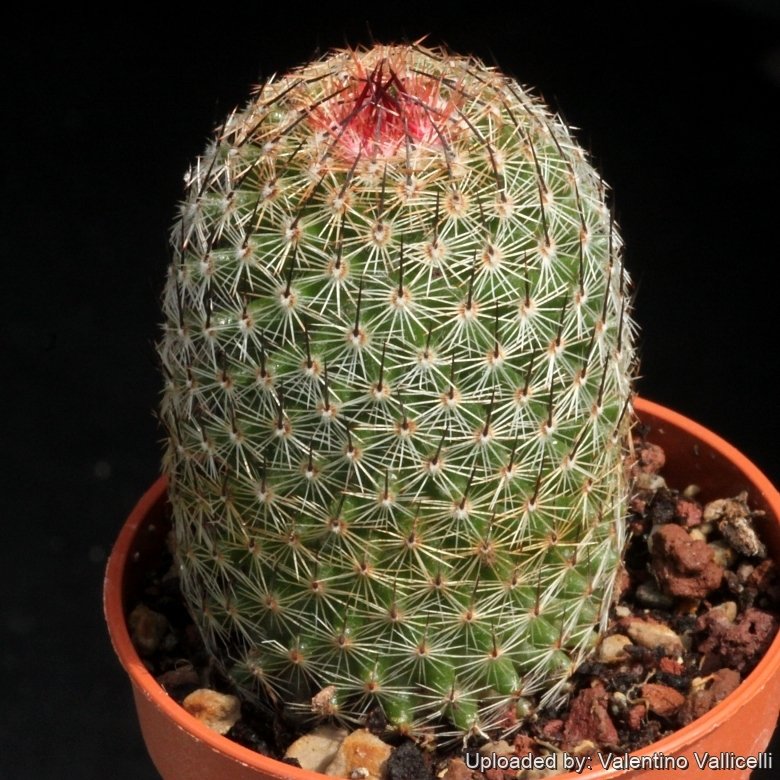
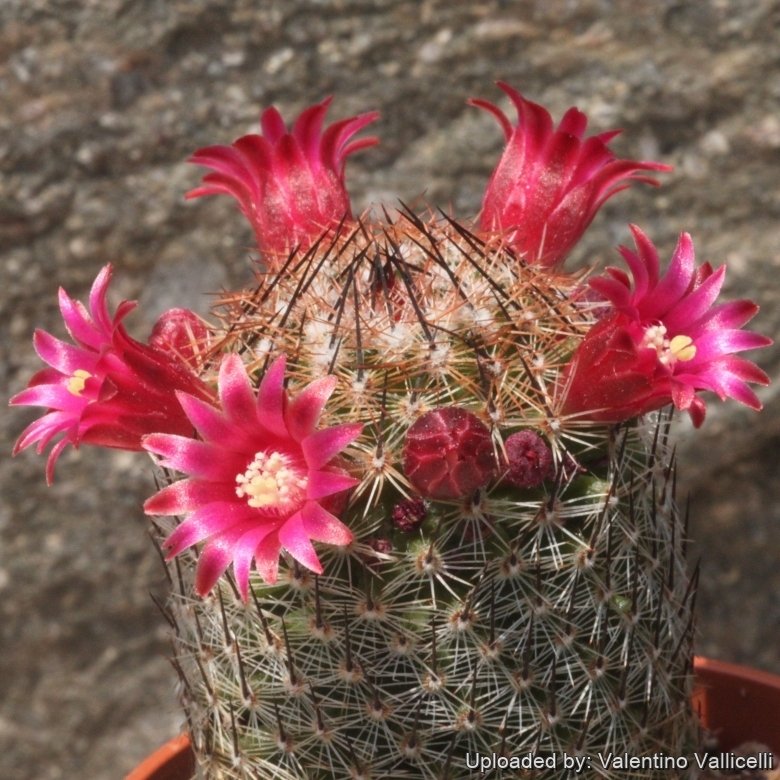
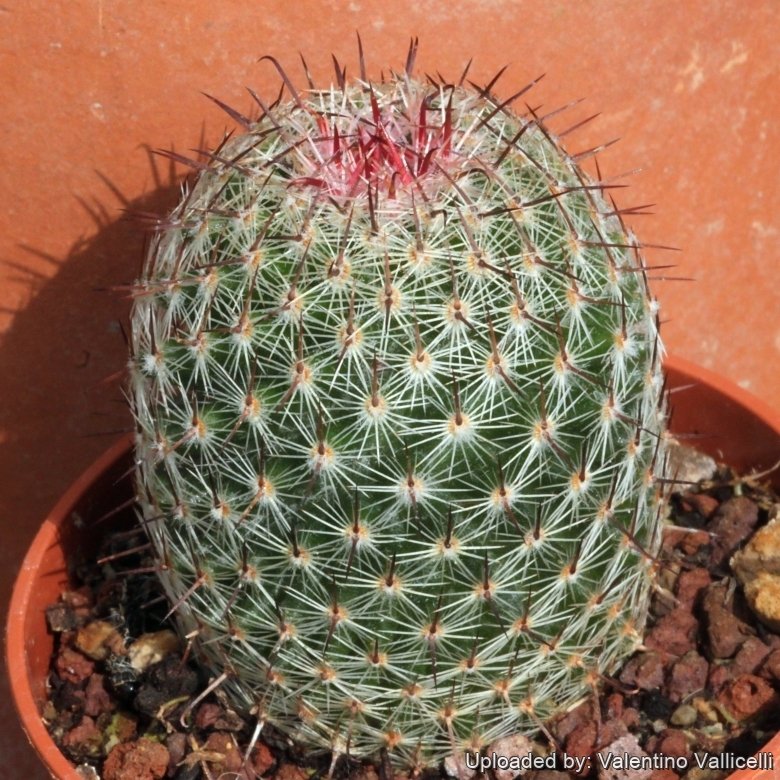
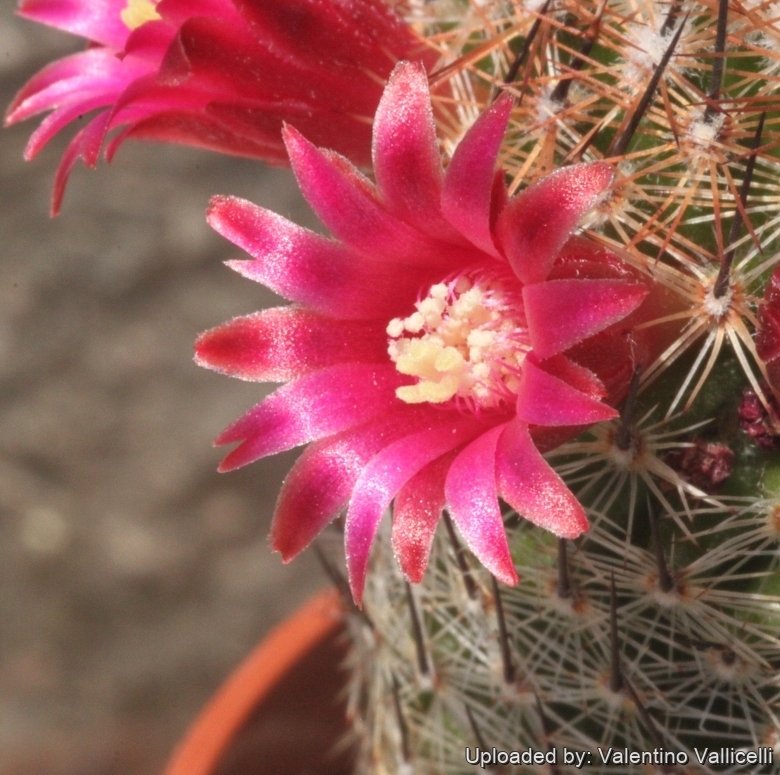
Mammillaria matudae is a columnar cactus that offsets basally to form wide clusters in time. The stem is quite tidy in youth and tends to recline as it elongates giving the old plant a characteristic sprawling habit. Each head is surrounded by a complete ring , 2-3 flowers thick, of starlike magenta flowers usually just 2-5 cm from the growing tip of the cactus. There are ample variations among spines colour. The var. robusta is distinguishable for the spines that are longer than the type.
Stem: Cylindrical, 10-20 cm or more high, to 3 cm in diameter.
Sap: With latex.
Tubercles: Conical.
Axil: Naked.
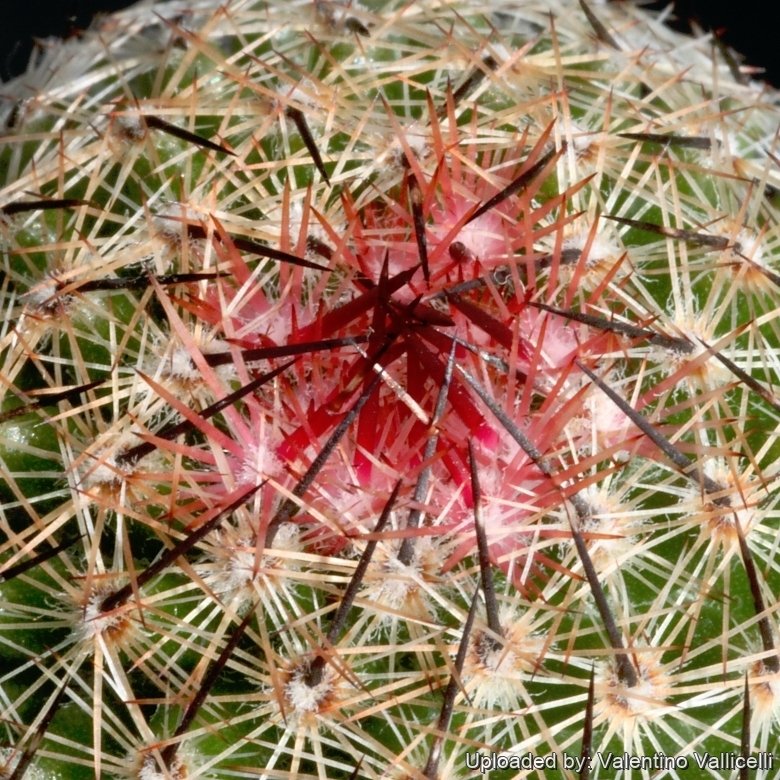
Radial spines: 18-20 very short only 2-3 mm long, lower ones longest, closely cropped, pectinate and appressed (curved toward body), white, translucent, with yellowish base.
Central spine: 1, pointing upward, white, becoming brownish with age, needle-like, slightly flattened, to 5 mm long.
Flowers: Brilliant pink to purplish-red infundibuliform and about 12 mm long.
Blooming season: March and April.
Fruit: Red with greenish tint, to 12 mm long.
Seed: Light brown.
Origin and Habitat
Guerrero, Mexico.
Cultivation and Propagation
It is a free-flowering and relatively fast growing species.
Exposition: Full sun to light shade. Best colour and form in bright light!
Watering: Water thoroughly. when soil is dry to the touch in summer but do not over-water. Keep dry in winter. Hardy down to -4°C.
Growing medium: Requires porous cactus soil with adequate drainage.
Growing tips: It is better that they be repotted regularly. Repotting will increase the number and size of stems, and will increase the number of flowers produced. Repot yearly until it reaches about 3 cm in size, then every two or three years will suffice. Repotting is best done at the end of winter, but it can be done at other time, too. Do not water for a couple of weeks after repotting, in order to reduce risk of root rot via broken roots. Additionally, it is important to keep growth as uniform as possible, as the long cylindrical body will readily show variations in growing conditions.
Propagation: Offsets, seeds.
Bibliography
Major references and further lectures
-
Edward Anderson “The Cactus family” Timber Press, Incorporated, 2001
-
James Cullen, Sabina G. Knees, H. Suzanne Cubey “The European Garden Flora Flowering Plants: A Manual for the Identification of Plants Cultivated in Europe, Both Out-of-Doors and Under Glass” Cambridge University Press, 11/Aug/2011
-
David R Hunt; Nigel P Taylor; Graham Charles; International Cactaceae Systematics Group. “The New Cactus Lexicon” dh books, 2006
-
N. L. Britton, J. N. Rose “The Cactaceae. Descriptions and Illustrations of Plants of the Cactus Family.” Volume 4, The Carnegie Institution of Washington, Washington 1923
-
John Pilbeam “Mammillaria The Cactus File Handbook” 1999
Gallery