Publication: Monatsschr. Kakteenk. 11: 154 (-155; fig.). 1901 as Mamillaria matzatlanensis
Description
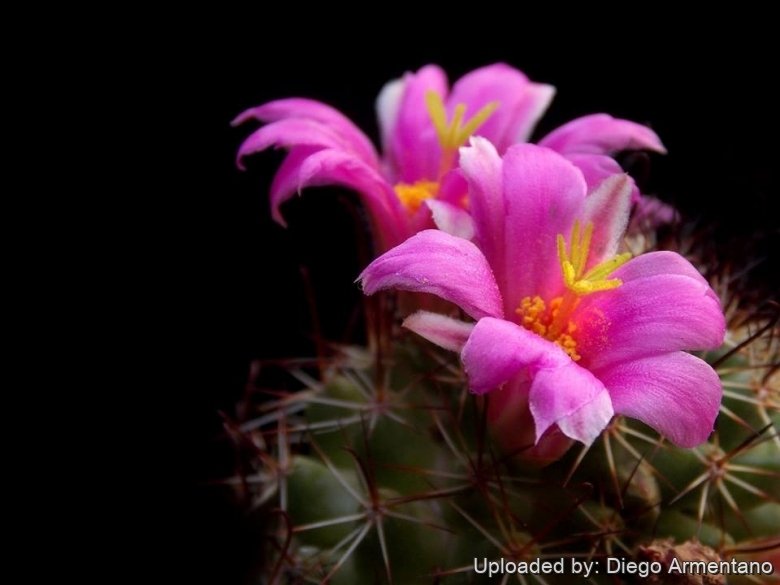
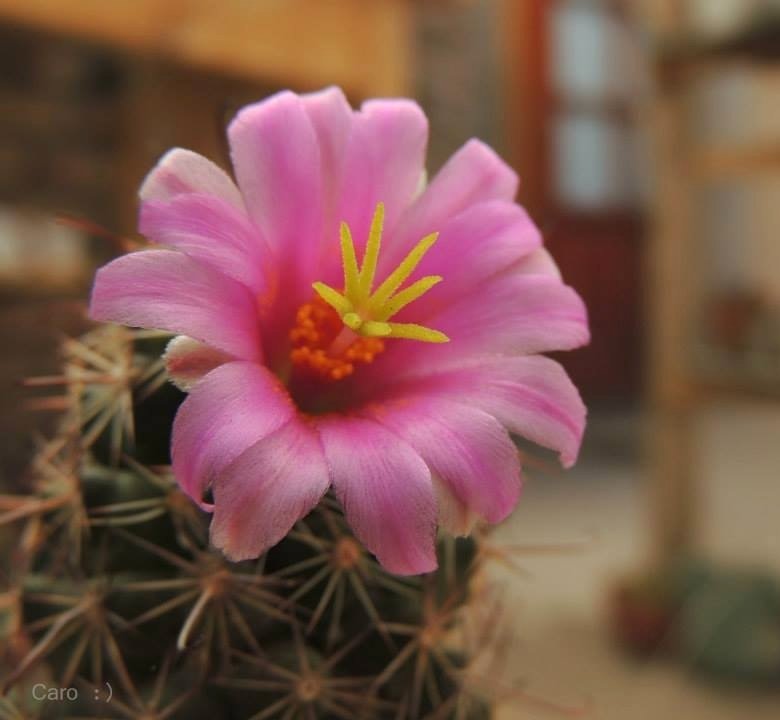
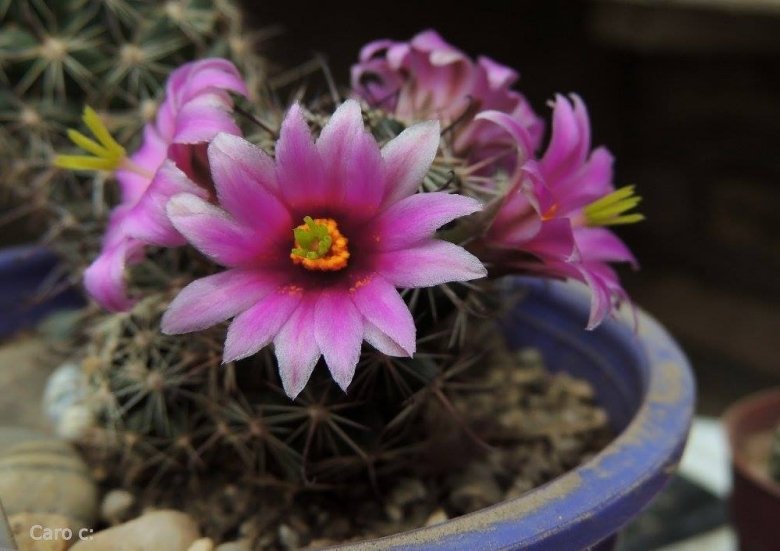
Mammillaria mazatlanensi is a cylindrical cactus, with reddish brown spines and large bright purple flowers with green stigmas. The plants are commonly cespitose, often forming broad clumps with many heads. Two subspecies are recognized, the nominate form and subs. patonii.
Stems: Oblong to slender-cylindrical, greyish-green, 4 to 15 cm long, about 2-4(-5) cm in diameter.
Tubercles: Terete, short, softish, rather cone-shaped, 3 to 4 mm long, without latex, their axils usually naked or with one or two short bristles.
Radial spines: 12 to 15(-18), slender, needle-like, setaceous or bristly, spreading, white 5-10 mm long.
Central spines: 1-4(-6), stouter than the radials, reddish brown, ascending, 8 to 15 mm long upper ones in the same plane as the radials, the lowermost typically or predominantly straight, sometimes more or less strongly hooked.
Flowers: From the axils of the old tubercles but towards the top of the plant, tubular, 3-4 cm long, 3 cm across, pink to carmine red to bright purple; perianth-segments oblong, spreading; stigma-lobes 8 green, very long and slender.
Booming season: Summer.
Fruit: Club shaped, to 20 mm long, brown, becoming reddish yellow.
Seeds: black.
Origin and Habitat
Neomammillaria mazatlanensi is endemic to NW Mexico. It occurs along the pacific coast in the states of Colima, Jalisco, Michoacan, Nayarit, Sinaloa and southern Sonora
Type locality: Mazatlan, Sinaloa, Mexico.
Altitude range: 0-500 metres above sea level.
Habitat and Ecology: The species occurs in thorn scrub on the hills near the sea and coastal sand dunes together with Rathbunia kerberi, Echinocereus ochoterenae, Mammillaria beneckei, Mammillaria rubida, Pachycereus pecten-aboriginum, Opuntia decumbens, Stenocereus thurberi, Rathbunia alamosensis, Pilosocereus purpusi, Pilosocereus alensis and Acanthocereus occidentalis. The species has a relatively wide range and is locally abundant. The species is threatened by coastal tourist developments, especially in sand dune habitats and close to the Pacific Ocean.
Cultivation and Propagation
Mammillaria mazatlanensis is somewhat difficult to cultivate. During the summer it is best to keep the plants outside where the temperature can rise to over 30° C with no harm to the plant, recommended for any collection that needs lots of light with ample airflow.
Growth rate: It is a small growing, but easily flowering species. It takes several years to offset, but once it starts it can fill a 25 cm pot in just a few years given the best conditions.
Soils: Use a an open and free draining mineral compost with little organic matter (peat, humus) that allows therefore roots to breath (as it is rot prone).
Repotting: Repotting every 2-3 years. As it is especially prone to rot under-pot in a smaller container filled with very porous compost. Use pot with good drainage.
Watering: It likes a winter’s rest and should be kept almost completely dry during the winter months, If the soil is allowed to be dry for too long root loss could follow but equally the same result would occur if the plants are both wet and cold. From March onwards the plant will begin to grow and watering should be increased gradually until late May when the plant should be in full growth. Water regularly during the summer so long as the plant pot is allowed to drain and not sit in a tray of water. During hot weather you may need to water the plants more frequently so long as the plant is actively growing. From late September watering should be reduced to force the plant to go in to a state of semi dormancy, by October you should be back in to the winter watering regime. Keep dry with ample airflow in winter. In the rest period no high atmospheric humidity!! Care must be taken with watering as they tends to become swollen and untidy in growth habit if given too much water and shade.
Fertilization: Feeding may not be necessary at all if the compost is fresh then, feed in summer only if the plant hasn’t been repotted recently. Do not feed the plants from September onwards as this can cause lush growth which can be fatal during the darker cold months. .
Hardiness: Grown specimens resist to -4°C for a short time, but it is best to keep above 5° C to avoid ugly spots on the plant epidermis. Some warmth throughout the year will increase the grower’s success.
Exposition: Need full sun avoiding only the harshest summer sun, if kept too dark they may become overly lush and greener and could be prone to rotting due to over watering. Tends to bronze in strong light, which encourages flowering and heavy wool and spine production.
Uses: It is an excellent plant for container growing. It always looks good and stays small. It look fine in a cold greenhouse and frame.
Pests & diseases: It may be attractive to a variety of insects, but plants in good condition should be nearly pest-free, particularly if they are grown in a mineral potting-mix, with good exposure and ventilation. Nonetheless, there are several pests to watch for:
- Red spiders: Sensitive to red spider mite. Overhead watering is helpful in controlling mites.
- Mealy bugs: Occasionally mealy bugs they develop aerial into the new growth among the wool with disfiguring results, but the worst types develop underground on the roots and are invisible except by their effects.
- Scales: Scales are rarely a problem.
- Rot: Rot it is only a minor problem with cacti if the plants are watered and “aired” correctly. If they are not, fungicides won’t help all that much.
Propagation: Direct sow after last frost. (seldom produces offsets)
Seeds germinate in 7-14 days at 21-27° C in spring, remove the glass cover gradually as the plants develops and keep ventilated, no full sun for young plants! The seedlings should not be disturbed until they are well rooted, after which they can be planted separately in small pots. Cuttings: wait until the offsets that appear at the base of old clustered specimens are 1/3 the size of the parent and then detach and plant. Cuttings will take root in a minimum temperature of 20° C (but better in hot weather). Cuttings of healthy shoots can be taken in the spring and summer. Cut the stem with a sharp, sterile knife, leave the cutting in a warm, dry place for a week or weeks (depending on how thick the cutting is) until a callus forms over the wound. Once the callus forms, the cutting may be inserted in a container filled with firmed cactus potting mix topped with a surface layer of coarse grit. They should be placed in the coarse grit only; this prevents the cut end from becoming too wet and allows the roots to penetrate the rich compost underneath. The cuttings should root in 2 to 6 weeks.
Bibliography
Major references and further lectures
-
David Hunt, Nigel Taylor “The New Cactus Lexicon” DH Books, 2006
-
John Pilbeam (1999) “Mammillaria The Cactus File Handbook” Nuffield Press.
-
Nathaniel Lord Britton, Joseph Nelson Rose “Cactaceae: Descriptions and Illustrations of Plants of the Cactus Family” vol. 4 The Carnegie Institution of Washington, Washington 1923
-
Edward F. Anderson “The Cactus Family” Timber Press, 2001
-
James Cullen, Sabina G. Knees, H. Suzanne Cubey “The European Garden Flora Flowering Plants: A Manual for the Identification of Plants Cultivated in Europe, Both Out-of-Doors and Under Glass”Cambridge University Press, 11/August/2011
-
Arreola, H. 2013. “Mammillaria mazatlanensis.” The IUCN Red List of Threatened Species. Version 2014.3. <www.iucnredlist.org>. Downloaded on 07 May 2015.
-
Paul Carpenter Standley “Trees and Shrubs of Mexico: Passifloraceae-Scrophulariaceae” U.S. Government Printing Office, 1924
-
Walther Haage “Cacti as House Plants” Studio Vista, 1965
-
Graf, “Exotica”, edn 11, 1: 725 1982
-
Haustein, “Der Kosmos-Kalcteenfuhrer”, 279 1983
-
Clive Innes, Charles Glass “Cacti” Portland House, 1991
-
John Borg “Cacti: A Gardener’s Handbook for Their Identification and Cultivation” Macmillan and Company, limited, 1937
-
Ulises Guzmán, Salvador Arias, Patricia Dávila “Catálogo de cactáceas mexicanas.” Universidad Nacional Autónoma de México, Mexiko-Stadt 2003
From llifle page Mammillaria occidentalis var. monocentra
Description
Mammillaria mazatlanensis var. monocentra Craig, is one of the innumerable forms of Mammillaria mazatlanensis which is a widespread and morphologically variable taxon. It is a small globular or cylyndrical cactus forming clumps with many heads. It distinguishes from the type species in having only a single central spine about 7 mm. long. The flowers of this species are bright pink 3 cm or so, so freely produced that a clump in flower is like a prickly bouquet. The varietal name “monocentra” is not accepted by many botanists that treat it as synonym, but it still has a value for a collector because they identify plants with particular characters.
Stem: Oblong to slender-cylindrical often branching from the base.
Tubercles: Short, conical with watery sap. Axils glabrous.
Central spine: One, straight or slightly bent to form an incomplete hook, brownish-red.
Radial spines: 15-16, white.
Origin and Habitat
Mammillaria mazatlanensis var. monocentra is known only from the type locality in the Yaqui Valley, Sonora, Mexico.
Habitat and ecology: Arid habitats, Lower Sonoran Zone.
Bibliography
Major references and further lectures
-
Forrest Shreve, Ira Loren Wiggins “Vegetation and Flora of the Sonoran Desert”, Volume 1 Stanford University Press, 1964
-
“the journal of the UK Mammillaria society” 1965
-
“The Cactus and Succulent Journal of Great Britain”, Volume 42, page 50, 1980
Source: Mammillaria occidentalis var. monocentra, LLIFLE - Encyclopedia of living forms, CC-BY-SA, retrieved 2026-10-25.
From llifle page Mammillaria sinaloensis
Description
Mammillaria sinaloensis, originally described as NeoSN’>32539’ alt=‘32538’>Mammillaria sinaloensis#SN#32538’>Neo[[Mammillaria sinaloensisSN’ style=‘border:none;’> (‘sinaloense’) by Rose in 1929, is a geographical or morphological form of Mammillaria mazatlanensis with hooked-spines. However the distinguishing characteristics of Mammillaria sinaloensis, appear to fall within the natural variation of Mammillaria mazatlanensis, and the two plants are not readily distinguishable, if not for the geographical provenance.
Origin and Habitat
Sinaloa and souther Sonora Mexico. (Firstly described from San Blas, Sinaloa)
Altitude range: 0-50 (?) metres above sea level.
Habitat and Ecology: The species occurs the hills near the sea and coastal sand dunes together with Echinocereus floresii, Marshallocereus thurberi, and Mammillaria becensis.
Cultivation and Propagation
Mammillaria sinaloensis makes interesting specimens for any collection. Over time it will produce small clumps. It grows by producing offsets and doesn’t require any special treatment.
Growth rate: Slow to offset and basically slow.
Exposure: It needs as much light as possible without burning the plant, to keep the stems compact.
Soil: It needs a very well-drained soil mix.
Watering: Water well and then allow to dry thoroughly before watering again, during the growing season. Should really get no water in the winter
Hardiness: From tropical countries and pretty cold sensitive (listed most places as 10b-11, but seems to do OK in 10a). It can however can survive short exposures to light freezing temperatures (-4° C.) if properly hardened off and kept dry.
Propagation: It is best propagated from seed. Seed readily germinates at 20°-22°C, or by offsets if available.
Bibliography
Major references and further lectures
- Mammillaria Society “The Journal of the Mammillaria Society”, Volumes 14-16, page 27, 1974
Source: Mammillaria sinaloensis, LLIFLE - Encyclopedia of living forms, CC-BY-SA, retrieved 2026-10-25.