Publication: Bol. Comite Regional Estado Durango i. 54 (1910) as Mamillaria; cf. Gray Herb. Card Cat., reimpr.corrig.
From llifle page Escobariopsis pennispinosa subs. nazasensis
Description
Mammillaria nazasensis, more often found as Mammillaria pennispinosa var. nazasensis, is a particularly attractive small spherical, perennial cactus usually solitary or forming clumps (clustering readily in cultivation) and bearing creamy-yellow to orange tan spines, discolouring with age. Has cream yellow flowers with faint pinkish tan midstripe in spring.
Stem: Plants solitary , flattened globose to globose, olive green to dark green, to 2.5 - 3.5 cm in diameter.
Tubercles: Axil naked.
Radial spines: 16 - 19 (to 22), fine, white and very pubescent.
Central spines: 4, of which 1 is strongly hooked, strongly pubescent, pale whitish yellow to lemon yellow to orange tan.
Flowers: Pale cream yellow with faint pinkish tan midstripe, 15 mm long and in diameter, stigmas pale greenish yellow to cream-white.
Bloom Season: Early Spring through late Spring.
Fruits: Red.
Seeds: Black.
Origin and Habitat
Durango, Mexico.
Altitude range: 1.000-1.700 metres above sea level.
Habitat and ecology: Mammillaria nazasensis grows on steep rocks in crevices, sometimes growing together with Mammillaria guelozwiana, Echinocereus stramineus, Opuntia herrfeldtii, Opuntia robusta, and Opuntia imbricata.
Cultivation and Propagation
Mammillaria nazasensis requires excellent drainage provided by porous cactus soil (With not less than 50% grit content). We suggest repotting every 2-3 years. Prefers bright light and ample airflow. Outside full sun or afternoon shade, inside it needs bright light, and some direct sun. Water should be carefully applied and only when the soil is dry to the touch, as fits this cliff-dwelling species. Allow soil to drain thoroughly before watering again. Do not water in the winter (Rot prone). Protect from frost. But it’s hardy to -5°C if kept dry. During the beautiful season enrich the soil using a fertilizer rich in potassium and phosphorous, but poor in nitrogen, because this chemical element doesn’t help the development of succulent plants, making them too soft and full of water. This rarely found species is slow growing, but rewards the patient grower with displays of small dark pink flowers. Winter rest is important to stimulate flowering. Use small sized pots.
Propagation: Direct sow after last frost or cuttings.
Bibliography
Major references and further lectures.
-
Robert T. Craig “The Mammillaria handbook: with descriptions, illustrations, and key to the species of the genus Mammillaria of the Cactaceae” E P Publishing, 1945
-
John Pilbeam “Mammillaria The Cactus File Handbook” Cirio Pub. Services, 01/Dec/1999Edward Anderson “The Cactus family” Timber Press, Incorporated, 2001
-
James Cullen, Sabina G. Knees, H. Suzanne Cubey “The European Garden Flora Flowering Plants: A Manual for the Identification of Plants Cultivated in Europe, Both Out-of-Doors and Under Glass” Cambridge University Press, 11/Aug/2011
-
David R Hunt; Nigel P Taylor; Graham Charles; International Cactaceae Systematics Group. “The New Cactus Lexicon” dh books, 2006
Source: Escobariopsis pennispinosa subs. nazasensis, LLIFLE - Encyclopedia of living forms, CC-BY-SA, retrieved 2026-10-25.
From llifle page Mammillaria berkiana
Description
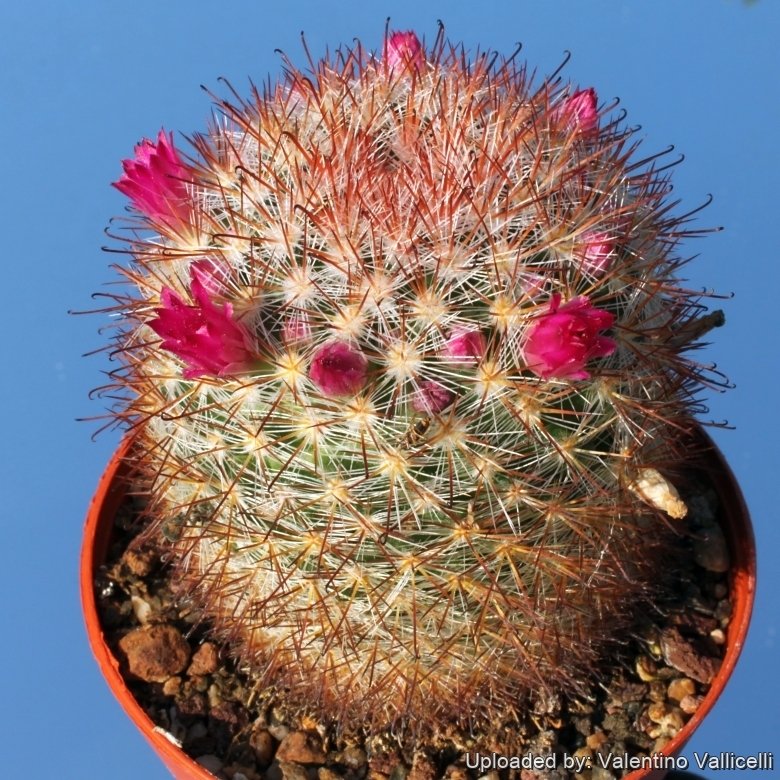
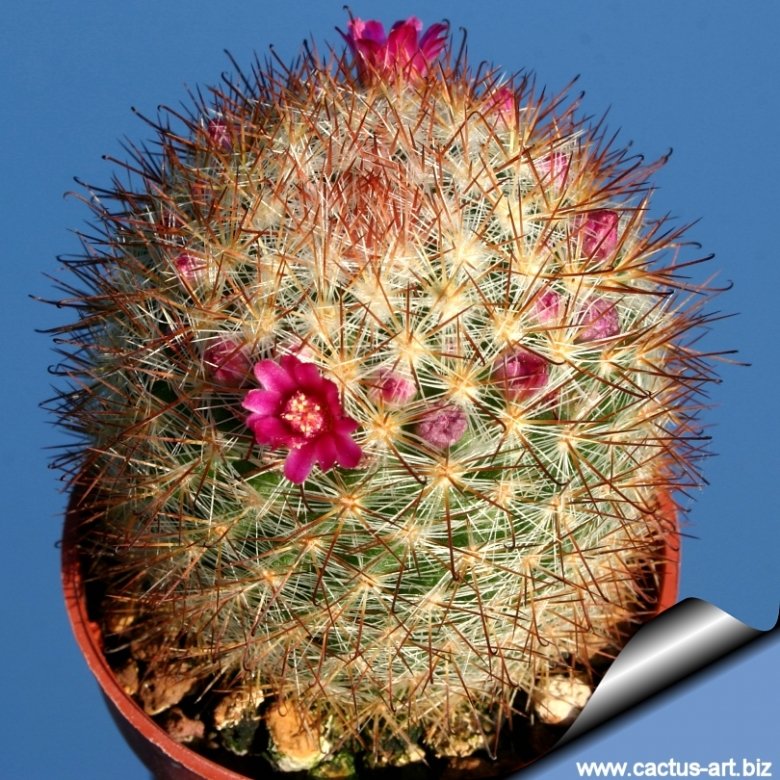
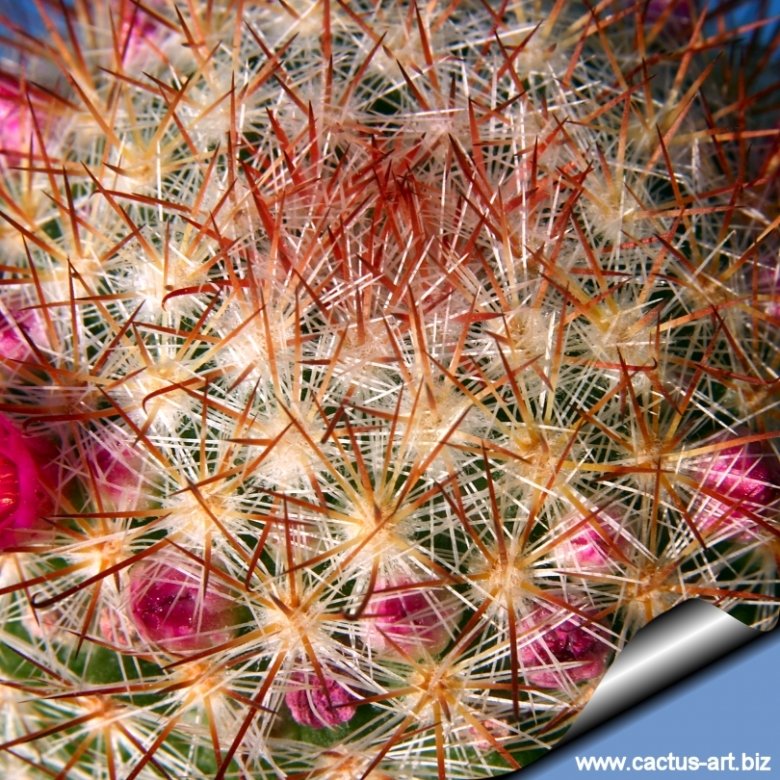
Plants at first solitary or clustering in the course of time with up to 40 stems.
Stem: Globose, olive-green to dark green, 4 to 6 cm in diameter with latex. The axil is without bristles occasionally with scarce wool.
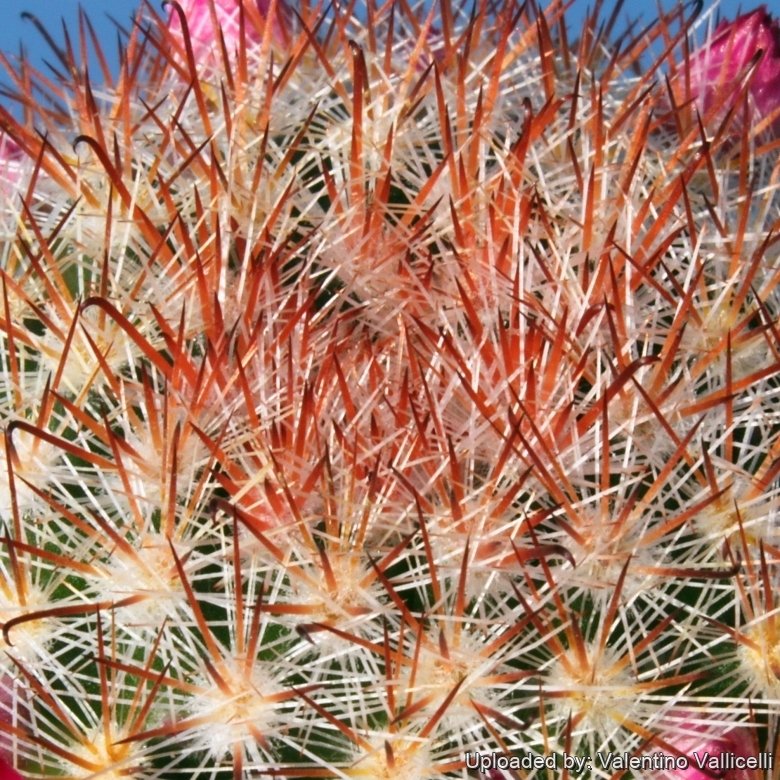
Radial spine: Numerous 35 to 38, widely spreading, up to 6 mm long, the upper up to 4 mm, white, fine, needle-like.
Central spine: 5 to 8, one more central, 2 to 4 hooked and 10 mm long, the others 4 to 5 mm long and straight, red-brown, whitish at base.
Roots: Taproots.
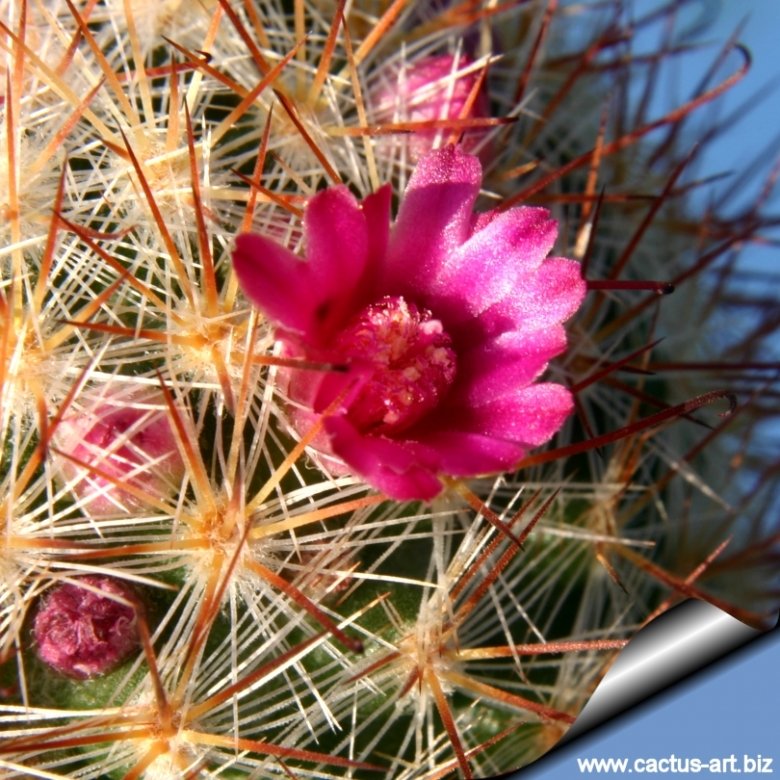
Flowers: Bell shaped, deep set, dark purple-pink, not widely opening, to 10 mm in diameter. Perianth-segments oblong, obtuse. Stigmas purple.
Fruits: Club-shaped, 15 - 20 mm long, whitish to pink.
Seeds: Black.
Blooming season: Autumn-winter to spring, the flowers remain open for five or six days, exceptionally more.
Origin and Habitat
Nayarit, Sierra Huichol , Jalisco, Mexico.
Habitat: It is a cliff-dwelling species that grows among rocks on hillsides at an altitude from 1.800 to 2.400 m
Cultivation and Propagation
Requires excellent drainage provided by porous cactus soil (With not less than 50% grit content). We suggest repotting every 2-3 years. Prefers bright light and ample airflow. Outside full sun or afternoon shade, inside it needs bright light, and some direct sun. Water should be carefully applied and only when the soil is dry to the touch, as fits this cliff-dwelling species. Allow soil to drain thoroughly before watering again. Do not water in the winter (Rot prone). Protect from frost. But it’s hardy to -5°C if kept dry. During the beautiful season enrich the soil using a fertilizer rich in potassium and phosphorous, but poor in nitrogen, because this chemical element doesn’t help the development of succulent plants, making them too soft and full of water. This rarely found species is slow growing, but rewards the patient grower with displays of small dark pink flowers. Winter rest is important to stimulate flowering. Use small sized pots.
Propagation: Direct sow after last frost or cuttings.
Source: Mammillaria berkiana, LLIFLE - Encyclopedia of living forms, CC-BY-SA, retrieved 2026-10-25.