Publication: Z. Sukkulentenk. 1924: 213 (fig.). as Mamillaria
From llifle page Mammillaria cowperae
Description
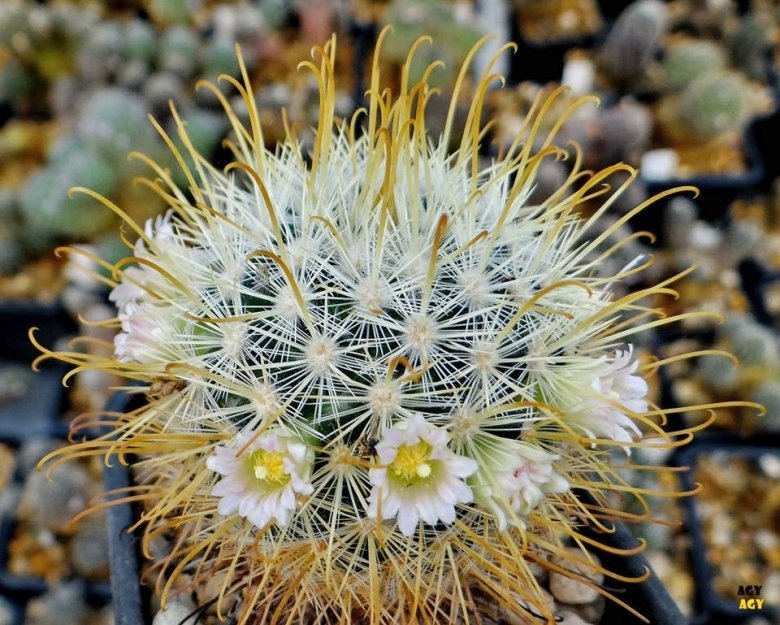
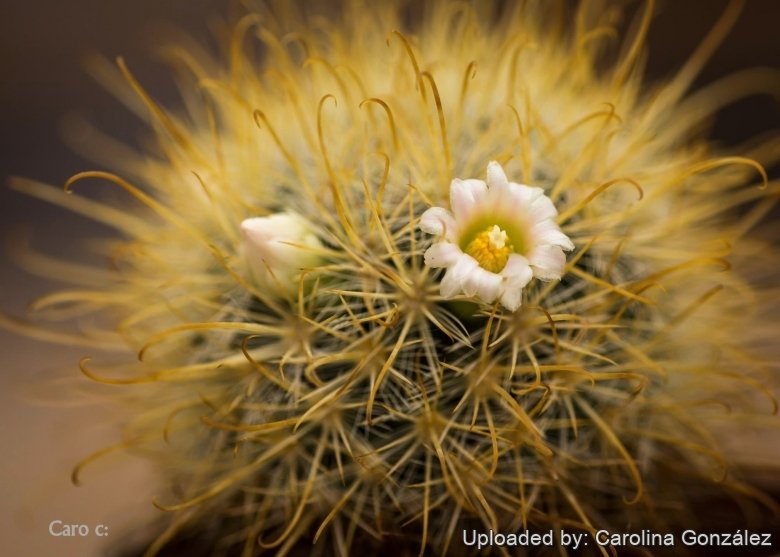
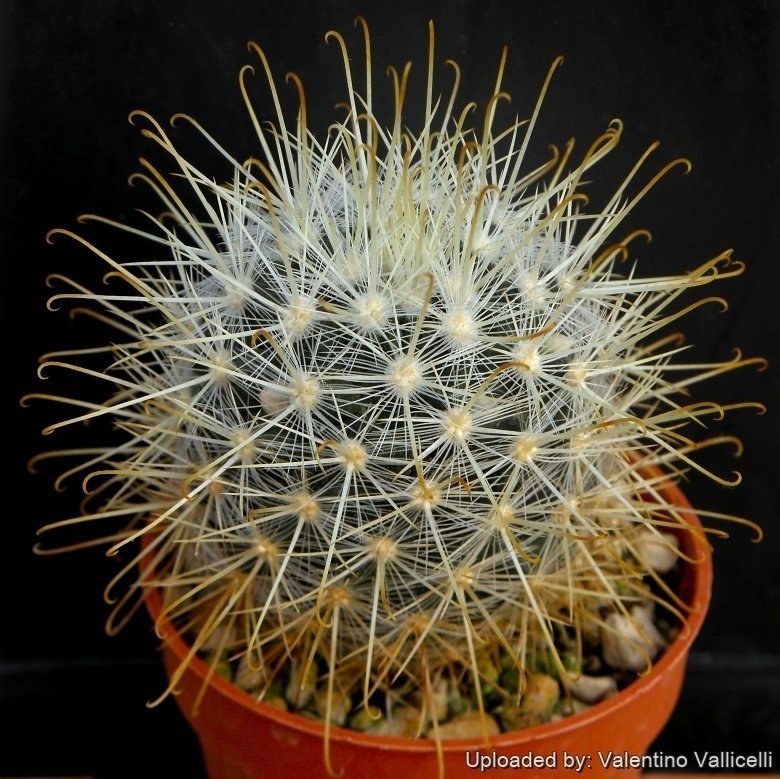
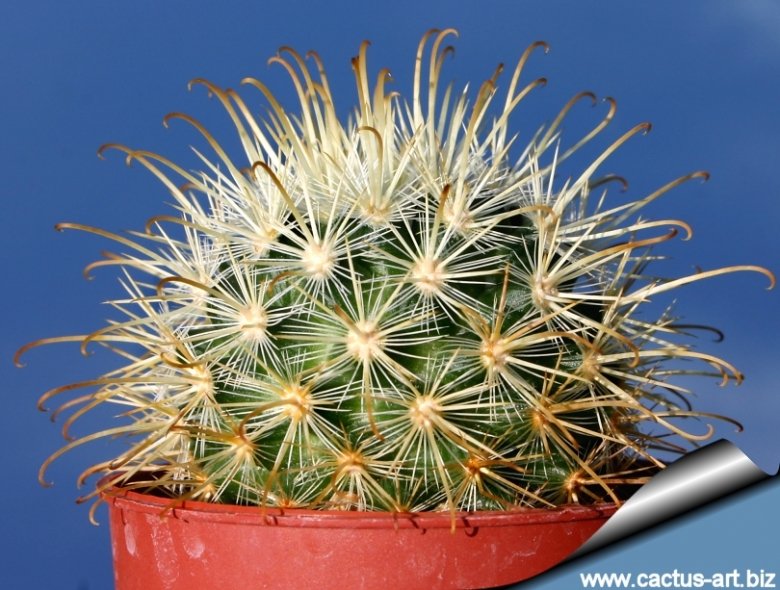
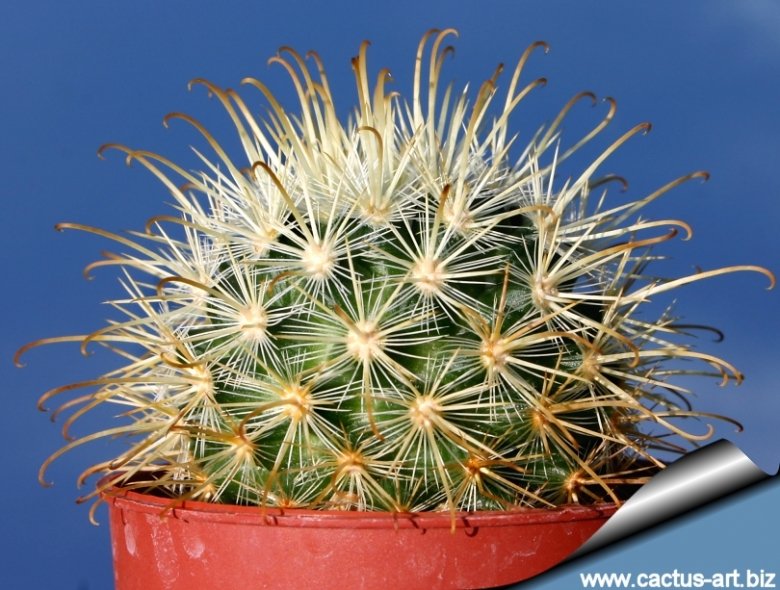
Mammillaria moelleriana is a small cactus that appears above the ground as a squat, spherical stem, completely covered by very strong hooked spines, and usually solitary. In cultivation the plant’s stem may be cylindrical. it is also one of the more difficult to grow, as it is subject to losing its roots. The yellow spined form is often labelled Mammillaria cowperae.
Stem: Flattened globose to short cylindrical, centrally depressed, up to 10 cm in diameter, 13 cm tall, glossy green. Tubercle firm, cylindrical to ovoid with woolly axil. Without latex.
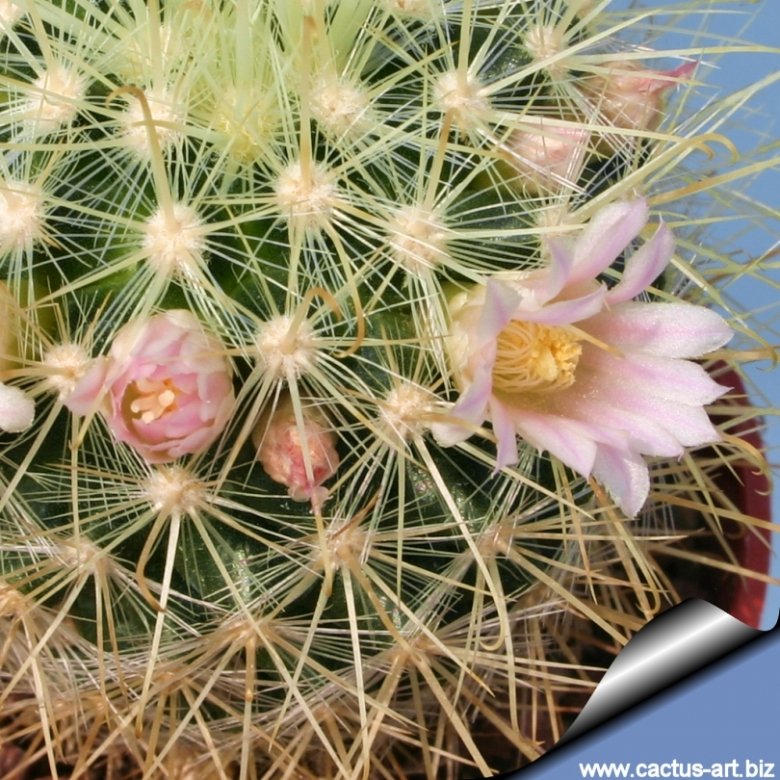
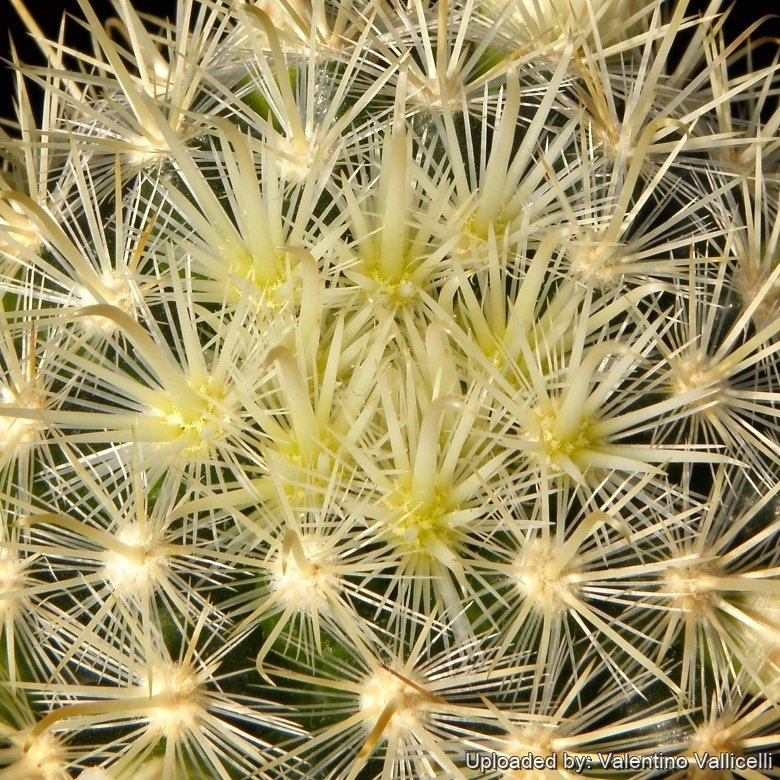
Radial spines: 35 to 50, white with yellow bases, needle-like, 7 - 9 mm long.
Central spines: 8 to 10, honey yellow (dark reddish brown, with yellow bases in M. moelleriana), 20-30 mm long, lower -4 hooked, upper ones shorter and straight.
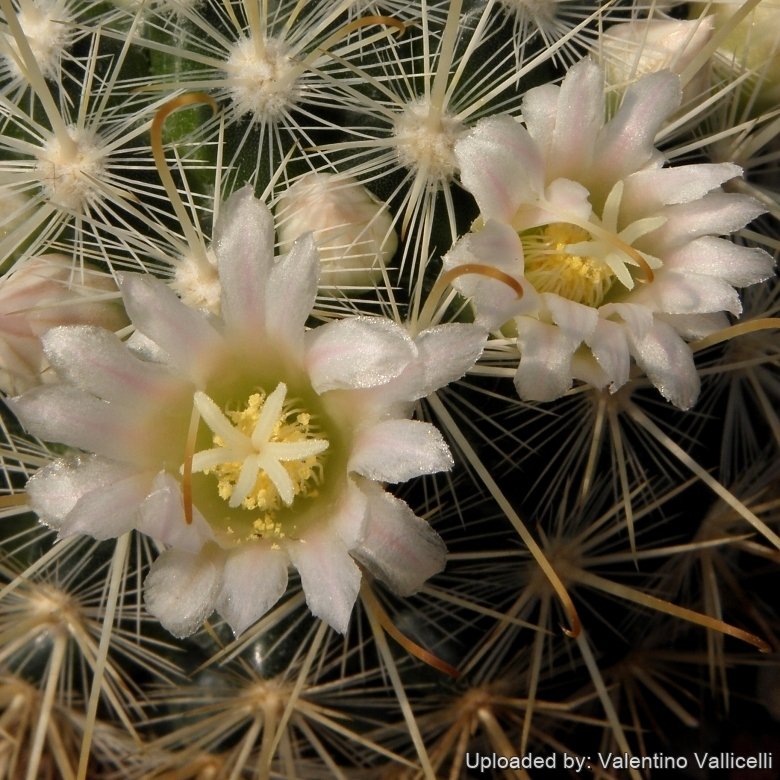
Flowers: White or light pink flowers, with darker midveins, up to 1.8 cm in diameter.
Blooming season (northern hemisphere): M. cowperae, show its buds early in January but sometimes these do not open until March, again much depending on weather conditions.
Fruits: Club shaped, greenish white, to 15 mm long.
Seeds: Black.
Origin and Habitat
Hornillos (near Fresnillo) and adjacent areas, Zacatecas, Mexico.
Altitude range: 2.150 - 2.600 metres above sea level.
Habitat and Ecology: Mammillaria cowperae grows among volcanic rocks in semi-desert together with Mamillaria zacatecasensis, Mammillaria gummifera, Echinocereus pectinatus, Echinocereus durangensis, Opuntia durangensis, Opuntia robusta, and Echinofossulocactus zacatecasensis. These plants seem to be little threatened by illegal collecting although the habitats are known to both commercial and amateur collectors.
Cultivation and Propagation
M. cowperae is one of the more difficult species to grow, this plant is very rot prone and temperamental when cultivated on its own roots, but it is easy to grow if grafted. Mammillaria pectinifera should be kept in a deep pot with a veryl oose and open potting mineral substrate. Watering during the active growing season (spring and summer), this will encourage steady growth. But be careful with watering, which all thick rooted species require (rot sensitive). Keep dry during the winter rest. Strong filtered light will encourage the formation of heavy spination.
Fertilize every 2 weeks with diluted high potassium fertilizer when the plant is in bud. Light shade or full sun exposures.
Propagation: Direct sow after last frost. (seldom produces offsets)
Bibliography
Major references and further lectures
-
David Hunt, Nigel Taylor “The New Cactus Lexicon” DH Books, 2006
-
John Pilbeam “Mammillaria The Cactus File Handbook” Nuffield Press. 1999
-
James Cullen, Sabina G. Knees, H. Suzanne Cubey “The European Garden Flora Flowering Plants: A Manual for the Identification of Plants Cultivated in Europe, Both Out-of-Doors and Under Glass”Cambridge University Press, 11/August/2011
-
Edward F. Anderson “The Cactus Family” Timber Press, 2001
-
Fitz Maurice, B & Fitz Maurice, W.A. 2013. Mammillaria moelleriana. The IUCN Red List of Threatened Species. Version 2015.1. <www.iucnredlist.org>. Downloaded on 03 June 2015.
Source: Mammillaria cowperae, LLIFLE - Encyclopedia of living forms, CC-BY-SA, retrieved 2026-10-25.
Cultivars and forms (2)
Varieties (1)
Forms (1)
Gallery