Publication: Hort. Reg. Monac. (1829) 127, nomen; et in Nova Acta Phys.-Med. Acad. Caes. Leop.-Carol. Nat. Cur. 16(1): 332. 1832
Description
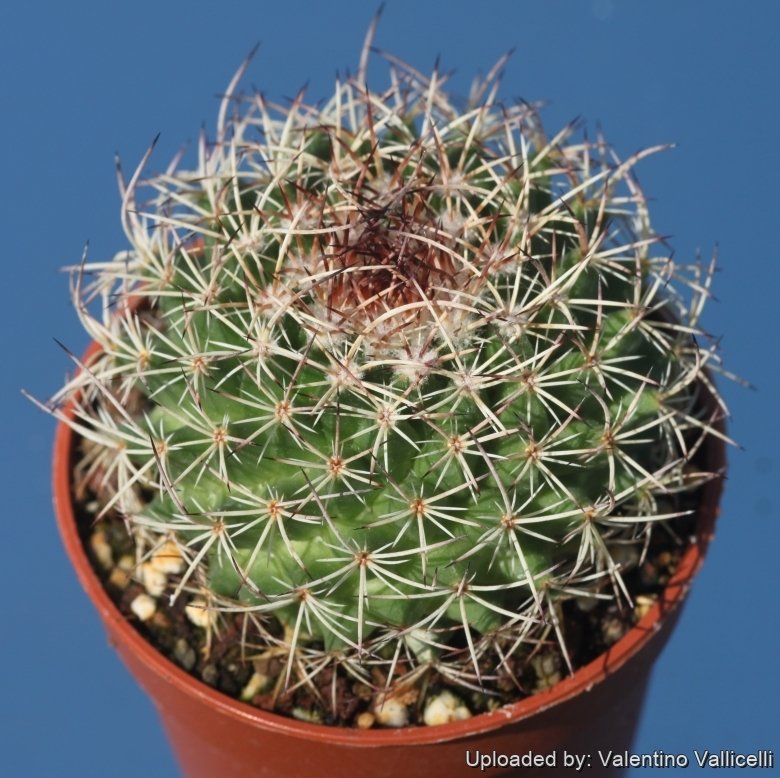
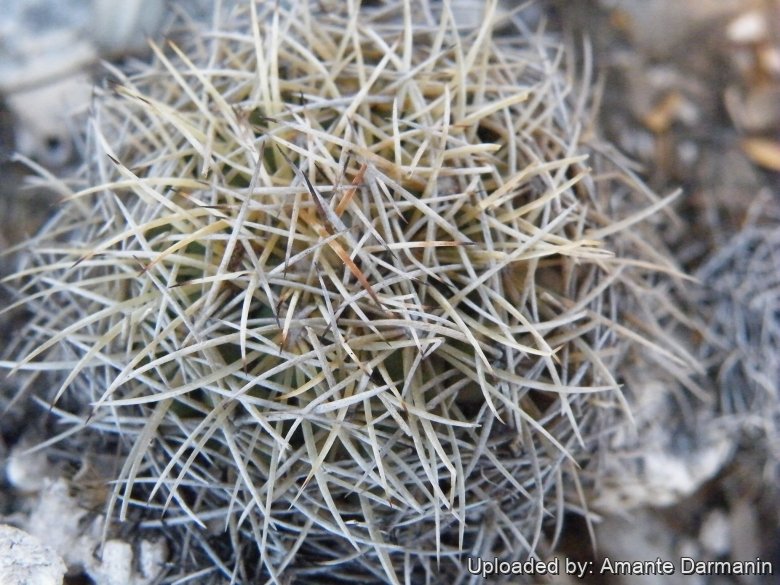
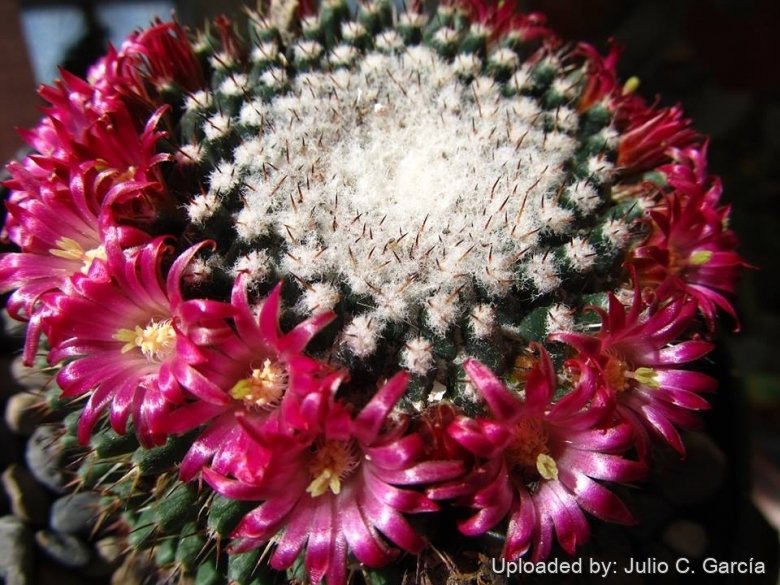
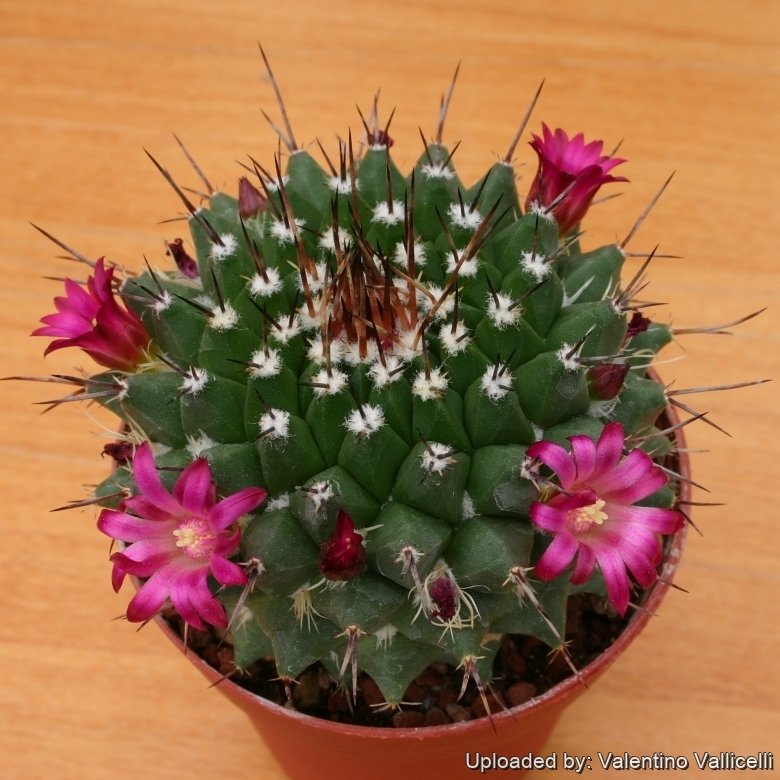
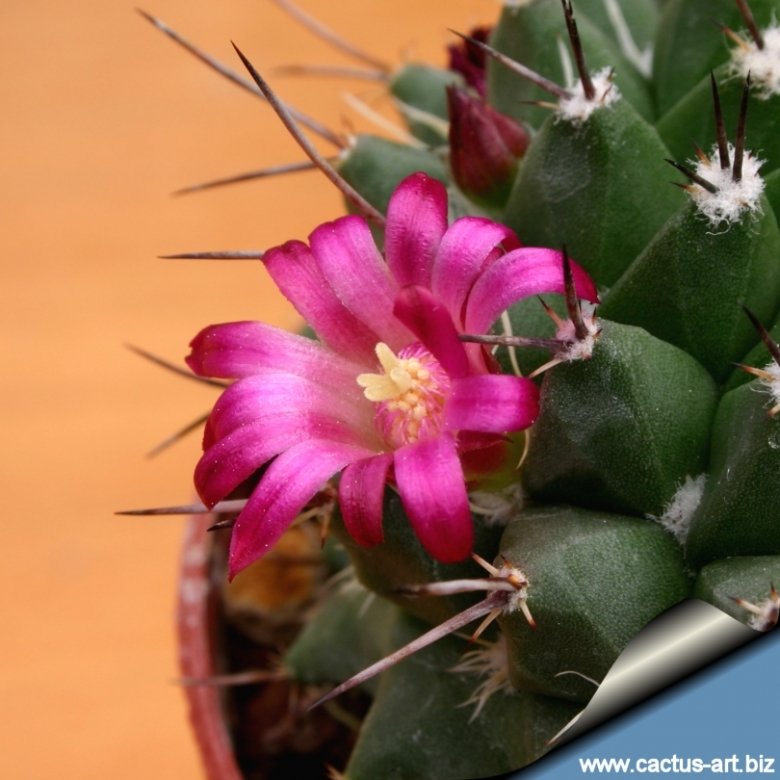
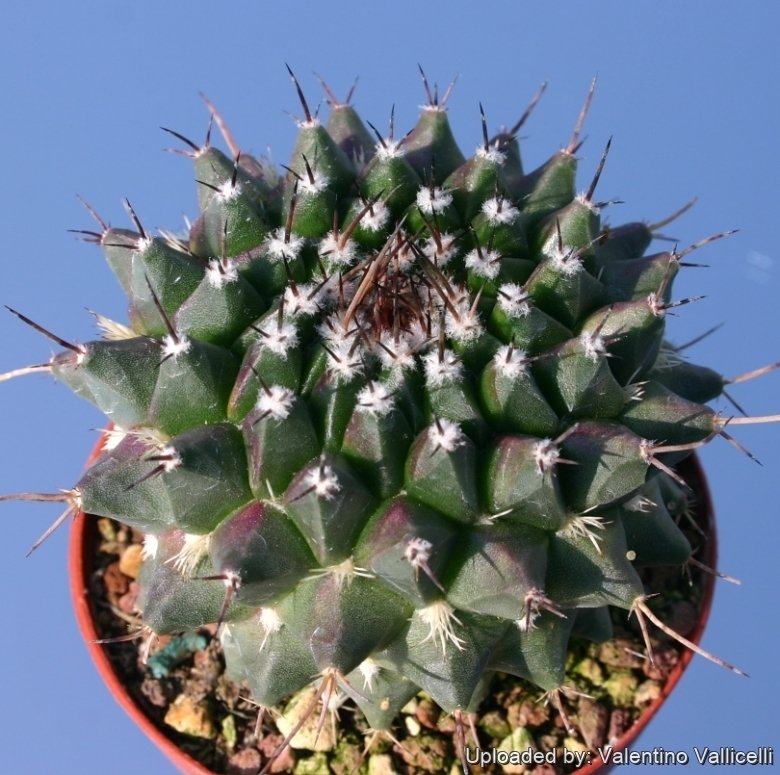
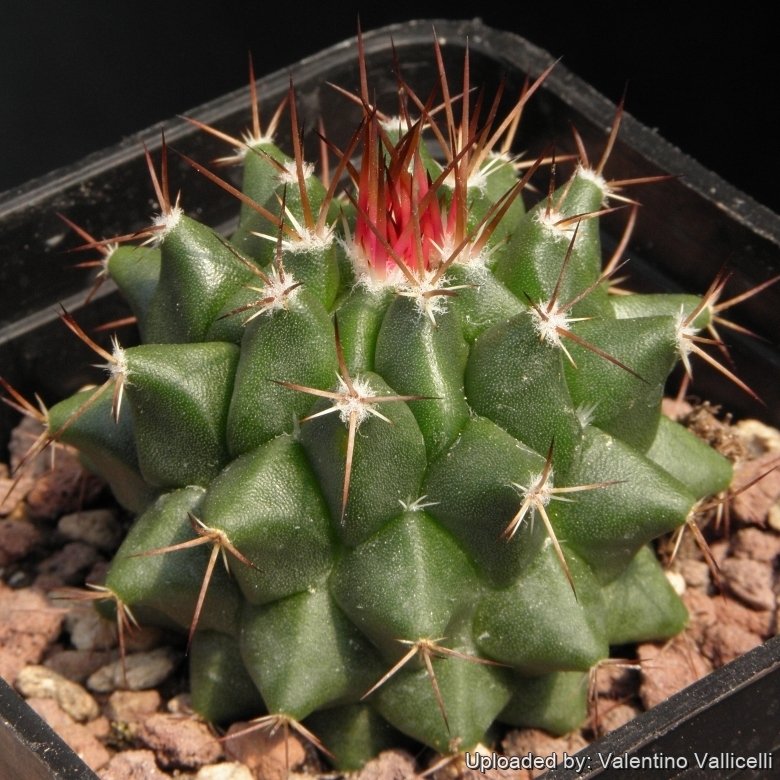
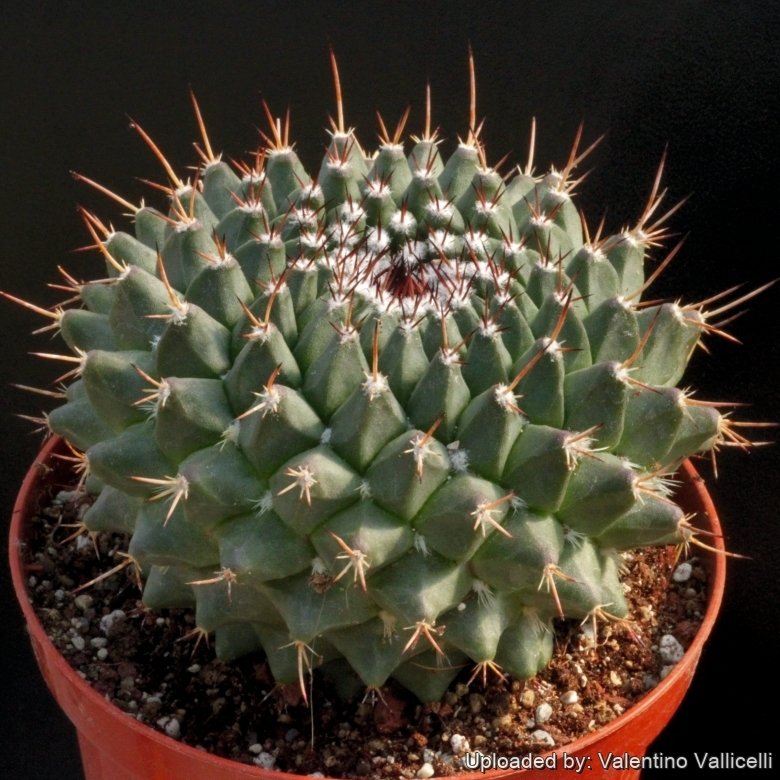
Mammillaria mystax is a single stemmed cactus with neat pyramid-shape tubercles and with age can offset to form loose clumps. In its wild state its crown is entirely covered with long entangled, erect, central spines which overtop the plan. The species is common in cultivation and produces a profusion of rose coloured flowers in a ring around the crown of the stem. Spines are of variable shape and length, occasionally they are very long (up to 7 cm long).
Stem: Globose to short-cylindric, 7 to 15 cm. high, 7-10 cm in diameter, flat-topped dark grey-green, eventually dividing dichotomically.
Tubercles: In as many as 34 rows, prominent, thickly set, firm, pyramidal, four- to six-angled, sharply keeled, 1-1,5 cm long, 8 mm broad, full of milk which freely flows when pricked or cut, axils with wool and bristles.
Radial spines: 3 to 10, small, spreading, white often with darker tips, 4-8 mm long.
Central spines: Stout, twisted, interwoven, purplish with dark brown tips, later grey, variable in number usually (3-)4, sometimes one, of which (2-)3 about twice as long as the radial ones, the other more centrally placed much elongated, 2 to 7 cm long (in cultivation this elongated spine does not always occur).
Flowers: Rose purple with brownish midveins, 10-25 mm long and in diameter appearing in 2 or 3 rows, very abundant. Inner perianth-segments dark red, 12 mm long. Stigma-lobes 4 or 5, greenish.
Blooming season (in habitat): It flowers from February to April.
Fruit: Red, club shaped, 2 to 2.5 cm long.
Seeds: Brown.
Origin and Habitat
Mammillaria mystax occours widespread in highlands of southern central Mexico, centering in Puebla and adjacent Guerrero and Oaxaca.
Altitude range: 1,000 to 2,600 metres above sea level.
Type locality: Mexico. According to Hemsley, Karwinsky’s plant, which is the type, came from Ixmiquilpan and San Pedro Nolasco at about 200 m altitude.
Habitat and Ecology: The species occurs in tropical dry deciduous forest (Vovides et al. 1997), Quercus forest and xerophyllous scrubs together with several other cactus species such as: Mammillaria conspicua, Mammillaria pectinifera, Mammillaria sphacelata, Mammillaria viperina, Coryphantha pallida, Echinocactus grandis, Ferocactus recurvus and Agave echinoides. This species is common and abundant within its limited range. There are no major threats. However, it is affected indirectly from land use change for farming and cattle ranching.
Cultivation and Propagation
Mammillaria mystax is easy to grow, requires excellent drainage provided by porous cactus soil.
Repotting: Repot every 2-3 years.
Fertilization: During the beautiful season enrich the soil using a fertilizer rich in potassium and phosphorous, but poor in nitrogen, because this chemical element doesn’t help the development of succulent plants, making them too soft and full of water.
Exposure: Prefers bright light and ample airflow. Outside full sun or afternoon shade, inside it needs bright light, and some direct sun.
Waterings: Water the soil abundantly when it is dry to the touch. Allow soil to drain thoroughly before watering again. Do not water much in the winter (Rot prone).
Hardiness: Protect from frost. But it’s hardy to -5°C if kept dry.
Propagation: Direct sow after last frost as it usually don’t braches.
Bibliography
Major references and further lectures.
-
Robert T. Craig “The Mammillaria handbook: with descriptions, illustrations, and key to the species of the genus Mammillaria of the Cactaceae” E P Publishing, 1945
-
John Pilbeam “Mammillaria The Cactus File Handbook” Cirio Pub. Services, 01/Dec/1999Edward Anderson “The Cactus family” Timber Press, Incorporated, 2001
-
James Cullen, Sabina G. Knees, H. Suzanne Cubey “The European Garden Flora Flowering Plants: A Manual for the Identification of Plants Cultivated in Europe, Both Out-of-Doors and Under Glass” Cambridge University Press, 11/Aug/2011
-
David R Hunt; Nigel P Taylor; Graham Charles; International Cactaceae Systematics Group. “The New Cactus Lexicon” dh books, 2006
-
Arias, S., Valverde, T. & Zavala-Hurtado, A. 2013. Mammillaria mystax. The IUCN Red List of Threatened Species. Version 2014.2. <www.iucnredlist.org>. Downloaded on 15 August 2014.
-
Ulises Guzmán, Salvador Arias, Patricia Dávila, “Catálogo de cactáceas mexicanas”
-
Hans Hecht “BLV-Handbuch der Kakteen” BLV-Verlagsgesellschaft, 1982
From llifle page Mammillaria atroflorens
Origin and Habitat
Mexico (Northern America)
Source: Mammillaria atroflorens, LLIFLE - Encyclopedia of living forms, CC-BY-SA, retrieved 2026-10-25.
From llifle page Mammillaria casoi
Description
Mammillaria casoi (M. mixtecensis) is a local variant of the widespread, South Mexican Mammillaria mystax, from Oaxaca. The stems are simple up to 10 cm in diameter, with 5-7 radial and 3-4 central spines. The flowers are pinkish, numerous in rings around the shoulder of the plant. M. casoi is very variable in spination and is generally included within (as a synonym of) M. mystax, suggesting that there is not really a fundamental difference between the two, and hard to name accurately without knowing where they come from.
For more details see: SN’>20654’ alt=‘20660’>Mammillaria mystax#SN#20654’> [[Mammillaria mystaxSN’ style=‘border:none;’> |.
Origin and Habitat
Oaxaca (Mexico, Northern America). This species occurs in abundance in the Sierra Mixteca between [Santiago] Tejupan and [San Cristóbal] Suchixtlahuaca, but you can find some specimens near Acatepec too.
Bibliography
Major references and further lectures
-
Mammillaria casoi in: Cactus and Succulent Journal of Great Britain, Volume 44 Cactus and Succulent Society of Great Britain, 1982
-
Salvador Arias Montes, Susana Gama López, Leonardo Ulises Guzmán Cruz “Flora del Valle de Tehuacán-Cuicatlán” UNAM, 1997
-
Jorge Meyrán García “Botanical guide to the Valley of Tehuacán: covering especially the cacti and other succulents” Sociedad Mexicana de Cactología, 1980
Source: Mammillaria casoi, LLIFLE - Encyclopedia of living forms, CC-BY-SA, retrieved 2026-10-25.
From llifle page Mammillaria erythra
Description
Mammillaria erythra is a solitary, flattened globose, cactus, with long pyramidal, four-angled tubercles and short distinctive spines. It is at most a race of the variably spined Mammillaria mystax. The key difference by which the two were separated, namely the reduced spination, the dull-green epidermis, the solitary growth and the body size, seems entirely spurious. The name Mammillaria erythra is not accepted by many botanists that treat it as synonym, but it still has a value for a collector because they identify plants with particular characters.
Remarks: Mammillaria erythra is considered by Werner Reppenhagen a connection between Mammillaria mystax and Mammillaria sartori.
Stem: Solitary, flattened globose, sunken apex, 4-9 mm high and 7-30 cm in diameter, dull green, in habitat reddish. With latex.
Roots: Fibrous.
Tubercles: Pyramidal, firm, 4-angled, keeled, 15-18 mm long and 12-15 mm wide. Axil with short white wool and 3-10 short, glassy white with reddish brown tip, straight bristles.
Radial spine: None to 8, needle like, straight, smooth, whitish to brown, 2-6 mm long.
Central spine: 1 - 4, the uppermost the longest, needle like, straight or slightly curving, with thicker base, glassy brown with black tip, to 50 mm long.
Flower: Carmine, funnelform, 18 - 22 mm long and 10 - 12 mm in diameter, not flowering frequently.
Fruit: Dark carmine, club-shaped, 10 - 15 mm long and 3 - 5 mm wide, ripens 5 months after flowering.
Seed: Brown, flattened keeled, 1,2 mm long and 0,8 mm wide. Hilum subbasal.
Origin and Habitat
Veracruz (near Azumbitla), on the border with puebla, at puerto del aire near Acultzingo, Mexico. (Northern America).
Type Locality: Grenzpas Puebla - Veracruz, Puerto del Aire.
Altitude range: Around 1850 metres above sea level. And also at Tecamayuca, Veracruz, Mexico at an altitude of 1400m (a.k.a. “ruber” form)
Habitat and ecology: Mammillaria erythra grows on lava rocks in a humus rich substrate.
Cultivation and Propagation
Requires excellent drainage provided by porous cactus soil. We suggest repotting every 2-3 years. Prefers bright light and ample airflow. Outside full sun or afternoon shade, inside it needs bright light, and some direct sun. Water the soil abundantly when it is dry to the touch. Allow soil to drain thoroughly before watering again. Do not water much in the winter (Rot prone). Protect from frost. But it’s hardy to -5°C if kept dry. During the beautiful season enrich the soil using a fertilizer rich in potassium and phosphorous, but poor in nitrogen, because this chemical element doesn’t help the development of succulent plants, making them too soft and full of water.
Propagation: Direct sow after last frost as it usually don’t braches.
Bibliography
Major references and further lectures:
-
David Hunt, Nigel Taylor “The New Cactus Lexicon” DH Books, 2006
-
John Pilbeam (1999) “Mammillaria The Cactus File Handbook” Nuffield Press.
-
Reppenhagen “Die gattung Mammillaria nach dem heutigen stand meines wissens 1987” Herausgeber AfM, 1987: 180 - 182 , 199 and 222.
Source: Mammillaria erythra, LLIFLE - Encyclopedia of living forms, CC-BY-SA, retrieved 2026-10-25.
From llifle page Mammillaria erythra f. ruber
Description
Mammillaria erythra f. ruber (Now referred to Mammillaria mystax) is an attractive plant with very dark carmine flowers and characteristic epidermis that reddens in full sun, which clearly differentiates it from Mammillaria mystax. Furthermore it has a solitary growth and a different body size.
Note: The f. ruber is a “nomen nudum”, an undescribed name used commercially to indicate one of the local forms of Mammillaria erythra, and the two are not distinguishable, if not for the geographical provenance.
Stem: Dull green, that reddens in full sun, globose with an almost a flat-topped appearance, 40-90 mm high and 70-300 mm in diameter. The apex is sunken and wooly. With latex.
Roots: Fibrous.
Tubercles: Pyramidal, firm, 4-angled, keeled, 15-18 mm long and 12-15 mm wide. The axil has white wool and 3-10 short, glassy white with reddish brown tip, straight bristles.
Radial spines: 0-8, needle-like, straight, smooth, whitish to brown, 2-6 mm long.
Central spines: 1-4, the uppermost the longest, needle-like, straight or slightly curving, with thicker base, glassy brown with black tip, up to 50 mm long.
Flowers: Dark carmine, funnel-form, 18-22 mm long and 10-12 mm in diameter.
Fruits: Dark carmine, club-shaped, 10-15 mm long and 3-5 mm wide, it ripens 5 months after flowering.
Seeds: Brown, flattened keeled, 1,2 mm long and 0,8 mm wide. Hilum subbasal.
Blooming season: Mainly in spring (and sometimes other times of year). It doesn’t bloom frequently.
Origin and Habitat
The “ruber” form has been collected by Werner Reppenhagen (Field number REP 879) at Tecamayuca, Veracruz, Mexico at an altitude of 1400m
Habitat: Grows on crevices filled with humus, in lava rocks.
Source: Mammillaria erythra f. ruber, LLIFLE - Encyclopedia of living forms, CC-BY-SA, retrieved 2026-10-25.
From llifle page Mammillaria huajuapensis
Origin and Habitat
Oaxaca (Mexico, Northern America)
Source: Mammillaria huajuapensis, LLIFLE - Encyclopedia of living forms, CC-BY-SA, retrieved 2026-10-25.
Cultivars and forms (1)
Varieties (1)
Gallery