Publication: Linnaea 14: 375. 1840
Description
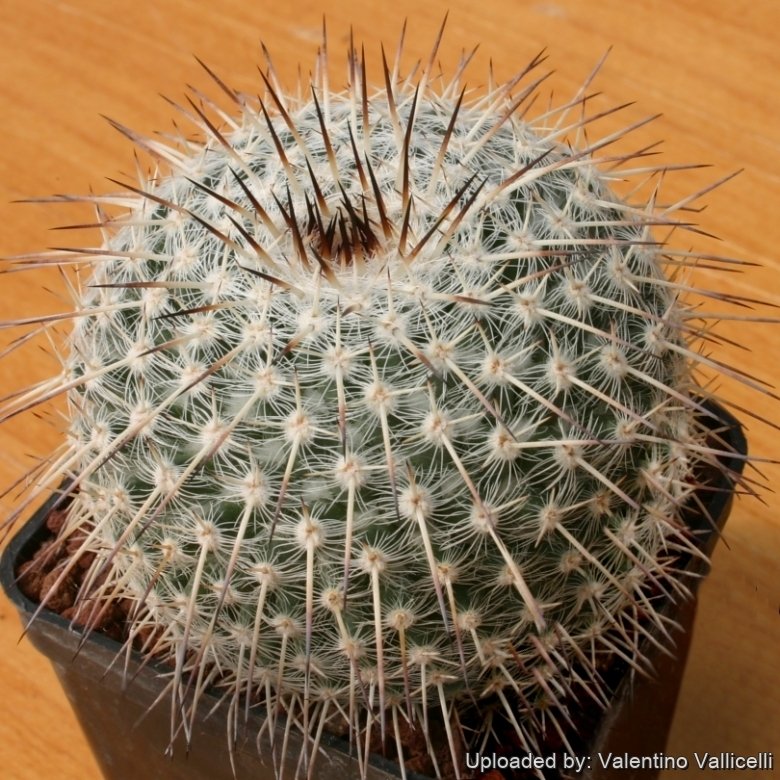
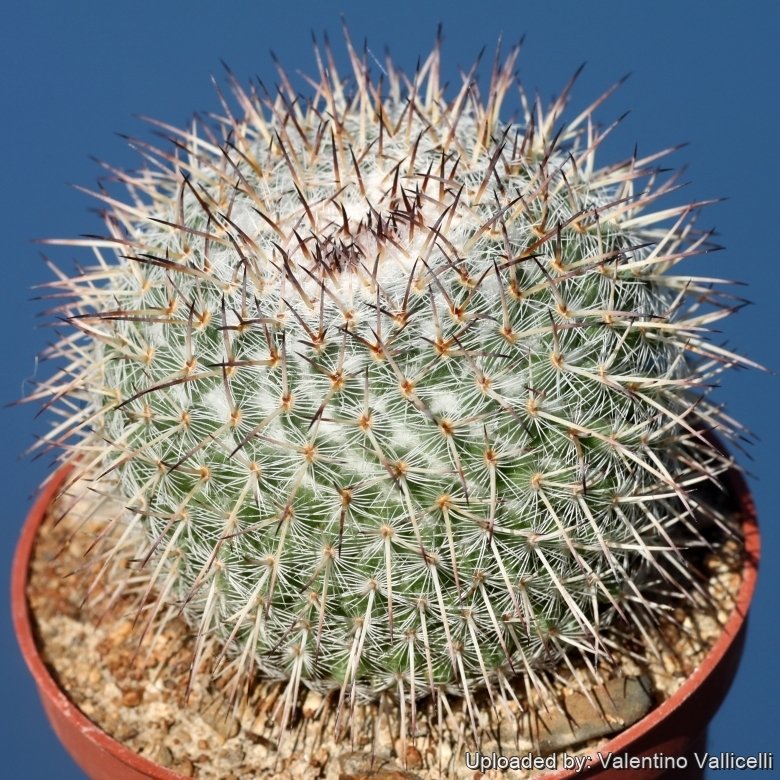
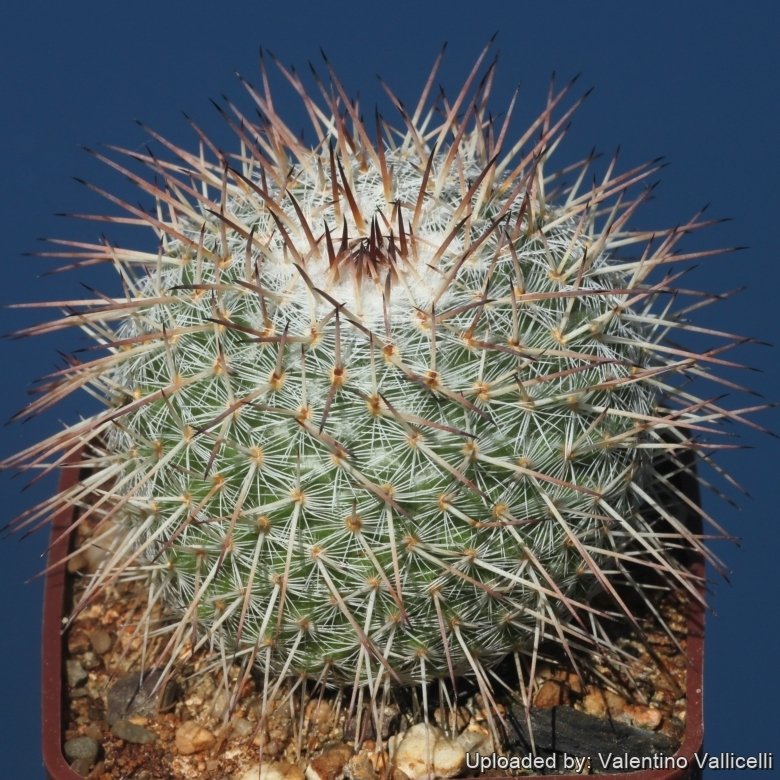
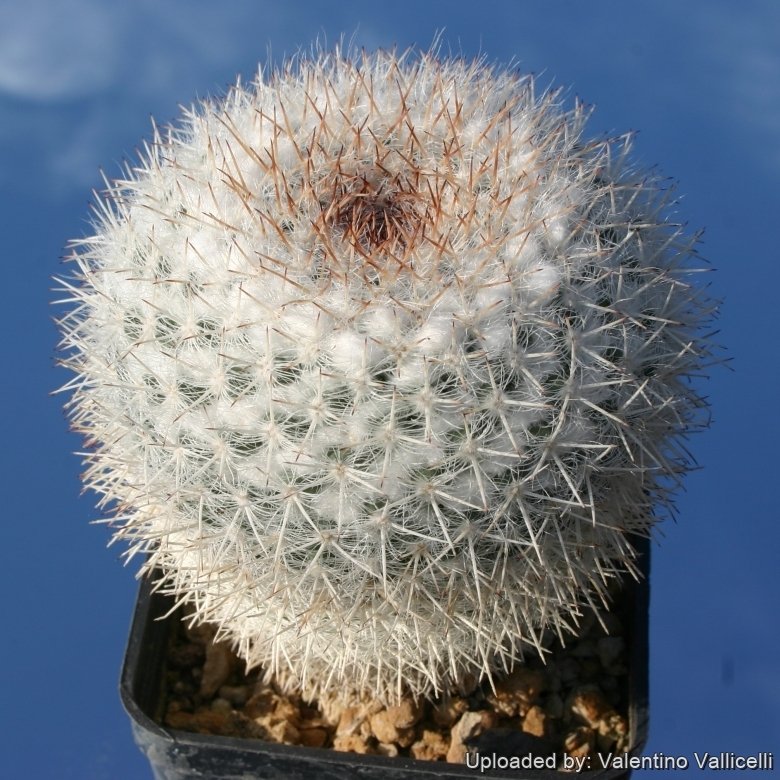
Mammillaria parkinsonii is a woolly, mound forming species, that, as it ages, tufts by dichotomic division forming compact bunches up to 60 cm in diameter (or more). This species is especially variable in spine length.
Stem: Glaucous green, globose to shortly cylindrical up to about 15 cm tall, 8 to 15 cm wide, slightly depressed at apex, covered at the centre by a white wool;
Tubercles: Spirally arranged, 8-10 mm long, 4-6 mm broad, pyramidal, with latex, axil woolly and silky.
Areoles: At first with abundant white felt, becoming naked as they ages.
Central spines: 2 (sometime 3-4 or rarely 5) usually bent downwards, rigid and whitish with dark brown tips, often purple red coloured on the new growth, the upper one, 4-8 mm long, the lower one up to 35 mm long often subulate.
Radial spines: 20-30 (or more) white, thin and slightly bent, 4-6 mm long.
Flowers: Diurnal, funnel-shaped, pale yellow with a central brownish or pinkish midvein, 12-15 mm long and in diameter, inner perianth segments apiculate; stigma lobes elongated. The flowers born in a circle close to the apex and originate from the areolae at the base of the tubercles. Flowers bud are surrounded by a mass of white wool.
Fruits: Club-shaped, about 10 mm long, orange red to scarlet.
Seeds: Pyriform, about 1,5 mm long, brown, edible.
Origin and Habitat
This species is endemic to Central Mexico, where it occurs in the state of Querétaro de Arteagaand into Hidalgo along the border of the Querétaro river. Extent of occurrence ca 2,500 km2
Altitude: 1.200-2.400 metres over sea level
Habitat: Mammillaria parkinsonii grows on lime rich soils and calcareous substrate in semi-desert areas characterized by warm-temperate and dry climate. It is severely fragmentation in small sub-populations and occurs in xerophyllous scrub and submontane matorral. Illegal collection and land use change are threats across the range of the species. This cactus is used as an ornamental, and is normally found elsewhere as propagated plants.
Cultivation and Propagation
It is a summer grower plant cultivated and appreciated by the collectors as it offers no cultivation difficulties.
Growing substrate: Needs a loose free draining mix which can be formed by about the 30-50% of common, manured, garden earth and for the rest, in equal quantity, by pumice or lava grit and sand (or agriperlite).
Watering: Water regularly in summer (but do not overwater ), but allowing the mould to dry up completely before giving water again, keep rather dry in winter, this resting period, cool and dry, is indispensable for a good blossoming.
Fertilization: Feed with a high potassium fertilizer in summer.
Hardiness: It is quite frost resistant if kept dry (hardy to -5° C) but for a safe cultivation avoid freezing temperatures.
Sun Exposure: Needs full sun or, however, at the maximum possible luminosity, but can tolerate light shade.
Maintenance: In order to keep the clumps compact, high light levels and steady growth are needed; otherwise there is the danger of having a number of elongated heads that are somewhat separated from one another. Frequent transplantations of the young plants protect the lower part of the stem from the lignification, to which the plant has a tendency.
Reproduction: It is propagated by seed. Sometimes old plants divide at their apex, ramifying dichotomously - to form two or more distinct joints - but the removal of one of these joints may prove fatal to the plant.
Notes
This is one of the Mammillaria commonly called “Owl Eye Cactus”, known for dichotomous branching (forking or dividing into two parts). Although dichotomous branching is not a common occurrence in cacti in general, it happens for some reason in this particular species. What is interesting about this cactus is that it began as a single head, one head became two, and so on. Other Owl Eye Cactus among others comprise Mammillaria karwnskiana, Mammillaria formosa, Mammillaria microthele and Mammillaria perbella.
Bibliography
Major references and further lectures.
-
Sánchez , E., Guadalupe Martínez, J. & Bárcenas Luna, R. 2013. Mammillaria parkinsonii. The IUCN Red List of Threatened Species. Version 2014.2. <www.iucnredlist.org>. Downloaded on 02 November 2014.
-
Wikipedia contributors. “Mammillaria parkinsonii.” Wikipedia, The Free Encyclopedia. Wikipedia, The Free Encyclopedia, 15 May. 2014. Web. 2 Nov. 2014.
-
Robert T. Craig “The Mammillaria handbook: with descriptions, illustrations, and key to the species of the genus Mammillaria of the Cactaceae” E P Publishing, 1945
-
John Pilbeam “Mammillaria The Cactus File Handbook” Cirio Pub. Services, 01/Dec/1999Edward Anderson “The Cactus family” Timber Press, Incorporated, 2001
-
James Cullen, Sabina G. Knees, H. Suzanne Cubey “The European Garden Flora Flowering Plants: A Manual for the Identification of Plants Cultivated in Europe, Both Out-of-Doors and Under Glass” Cambridge University Press, 11/Aug/2011
-
David R Hunt; Nigel P Taylor; Graham Charles; International Cactaceae Systematics Group. “The New Cactus Lexicon” dh books, 2006
From llifle page Mammillaria auriareolis
Origin and Habitat
Queretaro & Guanajuato, Mexico (Northern America)
Source: Mammillaria auriareolis, LLIFLE - Encyclopedia of living forms, CC-BY-SA, retrieved 2026-10-25.
From llifle page Mammillaria cadereytensis
Description
Simple or dichotomicously branched (occasionally ramifies , producing a few basal shoots) with short dense spines and wools.
Stem: Symmetrically globose at first, later cylindrical, with a depressed apex that appears completely white. Up to 12 cm tall, dull green and may, with age, become rubberized at its base. With latex.
Tubercles: Short cylindrical/conical firm, 6-7 mm long and 2 mm wide, arranged in numerous, very close-set spirals. The Axil is woolly with bristles in the floriferous portion.
Areoles: Oval and woolly when young.
Roots: Fibrous.
Radial spines: up to 30, short, 3-5 mm long, acicular, straight, somewhat horizontal radiating and arranged laterally on each side of the tubercle, white.
Central spines: 4-6 up to 1 cm long, subulated, rigid, divergent, one pointing upwards and often longer, smooth, thicker at base, they are reddish with a darker tip.
Flowers: Small, funnelform, 10-12 mm long and in diameter, yellowish with darker reddish midstripe.
Fruits: Attractively deep dull pinkish-red coloured. Club-shaped, 10-15 mm long and 2-3 mm wide.
Seeds: Pear-shaped, reddish-brown.
Origin and Habitat
Central Mexico, Queretaro (Typical locality: Cadereyta de Montes)
Habitat: On hills between rocks in humus soil on the limestone slopes. Altitude 1700-1330 m
Cultivation and Propagation
This plant is easy to cultivate but very slow growing. Cultivate it in a well drained and mineral substratum. Water regularly, avoid the use of peat or other humus sources in the potting mixture. It need full sun, so it keep a compact and flat shape. It does not tolerate intense cold, but tolerates some cold if kept dry. Frequent transplantations of the young plants protect the lower part of the stem from the lignification, to which the plant has a tendency.
Reproduction: It is propagated by seed. Sometimes old plants divide at their apex, ramifying dichotomously - to form two or more distinct joints - but the removal of one of these joints may prove fatal to the plant.
Notes
There is a lot a confusion about this species, hunt and Anderson consider it a form of Mammillaria perbella which forms dense clumps by dichotomous division, but it is clearly evident from the photos showed in the original description by Craig that they are not exactly the same. The M. cadereytensis is actually considered (Pilbeam) a short spined variant of Mammillaria parkinsonii.
Source: Mammillaria cadereytensis, LLIFLE - Encyclopedia of living forms, CC-BY-SA, retrieved 2026-10-25.
From llifle page Mammillaria dietrichiae
Origin and Habitat
Querétaro (Mexico, Northern America)
Source: Mammillaria dietrichiae, LLIFLE - Encyclopedia of living forms, CC-BY-SA, retrieved 2026-10-25.
From llifle page Neomammillaria parkinsonii var. brevispina
Origin and Habitat
Central Mexico, Mexico (Northern America)
Source: Neomammillaria parkinsonii var. brevispina, LLIFLE - Encyclopedia of living forms, CC-BY-SA, retrieved 2026-10-25.
From llifle page Mammillaria morganiana
Origin and Habitat
Guanajuato (Mexico, Northern America)
Source: Mammillaria morganiana, LLIFLE - Encyclopedia of living forms, CC-BY-SA, retrieved 2026-10-25.
Cultivars and forms (4)
Gallery