Publication: Hort. Reg. Monac. (1829) 127, nomen; et in Nov. Actorum Acad. Caes. Leop.-Carol. German. Nat. Cur. 16(1): 328, pl. 19 328 1832.
Description
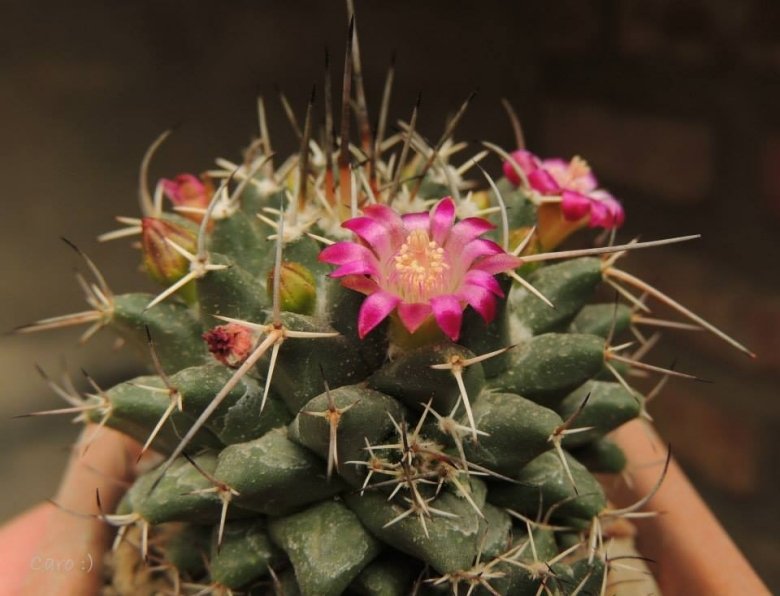
Mammillaria polythele is a single stemmed cactus with pink-purplish flowers in a ring around the top of the stem. It is covered by crowded tubercles bearing 2 to 4 spines and abundant wool in their axils, so that the wool nearly covering the top of the plant, in age becoming naked. Three subspecies are recognized, the nominate subspecies subsp. durispina (Boed.) D.R.Hunt, and subspecies obconella (Scheidw.) D.R.Hunt.
Stems: Elongated, cylindrical, usually erect but sometimes sprawling, dull green to dark bluish green, 30 to 60 cm high (rarely to 80), 5 to 15 cm in diameter(rarely to 17), but flowering just when 5 x 5 cm. Typical subsp. polythele, has stems 8-10 cm in diameter.
Tubercles: Prominent, globular pyramidal-conical, nearly terete, teat-like,somewhat narrowed toward apex, 9-14 long, 8 mm in diameter, milky, in about 21 spirals axils of young tubercles densely long-woolly, the wool nearly covering the top of the plant, in age becoming naked without axillary bristles.
Central spines: Looking like radials and often confused with them, sometimes only 2 at first (in subsp. polythele) and pointing up and down, later 3-4 or more, somewhat spreading, unequal, pale to dark brown, sometimes reddish brown, in some variants yellowish, 8-17 (rarely to 25) mm long.
Radial: Absent or rudimentary.
Flowers: From near top of plant, rose to pinkish purple, to 8-19 mm long ,10-14 mm in diameter; perianth-segments narrow, acuminate.
Blooming season: Summer.
Fruits: Club shaped, dull red or purplish.
Seeds: Small brownish to dark brown.
Origin and Habitat
Mammillaria polythele is endemic to Mexico, where it occurs in the states of Hidalgo, Querétaro, and Guanajuato. This species is widespread, common and abundant across its range.
Altitude range: It grows at elevations of 1,700 to 2,400 metres above sea level.
Habitat and Ecology: The species grows among quite dense vegetation, with Sedum humifusum and Calibanus hookeri, and in semishade (Pilbeam 1999). It grows in xerophyllous shrubland and in oak forests. Accompanying cactus species can be: Opuntia robusta, Opuntia streptacantha, Myrtillocactus geometrizans, Coryphantha erecta and Ferocactus latispinus. There are several threats affecting subpopulations. Illegal trade of wild specimens has been reported and the plants are also used locally for consumption and ornamental use. It is also threatened by overgrazing by goats and deforestation of oak forests but the species is not declining at a rate sufficient to warrant listing in a threatened category.
Cultivation and Propagation
In good conditions with careful application of water and excellent ventilation Mammillaria polythele grows without difficulty.
Growing rate: It is a slow growing species that rewards the patient grower with a beautiful displays of flowers since from an early age.
Soil: Requires good drainage provided by a very permeable open cactus soil (With not less than 50% grit content). Reduce the use of peat or other humus sources in the potting mixture.
Repotting: Repot every 2-3 years. Use small sized pots.
Feeding: During the beautiful season enrich the soil using a fertilizer rich in potassium and phosphorous, but poor in nitrogen, because this chemical element doesn’t help the development of succulent plants, making them too soft and full of water.
Watering: Water should be carefully applied and only when the soil is dry to the touch. Allow soil to drain thoroughly before watering again. Additionally, water should not be applied from above, as the feathery spines will retain water and add to rotting problems, but in good conditions with excellent ventilation, in bright light, it usually grows without particular difficulty. Do not water in the winter.
Light: Outside full sun or afternoon shade, inside it needs bright light, and some direct sun. Direct sun encourages flowering and heavy spine production.
Hardiness: Protect from frost. But it’s hardy to -5°C if kept dry. A winter rest that allows the plant to shrivel (perhaps losing up to 25% of its summer height) will encourage flowering and long time survival.
Pests & diseases: It may be attractive to a variety of insects, but plants in good condition should be nearly pest-free, particularly if they are grown in a mineral potting-mix, with good exposure and ventilation. Nonetheless, there are several pests to watch for:
- Red spiders: Red spiders may be effectively rubbed up by misting the vulnerable plants every day
- Mealy bugs: occasionally they develop aerial into the new growth among the wool with disfiguring results, but the worst types develop underground on the roots and are invisible except by their effects.
- Scales: Scales are rarely a problem.
- Rot: it is only a minor problem with cacti if the plants are watered and “aired” correctly. If they are not, fungicides won’t help all that much.
Propagation: Direct sow after last frost. Seeds germinate in 7-14 days at 21-27° C in spring, remove gradually the glass cover as soon the plants will be well rooted (ca 1-2 weeks) and keep ventilated, no full sun for young plants!
Bibliography
Major references and further lectures
-
Gómez-Hinostrosa, C., Sánchez , E., Bárcenas Luna, R. & Guadalupe Martínez, J. 2013. Mammillaria polythele. The IUCN Red List of Threatened Species. Version 2014.3. <www.iucnredlist.org>. Downloaded on 09 May 2015.
-
Mammillaria polythele in: Bradleya 4: 52 1986
-
David Hunt, Nigel Taylor “The New Cactus Lexicon” DH Books, 2006
-
John Pilbeam (1999) “Mammillaria The Cactus File Handbook” Nuffield Press.
-
Edward F. Anderson “The Cactus Family” Timber Press, 2001
-
James Cullen, Sabina G. Knees, H. Suzanne Cubey “The European Garden Flora Flowering Plants: A Manual for the Identification of Plants Cultivated in Europe, Both Out-of-Doors and Under Glass”Cambridge University Press, 11/August/2011
-
Nathaniel Lord Britton, Joseph Nelson Rose “Cactaceae: Descriptions and Illustrations of Plants of the Cactus Family” vol. 4 The Carnegie Institution of Washington, Washington 1923
From llifle page Mammillaria kewensis
Description
Mammillaria kewensis is one of the innumerable forms of Mammillaria polythele which is one of the most widespread and morphologically variable taxon. In the past there were a number of names amongst Mammillaria polythele (at least 11 varieties), but all this varieties merge gradually one with another through a continuous series of transitional forms and it is almost impossible to tell them apart, and now the names Mammillaria kewensis is not accepted by many botanists that treat it as synonym, but it still has a value for a collector because they identify plants with particular characters.
Stem: Globose to cylindric, 3 to 4 cm. in diameter.
Tubercles: Short, terete, when young short-woolly in the axils and at the areoles. Axils of tubercles bearing crisp hairs.
Central spines: Looking like radials and often confused with them, sometimes only 2 at first and pointing up and down, of which the lowermost longer, later 3 to 6, somewhat spreading, brown with dark tips, 4-17 (rarely to 25) mm long.
Radial: Absent or rudimentary.
Flowers: About 15 mm long, reddish purple; perianth-segments lanceolate, acute; stigma-lobes 5, reddish.
Origin and Habitat
Querétaro, Guanajuato, Hidalgo, Mexico
Altitude range: 1700-2250 metres above sea level.
Cultivation and Propagation
In good conditions with careful application of water and excellent ventilation Mammillaria kewensis grows without difficulty.
Growing rate: It is a slow growing species that rewards the patient grower with a beautiful displays of flowers since from an early age.
Soil: Requires good drainage provided by a very permeable open cactus soil (With not less than 50% grit content). Reduce the use of peat or other humus sources in the potting mixture.
Repotting: Repot every 2-3 years. Use small sized pots.
Feeding: During the beautiful season enrich the soil using a fertilizer rich in potassium and phosphorous, but poor in nitrogen, because this chemical element doesn’t help the development of succulent plants, making them too soft and full of water.
Watering: Water should be carefully applied and only when the soil is dry to the touch. Allow soil to drain thoroughly before watering again. Additionally, water should not be applied from above, as the feathery spines will retain water and add to rotting problems, but in good conditions with excellent ventilation, in bright light, it usually grows without particular difficulty. Do not water in the winter.
Light: Outside full sun or afternoon shade, inside it needs bright light, and some direct sun. Direct sun encourages flowering and heavy spine production.
Hardiness: Protect from frost. But it’s hardy to -5°C if kept dry. A winter rest that allows the plant to shrivel (perhaps losing up to 25% of its summer height) will encourage flowering and long time survival.
Pests & diseases: It may be attractive to a variety of insects, but plants in good condition should be nearly pest-free, particularly if they are grown in a mineral potting-mix, with good exposure and ventilation. Nonetheless, there are several pests to watch for:
- Red spiders: Red spiders may be effectively rubbed up by misting the vulnerable plants every day
- Mealy bugs: occasionally they develop aerial into the new growth among the wool with disfiguring results, but the worst types develop underground on the roots and are invisible except by their effects.
- Scales: Scales are rarely a problem.
- Rot: it is only a minor problem with cacti if the plants are watered and “aired” correctly. If they are not, fungicides won’t help all that much.
Propagation: Direct sow after last frost. Seeds germinate in 7-14 days at 21-27° C in spring, remove gradually the glass cover as soon the plants will be well rooted (ca 1-2 weeks) and keep ventilated, no full sun for young plants!
Bibliography
Major references and further lectures
- Nathaniel Lord Britton, Joseph Nelson Rose “Cactaceae: Descriptions and Illustrations of Plants of the Cactus Family” vol. 4 The Carnegie Institution of Washington, Washington 1923
Source: Mammillaria kewensis, LLIFLE - Encyclopedia of living forms, CC-BY-SA, retrieved 2026-10-25.
From llifle page Mammillaria neophaeacantha
Origin and Habitat
Guanajuato (Mexico, Northern America)
Source: Mammillaria neophaeacantha, LLIFLE - Encyclopedia of living forms, CC-BY-SA, retrieved 2026-10-25.
From llifle page Mammillaria xochipilli
Origin and Habitat
San Jose del Oro, Hidalgo (Mexico, Northern America)
Source: Mammillaria xochipilli, LLIFLE - Encyclopedia of living forms, CC-BY-SA, retrieved 2026-10-25.
Cultivars and forms (7)
Varieties (1)
Cultivars (1)
Other names (1)
Gallery