Publication: Syn. Pl. Succ. 177 (1812)
Description
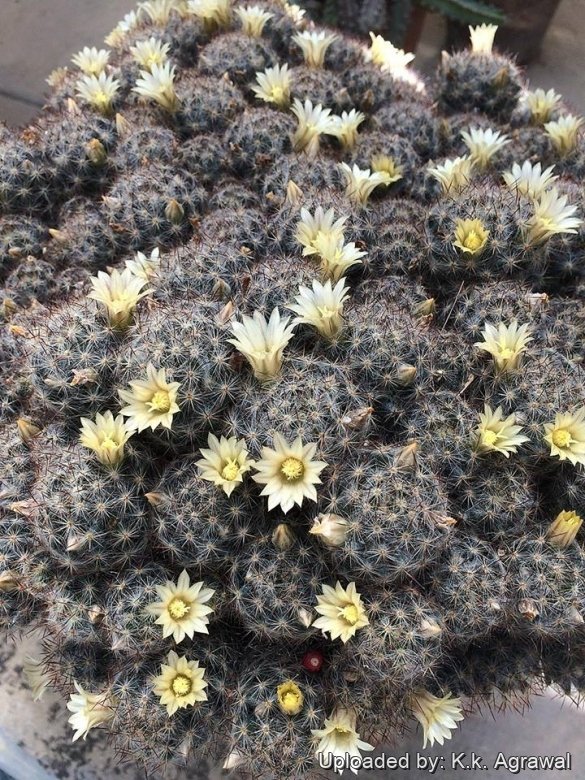
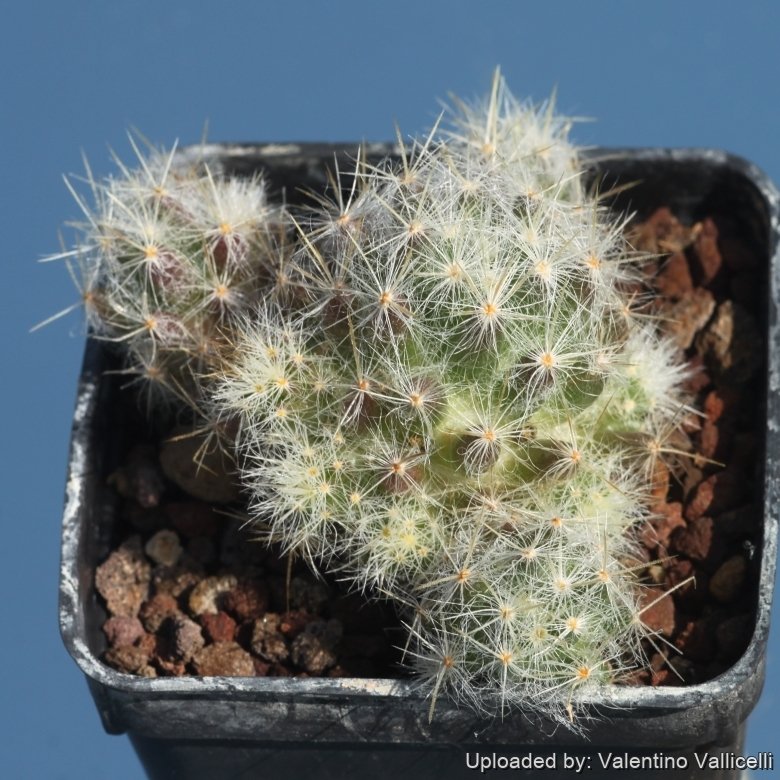
Mammillaria prolifera is a low growing cactus, commonly branching to form colonies often 6 dm in diameter. Four subspecies are recognized, the nominate subspecies, subspecies arachnoidea (D.R.Hunt) D.R.Hunt, subspecies haitiensis and subspecies multiceps (Salm-Dyck) U.Guzmán (including subsp. texana (Engelm.) D.R.Hunt.).
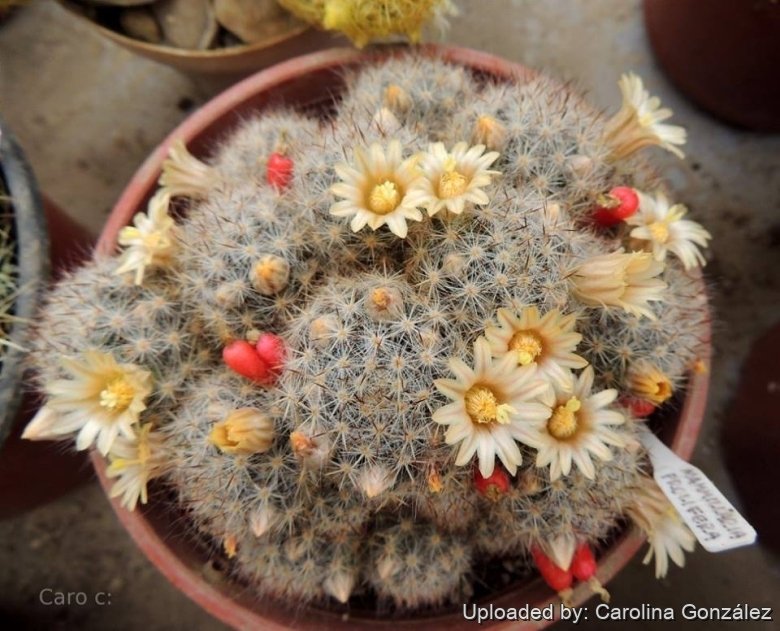
Stems: The individual stems dark green, globose, cylindric or club shaped to 9 cm high, 3 to 7 cm in diameter (6-7 cm in diameter in subsp. prolifera), of soft texture.
Tubercles: Cylindrical to conic, about 8 mm long, spreading, without latex, Axils of tubercles with several long, hair-like bristles.
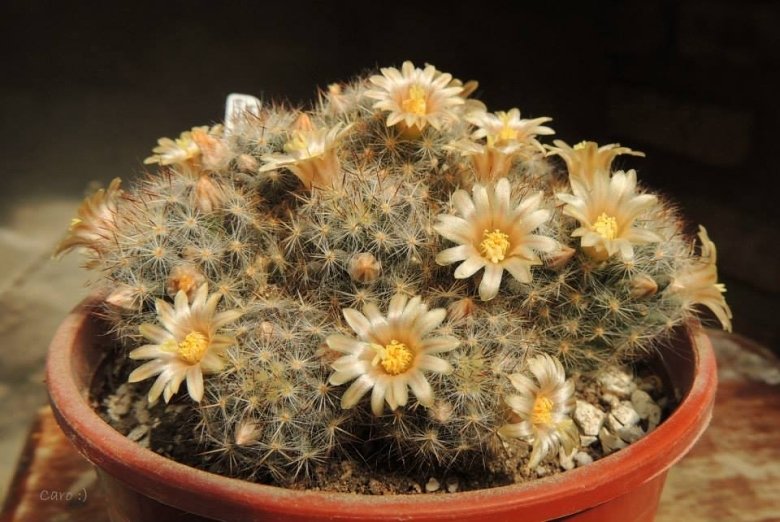
Radial spines: 25-40, hair-like, often intergrading with the centrals, straight or twisted, white to yellow to brown, 3-12 mm long.
Central spines: 5 to 12, needle-like, puberulent, 4-9 mm long, much stouter than the radials, straight, white to yellow to reddish, with darker tips (Typcally yellow in subsp. prolifera).
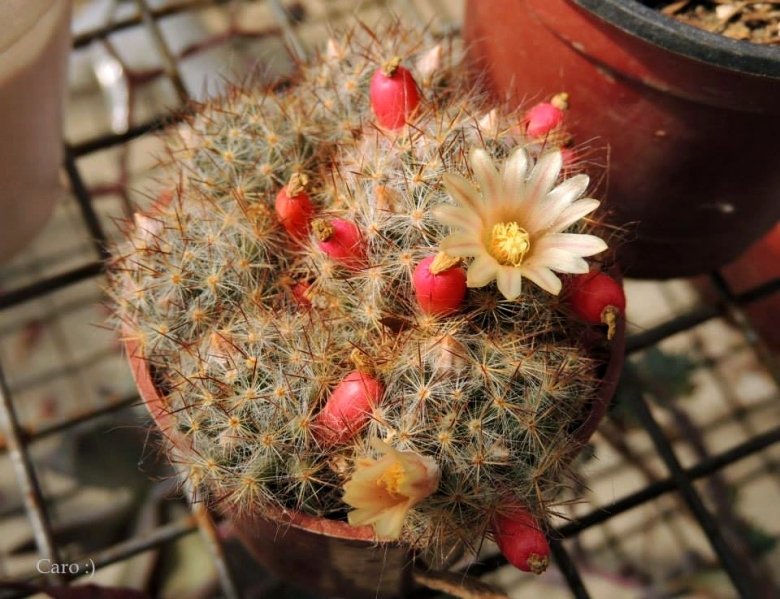
Flowers: 10-18 mm long, borne in old axils but toward top of plant, small, yellowish white, cream or pinkish yellow. Inner perianth-segments erect, pale yellow, with brownish mid-rib, acute; filaments pale rose-coloured; anthers at first deflexed inward; style shorter than filaments; stigma-lobes 3, yellow.
Fruit: Crowned by persistent withering perianth, club shaped to cylindrical, somewhat curved, 1.5 to 2 cm long, scarlet.
Seeds: Black, pitted, a little depressed; aril white, triangular.
Origin and Habitat
The species occurs very widely from Mexico (Coahuila, Nuevo León, Querétaro, San Luis Potosí and Tamaulipas), the USA (Texas), Cuba, the Dominican Republic, and Haiti. The typical subspecies prolifera occurs throughout much of the Caribbean.
Altitude range: It is found at elevations of 400 to 2,250 metres above sea level.
Habitat and Ecology: The species grows in submontane scrub. In Texas, it occurs in grasslands at low elevations and in Cuba, the plant grows in low, dry thicket. Mammillaria prolifera is quite inconspicuous but has a very large extent of occurrence and is abundant. Although there are threats in places (habitat destruction through logging), they are not sufficient to warrant any concern.
Cultivation and Propagation
Mammillaria prolifera is a freely clustering species that reproduces easily by cutting, recommended for any collection that needs lots of light with ample airflow. Given the kind of care used on any but the desert forms of cacti, even in a small pot, this little cactus will grow and proliferate its small heads into an interesting cluster.
Growth rate: It is a small growing, but easily flowering species. It offset from the base and can fill a 25 cm pot in just a few years given the best conditions.
Soils: It likes very porous standard cactus mix soil with little organic matter (peat, humus).
Repotting: Repotting every 2-3 years. It will need a pot with sufficient depth to allow the tap root. As it is especially prone to rot under-pot in a smaller container filled with very porous compost. Use pot with good drainage.
Watering: Water regularly in summer, but do not overwater (very wet-sensitively, especially in light of its succulent root system). Its roots are easily lost in pots that stay damp for any length of time. Keep dry with ample airflow in winter. In the rest period no high atmospheric humidity!! Care must be taken with watering as they tends to become swollen and untidy in growth habit if given too much water and shade.
Fertilization: During the growing season enrich the soil using a fertilizer rich in potassium and phosphorous, but poor in nitrogen, because this chemical element doesn’t help the development of succulent plants, making them too soft and full of water.
Hardiness: Reputedly sensitive to frost , but less so if kept on the dry side prior to, and during, cold weather (hardy to -5° C for short periods). However some warmth throughout the year will increase the grower’s success (minimum 5° to 8°C during rest season).
Exposition: Outside bright sun, filtered sunlight or afternoon shade, inside it needs bright light, and some direct sun. Subject to sunburn if exposed to direct sun for too long. Tends to bronze in strong light, which encourages flowering and heavy wool and spine production.
Uses: It is an excellent plant for container growing. It always looks good and stays small. It look fine in a cold greenhouse and frame.
Pests & diseases: It may be attractive to a variety of insects, but plants in good condition should be nearly pest-free, particularly if they are grown in a mineral potting-mix, with good exposure and ventilation. Nonetheless, there are several pests to watch for:
- Red spiders: Sensitive to red spider mite. Overhead watering is helpful in controlling mites.
- Mealy bugs: Occasionally mealy bugs they develop aerial into the new growth among the wool with disfiguring results, but the worst types develop underground on the roots and are invisible except by their effects.
- Scales: Scales are rarely a problem.
- Rot: Rot it is only a minor problem with cacti if the plants are watered and “aired” correctly. If they are not, fungicides won’t help all that much.
Propagation: Direct sow after last frost or (usually) cuttings. Seeds germinate in 7-14 days at 21-27° C in spring, remove the glass cover gradually as the plants develops and keep ventilated, no full sun for young plants! The seedlings should not be disturbed until they are well rooted, after which they can be planted separately in small pots. Cuttings: wait until the offsets that appear at the base of old clustered specimens are 1/3 the size of the parent and then detach and plant. Cuttings will take root in a minimum temperature of 20° C (but better in hot weather). Cuttings of healthy shoots can be taken in the spring and summer. Cut the stem with a sharp, sterile knife, leave the cutting in a warm, dry place for a week or weeks (depending on how thick the cutting is) until a callus forms over the wound. Once the callus forms, the cutting may be inserted in a container filled with firmed cactus potting mix topped with a surface layer of coarse grit. They should be placed in the coarse grit only; this prevents the cut end from becoming too wet and allows the roots to penetrate the rich compost underneath. The cuttings should root in 2 to 6 weeks.
Bibliography
Major references and further lectures
-
Nathaniel Lord Britton, Joseph Nelson Rose “Cactaceae: Descriptions and Illustrations of Plants of the Cactus Family” vol. 4 The Carnegie Institution of Washington, Washington 1923
-
Goettsch, B.K., Gómez-Hinostrosa, C. & Terry, M. 2013. Mammillaria prolifera. The IUCN Red List of Threatened Species. Version 2014.3. <www.iucnredlist.org>. Downloaded on 01 April 2015.
-
Ulises Guzmán, Salvador Arias, Patricia Dávila “Catálogo de cactáceas mexicanas. Universidad Nacional Autónoma de México” Mexiko-Stadt 2003
-
John Pilbeam “Mammillaria The Cactus File Handbook” Cirio Pub. Services, 01/December/1999
-
Edward Anderson “The Cactus family” Timber Press, Incorporated, 2001
-
James Cullen, Sabina G. Knees, H. Suzanne Cubey “The European Garden Flora Flowering Plants: A Manual for the Identification of Plants Cultivated in Europe, Both Out-of-Doors and Under Glass” Cambridge University Press, 11/August /2011
-
David R Hunt; Nigel P Taylor; Graham Charles; International Cactaceae Systematics Group. “The New Cactus Lexicon” dh books, 2006