Publication: Cact. Aliq. Nov. Desc. 4. 1838
Description
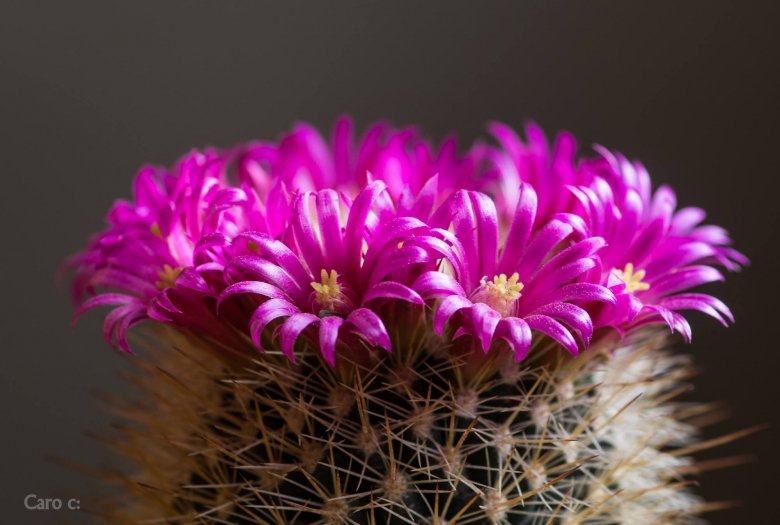
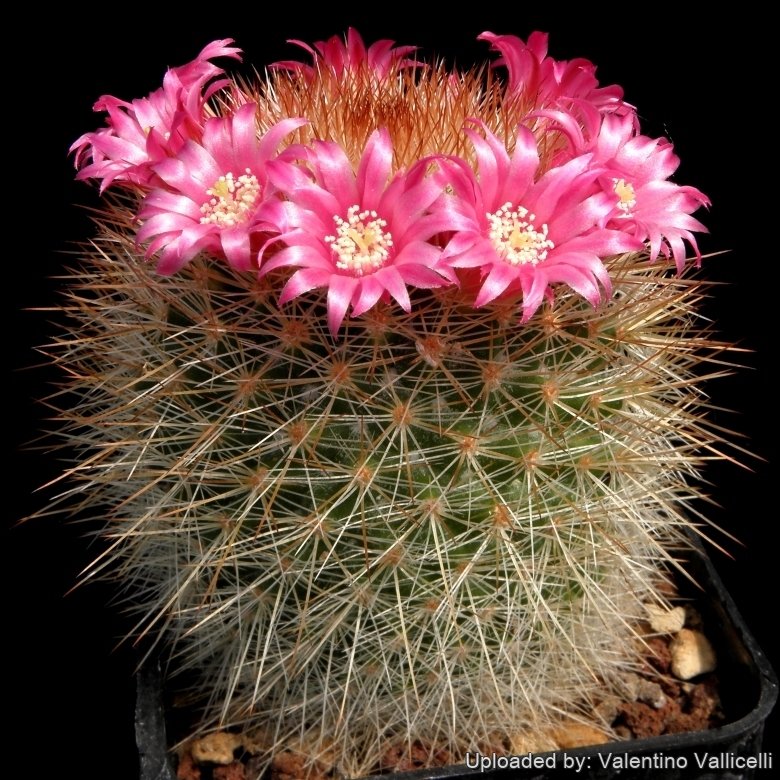
Mammillaria spinosissima is commonly cultivated around the world, often found in plant nurseries and private collections, and is nicknamed the “red-headed Irishman” because the most common cultivated forms have red or rust spine.
Habit: Simple at first. later often clustering.
Stem: Cylindrical, dark blue-green 7-30(-50) cm. long (2,5)6-7(-10) cm. in diameter, almost hidden under a dense covering of spines;
Tubercles: Very short, ovate conical, four-sided basally, 2 to 3 mm long; axils of tubercles setose but usually lacking bristles. Usually without latex.
Spines: Thin, needle-like, usually weak, hardly pungent, but variable.
Radial spines: 20 to 26, straight, whitish, white to dirty white to yellow to deep reddish brown, 4-6(-10) mm long.
Central spines: 4 to 15, bristle-like, 1-1,5(-2) cm long, reddish or pinkish brown, or yellowish, stouter than the radials.
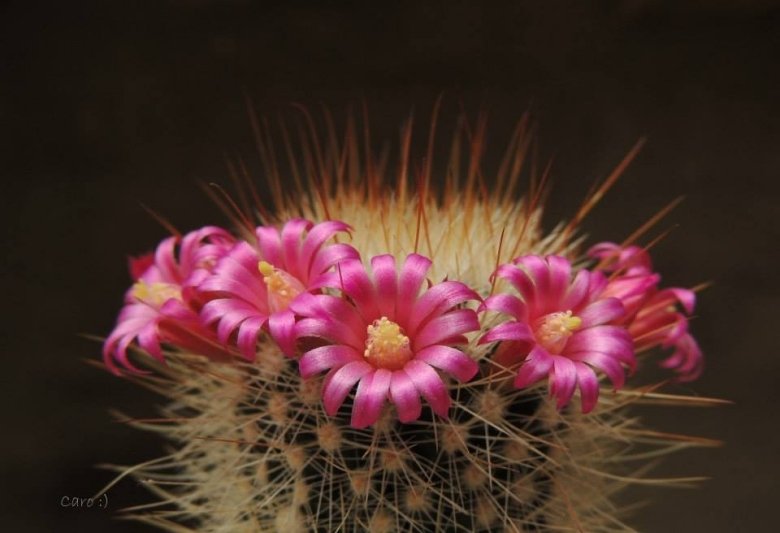
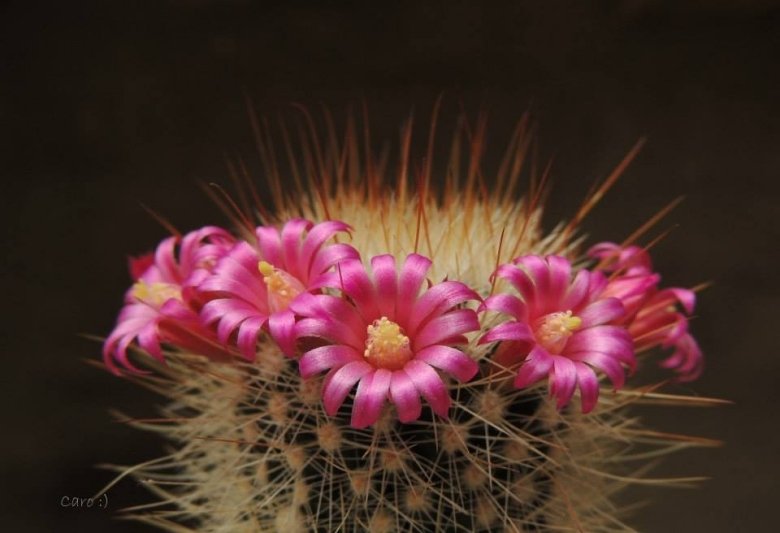
Flowers: Flowers from the upper part of the plant in a ring shape around the apex, purplish or deep-pink, 12-20 mm long, 15 mm in diameter; inner perianth-segments acute; filaments much shorter than the perianth-segments, purple. Self fertile.
Blooming season: Spring
Fruit: Club shaped up to 20 mm long, greenish to dull purple.
Seeds: Reddish brown.
Taxonomic note: Mammillaria spinosissima is a poorly known taxon, there are taxonomic uncertainties concerning its validity. It is very variable due to it’s wide area of origin in Mexico and spines ranges in colour from white, to yellow, red or brown. There are several different subspecies and cultivars. Three subspecies are recognized, the nominate subspecies, subspecies pilcayensis (Bravo) D.R.Hunt and subspecies tepoxtlana D.R.Hunt.
Origin and Habitat
Mammillaria spinosissima is endemic to mountains of central Mexico. (Morelos, Guerrero, and Mexico State)
Altitude: 1600-1900 meters above sea level.
Habitat: The species occurs in tropical dry forests and xerophyllous scrub. Accompanying species can be: Hechtia glomerata, Echeveria gibbiflora, Oxalis deppei and Agave horrida.
Cultivation and Propagation
Mammillaria sponosissima is an easy to grow cultivar, just as a classic cactus, don’t requires any special treatment, but need as much light as possible without burning the plant to encourage the heaviest spine formation. It is a great starter plant for the cactus grower, that readily builds up into a cluster of stems highlighted by reddish spines, further decorated by rings of purple-pink blooms.
Growth rate: It is a rapidly growing species. It offset from the base and can fill a 25 cm pot in just a few years given the best conditions.
Soils: It likes very porous standard cactus mix soil with little organic matter (peat, humus).
Repotting: Repotting every 2-3 years. As it is prone to rot under-pot in a smaller container filled with very porous compost. Use pot with good drainage.
Watering: Water regularly in summer, but do not overwater (very wet-sensitively, especially in light of its succulent root system). Its roots are easily lost in pots that stay damp for any length of time. Keep dry with ample airflow in winter. In the rest period no high atmospheric humidity!! Care must be taken with watering as they tends to become swollen and untidy in growth habit if given too much water and shade.
Fertilization: During the growing season enrich the soil using a fertilizer rich in potassium and phosphorous, but poor in nitrogen, because this chemical element doesn’t help the development of succulent plants, making them too soft and full of water.
Hardiness: It is quite frost resistant if kept dry, hardy as low as -5° C (some reports give it hardy to -12°C). However some warmth throughout the year will increase the grower’s success (minimum 5° to 8°C during rest season).
Exposition: Outside bright sun, filtered sunlight or afternoon shade, inside it needs bright light, and some direct sun. Subject to sunburn if exposed to direct sun for too long. Tends to bronze in strong light, which encourages flowering and heavy wool and spine production.
Uses: It is an excellent plant for container growing. It always looks good and stays small. It look fine in a cold greenhouse and frame.
Traditional uses: The white, hooked spines of this spherical cactus were used as fish hooks in its native Mexico.
Pests & diseases: It may be attractive to a variety of insects, but plants in good condition should be nearly pest-free, particularly if they are grown in a mineral potting-mix, with good exposure and ventilation. Nonetheless, there are several pests to watch for:
- Red spiders: Sensitive to red spider mite. Overhead watering is helpful in controlling mites.
- Mealy bugs: Occasionally mealy bugs they develop aerial into the new growth among the wool with disfiguring results, but the worst types develop underground on the roots and are invisible except by their effects.
- Scales: Scales are rarely a problem.
- Rot: Rot it is only a minor problem with cacti if the plants are watered and “aired” correctly. If they are not, fungicides won’t help all that much.
Propagation: Direct sow after last frost or (usually) or division . Seeds germinate in 7-14 days at 21-27° C in spring, remove the glass cover gradually as the plants develops and keep ventilated, no full sun for young plants! The seedlings should not be disturbed until they are well rooted, after which they can be planted separately in small pots. Cuttings: wait until the offsets that appear at the base of old clustered specimens are 1/3 the size of the parent and then detach and plant. Cuttings will take root in a minimum temperature of 20° C (but better in hot weather). Cuttings of healthy shoots can be taken in the spring and summer. Cut the stem with a sharp, sterile knife, leave the cutting in a warm, dry place for a week or weeks (depending on how thick the cutting is) until a callus forms over the wound. Once the callus forms, the cutting may be inserted in a container filled with firmed cactus potting mix topped with a surface layer of coarse grit. They should be placed in the coarse grit only; this prevents the cut end from becoming too wet and allows the roots to penetrate the rich compost underneath. The cuttings should root in 2 to 6 weeks.
Bibliography
Major references and further lectures
-
Edward Anderson “The Cactus family” Timber Press, Incorporated, 2001
-
James Cullen, Sabina G. Knees, H. Suzanne Cubey “The European Garden Flora Flowering Plants: A Manual for the Identification of Plants Cultivated in Europe, Both Out-of-Doors and Under Glass” Cambridge University Press, 11/August/2011
-
David R Hunt; Nigel P Taylor; Graham Charles; International Cactaceae Systematics Group. “The New Cactus Lexicon” dh books, 2006
-
Haustein, Erik “Der Kosmos-Kakteenführer” Franckh-Kosmos 1983
-
John Pilbeam “Mammillaria: the cactus file handbook” Cirio Publishing Services Ltd December/30/1999
-
Willy Cullmann, Erich Götz, Gerhard Gröner, “Kakteen: Kultur, Vermehrung und Pflege. Lexikon der Gattungen und Arten. Fünfte, völlig neubearbeitete und neugestaltete Auflage.” Stuttgart, Eugen Ulmer Verlag 1984
-
N. L. Britton, J. N. Rose “The Cactaceae. Descriptions and Illustrations of Plants of the Cactus Family.” Volume IV, The Carnegie Institution of Washington, Washington 1923
-
Ulises Guzmán “Catálogo de cactáceas mexicanas.” Universidad National Autonoma de México, Mexico-State 2007.
-
Goettsch, B.K. 2013. Mammillaria spinosissima. The IUCN Red List of Threatened Species. Version 2014.3. <www.iucnredlist.org>. Downloaded on 14 May 2015.
From llifle page Cactus mirabilis
Description
Mammillaria lasiacantha are usually unbranched or slowly clustering, deep-seated in substrate and inconspicuous.
Stems: Depressed-spheric to short cylindric, 1-3.5cm wide × 1,5-7 cm tall. axils bare.
Roots: Diffuse not enlarged.
Spines: 40-80 per areole, in several series but all equally thin, mostly appressed, white or very pale pink, often minutely tipped pinkish brown, innocuous, bristlelike, 0,5-6 mm, glabrous to plumose, all interpreted as radial, innermost spines shortest; No central spines.
Flowers: 1-2,5 cm; white or cream, usually with sharply defined midstripes of green, yellow, tan, pink, pale purple, or reddish, blooming from January to March
Fruits: Scarlet, cylindric or clavate, 10-25 mm long with floral remnant persistent ripening in June August.
“SB500”: Adults of Mammillaria lasiacantha usually have glabrous spines, but in the SB500 population all plants may retain plumose spines at maturity.
Origin and Habitat
Cuatrocienagas, Coahuila, Mexico
Cultivation and Propagation
This plant has not the fame to be easy to cultivate, but in good conditions with excellent ventilation, it grows without difficulty. It is especially sensitive to overwatering. So careful watering and an open mineral potting soil are a must. Avoid the use of peat or other humus sources in the potting mixture. Don’t add limestone to the potting mix which must be moderately acidic. Can be sensitive to frost (but if dry they are resistant to -5° C). Requires maximum sun exposure to reach its full potential and to achieve success in flowering. A winter rest that allows the plant to shrivel (perhaps losing up to 25% of its summer height) will encourage flowering and long time survival. Be careful to encourage slow growth. Provide very good ventilation.
Propagation:: Direct sow after last frost. (it usually doesn’t produces offsets).
Source: Cactus mirabilis, LLIFLE - Encyclopedia of living forms, CC-BY-SA, retrieved 2026-10-25.
From llifle page Mammillaria centraliplumosa var. gracilis
Origin and Habitat
Cuernavaca, Mexico Central (Morelos).
Source: Mammillaria centraliplumosa var. gracilis, LLIFLE - Encyclopedia of living forms, CC-BY-SA, retrieved 2026-10-25.
From llifle page Mammillaria haasii
Origin and Habitat
Mexico Central (México State).
Source: Mammillaria haasii, LLIFLE - Encyclopedia of living forms, CC-BY-SA, retrieved 2026-10-25.
From llifle page Mammillaria virginis
Origin and Habitat
Guerrero (Mexico, Northern America)
Source: Mammillaria virginis, LLIFLE - Encyclopedia of living forms, CC-BY-SA, retrieved 2026-10-25.
From llifle page Mammillaria pitcayensis
Origin and Habitat
Barranca of Pilcaya, Guerrero (Mexico, Northern America)
Source: Mammillaria pitcayensis, LLIFLE - Encyclopedia of living forms, CC-BY-SA, retrieved 2026-10-25.
From llifle page Mammillaria pretiosa var. cristata
Cultivation and Propagation
Although regarded as a choice and difficult plant is not too difficult in a greenhouse, although grows quite slowly. It is sometime seen as a grafted plant but grows very well on its own roots too.
Soil: Use mineral well permeable mineral soil with little organic matter (peat, humus).
Exposure: They need a good amount of light shade to full sun this help to keep the plants healthy, although slow growth.
Watering: Water sparingly from March till October (weekly during summertime, if the weather is sunny enough) , with a little fertilizer added. Less or no water during cold winter months, or when night temperatures remain below 10° to prevent root loss. It is sensitive to overwatering (rot prone).
Fertilization: Feeding may not be necessary at all if the compost is fresh then, feed in summer only if the plant hasn’t been repotted recently. Do not feed the plants from September onwards as this can cause lush growth which can be fatal during the darker cold months.
Hardiness: Keep perfectly dry in winter at temperatures from 5 to 15 degrees centigrade. (but it is relatively cold resistant and hardy to -5° C, or possibly colder for short periods) In the rest period no high atmospheric humidity!! (Temperature Zone: USDA 9-11)
Crested growth: Unlike ‘monstrose’ varieties of plants, where the variation from normal growth is due to genetic mutation, crested growth can occur on normal plants. Sometimes it’s due to variances in light intensity, or damage, but generally the causes are unknown. A crested plant may have some areas growing normally, and a cresting plant that looks like a brain, may revert to normal growth for no apparent reason. If you have any of the crested part left you need to remove the normal growth and leave the crested part behind this will need to be done regularly.
Propagation: Grafting or cuttings. Plants are usually grafted onto column-shaped cacti but proved to be able to produce their own roots if degrafted. Cuttings will take root in a minimum temperature of 20° C (but better in hot weather). Cuttings of healthy shoots can be taken in the spring and summer. Cut the stem with a sharp, sterile knife, leave the cutting in a warm, dry place for a week or weeks (depending on how thick the cutting is) until a callus forms over the wound. Once the callus forms, the cutting may be inserted in a container filled with firmed cactus potting mix topped with a surface layer of coarse grit. They should be placed in the coarse grit only; this prevents the cut end from becoming too wet and allows the roots to penetrate the rich compost underneath. The cuttings should root in 2 to 6 weeks. Large crested piece must be placed on the soil surface without burying the plant base down in the soil.
Source: Mammillaria pretiosa var. cristata, LLIFLE - Encyclopedia of living forms, CC-BY-SA, retrieved 2026-10-25.