Publication: Gartenflora 53(8): 214 (-215). 1904 [15 Apr 1904]
Description
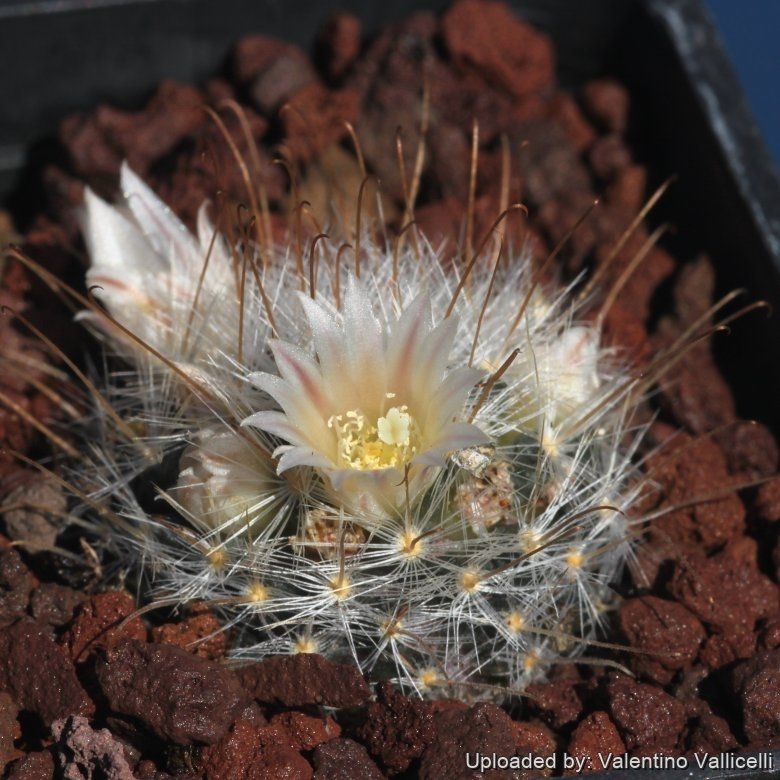
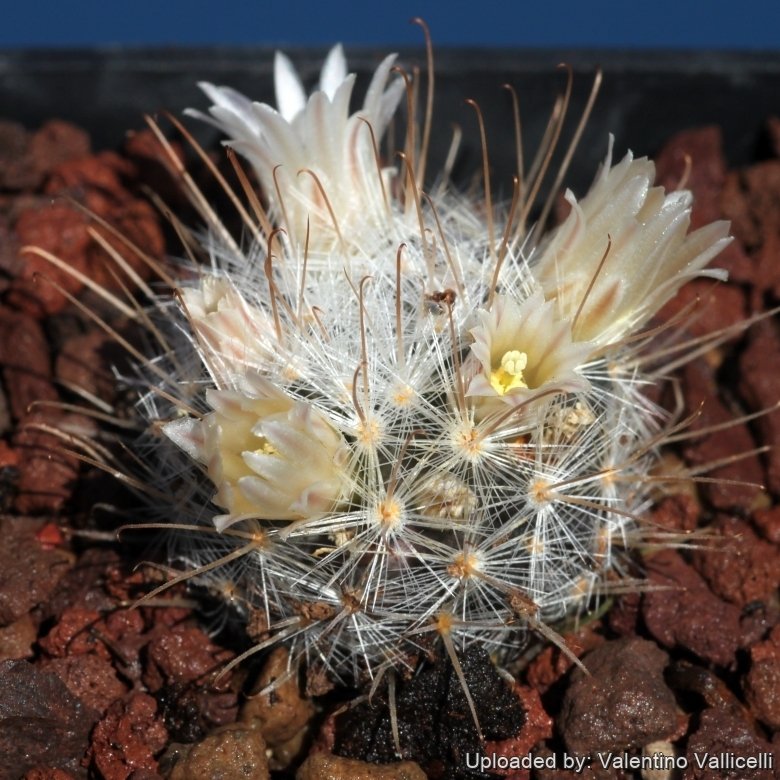
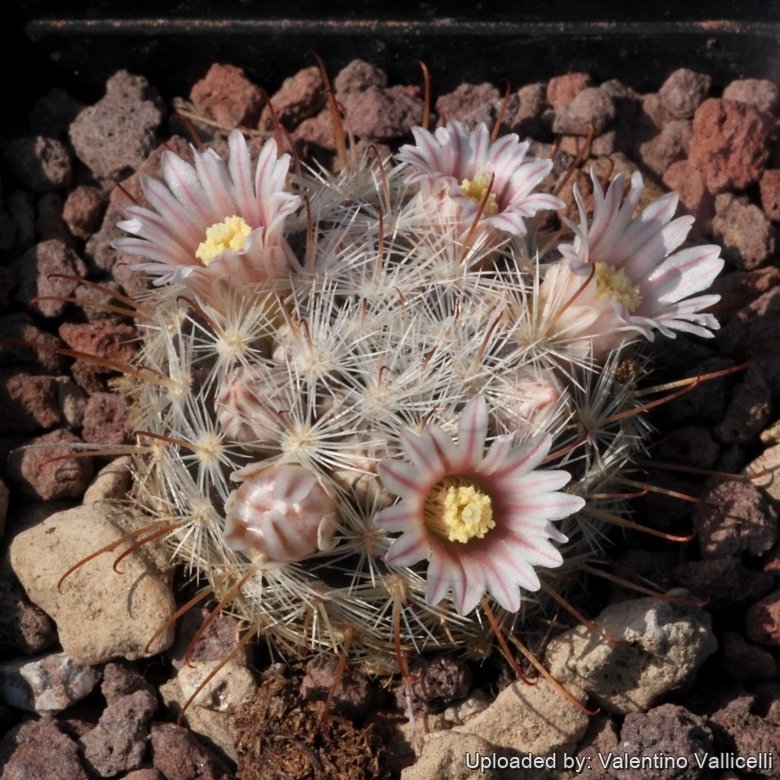
Mammillaria stella-de-tacubaya is tiny Mammillaria species of the series Lasiacanthae with one distinctive hooked central spine (if present).
Habit: Plants usually solitary, deep-seated in substrate, and inconspicuous. .
Stems: globose, later somewhat cylindrical, light green or greyish green, 4 - 5 cm high, 4 - 6 cm in diameter, obscured by white spines. Without milky sap.
Tubercles: Short cylindrical, rounded apically in 13 – 21 series, axils slightly woolly.
Spines: Plumose in seedlings, becoming smooth and naked in adult specimens, but sometime the plants may retain plumose spines at maturity.
Radial spines: 35-40(-60), white, in separated clusters or more or less interlacing, radiating from areole and appressed against plant, bristle-like, 3-5(-7) mm long.
Central spine: One often wanting, hooked, whitish with dark tip, (4-)5-6(-11) mm long.
Flower: Funnel-form up to 15 mm long, white or reddish-white or greenish white usually with reddish brown midveins.
Fruit: 9-15 mm long, club shaped, brownish red,.
Seed: Brownish black.
Flowering period: Late winter to early spring
Remarks: There is a lot a confusion about Mammillaria stella-de-tacubaya and Mammillaria gasseriana (comprising Mammillaria chica and Mammillaria viescensis), if the plant has separated clusters of radial spines and a single strong hooked central it should be stella-de-tacubaya, and if the radial spines are fine and overlapping, and the central slender and long, then its proper name should be gasseriana. It is not surprising to have caused so much difficulty, because both types (with or without central spines) can exist side by side in many parts of the state of Durango and intermediate forms occurs too. Whatever view one adopts, them all worth a place in every Mammillaria collection.
Origin and Habitat
Rio Nazas, Rancho de Tacubaya and adjacent areas, Durango, Mexico.
Altitude: 1300 - 2300 metres above sea level.
Habitat: It grows on gentle slope or flat calcareous area on hillsides. Often along with Agave striata.
Cultivation and Propagation
This rarely found species needs bright light, very careful application of water, ample airflow and is not one of the easiest to grow, but if you succeed in growing it then the results will repay all the growing efforts.
Growing rate: It is a slow growing that will make clumps given the best conditions, but rewards the patient grower with a beautiful displays of flowers since from an early age.
Soil: Requires excellent drainage provided by a very permeable open cactus soil (With not less than 50% grit content).
Repotting: Repot every 2-3 years. Use small sized pots.
Feeding: During the beautiful season enrich the soil using a fertilizer rich in potassium and phosphorous, but poor in nitrogen, because this chemical element doesn’t help the development of succulent plants, making them too soft and full of water.
Watering: Water should be carefully applied and only when the soil is dry to the touch, as this cliff-dwelling species is very prone to root rot. Allow soil to drain thoroughly before watering again. Additionally, water should not be applied from above, as the feathery spines will retain water and add to rotting problems, but in good conditions with excellent ventilation, in bright light, it usually grows without particular difficulty. Do not water in the winter.
Light: Outside full sun or afternoon shade, inside it needs bright light, and some direct sun. Direct sun encourages flowering and heavy spine production.
Hardiness: Protect from frost. But it’s hardy to -5°C if kept dry. Winter rest is important to stimulate flowering.
Pests & diseases: It may be attractive to a variety of insects, but plants in good condition should be nearly pest-free, particularly if they are grown in a mineral potting-mix, with good exposure and ventilation. Nonetheless, there are several pests to watch for:
- Red spiders: Red spiders may be effectively rubbed up by misting the vulnerable plants every day
- Mealy bugs: occasionally they develop aerial into the new growth among the wool with disfiguring results, but the worst types develop underground on the roots and are invisible except by their effects.
- Scales: Scales are rarely a problem.
- Rot: it is only a minor problem with cacti if the plants are watered and “aired” correctly. If they are not, fungicides won’t help all that much.
Propagation: Direct sow after last frost or (rarely) cuttings. Seeds germinate in 7-14 days at 21-27° C in spring, remove gradually the glass cover as soon the plants will be well rooted (ca 1-2 weeks) and keep ventilated, no full sun for young plants!
Bibliography
Major references and further lectures
-
David Hunt, Nigel Taylor “The New Cactus Lexicon” DH Books, 2006 ISBN 0953813444, 9780953813445
-
John Pilbeam (1999) “Mammillaria The Cactus File Handbook” Nuffield Press. ISBN 10: 0952830280
-
Edward F. Anderson “The Cactus Family” Timber Press, 2001
-
James Cullen, Sabina G. Knees, H. Suzanne Cubey “The European Garden Flora Flowering Plants: A Manual for the Identification of Plants Cultivated in Europe, Both Out-of-Doors and Under Glass”Cambridge University Press, 11/ago/2011
-
Nathaniel Lord Britton, Joseph Nelson Rose “Cactaceae: Descriptions and Illustrations of Plants of the Cactus Family” Courier Dover Publications, 1963
From llifle page Mammillaria chica
Description
Mammillaria chica is a tiny controversial species with hooked central spines in immature seedlings, but no central spines in the mature specimens (Reppenhagean 1991). It was then dismissed by Charle Glass and Fitz and Betty Fitz Maurice as a variant form of Mammillaria gasseriana with no central spines, except in the seedling stage. Both Hunt and E.F.Anderson refers this taxon to synonymy with Mammillaria stella-de-tacubaya and other synonymized it with Mammillaria tepexicensis, creating a taxonomig nightmare. And also the photographies of this species available on the net show a great variability in spination especially regarding the presence and size of hooked spines in adult plants. However, there remains a considerable confusion surrounding the true identity of this species. Whatever view one adopts, it is worth a place in every Mammillaria collection.
Origin and Habitat
Mountains south of San Pedro close to Torreon, Amparo, comprising Cerro Bola, Villa Real, Viesca, Villa Carranza in the Mexican state of Coahuila
Habitat: It grows mainly in crevices in step cliff along with other succulents like Coryphantha durangensis, Ferocactus hamatacanthus, Thelocactus bicolor and Mammillaria gasseriana.
Altitude: Approx 1100-1400 m a.s.l.
Cultivation and Propagation
This plant has not the fame to be easy to cultivate, but in good conditions with very careful application of water and excellent ventilation, it grows without difficulty. Be careful to encourage slow growth, but if you succeed in growing a colony of stems, then the results will repay all the growing efforts.
Growing rate: It is a slow growing species that will make clumps given the best conditions, but rewards the patient grower with a beautiful displays of flowers since from an early age.
Soil: Requires excellent drainage provided by a very permeable open cactus soil (With not less than 50% grit content). Avoid the use of peat or other humus sources in the potting mixture.
Repotting: Repot every 2-3 years. Use small sized pots.
Feeding: During the beautiful season enrich the soil using a fertilizer rich in potassium and phosphorous, but poor in nitrogen, because this chemical element doesn’t help the development of succulent plants, making them too soft and full of water.
Watering: Water should be carefully applied and only when the soil is dry to the touch, as this cliff-dwelling species is very prone to root rot. Allow soil to drain thoroughly before watering again. Additionally, water should not be applied from above, as the feathery spines will retain water and add to rotting problems, but in good conditions with excellent ventilation, in bright light, it usually grows without particular difficulty. Do not water in the winter.
Light: Outside full sun or afternoon shade, inside it needs bright light, and some direct sun. Direct sun encourages flowering and heavy spine production.
Hardiness: Protect from frost. But it’s hardy to -5°C if kept dry. A winter rest that allows the plant to shrivel (perhaps losing up to 25% of its summer height) will encourage flowering and long time survival.
Pests & diseases: It may be attractive to a variety of insects, but plants in good condition should be nearly pest-free, particularly if they are grown in a mineral potting-mix, with good exposure and ventilation. Nonetheless, there are several pests to watch for:
- Red spiders: Red spiders may be effectively rubbed up by misting the vulnerable plants every day
- Mealy bugs: occasionally they develop aerial into the new growth among the wool with disfiguring results, but the worst types develop underground on the roots and are invisible except by their effects.
- Scales: Scales are rarely a problem.
- Rot: it is only a minor problem with cacti if the plants are watered and “aired” correctly. If they are not, fungicides won’t help all that much.
Propagation: Direct sow after last frost or (rarely) cuttings. Seeds germinate in 7-14 days at 21-27° C in spring, remove gradually the glass cover as soon the plants will be well rooted (ca 1-2 weeks) and keep ventilated, no full sun for young plants!
Bibliography
major references and further lectures
-
David Hunt, Nigel Taylor “The New Cactus Lexicon” DH Books, 2006
-
John Pilbeam (1999) “Mammillaria The Cactus File Handbook” Nuffield Press.
-
Edward F. Anderson “The Cactus Family” Timber Press, 2001
-
James Cullen, Sabina G. Knees, H. Suzanne Cubey “The European Garden Flora Flowering Plants: A Manual for the Identification of Plants Cultivated in Europe, Both Out-of-Doors and Under Glass” Cambridge University Press, 11/ago/2011
-
Nathaniel Lord Britton, Joseph Nelson Rose “Cactaceae: Descriptions and Illustrations of Plants of the Cactus Family” Courier Dover Publications, 1963
Source: Mammillaria chica, LLIFLE - Encyclopedia of living forms, CC-BY-SA, retrieved 2026-10-25.