Publication: Cact. Succ. J. Gr. Brit. 41(4): 103–104 1979
Description
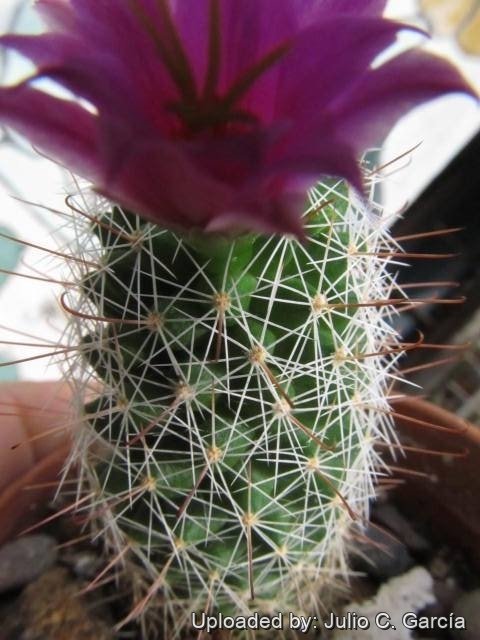
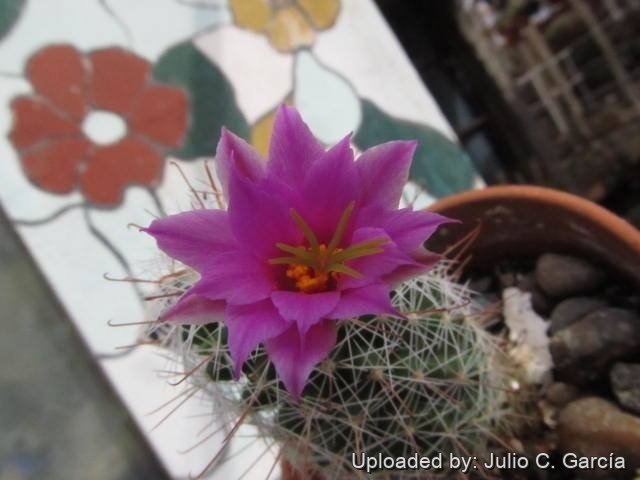
Mammillaria tonalensis is a small columnar cactus usually freely clustering from offsets with white radial spines and a single chestnut-brown hooked central. The flowers are carmine with whitish margins, but the plant is reluctant to produce its flowers unless the sunniest spot is found.
Roots: Fibrous.
Stems: Erect or sprawling, slender cylindrical, and ofsetting light green, to 12 cm or more high, 2-3.5 cm in diameter. Tubercles obtusely conical, axils naked or slightly woolly.
Central spine: One, hooked, chestnut brown, becoming dark with age, to 18 mm long.
Radial spines: 9-12, needle-like, straight, chalky white with brown tips, to 10 mm long.
Flowers: Carmine with whitish margins, to 15 mm long, 10-12 mm in diameter.
Fruits: Bright red.
Seeds: Black.
Origin and Habitat
Mammillaria tonalensis is endemic to the Tonalá Canyon in the north-west of the Mexican State of Oaxaca. All known collections are from the same area, which appears to indicate that it may have a very small range.
Altitude range: 1,000 and 1,400 metres above sea level.
Habitat and Ecology: The species grows in tropical deciduous forest, on vertical cliffs together with Mammillaria supertexta, Mammillaria dixanthocentron and Mammillaria carnea. It lives in a relatively inaccessible habitat that does not appear to be under any threat, hence there is no apparent decline. This cactus is only grown by specialist collectors, and locally used as a remedy.
Cultivation and Propagation
Mammillaria tonalensis is easy to cultivate, and makes interesting specimens for any collection. Over time it will produce large clumps. It grows by producing offsets and doesn’t require any special treatment.
Growth rate: Slow to offset and basically slow.
Exposure: It needs as much light as possible without burning the plant, to keep the stems compact.
Soil: It needs a well-drained soil mix.
Watering: Water well and then allow to dry thoroughly before watering again, during the growing season. Should really get no water in the winter
Hardiness: From tropical countries and pretty cold sensitive (listed most places as 10b-11, but seems to do OK in 10a). It can however can survive short exposures to light freezing temperatures (-4° C.) if properly hardened off and kept dry.
Propagation: It is best propagated from seed. Seed readily germinates at 20°-22°C, or by offsets if available.
Bibliography
Major references and further lectures.
-
Cházaro, M. 2013. Mammillaria tonalensis. The IUCN Red List of Threatened Species. Version 2014.3. <www.iucnredlist.org>. Downloaded on 20 January 2015.
-
D.R. Hunt “Mammillaria tonalensis D. R. Hunt, species nova” Cact. Succ. J. Gr. Brit. 41(4): 103?104 1979
-
John Pilbeam “Mammillaria The Cactus File Handbook” Cirio Pub. Services, 01/December/1999
-
John Pilbeam “Cacti for the Connoisseur: A Guide for Growers & Collectors” Timber Press, 01 July 1987
-
Edward Anderson “The Cactus family” Timber Press, Incorporated, 2001
-
James Cullen, Sabina G. Knees, H. Suzanne Cubey “The European Garden Flora Flowering Plants: A Manual for the Identification of Plants Cultivated in Europe, Both Out-of-Doors and Under Glass” Cambridge University Press, 11/August /2011
-
David R Hunt; Nigel P Taylor; Graham Charles; International Cactaceae Systematics Group. “The New Cactus Lexicon” dh books, 2006
-
“Mammillaria tonalensis” Mammillarias.net <http://mammillarias.net\> Web. 20 Jan. 2015.
-
Urs Eggli, Leonard E. Newton: “Etymological Dictionary of Succulent Plant Names.” Birkhäuser 2004
-
Ulises Guzmán, Salvador Arias, Patricia Dávila: “Catálogo de cactáceas mexicanas.” Universidad Nacional Autónoma de México, Mexiko-Stadt 2003