Publication: Mammillaria Postscripts 6: 6 (1997)
Description
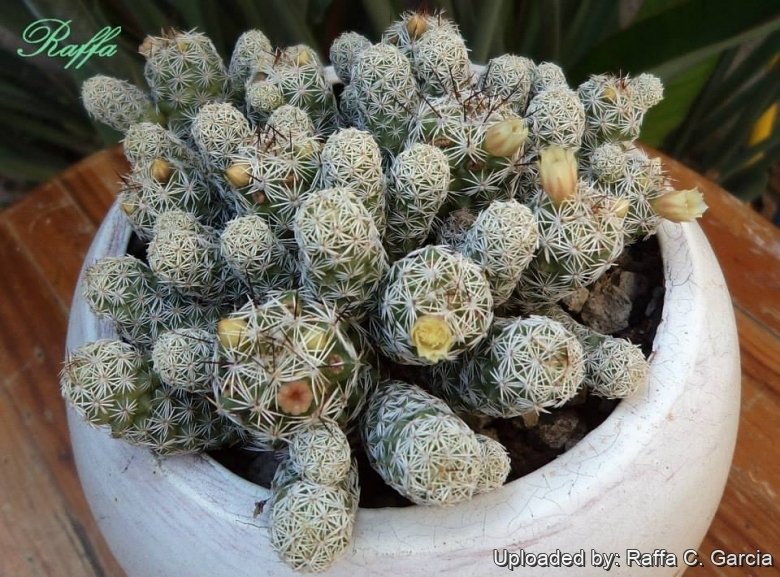
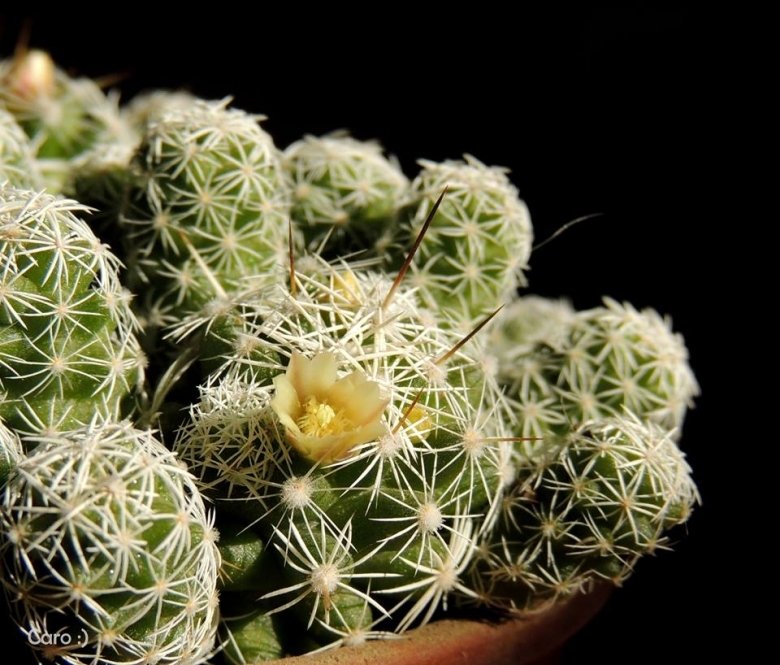
The thimble cactus, Mammillaria vetula subsp. gracilis (Mammillaria gracilis), is a small cactus with somewhat slender, cylindrical, bright green body clustering and branching freely, but the offsets easily detached. The offsets are easily knocked off so the plant must be handled with care; however, these offsets quickly root if placed on the ground. The tubercles are roundish, each being tipped by stiff white spines, radiating like a star, making the plant look lace-covered. There are one or more longer dark-brown central spines. Creamy white, bell-shaped flowers appear in spring or in late summer-autumn. Eventually, this cactus forms a large, rounded clumps. Typically subsp. gracilis has only 11-16 radials, often lacks central spines, and flowers are less than 12 mm long.
Stems: Principal stems cylicndrical to 13 cm long and 3 cm across, bright-green, offsets numerous but more weakly attached than in subsp. vetula.
Tubercles: Main stem tubercles to 6 mm, firm to slightly flabby, bluntly roundish, without latex, axils naked.
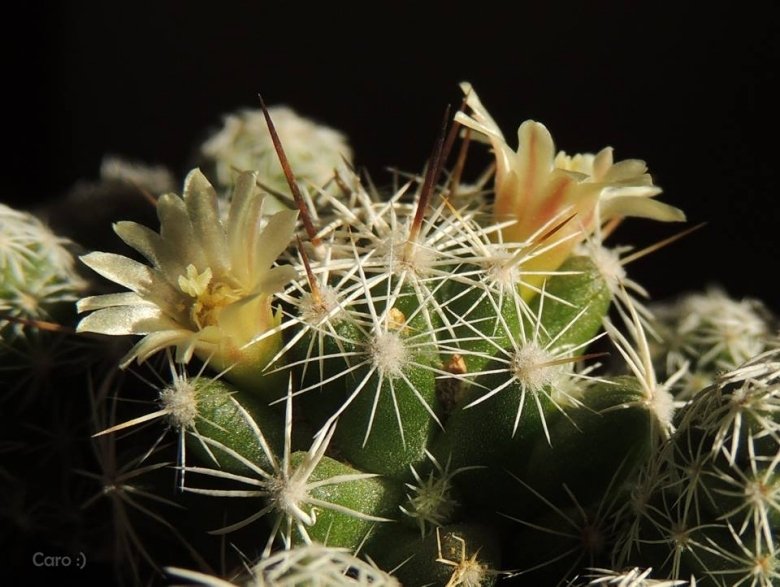
Central spines: None or 1-2, (sometimes 2 to 5 on mature stems), straight, bristle-like white to dark-brown,to 10-12 mm long.
Radial spines: Only 11-16(-17), chalky white, thin, straight, needle-like, 3-8 mm long.
Flowers: Creamy vitae , up to 12 mm long.
Blooming season: Spring and also in late summer-autumn.
Fruits: Red.
Seeds. Black
Origin and Habitat
Eastern mexico (Hidalgo and Queretaro.)
Cultivation and Propagation
Readily Mammillaria gracilis forms many offsets from sides and top. It does best in a mineral soil, good drainage is essential. Water sparingly during the summer months and keep dry in winter. It is a slow growing plant and once established, it will be content in its position and with its soil for years. Extremely hardy, can tolerate full sun, long periods of dryness and light frost (-4° C). It can also grows in moderate shade, and a plant that has been growing in shade should be slowly hardened off before placing it in full sun as the plant will be severely scorched if moved too suddenly from shade into sun.
Propagation: It is propagated exclusively from cutting during spring or summer.
Bibliography
Major references and further lectures.
-
Gómez-Hinostrosa, C., Sánchez , E., Guadalupe Martínez, J. & Bárcenas Luna, R. 2013. “Mammillaria vetula.” The IUCN Red List of Threatened Species. Version 2014.3. <www.iucnredlist.org>. Downloaded on 29 January 2015.
-
John Pilbeam “Mammillaria The Cactus File Handbook” Cirio Pub. Services, 01/December/1999
-
John Pilbeam “Cacti for the Connoisseur: A Guide for Growers & Collectors” Timber Press, 01 July 1987
-
Hans Hecht “Cacti & Succulents” Sterling Publishing Company Incorporated, 1994
-
Alfred Byrd Graf “Exotica, series 4 international: pictorial cyclopedia of exotic plants from tropical and near-tropic regions” Roehrs Co. Publishers, 1982
-
David Squire “Photographic Encyclopedia of Indoor Plants” Gallery Books, 1991
-
Edward Anderson “The Cactus family” Timber Press, Incorporated, 2001
-
James Cullen, Sabina G. Knees, H. Suzanne Cubey “The European Garden Flora Flowering Plants: A Manual for the Identification of Plants Cultivated in Europe, Both Out-of-Doors and Under Glass” Cambridge University Press, 11/August /2011
-
David R Hunt; Nigel P Taylor; Graham Charles; International Cactaceae Systematics Group. “The New Cactus Lexicon” dh books, 2006
-
Urs Eggli, Leonard E. Newton: “Etymological Dictionary of Succulent Plant Names.” Birkhäuser 2004
-
Ulises Guzmán, Salvador Arias, Patricia Dávila: “Catálogo de cactáceas mexicanas.” Universidad Nacional Autónoma de México, Mexiko-Stadt 2003