Publication: Monatsschr. Deutsch. Kakteen-Ges. 4: 199, figs. 1932
Description
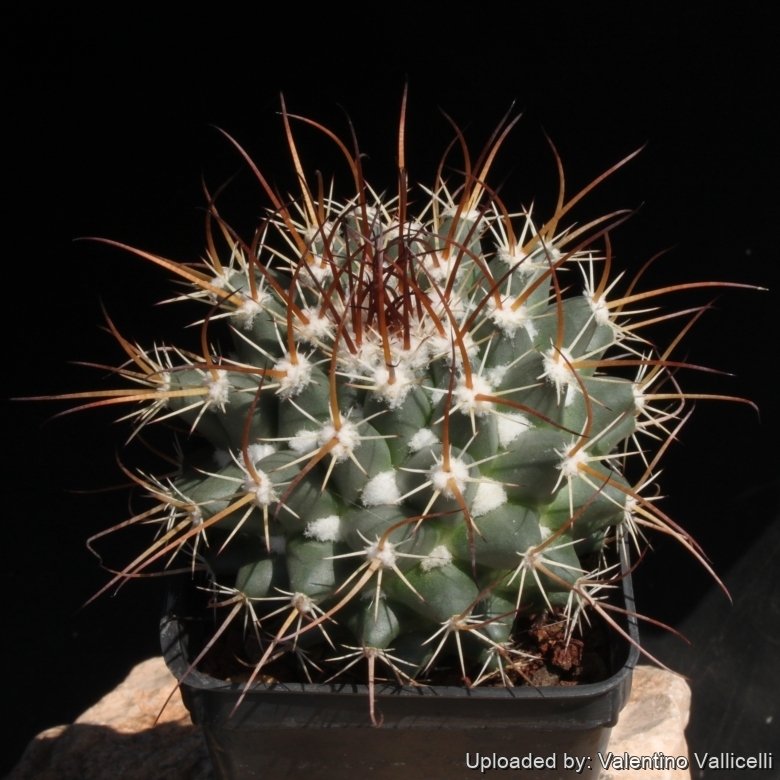
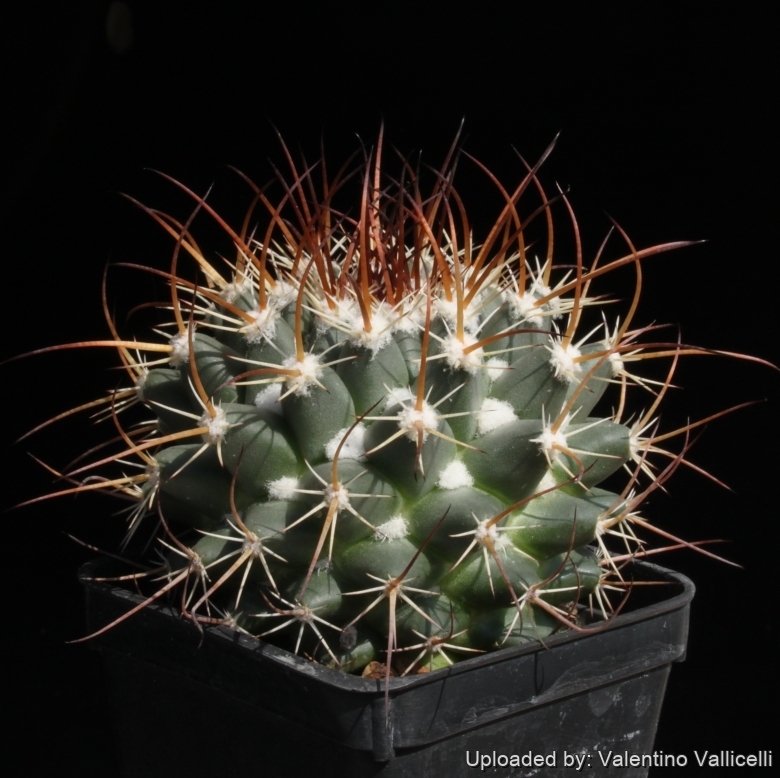
Mammillaria wagneriana is a a little known, strong and relatively fast growing species with mostly solitary hemispherical stems. It is sometime grown as an ornamental, although there may be issues of whether the plants grown are correctly identified.
Taxonomic notes: There are taxonomic uncertainties concerning the validity of this taxon as a good species. It is closely allied to Mammillaria petterssonii and allied taxa from Durango, Jalisco and Zacatecas. W.A. Fitz Maurice argues that plants at the type locality are all M. pettersonii. M. wagneriana is regarded otheres as a transition form between Mammillaria gigantea and Mammillaria melanocentra.
Stem: Simple, depressed-spherical, to oval (or short-cylindrical in cultivation), 6 to 20 cm thick and up to 15 cm high, slightly depressed at the top, dark green.
Tubercles: Short, pyramidal, quadrangular to almost conical, obtuse-angled with latex. In 13-21 spiral rows of 8 to 10 tubercles. Axil with dense wool but no bristles.
Axils: With dense white especially in the floriferous parts, wool but no bristles.
Central spines: 2-4, variable, 10 to 30(-50) mm long, rugose, straight or twisted, reddish/horn-coloured to almost black, grey later.
Radial spines: 6-10, slightly subulate whitish yellow, or fleshy coloured with brown tips, unequal, upper 2-3 to 6-7 mm long, lateral ones twice as long , lower ones three times as long (to c. 22 mm long).
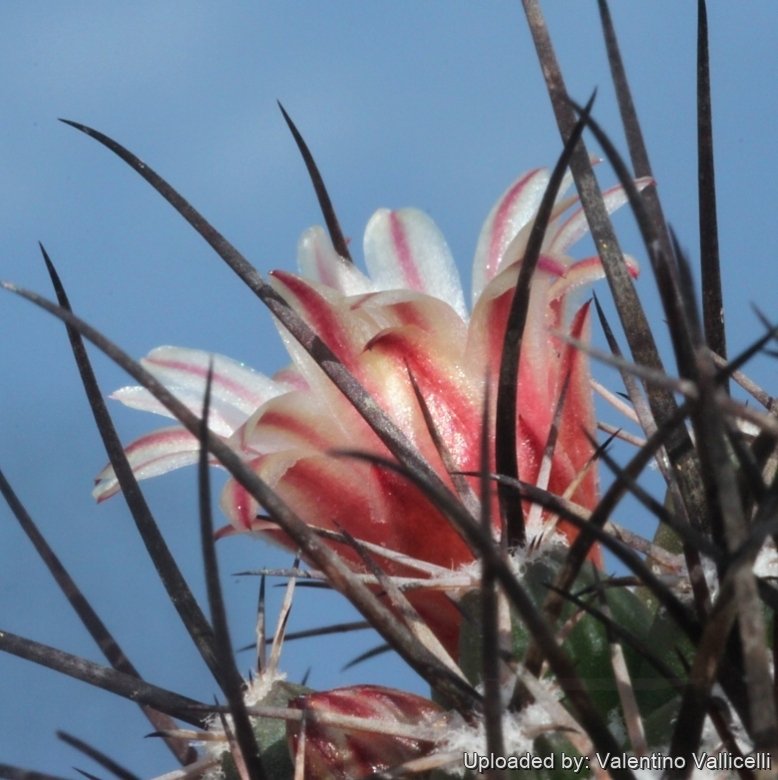
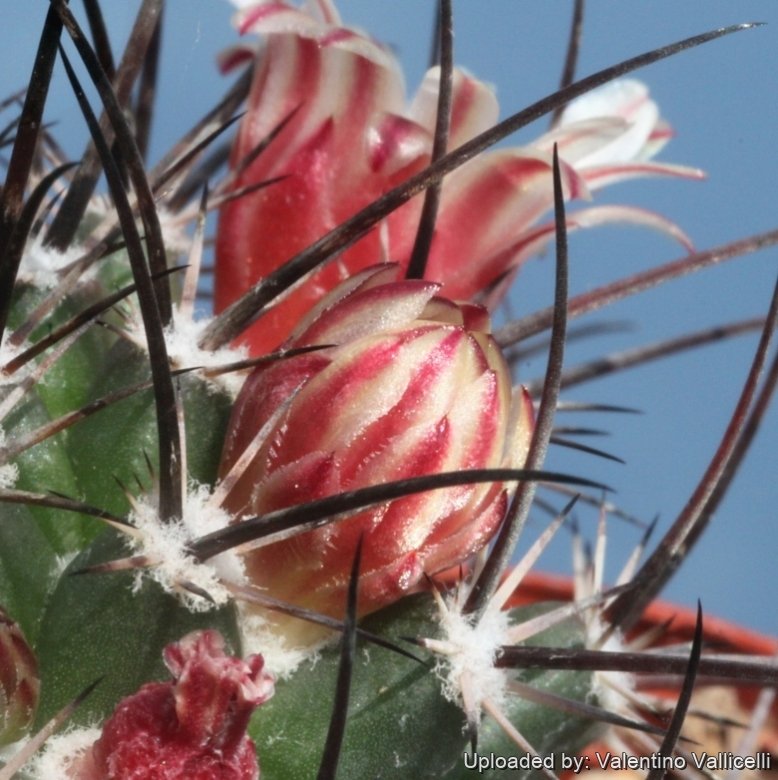
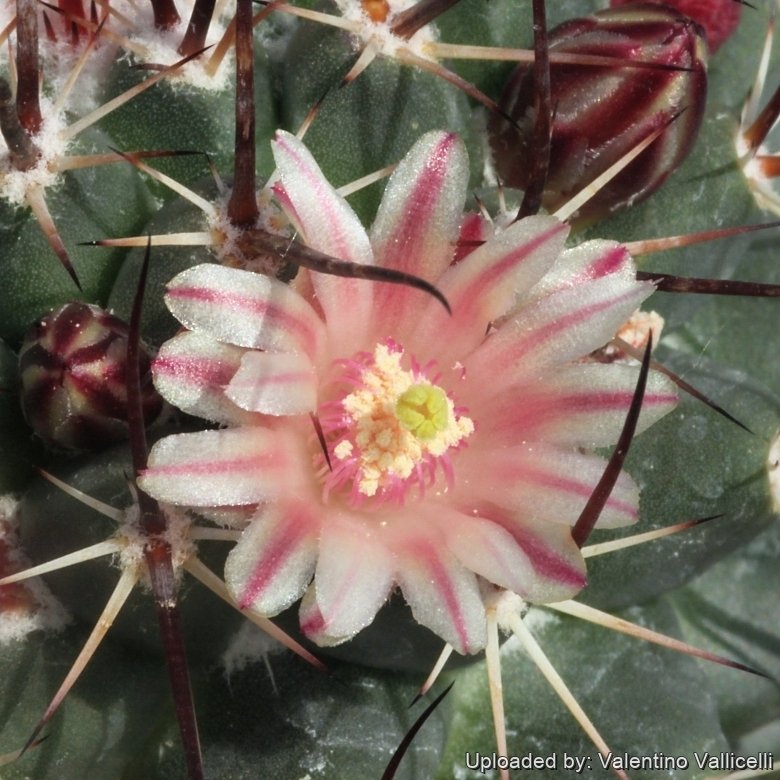
Flowers: Whitish with pale pink midveins and tips, 15-20 mm in diameter, stigma greenish-yellow.
Blooming season: Spring.
Fruits: Red.
Seeds: Brown.
Origin and Habitat
Mammillaria wagneriana has been reported from Zacatecas, Jalisco, and Aguascalientes, Mexico. Work is required to resolve whether or not this is a good species, and if it is what its distribution and population details are.
Altitude range: 1700-2300 metres above sea level.
Habitat and Ecology: Mammillaria wagneriana is found growing on rocky slopes in open oak woodland on volcanic soils. No major threats are known to affect this species.
Cultivation and Propagation
An easy-to-grow and easily flowering species. Water regularly in summer, but do not over-water (rot prone). Use a pot with good drainage and a very porous potting media, and keep dry in winter. Feed with a high potassium fertilizer in summer. Avoid frost. Reputedly sensitive to low temperatures, but less so if kept on the dry side prior to, and during, cold weather. Outside full sun or afternoon shade, inside it needs bright light, and some direct sun. Tends to get yellowish in strong light, which encourages flowering and heavy wool and spine production.
Propagation: Direct sow after last frost.
Bibliography
Major references and further lectures
-
David Hunt, Nigel Taylor “The New Cactus Lexicon” DH Books, 2006
-
John Pilbeam (1999) “Mammillaria The Cactus File Handbook” Nuffield Press.
-
Edward F. Anderson “The Cactus Family” Timber Press, 2001
-
Fitz Maurice, B, Sotomayor, M., Fitz Maurice, W.A. & Hernández, H.M. 2013. Mammillaria wagneriana. The IUCN Red List of Threatened Species 2013: e.T152806A680719. http://dx.doi.org/10.2305/IUCN.UK.2013-1.RLTS.T152806A680719.en. Downloaded on 22 March 2016.
Gallery