Publication: Oesterr. Bot. Z. 98: 65. 1951
Description
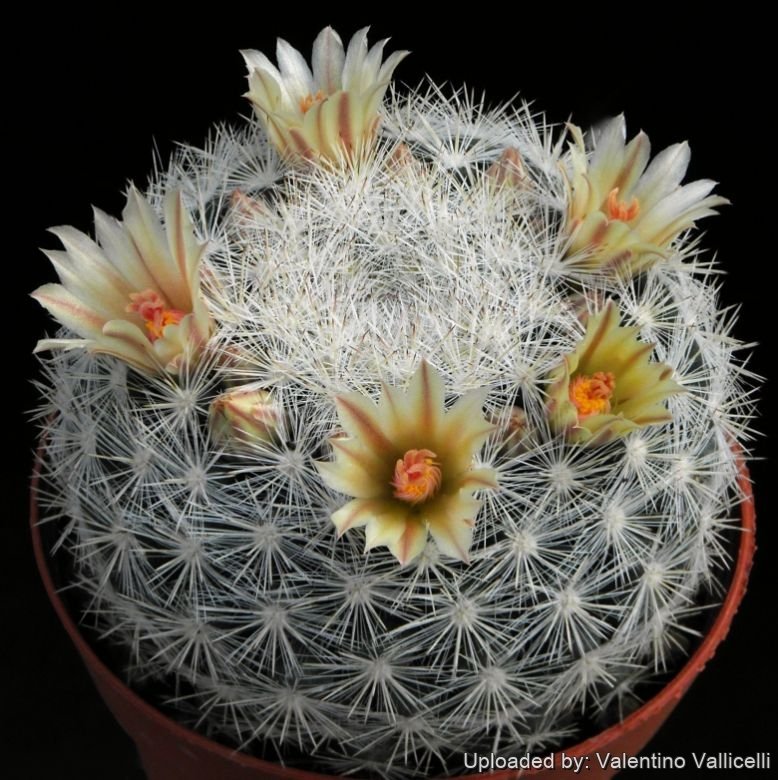
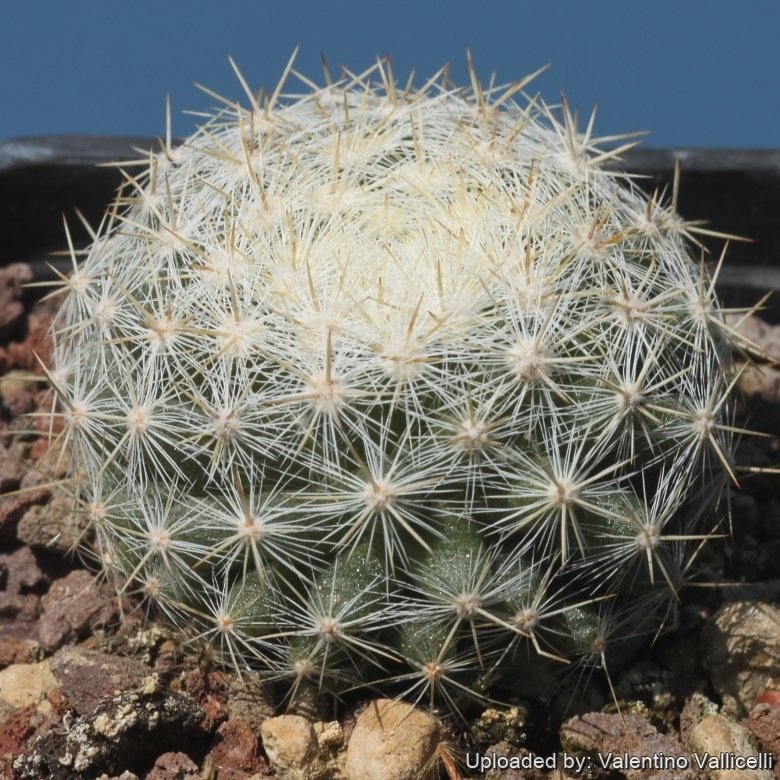
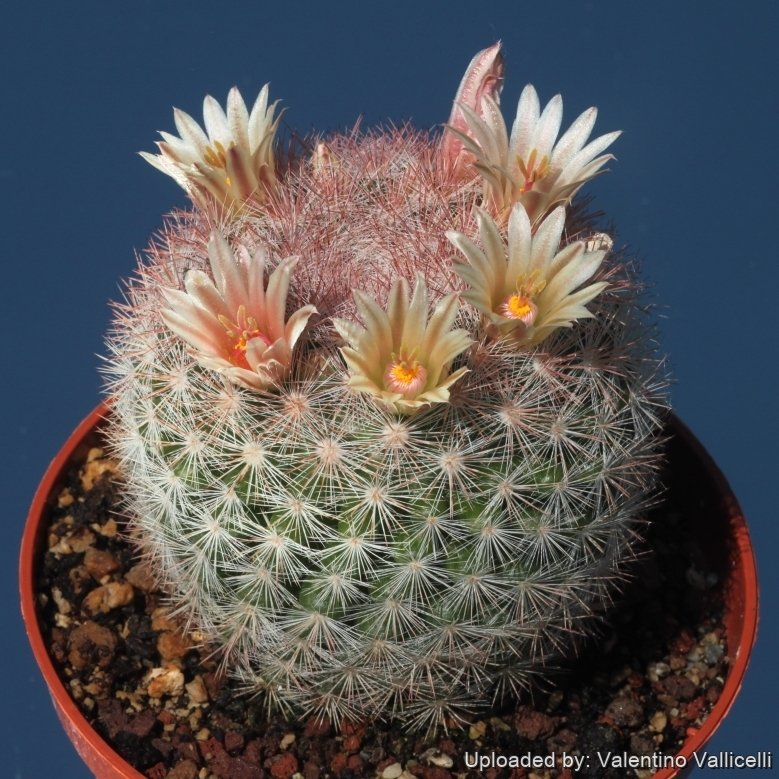
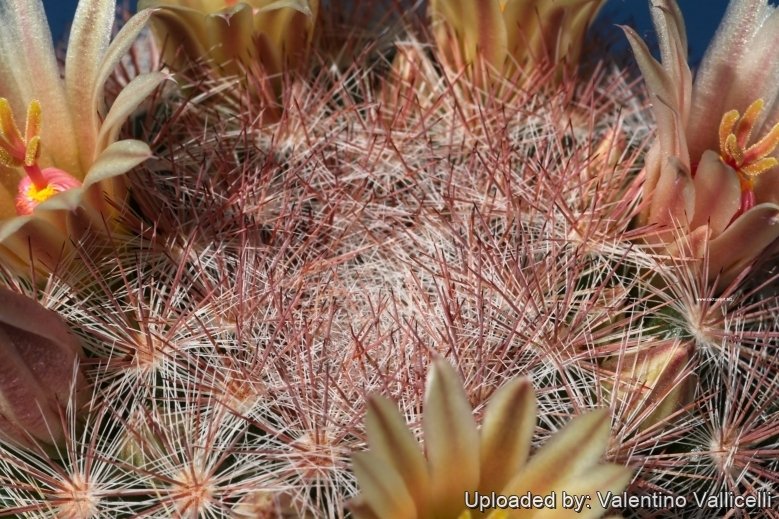
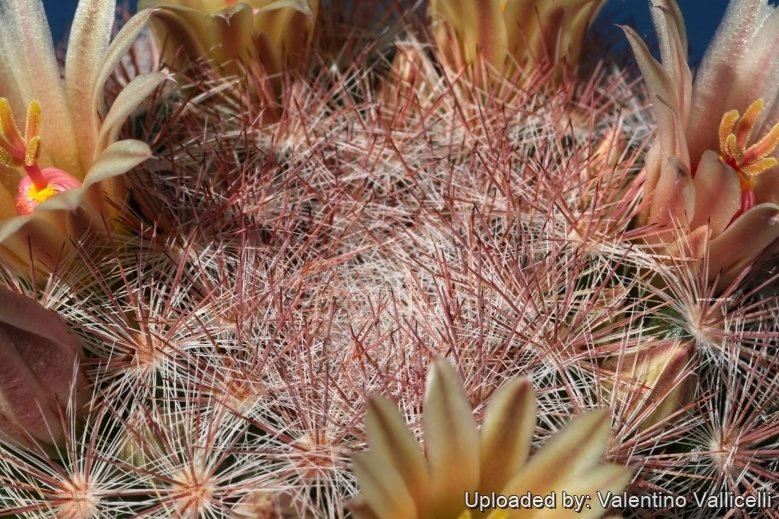
Mammilloydia candida popularly called ‘Snowball’ is a choice, attractive succulent plant with a so dense snowy white, spination, that its body appears almost hidden by spines. Mammilloydia are clearly related to the genus Mammillaria, but their unique seed structure and other anomalies indicates that their overall resemblance to Mammillaria is due to convergence and are usually recognized as segregate genera. However their true relationship remains unclear. So far: Mammilloydia candida subs. ortizrubiona, connected through the particularly lovely Mammilloydia candida var. rosea, representt the segregate genus Mammilloydia.
Habit: It is a simple or eventually clustering perennial cactus .
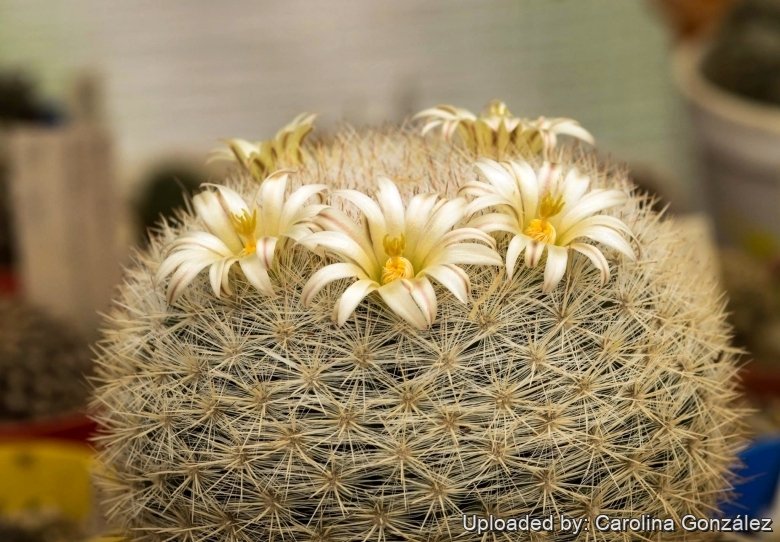
Stems: Spherical, eventually short-cylindric at maturity, pale, bluish green, up to 30 cm high and (3-)6-12(-20) cm cm wide, crown distinctly depressed or flat.
Tubercles: broadly cylindrical, obtuse, not grooved, 5 to 6 mm long, axils with 4-7 white bristles.
Spines: 50-80 in several series, up to 19 mm long, glabrous or nearly so, not clearly differentiated as centrals and radials or.
Central spines: 6-12 pure white to pinkish white often tipped pink or brown, 5-10 mm long.
Radial spines: 50-120 white spreading, up to 15 mm long, often shorter.
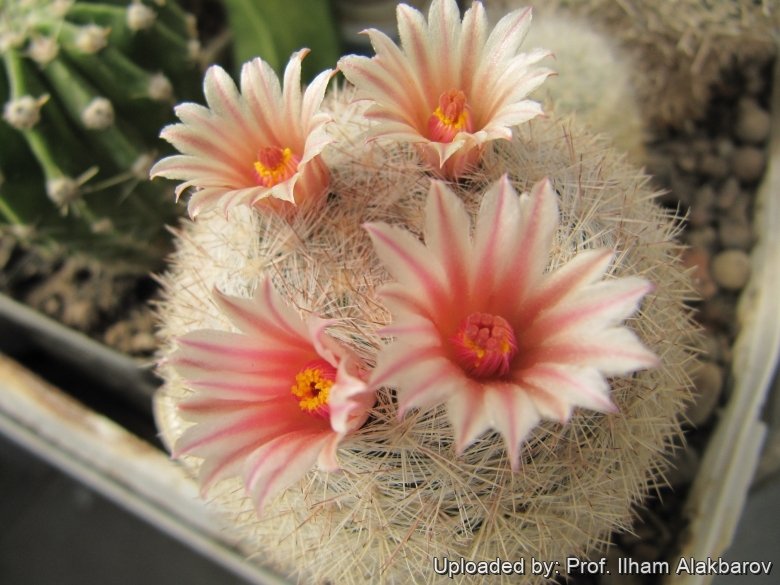
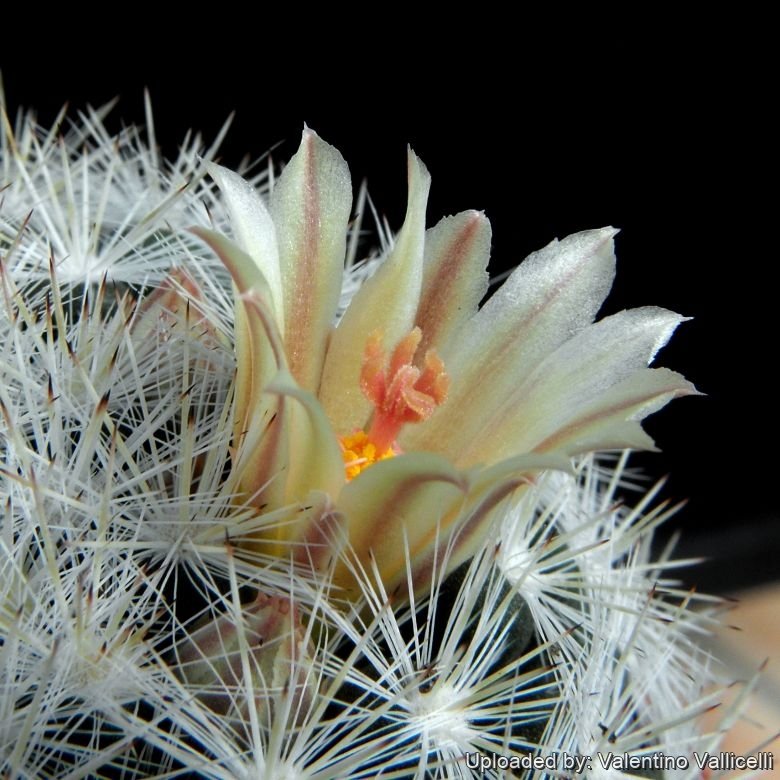
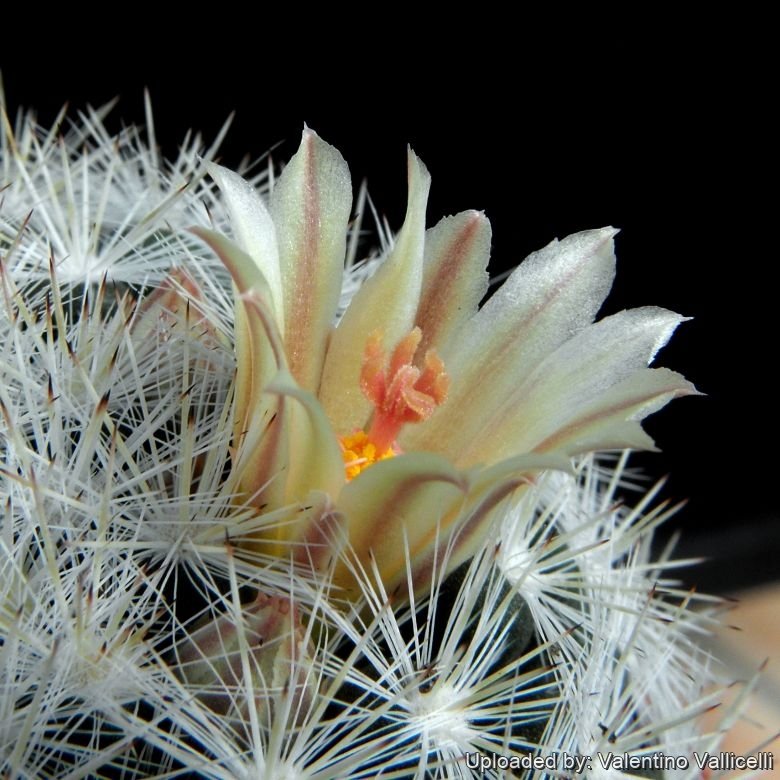
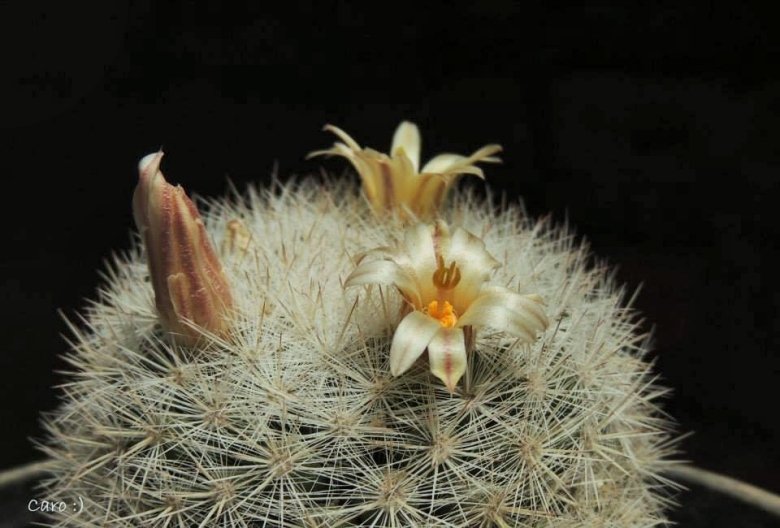
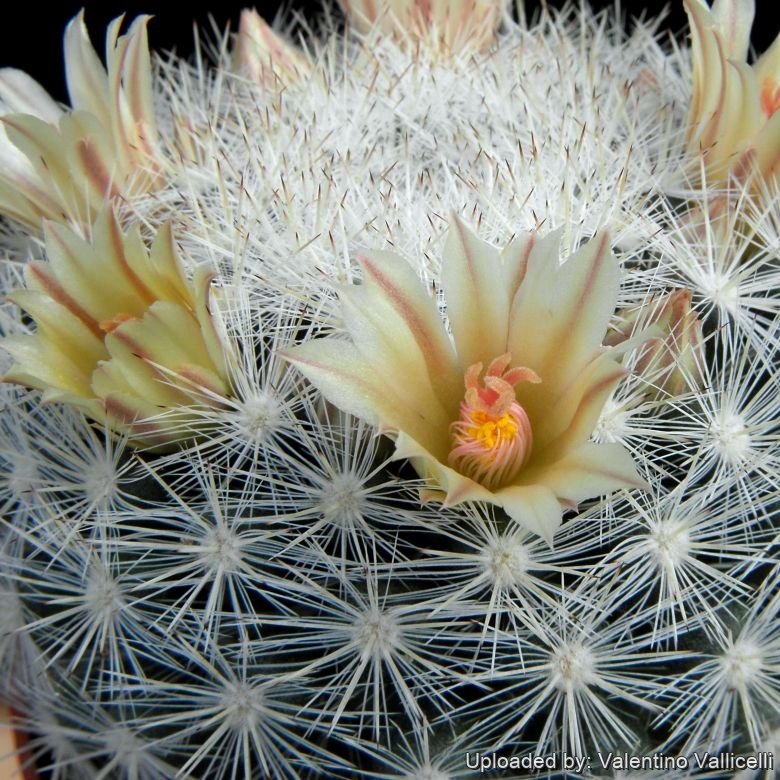
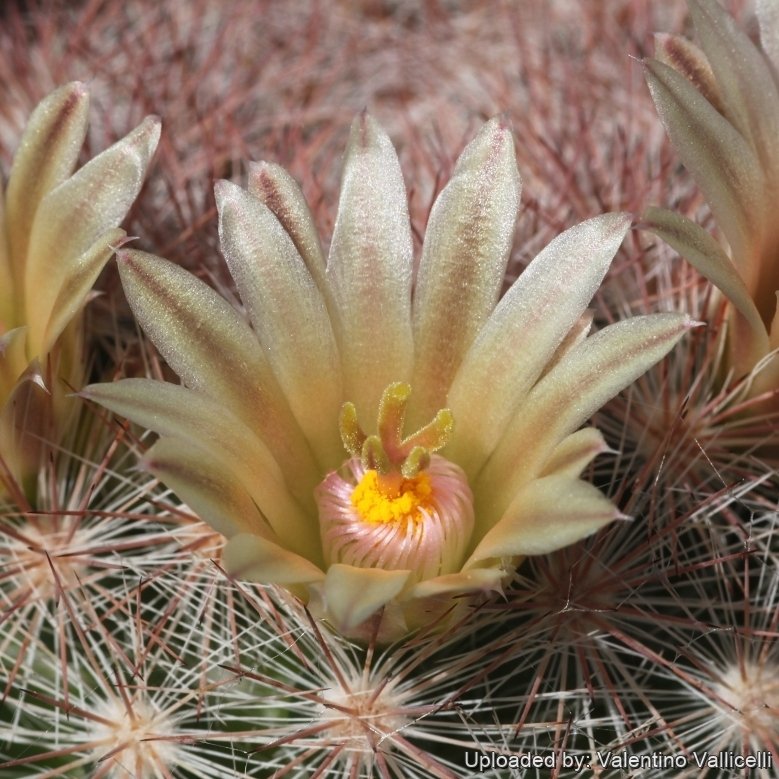
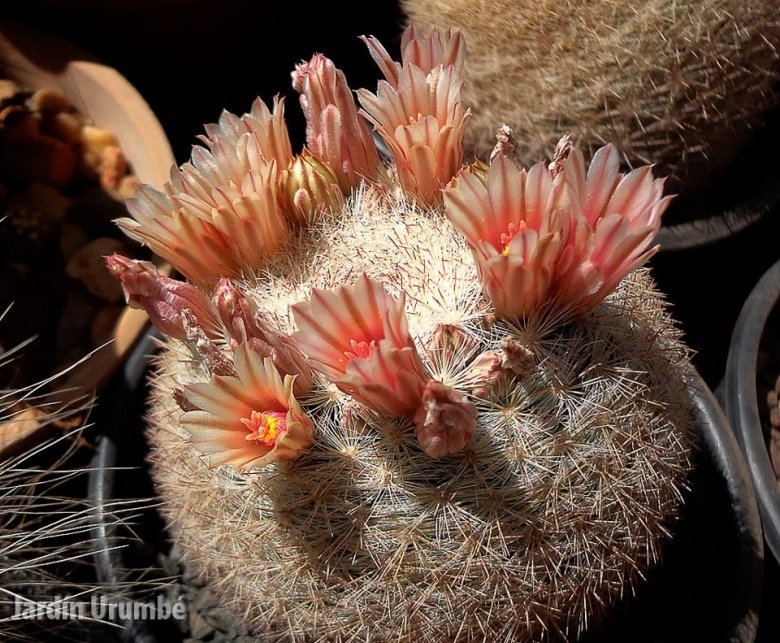
Flowers: Flowers and fruit from near the centre but not from the axils of young tubercles 2-3 cm long. Perianth-segments few, about 12, oblong, obtuse, rose pink or white with greenish red or creamy brown midveins, and white margins, the centre often light purple. Pericarpels and floral tubes naked. Stamens white. Style and stigma-lobes purplish (or green).
Fruits: Oblong to clavate, red or pinkish., juicy, indehiscent, 7-14 mm, the perianth not persistent.
Blooming season: Spring.
Seeds: Black, shiny, about 1 mm in diameter, with flat or domed testa, not pitied and lacking perisperm. Hilum basal, and seed coat with flat or domed cells.
Origin and Habitat
Northeastern Mexico in Coahuila, Guanajuato, Nuevo Leon, San Luis Potosi, and Tamaulipas.
Altitude: 500-2500
Habitat and ecology: It grows in well drained, flat area in crevices on limestone rock, hilltops, rocky slopes and canyon walls. This species is often found under xerophytic bushes in association with other plant species, including Pelecyphora strobiliformis, Turbinicarpus pseudopectinatus, Gymnocactus subterraneus, Echinocereus conglomeratus, Coryphantha scolymoides, Mammillaria lenta, Astrophytum senile, Astrophytum capricorne, Echinocactus platyacanthus, Yucca filifera, Ferocactus hamatacanthus, Ferocactus histrix, Ferocactus glaucescens, Hechtia glomerata, Neobuxbaumia euphorbioides, Agave stricta, Agave deweyana, Agave xylonacantha, Thelocactus hexaedrophorus, and Glandulicactus uncinatus. Large subpopulations are found over a relatively large area and current levels of decline are relatively small. This species is widely cultivated as an ornamental, but most plants, e.g. in Europe, are now grown from seed obtained from cultivated sources. It is collected from the wild to make nativity scenes by local people and afterwards thrown away. There are no major threats to this species, although there is habitat degradation due to overgrazing by goats.
Cultivation and Propagation
Mammilloydia candida is a slow-growing, clustering species that reproduces easily by cutting. It is a great starter plant for the cactus grower, that builds up into a dense cluster of stems brightened by white spines.
Soils: It likes very porous standard cactus mix soil with little organic matter (peat, humus).
Repotting: Repotting every 2-3 years. As it is prone to rot under-pot in a smaller container filled with very porous compost. Use pot with good drainage.
Watering: Water regularly in summer, but do not overwater (very wet-sensitively, especially in light of its succulent root system). Its roots are easily lost in pots that stay damp for any length of time. Keep dry with ample airflow in winter. In the rest period no high atmospheric humidity!! Care must be taken with watering as they tends to become swollen and untidy in growth habit if given too much water and shade.
Fertilization: During the growing season enrich the soil using a fertilizer rich in potassium and phosphorous, but poor in nitrogen, because this chemical element doesn’t help the development of succulent plants, making them too soft and full of water.
Hardiness: It is quite frost resistant if kept dry, hardy as low as -5° C (some reports give it hardy to -12°C). However some warmth throughout the year will increase the grower’s success (minimum 5° to 8°C during rest season).
Exposition: Outside bright sun, filtered sunlight or afternoon shade, inside it needs bright light, and some direct sun. Subject to sunburn if exposed to direct sun for too long. Tends to bronze in strong light, which encourages flowering and heavy wool and spine production.
Uses: It is an excellent plant for container growing. It always looks good and stays small. It look fine in a cold greenhouse and frame.
Pests & diseases: It may be attractive to a variety of insects, but plants in good condition should be nearly pest-free, particularly if they are grown in a mineral potting-mix, with good exposure and ventilation. Nonetheless, there are several pests to watch for:
- Red spiders: Sensitive to red spider mite. Overhead watering is helpful in controlling mites.
- Mealy bugs: Occasionally mealy bugs they develop aerial into the new growth among the wool with disfiguring results, but the worst types develop underground on the roots and are invisible except by their effects.
- Scales: Scales are rarely a problem.
- Rot: Rot it is only a minor problem with cacti if the plants are watered and “aired” correctly. If they are not, fungicides won’t help all that much.
Propagation: Direct sow after last frost or division . Seeds germinate in 7-14 days at 21-27° C in spring, remove the glass cover gradually as the plants develops and keep ventilated, no full sun for young plants! The seedlings should not be disturbed until they are well rooted, after which they can be planted separately in small pots. Cuttings: wait until the offsets that appear at the base of old clustered specimens are 1/3 the size of the parent and then detach and plant. Cuttings will take root in a minimum temperature of 20° C (but better in hot weather). Cuttings of healthy shoots can be taken in the spring and summer. Cut the stem with a sharp, sterile knife, leave the cutting in a warm, dry place for a week or weeks (depending on how thick the cutting is) until a callus forms over the wound. Once the callus forms, the cutting may be inserted in a container filled with firmed cactus potting mix topped with a surface layer of coarse grit. They should be placed in the coarse grit only; this prevents the cut end from becoming too wet and allows the roots to penetrate the rich compost underneath. The cuttings should root in 2 to 6 weeks.
Bibliography
Major references and further lectures
-
John Pilbeam “Mammillaria The Cactus File Handbook” Cirio Pub. Services, 01/Dec/1999
-
Edward Anderson “The Cactus family” Timber Press, Incorporated, 2001
-
James Cullen, Sabina G. Knees, H. Suzanne Cubey “The European Garden Flora Flowering Plants: A Manual for the Identification of Plants Cultivated in Europe, Both Out-of-Doors and Under Glass” Cambridge University Press, 11/Aug/2011
-
David R Hunt; Nigel P Taylor; Graham Charles; International Cactaceae Systematics Group. “The New Cactus Lexicon” dh books, 2006
-
Gurcharan Singh Randhawa, Amitabha Mukhopadhyay “Floriculture in India” Allied Publishers, 01/Jan/1986
-
N. L. Britton, J. N. Rose “The Cactaceae. Descriptions and Illustrations of Plants of the Cactus Family.” Volume 4, The Carnegie Institution of Washington, Washington 1923
-
Haustein, E. “Der Kosmos-Kakteen-fuhrer” Balogh Scientific Books, 1998
-
Alfred Byrd Graf “Exotica, series 4 international: pictorial ecyclopedia of exotic plants from tropical and near-tropic regions” Roehrs Co. Publishers, 1982
-
Roger Spencer “Horticultural Flora of South-eastern Australia: Flowering plants. Dicotyledons. Pt. 1” UNSW Press, 01/Jan/1995
-
Fitz Maurice, B, Fitz Maurice, W.A., Hernández, H.M., Sotomayor, M. & Smith, M. 2013. Mammilloydia candida. The IUCN Red List of Threatened Species. Version 2014.3. <www.iucnredlist.org>. Downloaded on 02 May 2015.
From llifle page Mammillaria candida subs. ortizrubioana
Description
Mammilloydia candida subs. ortizrubiona (Mammillaria ortizrubiona) is an nice cactus species characterized by a so dense spination, that its body appears almost hidden by spines.
It distinguishes from the satandard Mammilloydia candida for having fewer spines, fewer and larger tubercles, long axillary hairs and paler flowers.
Habit: It is a simple or eventually clustering perennial cactus .
Stems: Spherical, eventually short-cylindric at maturity, dull grey green up to 8 cm high and 8-15 cm cm wide, crown distinctly depressed or flat and closed by spines.
Tubercles: Conical eounded on top, not grooved,at base 15 mm broad, and 15-18 mm long, axils with stout white bristles.
Spines: 50-80 in several series, up to 19 mm long, glabrous or nearly so, not clearly differentiated as centrals and radials or.
Central spines: Up to12 straight, stiff, stout, white, tapering red-brown, almost black at tips, up to 25 mm long, of which 1erect 5 others ascending and other speading.
Radial spines: Less than 60, white, straight, thin, very fine acicular, flexible, spreading star-like around the areole, up to 2,5 cm long.
Flowers: Flowers and fruit from near the centre but not from the axils of young tubercles. Funnel form 35 mm high and 30 mm in diameter. Perianth-segments greenish white with a pale pink midstripe. Pericarpels and floral tubes naked.
Fruits: Clavate, red, juicy, indehiscent, 10 mm in diameter and 15 mm long, with perianth persistent.
Blooming season: Spring.
Seeds: Black, glossy, about 1,5 mm in diameter amn broad, with flat or domed testa, pitted regularly in rows.
Remarks: Mammilloydia are clearly related to the genus Mammillaria, but their unique seed structure and other anomalies indicates that their overall resemblance to Mammillaria is due to convergence and are usually recognized as segregate genera. However their true relationship remains unclear. So far only two species: Mammilloydia candida and Mammilloydia ortizrubiona, connected through the particularly lovely Mammilloydia candida var. rosea, representt the segregate genus Mammilloydia
Origin and Habitat
Xichú and Guamúchil and adjacent areas, Guanajuato, Mexico
Altitude : 1250-1500 meters above sea level.
Habitat: It grows in crevices filled with humus on steep rock walls of the Rio Xichú.
Cultivation and Propagation
Mammilloydia candida subs. ortizrubiona is a slow-growing, clustering species that reproduces easily by cutting. It is a great starter plant for the cactus grower, that builds up into a dense cluster of stems brightened by white spines.
Soils: It likes very porous standard cactus mix soil with little organic matter (peat, humus).
Repotting: Repotting every 2-3 years. As it is prone to rot under-pot in a smaller container filled with very porous compost. Use pot with good drainage.
Watering: Water regularly in summer, but do not overwater (very wet-sensitively, especially in light of its succulent root system). Its roots are easily lost in pots that stay damp for any length of time. Keep dry with ample airflow in winter. In the rest period no high atmospheric humidity!! Care must be taken with watering as they tends to become swollen and untidy in growth habit if given too much water and shade.
Fertilization: During the growing season enrich the soil using a fertilizer rich in potassium and phosphorous, but poor in nitrogen, because this chemical element doesn’t help the development of succulent plants, making them too soft and full of water.
Hardiness: It is quite frost resistant if kept dry, hardy as low as -5° C (some reports give it hardy to -12°C). However some warmth throughout the year will increase the grower’s success (minimum 5° to 8°C during rest season).
Exposition: Outside bright sun, filtered sunlight or afternoon shade, inside it needs bright light, and some direct sun. Subject to sunburn if exposed to direct sun for too long. Tends to bronze in strong light, which encourages flowering and heavy wool and spine production.
Uses: It is an excellent plant for container growing. It always looks good and stays small. It look fine in a cold greenhouse and frame.
Pests & diseases: It may be attractive to a variety of insects, but plants in good condition should be nearly pest-free, particularly if they are grown in a mineral potting-mix, with good exposure and ventilation. Nonetheless, there are several pests to watch for:
- Red spiders: Sensitive to red spider mite. Overhead watering is helpful in controlling mites.
- Mealy bugs: Occasionally mealy bugs they develop aerial into the new growth among the wool with disfiguring results, but the worst types develop underground on the roots and are invisible except by their effects.
- Scales: Scales are rarely a problem.
- Rot: Rot it is only a minor problem with cacti if the plants are watered and “aired” correctly. If they are not, fungicides won’t help all that much.
Propagation: Direct sow after last frost or division . Seeds germinate in 7-14 days at 21-27° C in spring, remove the glass cover gradually as the plants develops and keep ventilated, no full sun for young plants! The seedlings should not be disturbed until they are well rooted, after which they can be planted separately in small pots. Cuttings: wait until the offsets that appear at the base of old clustered specimens are 1/3 the size of the parent and then detach and plant. Cuttings will take root in a minimum temperature of 20° C (but better in hot weather). Cuttings of healthy shoots can be taken in the spring and summer. Cut the stem with a sharp, sterile knife, leave the cutting in a warm, dry place for a week or weeks (depending on how thick the cutting is) until a callus forms over the wound. Once the callus forms, the cutting may be inserted in a container filled with firmed cactus potting mix topped with a surface layer of coarse grit. They should be placed in the coarse grit only; this prevents the cut end from becoming too wet and allows the roots to penetrate the rich compost underneath. The cuttings should root in 2 to 6 weeks.
Bibliography
Major references and further lectures
-
John Pilbeam “Mammillaria The Cactus File Handbook” Cirio Pub. Services, 01/Dec/1999
-
Edward Anderson “The Cactus family” Timber Press, Incorporated, 2001
-
James Cullen, Sabina G. Knees, H. Suzanne Cubey “The European Garden Flora Flowering Plants: A Manual for the Identification of Plants Cultivated in Europe, Both Out-of-Doors and Under Glass” Cambridge University Press, 11/Aug/2011
-
David R Hunt; Nigel P Taylor; Graham Charles; International Cactaceae Systematics Group. “The New Cactus Lexicon” dh books, 2006
-
Gurcharan Singh Randhawa, Amitabha Mukhopadhyay “Floriculture in India” Allied Publishers, 01/Jan/1986
-
N. L. Britton, J. N. Rose “The Cactaceae. Descriptions and Illustrations of Plants of the Cactus Family.” Volume 4, The Carnegie Institution of Washington, Washington 1923
-
Haustein, E. “Der Kosmos-Kakteen-fuhrer” Balogh Scientific Books, 1998
-
Alfred Byrd Graf “Exotica, series 4 international: pictorial ecyclopedia of exotic plants from tropical and near-tropic regions” Roehrs Co. Publishers, 1982
-
Roger Spencer “Horticultural Flora of South-eastern Australia: Flowering plants. Dicotyledons. Pt. 1” UNSW Press, 01/Jan/1995
Source: Mammillaria candida subs. ortizrubioana, LLIFLE - Encyclopedia of living forms, CC-BY-SA, retrieved 2026-10-25.
From llifle page Mammillaria candida var. rosea
Description
Mammillaria candida f. rosea was originally described by Salm-Dyck in 1898. It is a nice pink spined form of the usually white Mammillaria candida. Today the names Mammillaria candida var. rosea has been dismissed as a colour variant in a colour variabile species, and is not accepted by many botanists that treat it as synonym, but it still has a value for a collector because they identify plants with particular characters. However in the trade there are different plants labelled simply Mammillaria candida that have central spines, with noticeable pink apex.
Origin and Habitat
San Luis Potosi, Mexico.
Cultivation and Propagation
Mammilloydia candida f. rosea is a slow-growing, clustering species that reproduces easily by cutting. It is a great starter plant for the cactus grower, that builds up into a dense cluster of stems brightened by white spines.
Soils: It likes very porous standard cactus mix soil with little organic matter (peat, humus).
Repotting: Repotting every 2-3 years. As it is prone to rot under-pot in a smaller container filled with very porous compost. Use pot with good drainage.
Watering: Water regularly in summer, but do not overwater (very wet-sensitively, especially in light of its succulent root system). Its roots are easily lost in pots that stay damp for any length of time. Keep dry with ample airflow in winter. In the rest period no high atmospheric humidity!! Care must be taken with watering as they tends to become swollen and untidy in growth habit if given too much water and shade.
Fertilization: During the growing season enrich the soil using a fertilizer rich in potassium and phosphorous, but poor in nitrogen, because this chemical element doesn’t help the development of succulent plants, making them too soft and full of water.
Hardiness: It is quite frost resistant if kept dry, hardy as low as -5° C (some reports give it hardy to -12°C). However some warmth throughout the year will increase the grower’s success (minimum 5° to 8°C during rest season).
Exposition: Outside bright sun, filtered sunlight or afternoon shade, inside it needs bright light, and some direct sun. Subject to sunburn if exposed to direct sun for too long. Tends to bronze in strong light, which encourages flowering and heavy wool and spine production.
Uses: It is an excellent plant for container growing. It always looks good and stays small. It look fine in a cold greenhouse and frame.
Pests & diseases: It may be attractive to a variety of insects, but plants in good condition should be nearly pest-free, particularly if they are grown in a mineral potting-mix, with good exposure and ventilation. Nonetheless, there are several pests to watch for:
- Red spiders: Sensitive to red spider mite. Overhead watering is helpful in controlling mites.
- Mealy bugs: Occasionally mealy bugs they develop aerial into the new growth among the wool with disfiguring results, but the worst types develop underground on the roots and are invisible except by their effects.
- Scales: Scales are rarely a problem.
- Rot: Rot it is only a minor problem with cacti if the plants are watered and “aired” correctly. If they are not, fungicides won’t help all that much.
Propagation: Direct sow after last frost or division . Seeds germinate in 7-14 days at 21-27° C in spring, remove the glass cover gradually as the plants develops and keep ventilated, no full sun for young plants! The seedlings should not be disturbed until they are well rooted, after which they can be planted separately in small pots. Cuttings: wait until the offsets that appear at the base of old clustered specimens are 1/3 the size of the parent and then detach and plant. Cuttings will take root in a minimum temperature of 20° C (but better in hot weather). Cuttings of healthy shoots can be taken in the spring and summer. Cut the stem with a sharp, sterile knife, leave the cutting in a warm, dry place for a week or weeks (depending on how thick the cutting is) until a callus forms over the wound. Once the callus forms, the cutting may be inserted in a container filled with firmed cactus potting mix topped with a surface layer of coarse grit. They should be placed in the coarse grit only; this prevents the cut end from becoming too wet and allows the roots to penetrate the rich compost underneath. The cuttings should root in 2 to 6 weeks.
Source: Mammillaria candida var. rosea, LLIFLE - Encyclopedia of living forms, CC-BY-SA, retrieved 2026-10-25.
Cultivars and forms (3)
Subspecies (1)
Varieties (1)
Forms (1)
Gallery