Publication: J. Linn. Soc., Bot. 11: 390 (1870).
Description
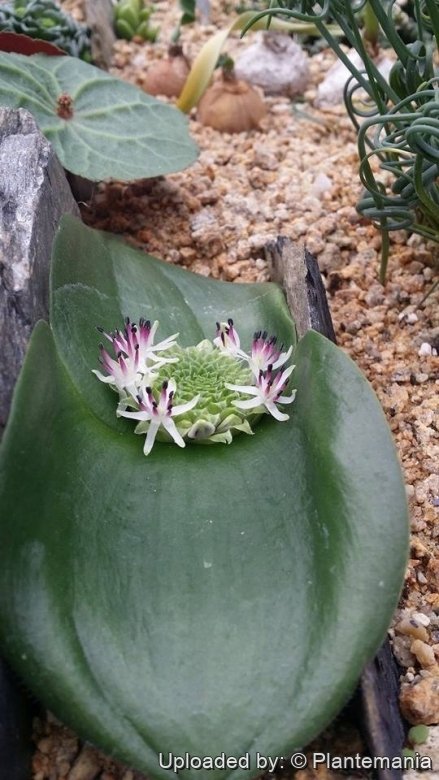
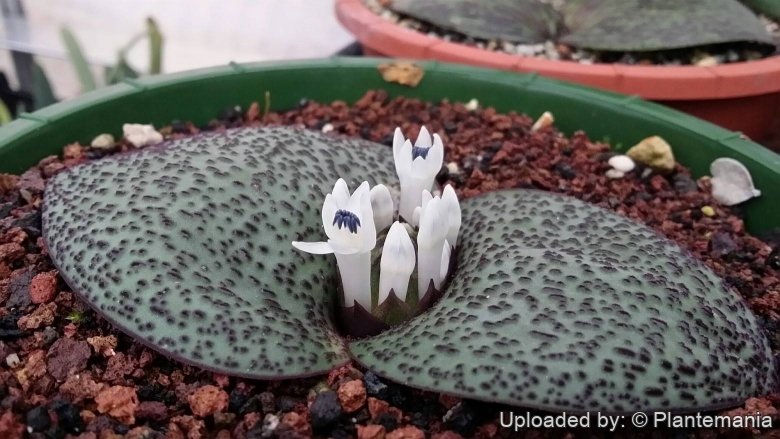
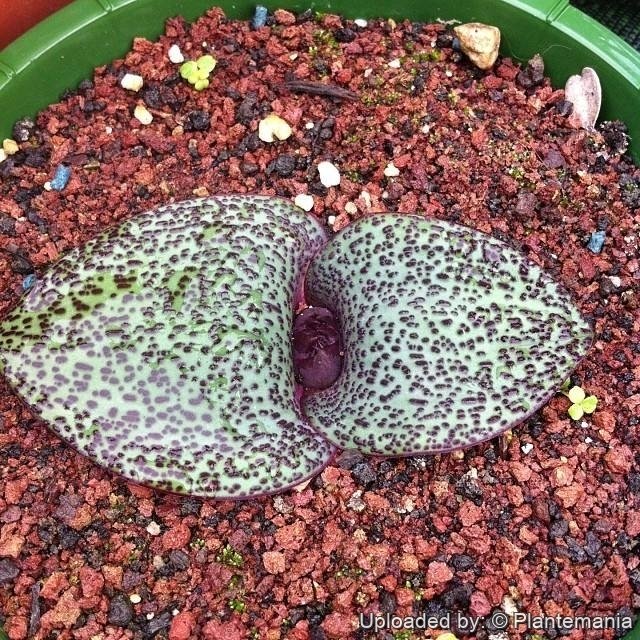
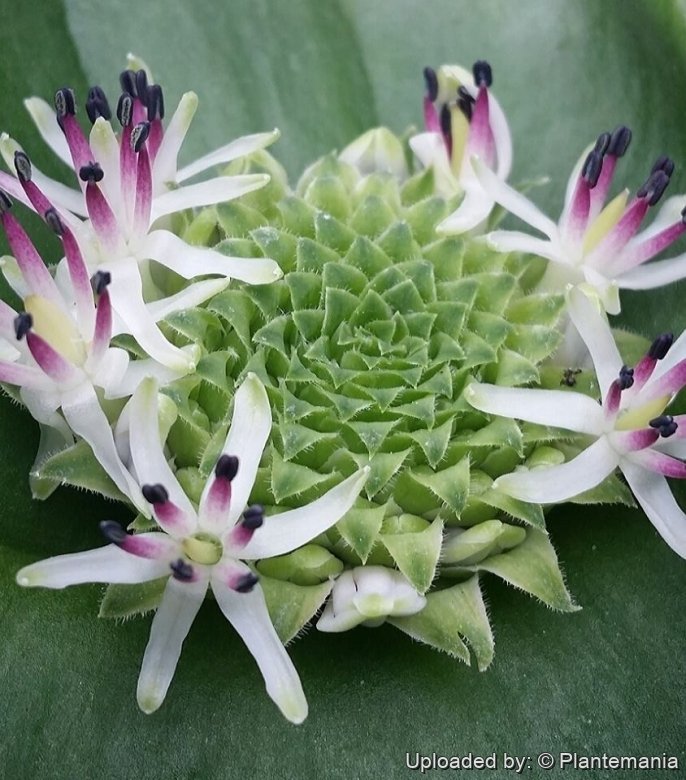
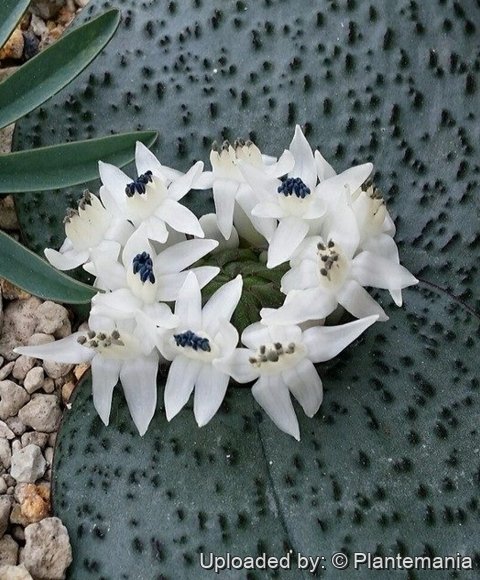
Abraham’s Book or the Buttonhole Flower, scientifically Massonia jasminiflora has just two large darkish green leaves which arise from a small bulb and lie flat on the ground like an open book. The leaves are sometimes with reddish streaks, sometimes with pustules, pustulate hairy, or knobbly. From the centre of the open book come a mass of beautiful white flowers with green, blue, deep purple or almost black anthers, whose scent are reminiscent of jasmine and provide the plant with its specific name. It is the smallest growing of the genus and - because of the wide range of this species - there are many variations and these variations was previously considered different species, but recent work using DNA has ‘lumped’ these forms together as being the same species.
Derivation of specific name: As the specific name suggests, the flowers are highly perfumed, suggestive of Jasmine.
Bulb: Small, globose, white and shallow rooted.
Leaves: 2, usually lay flat or nearly so on the ground, broadly oblong to ovate, subacute, thin glabrous, dark green, sometimes with reddish streaks, smooth, not spotted or sometimes with pustules or knobbly, occasionally ciliate 3-6(-7.5) cm long, 2-5 cm broad.
Inflorescece (umbel): Sessile, 2.5 or more in diameter; outer bracts ovate, acute, much imbricated, 12 mm long; outer pedicels 6-8 mm long.
Flowers: The flowers are white (or pink), often strongly scented like jasmine. perianth white, 12-28 m long. Segments lanceolate, reflexing, half as long as the slender cylindrical tube; filaments ligulate, 3 mm long; anthers small, oblong, green, blue, deep purple or almost black anthers.
Origin and Habitat
Massonia jasminiflora is a beautiful species from the costal regions and the climatically severe interior of South Africa (Free State, Gauteng, Northern Cape, North West), and Lesotho, further east than most other species.
Habitat and ecology: Lowlands and Foothills grasslands and montane grassland and stony ground at relatively high altitudes. In winter the temperatures are often well below freezing and snow may fall on the mountains. The flat leaves no doubt saving it from being eaten by grazing animals. Although this species occurs in a summer-rainfall area, it grows and flowers in winter and the blooms are very conspicuous white and strongly scented. These characteristics make them attractive to pollinators, particularly as nothing else is in bloom and the grassland has turned a uniform golden brown. This peculiar habit of M. jasminiflora may have evolved to permit the best chances for pollination since most other grassland flora is dormant at their flowering time.
Cultivation and Propagation
As with the other members of the genus, Massonia jasminiflora requires the protection of an alpine house or bulb frame in regions subject to frosts. Well-drained soil and a bright, sunny aspect give the best results. They can be propagated by seed, flowering can be expected from two to three years from sowing.
Traditional use: The genus Massonia is known to practitioners of traditional medicine who roast the bulb, grind it into a powder and rub it into incisions to treat certain illnesses.
Bibliography
Major references and further lectures
-
J. G. Baker “Flora Capensis”, 1897
-
Foden, W. & Potter, L. 2005. Massonia jasminiflora Burch. ex Baker. National Assessment: Red List of South African Plants version 2015.1. Accessed on 2016/12/28
-
Herbertia, American Plant Life Society, 2000
-
David Ambrose, Sumitra Talukdar “Know your campus: 1-40” National University of Lesotho, 2001
-
Pacific Bulb Society “Massonia” web <www.pacificbulbsociety.org/pbswiki/index.php/Massonia>
-
Alison van der Merwe; PhD thesis, unpublished.
-
“Massonia jasminiflora - plant of the month December 2013” The Alpine Garden Society web <http://www.alpinegardensociety.net/plants/plant-portraits/Massonia+jasminiflora+plant+of+the+month+December+/130/\>
-
Wisley’s Alpine Log By Paul Cumbleton “Log 8 8th Nov 2007 Massonia and Daubenya” web <http://www.srgc.org.uk/wisley/2007/071107/log.html\>
-
Baker, J.G. “Massonia jasminiflora Burch. ex Baker.” Curtis’s Botanical Magazine 122: t. 7465. 1896
Gallery