Publication: Cactaceae Syst. Init. 14: 17. 2002 [Oct 2002]
Description
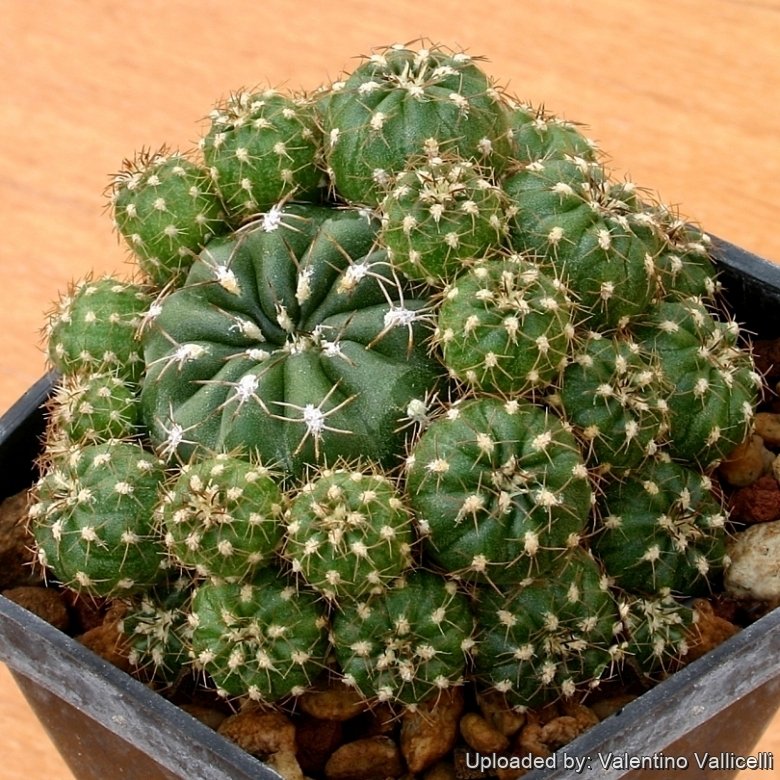
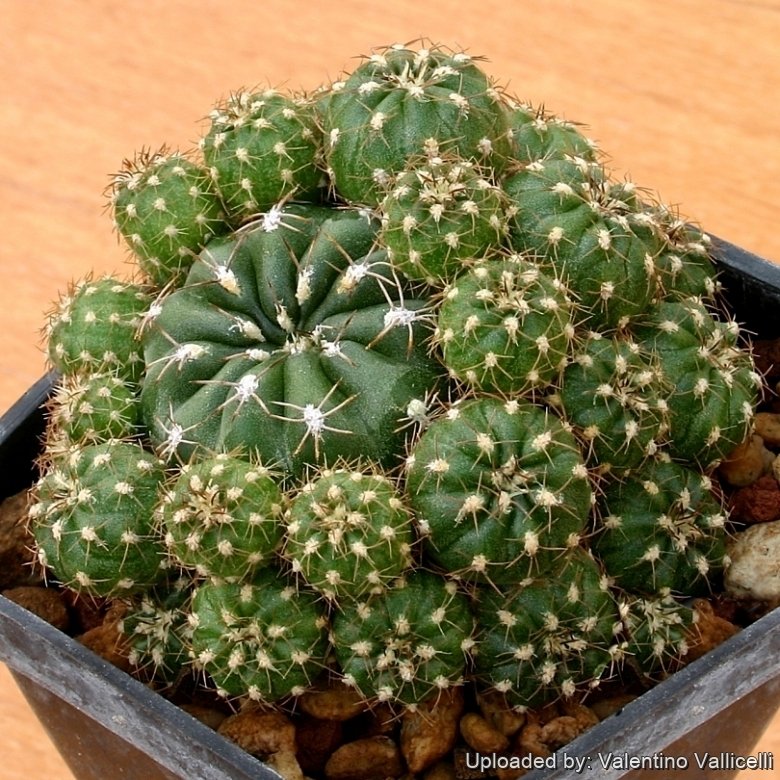
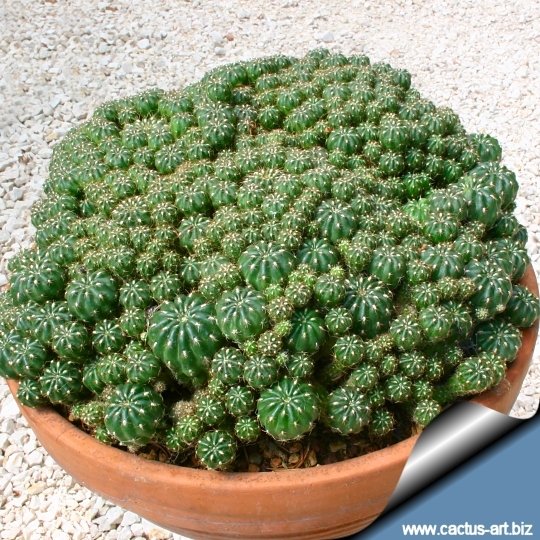
Matucana aurantiaca subs. polzii (Matucana polzii) is a relatively small clustering cactus with a strange squat stems up to 5 cm tall, up to 8-10 cm in diameter. It offsets strongly, with even small heads covered with numerous pups reaching only 2-5 cm across. In age forms huge cushion up to 30-40 cm in diameter whit hundreds of heads. The spines are short, pectinate and widely spaced
Derivation of specific name: This member of the Cactaceae family was given this name by Frank Polz (fl. 1986), German cactus and succulent plant enthusiast in München.
Stems: Spherical more or less flattened, grass-green, to 5 cm high and 8 cm in diameter branching basally and from the sides. Side shoots often very numerous and smaller.
Roots: Fibrous, not taproots.
Ribs: 9-16, flat, rounded, with transverse grooves, usually straight or slightly twisted.
Areoles: Oval, up to 8 mm in length and 3 mm in width, covered with pale cream to white hairs, over time grey and bare.
Spines: The spines are tiny, flexible, pectinate and widely spaced whitish, to brownish-yellow to black on tips, later grey, sometimes slightly curved.
Central spines: 1-3, to 25(-30) mm long.
Radial spines: 6-12(-13), 6-18(-20) mm long, mostly yellowish-white.
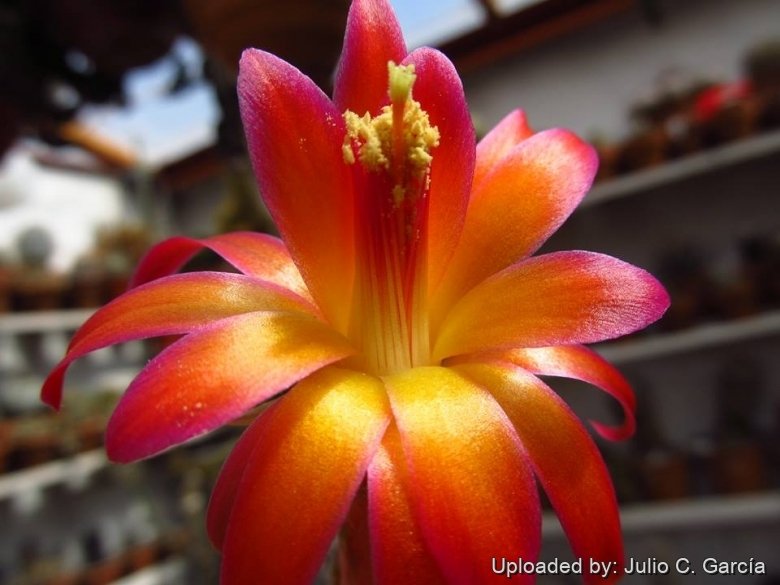
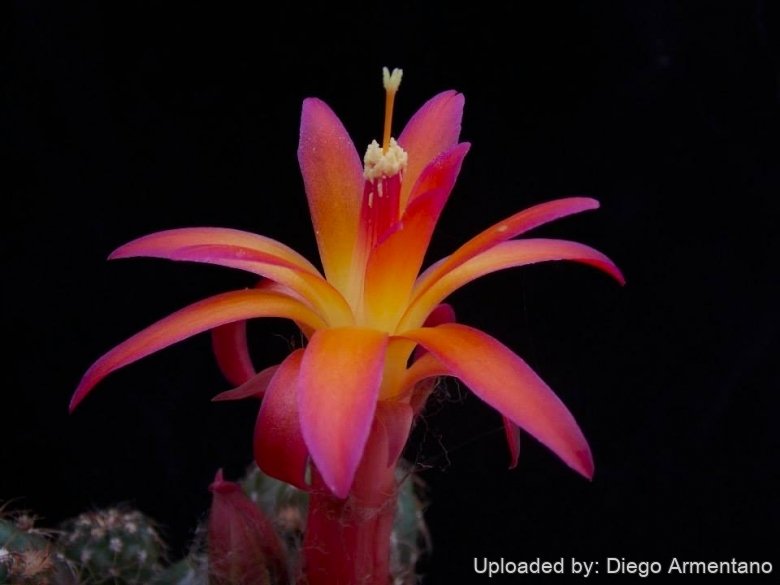
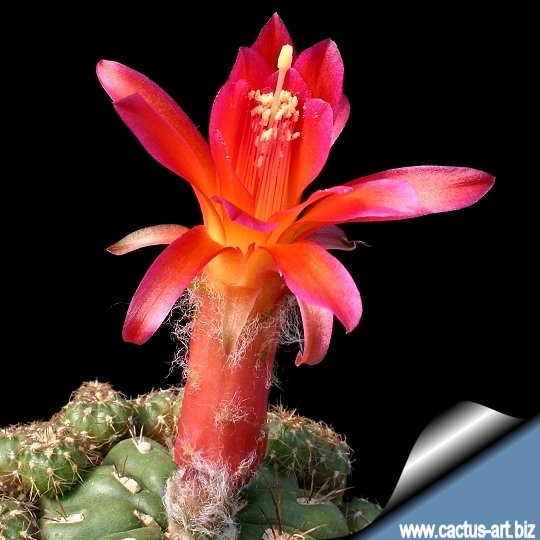
Flowers: Funnel-shaped, slightly curved, dark carmine red to orange, 5-7 cm long, 3.5-5 cm in diameter.
Fruits: Oval, purplish brown, 5-7 mm in diameter.
Taxonomic note: Matucana aurantiaca subs. polzii is recognised by some authorities as subspecies of Matucana aurantiaca, but other authorities still consider it a legitimate species in its own right Matucana polzii.
Origin and Habitat
Upper reaches of the Río Marañon, Huánuco, Peru. (Western South America)
Altitude range: 2100-2300 metres above sea level.
Cultivation and Propagation
Matucana aurantiaca subs. polzii is a very easy to grow ornamental species suited for any well drained soil in half or full sun.
Growth rate: It is a small growing species, but it it possible to increase the speed of growth to some extent by providing adequate amount of water, warmth, and fertilizer during the active growing season, but it’s susceptible to rotting if too wet and do not like a lot of water when it is on rest.
Soil and pots: It likes deep pot with generous drain holes to accommodate its tap root, needs a very airy potting medium very permeable to water which mainly consists of non organic material such us clay, pumice, lava grit, expanded slate and only a little peat or leaf-mould, slightly acid, pH-value between 4,5–6. Re-pot every two years.
Fertilization: Need a perfect fertilizer diet in summer. Use preferably a cacti and succulents fertilizer with high potassium content including all micro nutrients and trace elements or slow release fertilizer.
Exposure: This plant need full sun but tolerate moderate shade, and a plant that has been growing in shade should be slowly hardened off before placing it in full sun as the plant will be severely scorched if moved too suddenly from shade into sun.
Watering: No water should ever be allowed to stand around the roots. Keep almost completely dry in winter. However this spurge will tolerate dryness and can even thrives in poor, dry soils, but do better when grown in nutrient-rich soils with regular watering.
Hardiness: Tender. It can be difficult to get it to look its best without a good amount of heat. In winter keep completely dry at temperatures of 10-12 ° C. However it can take a short period of light frost if very dry. It can be grown outdoors in frost-free climates.
Rot: Rot it is only a minor problem with cacti if the plants are watered and “aired” correctly. If they are not, fungicides won’t help all that much.
Propagation: The plant can be reproduced by seeds or cuttings. If you remove an offset, remember to let it dry for some days, letting the wound heal (cuttings planted too soon easily rot before they can grow roots). Lay it on the soil and insert the stem end partially into the substrate. Try to keep the cutting somewhat upright so that the roots are able to grow downward.
Bibliography
Major references and further lectures
-
James Cullen, Sabina G. Knees, H. Suzanne Cubey “The European Garden Flora Flowering Plants: A Manual for the Identification of Plants Cultivated in Europe, Both Out-of-Doors and Under Glass” Cambridge University Press, 11/Aug/2011
-
David R Hunt; Nigel P Taylor; Graham Charles; International Cactaceae Systematics Group. “The New Cactus Lexicon” dh books, 2006
-
Edward Anderson “The Cactus family” Timber Press, Incorporated, 2001
-
Urs Eggli, Leonard E. Newton “Etymological Dictionary of Succulent Plant Names” Springer Science & Business Media, 29 June 2013
Gallery