Publication: Taxon 12: 124. 1963
Description
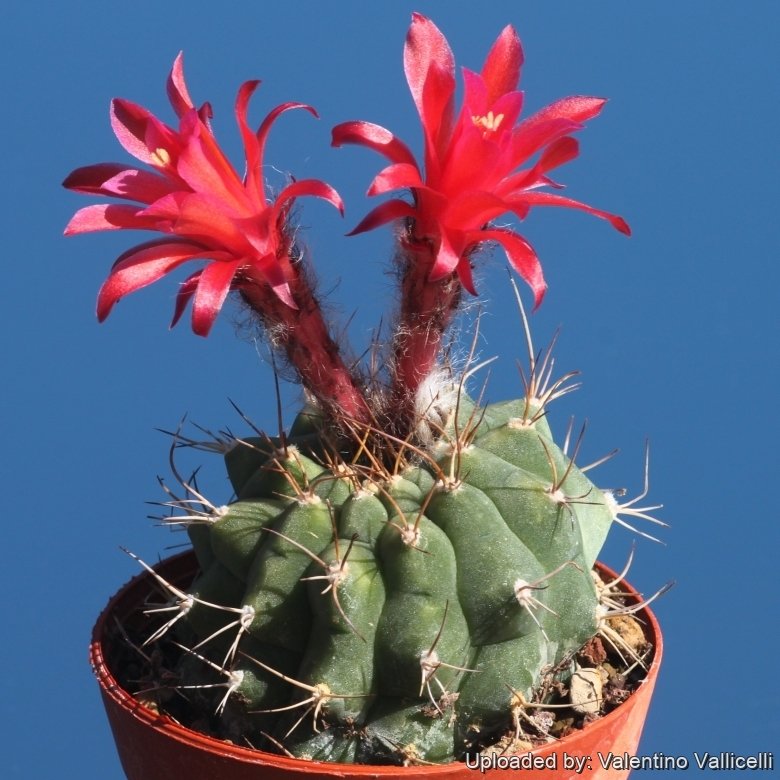
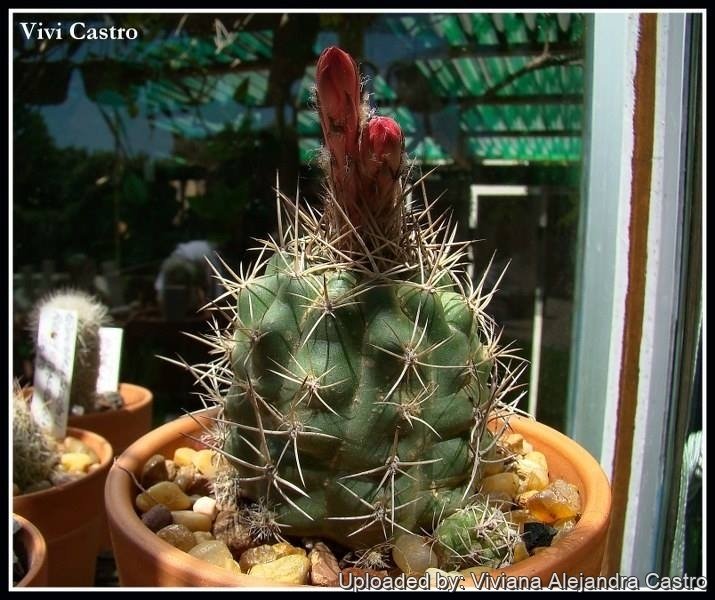
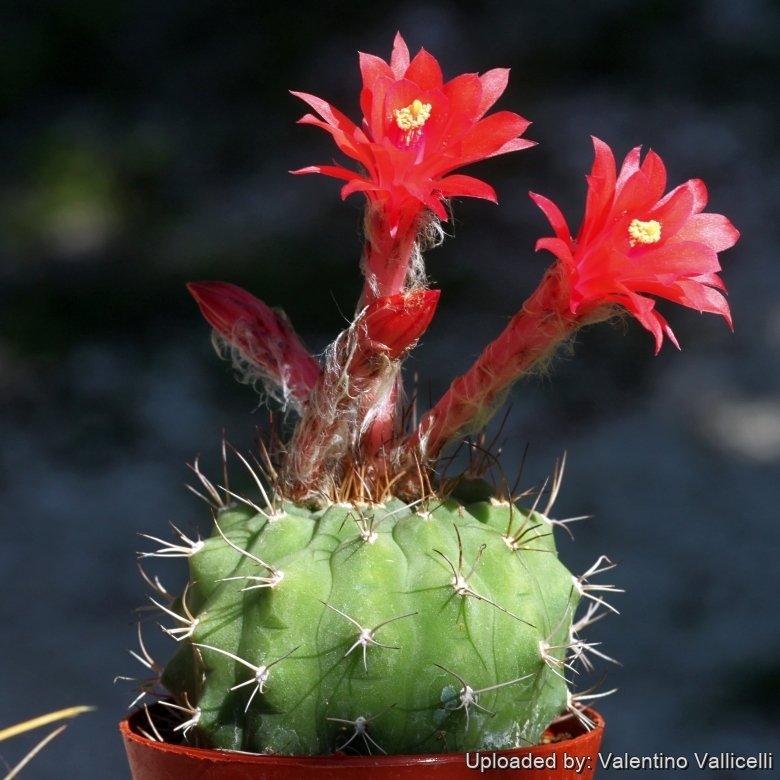
Matucana paucicostata is a sparse ribbed globular cactus often branching basally to form small clusters. It is one of the smallest Matucana species. The plants mature and start flowering at the size of a nut (3-4 years from seed), and generally do not overgrow the sized of a small apple.
Stems: Globose when young slowly becoming short cylindrical, dark grey-green, notched and tubercular, 7-15 cm high, 4-7 cm wide.
Ribs: 7-11, broad, straight, forming conical tubercles.
Root: Short taproots.
Spines: Reddish brown, turning grey with age, bended, somewhat flexible.
Central spines: Single (often missing), up to 30 mm long.
Radial spines: 4 to 8, 5-30 mm long.
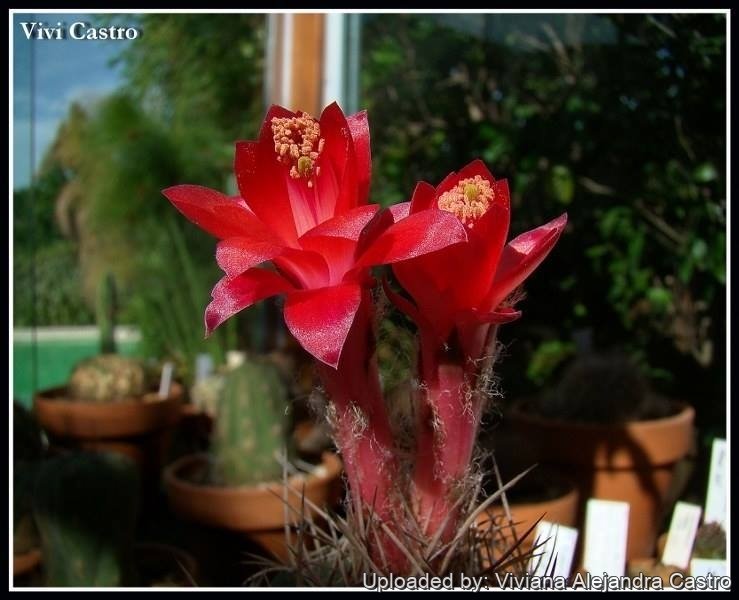
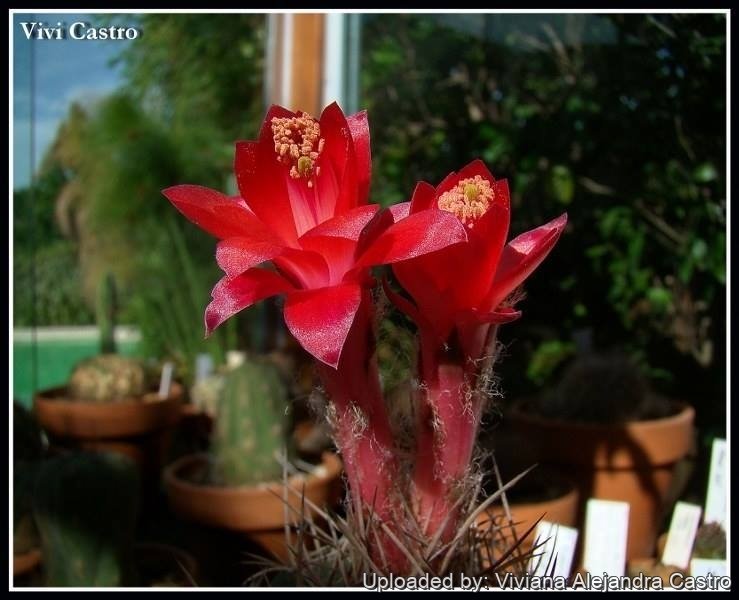
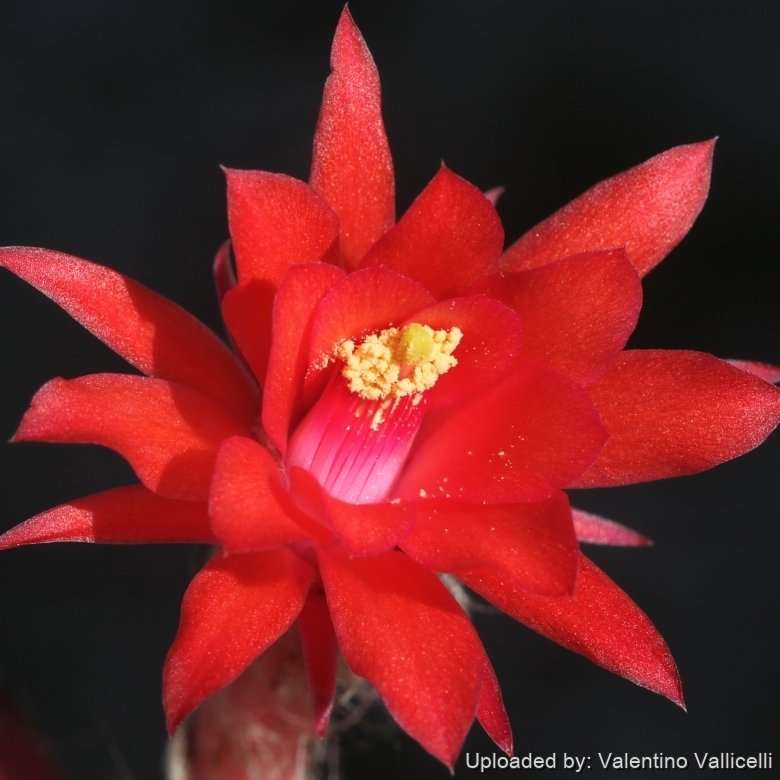
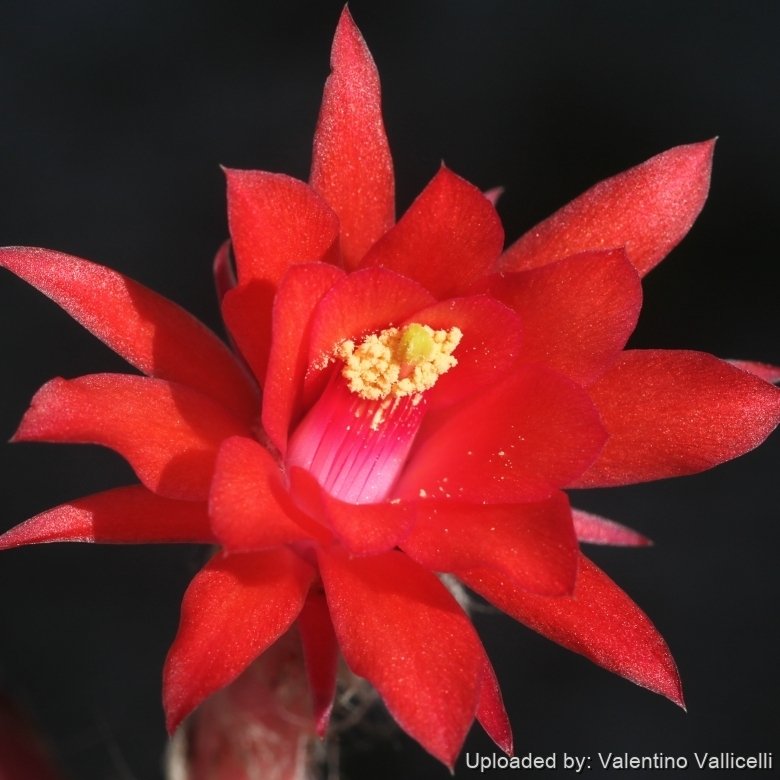
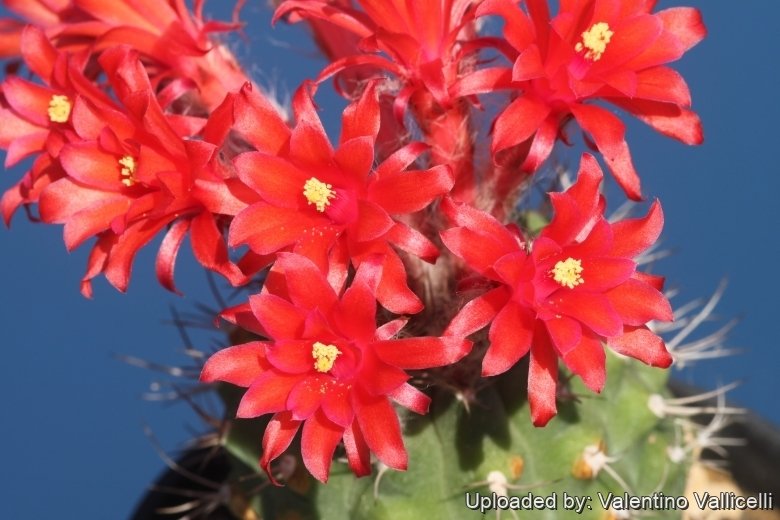
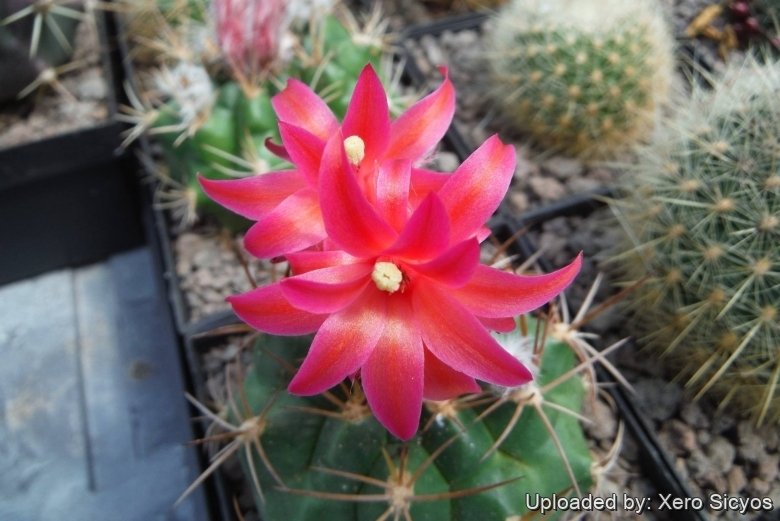
Flowers: Very showy, almost vertical on the stem apex, purplish pink to carmine red, funnel shaped, long-necked, slightly curved (zygomorphic), 6 cm and 3 cm in diameter with a tight bunch of filaments around style. Petals, margined, dark vermillion and violet, with gentle changing colour shades, flower tube white hairy.
Phenology: Large plants usually produce small bouquets of 5-10 blooms at time, forming pretty crown. Flowering period summer (June–July in northern hemisphere) but in favourable conditions some flowers may appear from early spring to late autumn.
Fruits: Green, sparse hairy, approximatively 11 mm broad.
Seed: Brown.
Origin and Habitat
Peruvian region of Ancash and La Libertad (valleys of the Rio Puchca, Rio Mosna, Rio Huari, and Maranon). Extent of Occurrence is less than 2,500 km2, and occurs in less than ten locations.
Altitude:1800-2800 metres above sea level.
Habitat and ecology: It is both solitary or in groups and occurs in inter-Andean valleys. In this area grow other related matucanas such as Matucana madisoniorum, Matucana calliantha, Matucana tuberculosa and Matucana formosa. It is not frequent, but not rare either. The population seems to be decreasing due to illegal collection.
Cultivation and Propagation
Matucana paucicostata is an easy to grow ornamental species suited for any well drained soil in half or full sun.
Growth rate: It is a small growing species, but it it possible to increase the speed of growth to some extent by providing adequate amount of water, warmth, and fertilizer during the active growing season, but it’s susceptible to rotting if too wet and do not like a lot of water when it is on rest.
Soil and pots: It likes deep pot with generous drain holes to accommodate its tap root, needs a very airy potting medium very permeable to water which mainly consists of non organic material such us clay, pumice, lava grit, expanded slate and only a little peat or leaf-mould, slightly acid, pH-value between 4,5–6. Re-pot every two years.
Fertilization: Need a perfect fertilizer diet in summer. Use preferably a cacti and succulents fertilizer with high potassium content including all micro nutrients and trace elements or slow release fertilizer.
Exposure: This plant need full sun but tolerate moderate shade, and a plant that has been growing in shade should be slowly hardened off before placing it in full sun as the plant will be severely scorched if moved too suddenly from shade into sun.
Watering: No water should ever be allowed to stand around the roots. Keep almost completely dry in winter. However this spurge will tolerate dryness and can even thrives in poor, dry soils, but do better when grown in nutrient-rich soils with regular watering.
Hardiness: Tender. This cactus cannot tolerate any frost and can be difficult to get it to look its best without a good amount of heat. It can be grown outdoors in frost-free climates.
Rot: Rot it is only a minor problem with cacti if the plants are watered and “aired” correctly. If they are not, fungicides won’t help all that much.
Propagation: The plant can be reproduced by seeds or cuttings. If you remove an offset, remember to let it dry for some days, letting the wound heal (cuttings planted too soon easily rot before they can grow roots). Lay it on the soil and insert the stem end partially into the substrate. Try to keep the cutting somewhat upright so that the roots are able to grow downward.
Bibliography
Major references and further lectures
-
Edward F. Anderson “The Cactus Family” Timber Press, 2001
-
James Cullen, Sabina G. Knees, H. Suzanne Cubey “The European Garden Flora Flowering Plants: A Manual for the Identification of Plants Cultivated in Europe, Both Out-of-Doors and Under Glass” Cambridge University Press, 11/Aug/2011
-
David Hunt, Nigel Taylor “The New Cactus Lexicon” DH Books, 2006
-
Walther Haage “Kakteen von A bis Z”+ Neumann Verlag, 1981
-
Ostalaza, C. & Roque, J. 2013. Matucana paucicostata. The IUCN Red List of Threatened Species. Version 2015.2. <www.iucnredlist.org>. Downloaded on 18 August 2015.
From llifle page Matucana caespitosa
Description
Matucana caespitosa n.n. is an undescribed name used commercially to indicate one of the local forms of Matucana paucicostata, which is a sparse ribbed globular cactus often branching basally to form small clusters. It is one of the smallest matucana species. Friedrich Ritter found this type in 1956, and spread it under no. FR 597. Commercially the type has emerged as Matucana / Submatucana caespitosa nn or Matucana spec. nov. FR597.
Remarks: Matucana paucicostata is a relatively variable species that has received an undue number of names. The differences usually concern only the spination, however the colouring, size and density of spines is greatly influenced by the conditions of culture, at lower light levels the spines are less numerous, delicate and paler, while with strong solar radiation the spines are stronger with a darker tint. Minor differences can also be found in the colour of flowers sometime with a more orange or purple tint.
Origin and Habitat
Rio Huari, Peruvian region of Ancash.
Altitude: 2000 metres above sea level.
Habitat and ecology: In this area grow other related matucanas such as Matucana madisoniorum, Matucana calliantha, Matucana tuberculosa and Matucana formosa.
Cultivation and Propagation
Matucana caespitosa is an easy to grow ornamental species suited for any well drained soil in half or full sun.
Growth rate: It is a small growing species, but it it possible to increase the speed of growth to some extent by providing adequate amount of water, warmth, and fertilizer during the active growing season, but it’s susceptible to rotting if too wet and do not like a lot of water when it is on rest.
Soil and pots: It likes deep pot with generous drain holes to accommodate its tap root, needs a very airy potting medium very permeable to water which mainly consists of non organic material such us clay, pumice, lava grit, expanded slate and only a little peat or leaf-mould, slightly acid, pH-value between 4,5–6. Re-pot every two years.
Fertilization: Need a perfect fertilizer diet in summer. Use preferably a cacti and succulents fertilizer with high potassium content including all micro nutrients and trace elements or slow release fertilizer.
Exposure: This plant need full sun but tolerate moderate shade, and a plant that has been growing in shade should be slowly hardened off before placing it in full sun as the plant will be severely scorched if moved too suddenly from shade into sun.
Watering: No water should ever be allowed to stand around the roots. Keep almost completely dry in winter. However this spurge will tolerate dryness and can even thrives in poor, dry soils, but do better when grown in nutrient-rich soils with regular watering.
Hardiness: Tender. This cactus cannot tolerate any frost and can be difficult to get it to look its best without a good amount of heat. It can be grown outdoors in frost-free climates.
Rot: Rot it is only a minor problem with cacti if the plants are watered and “aired” correctly. If they are not, fungicides won’t help all that much.
Propagation: The plant can be reproduced by seeds or cuttings. If you remove an offset, remember to let it dry for some days, letting the wound heal (cuttings planted too soon easily rot before they can grow roots). Lay it on the soil and insert the stem end partially into the substrate. Try to keep the cutting somewhat upright so that the roots are able to grow downward.
Bibliography
Major references and further lectures
- Kakteen und andere Sukkulenten, Volume 38 Steinhart KG, 1987
Edward F. Anderson “The Cactus Family” Timber Press, 2001
-
David Hunt, Nigel Taylor “The New Cactus Lexicon” DH Books, 2006
-
Walther Haage “Kakteen von A bis Z”+ Neumann Verlag, 1981
-
James Cullen, Sabina G. Knees, H. Suzanne Cubey “The European Garden Flora Flowering Plants: A Manual for the Identification of Plants Cultivated in Europe, Both Out-of-Doors and Under Glass” Cambridge University Press, 11/Aug/2011
Source: Matucana caespitosa, LLIFLE - Encyclopedia of living forms, CC-BY-SA, retrieved 2026-10-25.
Gallery