Publication: Monatsschr. Kakteenk. 30: 8. 1920
Description
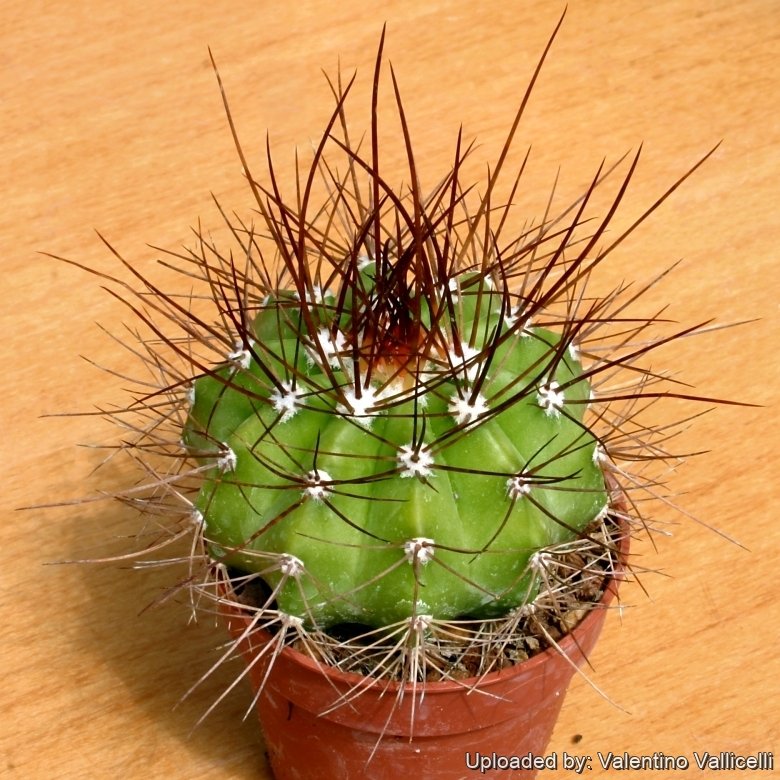
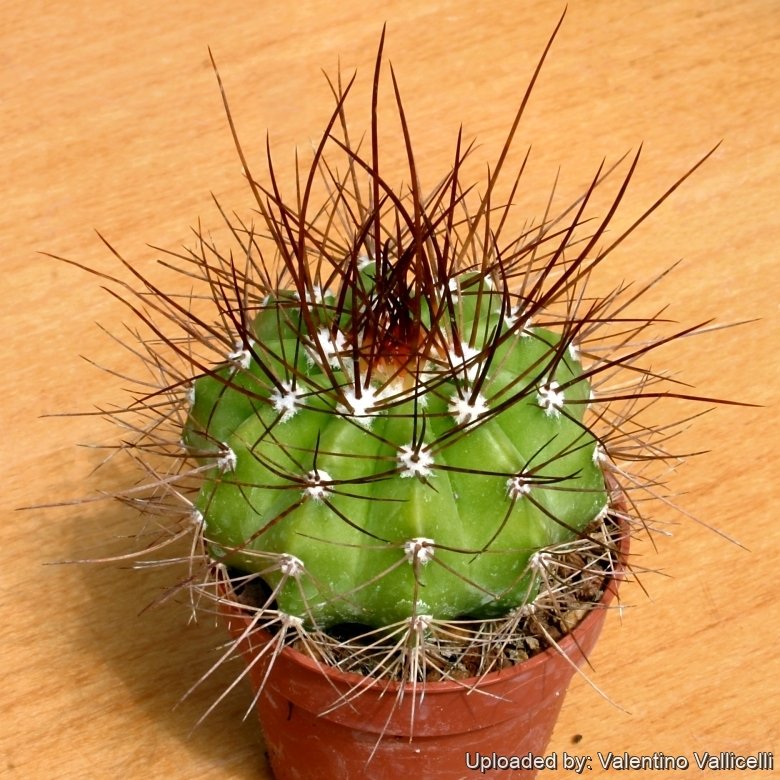
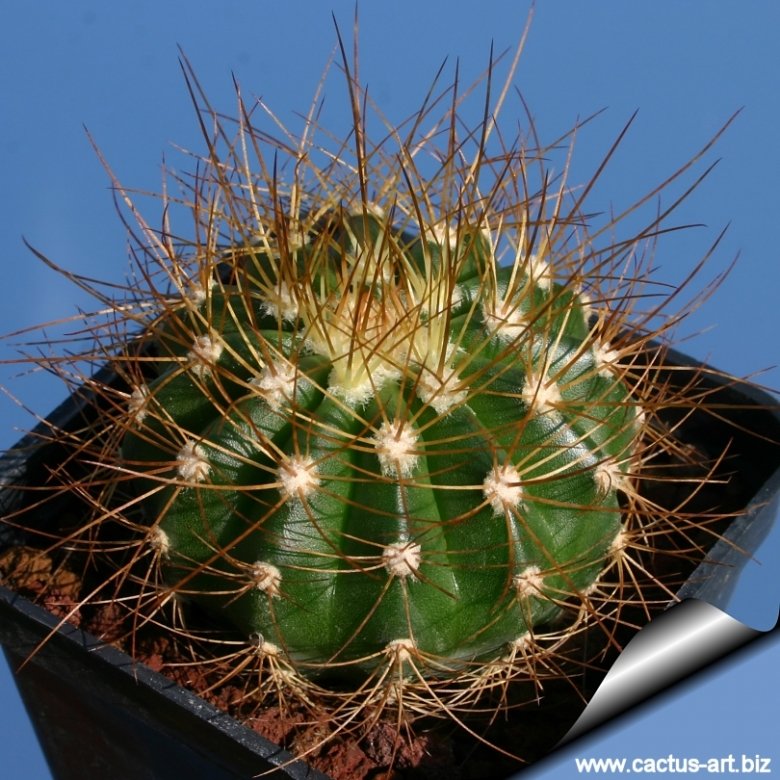
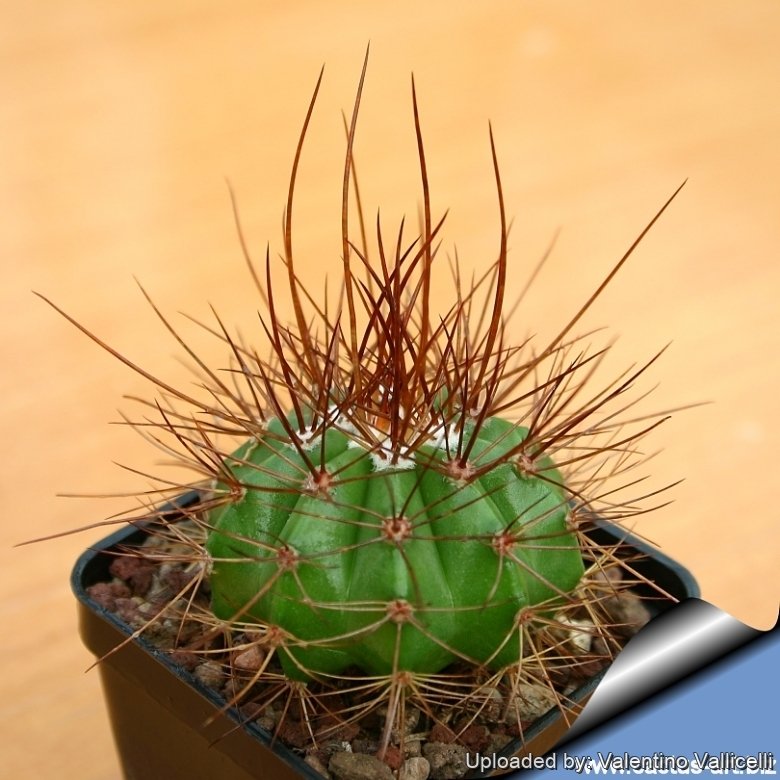
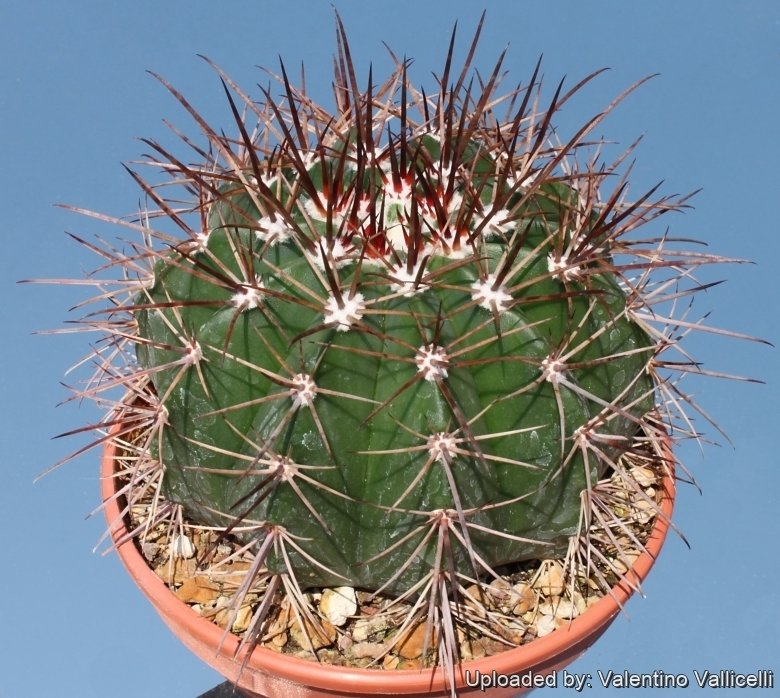
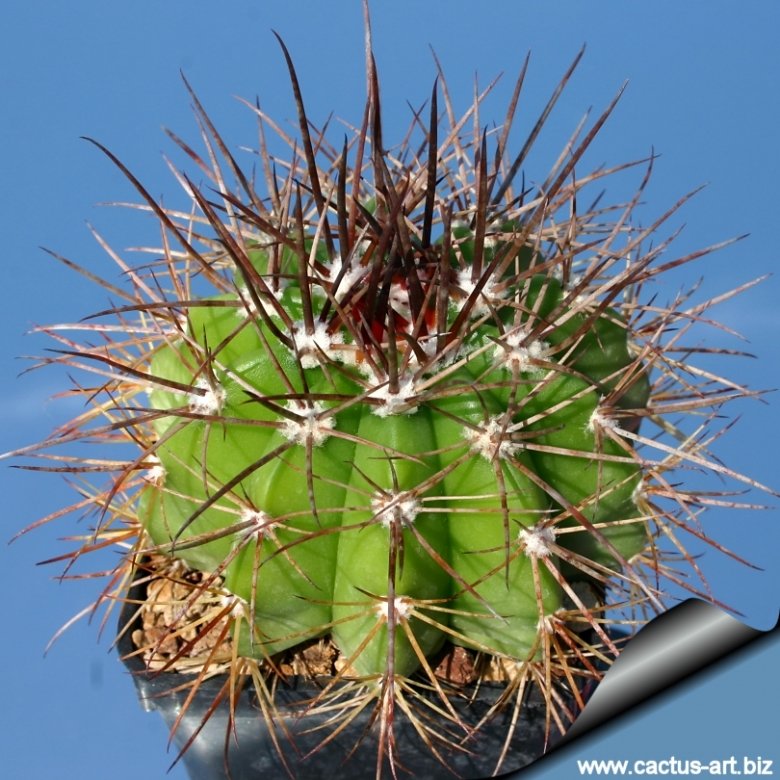
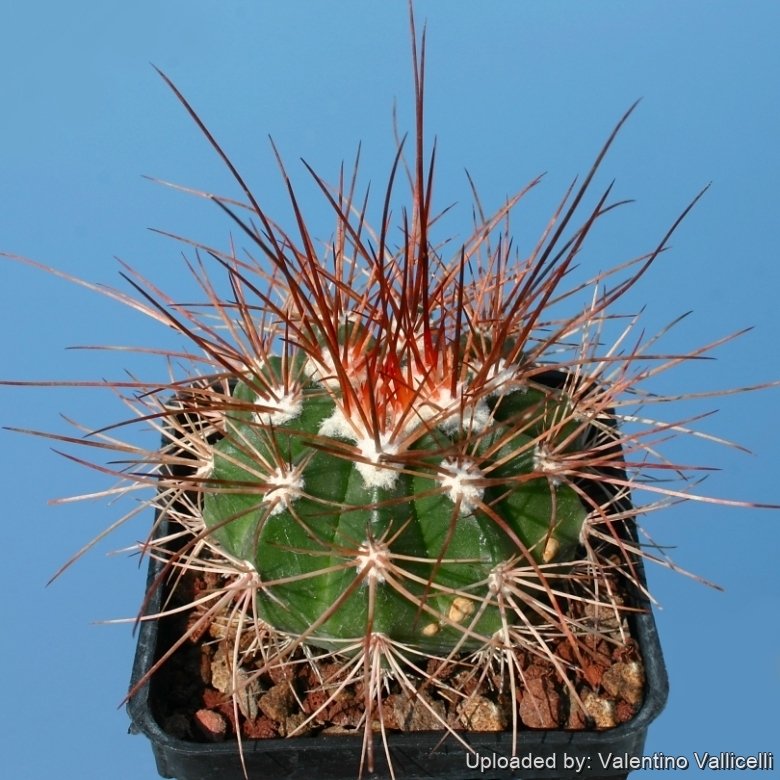
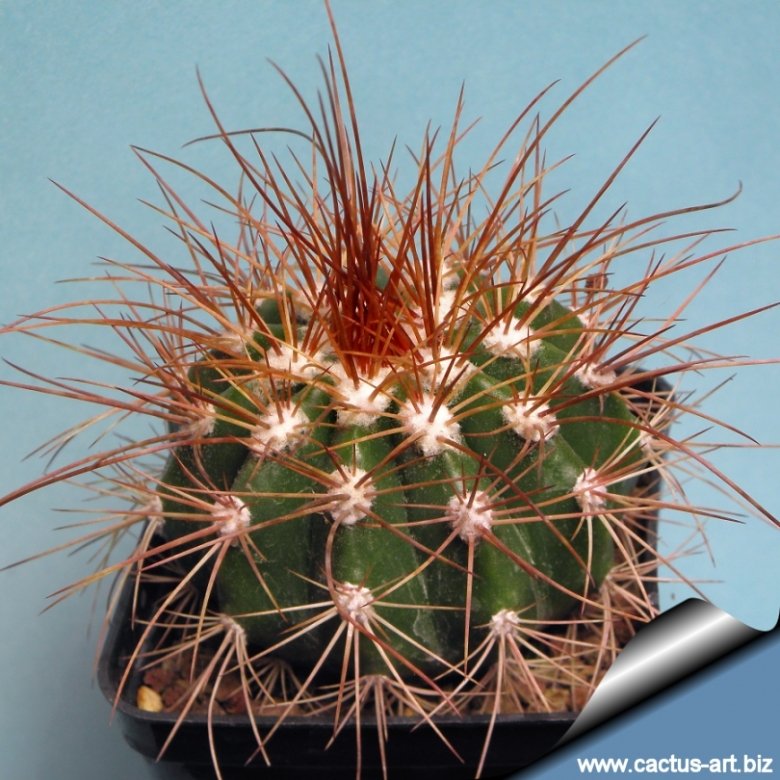
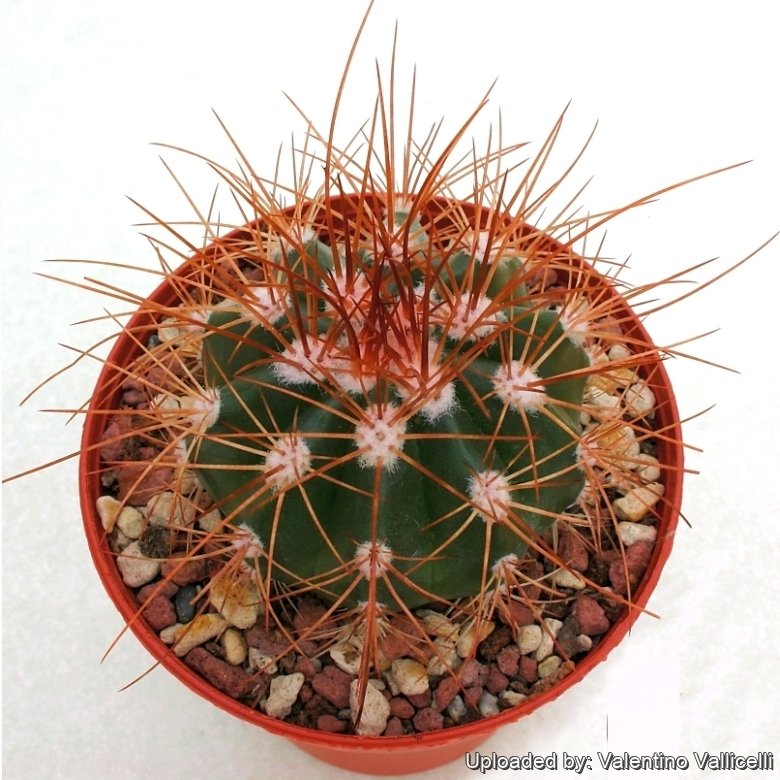
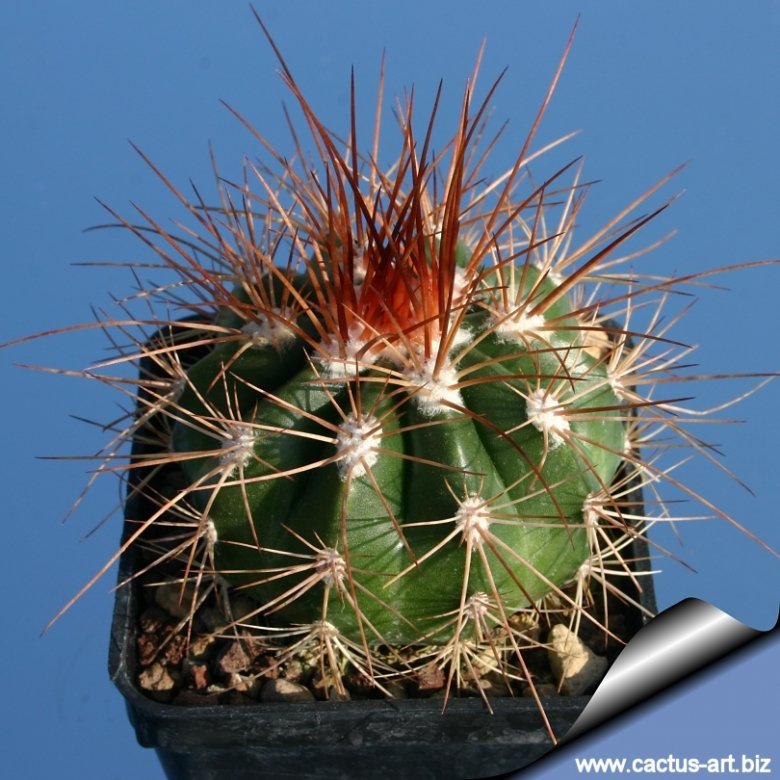
Melocactus ernestii is one of the larger Melocactus and one of the longest spined species of the genus, it is also a very variable species in size colour and form of the spines. Mature plants are easily recognizable by their cephalium, that have a covering of wool and bristles, while the immature plant looks like a smallish barrel cactus, and there is nothing in its appearance that would suggest a Melocactus. Plants of this genus attract more attention in collections than those of any other cactus genera.
Habit: It is a solitary perennial stem succulent with determinate growth in which the axis does not continue to elongate indefinitely being limited by the development of the flower bearing cephalium.
Stem: Spherical to depressed conical to ellipsoid to short cylindrical, distinctly mucilaginous, light yellowish green to dark green, (8-)9-25(-45) cm high, (7-)12-22(-25) cm in diameter. When the plant has reached a certain age it shows at the growing tip a cephalium (the structure, where the flower buds will form.
Ribs: 9-13, more or less rounded but sometimes sharp-edged.
Cephalium: Cap-like, globose to shortly cylindrical, (hence the common name of “Turk’s Cap”) to 2-18 cm high and 4-8 cm in diameter, covered by tightly peaked areoles that bear wool and pinkish-red bristles, the tips sometimes covered with white wool.
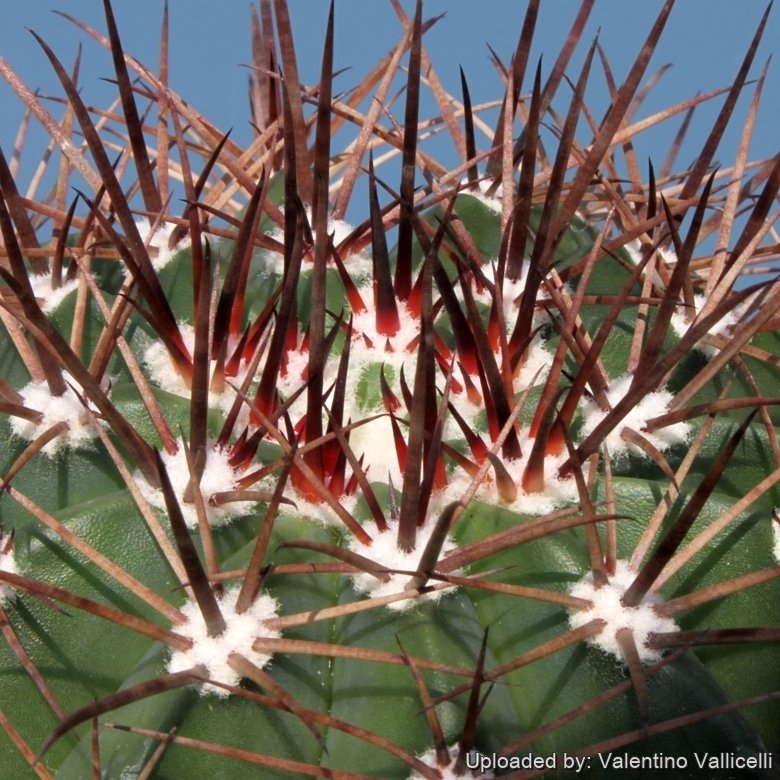
Areoles:Somewhat rounded to obtuse with, 1-2 cm apart,m a little white wool nearer the centre of a juvenile plants.
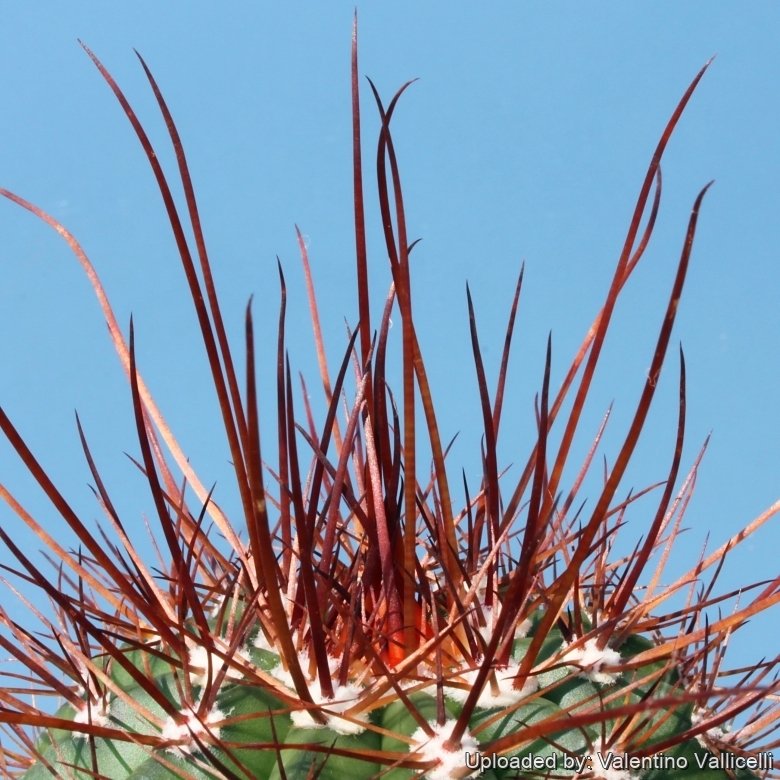
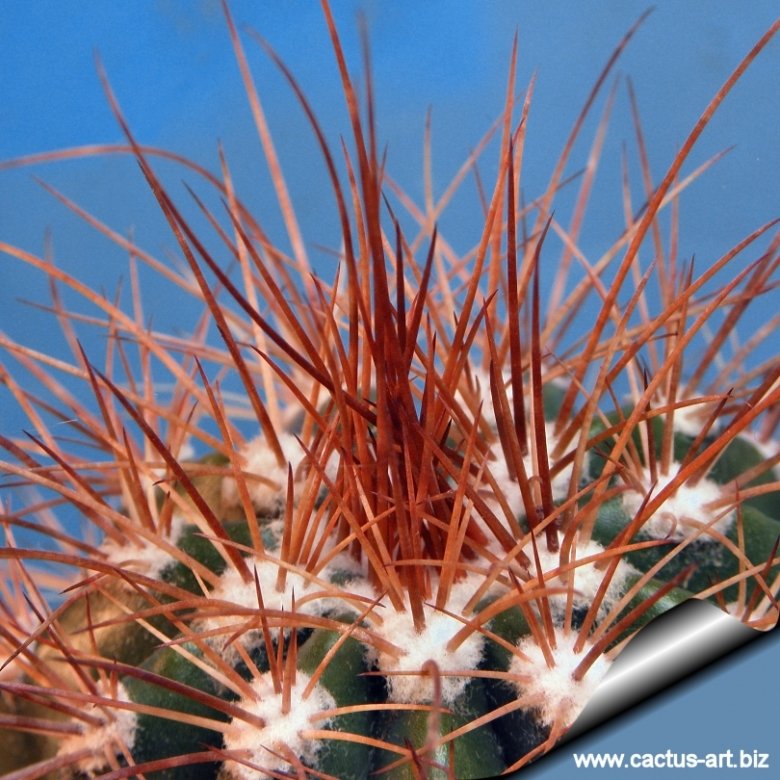
Spines: with red and yellow bands or reddish or brownish, becoming grey or black with age on old mature specimens.
Radial spines: 6-13, slender, straight or curved outward, 4-15 cm long. The lowermost the longer.
Central spine: 3-8, lowermost curved or straight, 3,2-9 cm long
Flowers: Small, light to dark pinkish magenta, 17-30 mm long, 7-18 mm in diameter, similar in form to Mammillaria flowers. They do not emerge fully from the cephalium.
Blooming season: The flowers arise annually in mid summer from the cephalium in a ring. The flowers are diurnal and opens for a few hours at about lunchtime. It starts flowering in 6-10 years.
Fruits: Clavate berry, often somewhat flattened, especially near the tip, variable in size 1,5 to 4,5 cm long, 6-10 mm in diameter, deep pink to crimson-red. Ripened fruits are present apically on the cephalium.
Seeds: 1-1,3 mm long, 0,8-1 mm broad slightly tuberculatate.
Chromosome number: 2n = 44
Origin and Habitat
Bahia and Minas Gerais, Brazil.
Altitude: 200-1100 metres above sea level.
Habitat: It grows in crevices in places dominated by gneiss/granite inselbergs and on rocky outcrop among low xerophytic vegetation.
Cultivation and Propagation
These tropical cacti are not the easiest things to grow and aren’t plants for beginners.
Growth rate: It is a relatively rapidly growing given the best conditions.
Soils: It likes very porous standard cactus mix soil.
Repotting: The root system is weak and generally resents being repotted and can take a long time to re-establish. Use pot with good drainage.
Light: They prefer very bright light, not as much as the most arid growing cacti, but plenty nonetheless. Tends to bronze in strong light, which encourages flowering and heavy spine production.
Watering: Melocacti grow from April to October and cannot endure long stretches of total dryness, and also too much water will rot them, as their weak root systems tends to be inefficient at sucking up water from wet soil. Nonetheless, again as a result of their tropical origins, they need a fair amount of water, but allow the soil to dry quite a bit before watering again.
Fertilization: Do not feed in winter.
Hardiness: Melocactus rest from October to April but can’t stand cold, or even fairly cool temperatures, so is indispensable to keep them above 8-12°C at all times, severe damage or death occurring at temperatures that the great majority of cacti wouldn’t mind in the least and prefer more frequent water in winter than other cacti, say once a month. (but hardy to 4 C ° C for short periods). However warmth throughout the year will increase the grower’s success (minimum 12° to 20° C during rest season).
Pests & diseases: It may be attractive to a variety of insects, but plants in good condition should be nearly pest-free, particularly if they are grown in a mineral potting-mix, with good exposure and ventilation. Nonetheless, there are several pests to watch for:
- Red spiders: Red spiders may be effectively rubbed up by misting the vulnerable plants every day
- Mealy bugs: Mealy bugs occasionally they develop aerial into the new growth among the wool with disfiguring results, but the worst types develop underground on the roots and are invisible except by their effects.
- Scales: Scales are rarely a problem.
- Rot: it is only a minor problem with cacti if the plants are watered and “aired” correctly. If they are not, fungicides won’t help all that much.
Propagation: Exclusively by Seeds. Sow in February-march in a light, sandy, porous soil. Cover germinating tray with glass to prevent seed from drying out. Germination is most successful at a temperature of 18 to 22° C.
Bibliography
major references and further lectures
-
Willy Cullmann “Kakteen: Einführung in die Kakteenkunde und Anleitung zu erfolgreicher Kakteenkultur” E. Ulmer, 1972
-
Hirao, H. “Colour Encyclopedia of Cacti” Seibundo Shinkocha Pub. Co. 1979
-
Stuart Max Walters “The European garden flora. 3.[Angiospermae], Dicotyledons. [Casuarinaceae to Aristolochiaceae]” Cambridge University Press, 1989
-
Edward Anderson “The Cactus family” Timber Press, Incorporated, 2001
-
David R Hunt; Nigel P Taylor; Graham Charles; International Cactaceae Systematics Group. “The New Cactus Lexicon” dh books, 2006
-
John Borg “Cacti: a gardener’s handbook for their identification and cultivation” Blandford Press, 1959
-
Curt Backeberg: “Die Cactaceae: Handbuch der Kakteenkunde.” Vol. IV, Gustav Fischer Verlag, Stuttgart New York 1984
-
Sara Oldfield “Cactus and Succulent Plants: Status Survey and Conservation Action Plan” IUCN, 01/Jan/1997
-
Edgar Lamb, Brian Lamb ”The Illustrated Reference on Cacti & Other Succulents,” Volume 5 Blandford Press, 1978
-
Urs Eggli, Leonard E. Newton “Etymological Dictionary of Succulent Plant Names” Birkhäuser 2004
-
Juliana P. Castro, Luiz G.R. Souza, Lânia F. Alves, Ana E.B. Silva, Marcelo Guerra & Leonardo P. Felix. 1073 Marhold (ed.) “IAPT/IOPB chromosome data 15” TAXON 62 (5) • October 2013: 1073–1083
From llifle page Melocactus deinacanthus
Description
It is a large species strictly related to Melocactus ernestii
Stem:Usually solitary, globose to cylindrical about 35 cm tall and 25 cm in diameter.
Ribs: 10 to 12 sharp-edged.
Cephalium: Up to 25 cm tall and 9 cm in diameter. In contrast to the typical cephaliums covered with reddish bristles, in Melocactus deinacanthus, the upper portion of the cephalium tends to remain white, with few bristles to poke out beyond an abundant layer of woolly fibers. The immature plant looks like a smallish barrel cactus, and there is nothing in its appearance that would suggest a Melocactus.
Central spines: 4-7 reddish-brown up to 5,3 cm long.
Radial spines: 11-14 slightly curved up to 8 centimetres long.
Flowers: Up to 2,6 cm long and 1,2 cm in diameter in various gradation of pink-magenta
Fruit: Club-shaped pure white 1,2 to 2,2 centimetres long.
Origin and Habitat
Melocactus deinacanthus is a rare and isolated species, endemic to east of the Rio Sao Francisco in southern Bahia (Brasil)
Altitude. 500–540 m.
Habitat: Grows on large plates of exposed granite/gneiss rock often in large numbers with several rare plants in crests form. It is a co-dominant element of the rupicolous vegetation. The 2 only population known are seriously threatened by agriculture development and by inundation from the “represa de spradinho” a large dam lake on Rio São Francisco.
Cultivation and Propagation
These cacti are not the easiest things to grow and aren’t plants for beginners. Melocactus deinacanthus grows from April to October, it can’t endure long stretches of total dryness, and also too much water will rot it, as its weak root systems tends to be inefficient at sucking up water from wet soil. Nonetheless, again as a result of their tropical origins, they need a fair amount of water, but allow the soil to dry quite a bit before watering again. Melocactus rests from October to April but can’t stand cold, or even fairly cool temperatures, so is indispensable to keep it above 8-12°C at all times, severe damage or death occurring at temperatures that the great majority of cacti wouldn’t mind in the least and prefer more frequent water in winter than other cacti, say once a month. Do not feed in winter.
The root system is weak and generally resents being repotted and can take a long time to re-establish. The soil mix should be very quick draining, prefers very bright light, not as much as the most arid growing cacti, but plenty nonetheless.
Propagation: Exclusively by Seeds. Sow in February-march in a light, sandy, porous soil. Cover germinating tray with glass to prevent seed from drying out. Germination is most successful at a temperature of 18 to 22° C.
Notes
The most remarkable part of a Melocactus is its cephalium a bristle-coated structure on the summit of the plant, only Melocactus, and the similar genus Discocactus possesses this type of permanent, apical, hatlike appendage. It’s only when a Melocactus reaches maturity that the cephalium begins to grow. Cylindrical, with a diameter distinctly smaller than that of the plant body below, the cephalium will keep growing for the rest of the plant’s life, but the body of the plant stops growing the moment the cephalium starts to form. As the plants age the cephalium doesn’t increase in circumference it will steadily grow taller
Source: Melocactus deinacanthus, LLIFLE - Encyclopedia of living forms, CC-BY-SA, retrieved 2026-10-25.
From llifle page Melocactus erythracanthus
Description
Melocactus erythracanthus is one of the innumerable local form of the very variable Melocactus ernestii which distingushes for the green, not glaucous body and the areoles bearing very long, reddish spines up to 15 cm in length, giving it a very spiny appearance. The cephalium is reddish with intermixed white wool. It is also one of the larger melocacti.
Habit: It is a solitary perennial stem succulent with determinate growth in which the axis does not continue to elongate indefinitely being limited by the development of the flower bearing cephalium.
Stem: Globose to conical strongly longitudinally ribbed, up to 45 cm tall, 35 cm in diameter (but usually less). Mature plants are easily recognizable by their cephalium, that have a covering of wool and bristles. The immature plant looks like a smallish barrel cactus, and there is nothing in its appearance that would suggest a Melocactus.
Ribs: 10 to 13.
Origin and Habitat
It is a critically endangered species endemic to north-eastern Brazil. (Morro do Chapeu, Bahia)
Altitude: About 700-800 metres above sea level.
habitat: It grows in sympatry with other congeneric species and it has generated some natural hybrid like Melocactus x albicephalus (Melocactus ernestii × Melocactus glaucescens).
Cultivation and Propagation
These cacti are not the easiest things to grow and aren’t plants for beginners.
Melocactus erythracanthus grows from April to October, it can’t endure long stretches of total dryness, and also too much water will rot it, as its weak root systems tends to be inefficient at sucking up water from wet soil. Nonetheless, again as a result of their tropical origins, they need a fair amount of water, but allow the soil to dry quite a bit before watering again. Melocactus rests from October to April but can’t stand cold, or even fairly cool temperatures, so is indispensable to keep it above 8-12°C at all times, severe damage or death occurring at temperatures that the great majority of cacti wouldn’t mind in the least and prefer more frequent water in winter than other cacti, say once a month. Do not feed in winter.
The root system is weak and generally resents being repotted and can take a long time to re-establish. The soil mix should be very quick draining, prefers very bright light, not as much as the most arid growing cacti, but plenty nonetheless.
Propagation: Exclusively by Seeds. Sow in February-march in a light, sandy, porous soil. Cover germinating tray with glass to prevent seed from drying out. Germination is most successful at a temperature of 18 to 22° C.
Notes
The most remarkable part of a Melocactus is its cephalium a bristle-coated structure on the summit of the plant, only Melocactus, and the similar genus Discocactus possesses this type of permanent, apical, hatlike appendage. It’s only when a Melocactus reaches maturity that the cephalium begins to grow. Cylindrical, with a diameter distinctly smaller than that of the plant body below, the cephalium will keep growing for the rest of the plant’s life, but the body of the plant stops growing the moment the cephalium starts to form. . As the plants age the cephalium doesn’t increase in circumference it will steadily grow taller
Bibliography
major references and further lectures
-
Willy Cullmann “Kakteen: Einführung in die Kakteenkunde und Anleitung zu erfolgreicher Kakteenkultur” E. Ulmer, 1972
-
Hirao, H. “Colour Encyclopedia of Cacti” Seibundo Shinkocha Pub. Co. 1979
-
Stuart Max Walters “The European garden flora. 3.[Angiospermae], Dicotyledons. [Casuarinaceae to Aristolochiaceae]” Cambridge University Press, 1989
-
Edward Anderson “The Cactus family” Timber Press, Incorporated, 2001
-
David R Hunt; Nigel P Taylor; Graham Charles; International Cactaceae Systematics Group. “The New Cactus Lexicon” dh books, 2006
-
John Borg “Cacti: a gardener’s handbook for their identification and cultivation” Blandford Press, 1959
-
Curt Backeberg: “Die Cactaceae: Handbuch der Kakteenkunde.” Vol. IV, Gustav Fischer Verlag, Stuttgart New York 1984
-
Sara Oldfield “Cactus and Succulent Plants: Status Survey and Conservation Action Plan” IUCN, 01/Jan/1997
-
Edgar Lamb, Brian Lamb ”The Illustrated Reference on Cacti & Other Succulents,” Volume 5 Blandford Press, 1978
-
Urs Eggli, Leonard E. Newton “Etymological Dictionary of Succulent Plant Names” Birkhäuser 2004
Source: Melocactus erythracanthus, LLIFLE - Encyclopedia of living forms, CC-BY-SA, retrieved 2026-10-25.
From llifle page Melocactus azulensis f. multiceps
Description
Melocactus ernestii var. multiceps is one of the innumerable local form of the very variable Melocactus ernestii which distinguishes for the stout brown spines, and for the presence in habitat both of normal vegetative growth and mutant plant with cristate cephalia, multiple cephalia (up 7 cephalia on a single plant) and crested cephalia often divided into multiple crests.
Habit: It is a solitary perennial stem succulent with determinate growth in which the axis does not continue to elongate indefinitely being limited by the development of the flower bearing cephalium.
Stem: Globose to conical strongly longitudinally ribbed, up to 45 cm tall, 35 cm in diameter (but usually less). Mature plants are easily recognizable by their cephalium, that have a covering of wool and bristles. The immature plant looks like a smallish barrel cactus, and there is nothing in its appearance that would suggest a Melocactus.
Habit: It is a solitary perennial stem succulent with determinate growth in which the axis does not continue to elongate indefinitely being limited by the development of the flower bearing cephalium.
Stem: Spherical to depressed conical to ellipsoid to short cylindrical, distinctly mucilaginous, up to 25 cm high, and 22cm in diameter. When the plant has reached a certain age it shows at the growing tip a cephalium (the structure, where the flower buds will form.
Ribs: up to 13.
Cephalium: Cap-like, globose to shortly cylindrical often cichotomicously branched or crested, covered by tightly packed areoles that bear wool and reddish bristles
Areoles: Somewhat rounded to obtuse.
Spines: Stout, reddish or brownish, becoming grey with age on old mature specimens.
Flowers: Small, light to dark pinkish magenta, 17-30 mm long, 7-18 mm in diameter, similar in form to Mammillaria flowers. They do not emerge fully from the cephalium.
Blooming season: The flowers arise annually in mid summer from the cephalium in a ring. The flowers are diurnal and opens for a few hours at about lunchtime.
Fruits: Clavate berry, often somewhat flattened, especially near the tip,deep pink to crimson-red.
Origin and Habitat
West of Itaobim, Minas Gerais, Brazil
Altitude: 300-400 metres above sea level.
Source: Melocactus azulensis f. multiceps, LLIFLE - Encyclopedia of living forms, CC-BY-SA, retrieved 2026-10-25.
From llifle page Melocactus diamantinus
Description
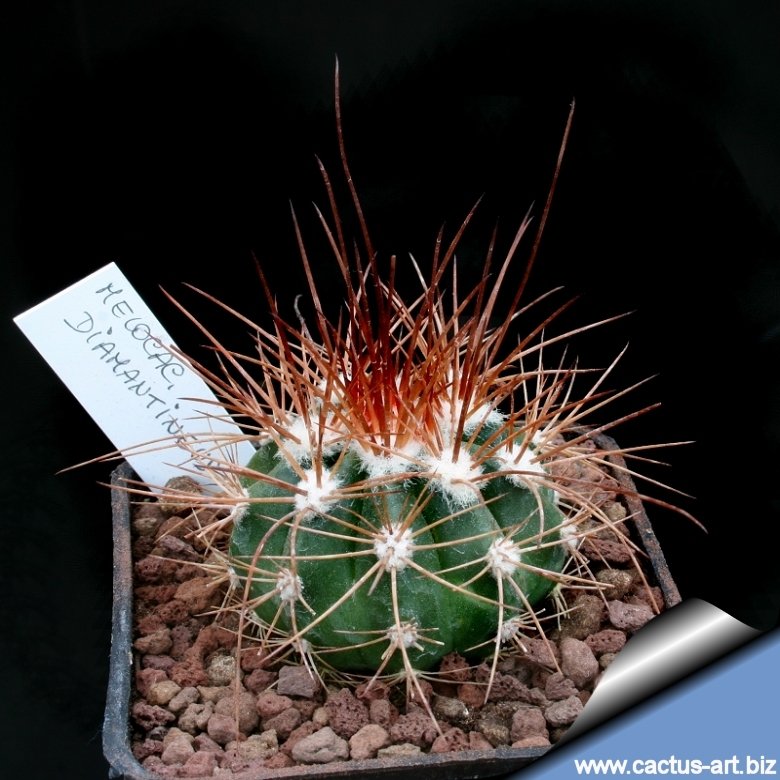
Melocactus diamantinus (or diamantineus) is an hoticultural name used to indicate one of the innumerable local form of the very variable Melocactus ernestii with extremely beautiful and very long red spines and large white woolly areoles.
Stem: Globose, up to 15 cm in diameter with 10 to 12 ribs and a cephalium with many brown bristles.
Remarks: The most remarkable part of a Melocactus is its cephalium a bristle-coated structure on the summit of the plant, only Melocactus, and the similar genus Discocactus possesses this type of permanent, apical, hat-like appendage. It’s only when a Melocactus reaches maturity that the cephalium begins to grow. Cylindrical, with a diameter distinctly smaller than that of the plant body below, the cephalium will keep growing for the rest of the plant’s life, but the body of the plant stops growing the moment the cephalium starts to form. As the plants age the cephalium doesn’t increase in circumference it will steadily grow taller.
Origin and Habitat
Chapado do Diamantina (Mercedes de Diamantina), Minas Gerais (Brasilia), Brasil
Cultivation and Propagation
These cacti are not the easiest things to grow and aren’t plants for beginners. It grows from April to October, it can’t endure long stretches of total dryness, and also too much water will rot it, as its weak root systems tends to be inefficient at sucking up water from wet soil. Nonetheless, again as a result of their tropical origins, they need a fair amount of water, but allow the soil to dry quite a bit before watering again. Melocactus rests from October to April but can’t stand cold, or even fairly cool temperatures, so is indispensable to keep it above 8-12°C at all times, severe damage or death occurring at temperatures that the great majority of cacti wouldn’t mind in the least and prefer more frequent water in winter than other cacti, say once a month. Do not feed in winter.
The root system is weak and generally resents being repotted and can take a long time to re-establish. The soil mix should be very quick draining, prefers very bright light, not as much as the most arid growing cacti, but plenty nonetheless.
Propagation: Exclusively by Seeds. Sow in February-march in a light, sandy, porous soil. Cover germinating tray with glass to prevent seed from drying out. Germination is most successful at a temperature of 18 to 22° C.
Source: Melocactus diamantinus, LLIFLE - Encyclopedia of living forms, CC-BY-SA, retrieved 2026-10-25.
Cultivars and forms (2)
Subspecies (1)
Varieties (1)
Gallery