Publication: Monatsschr. Kakteenk. 22: 66 1912
Description
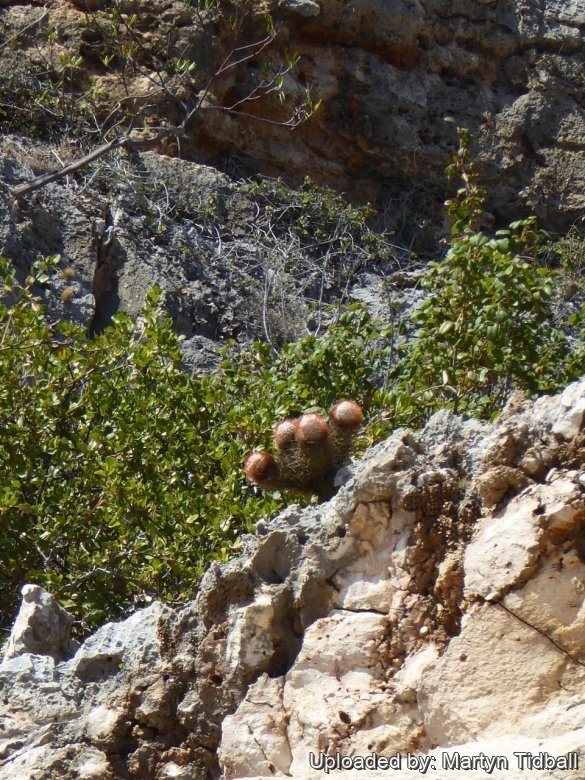
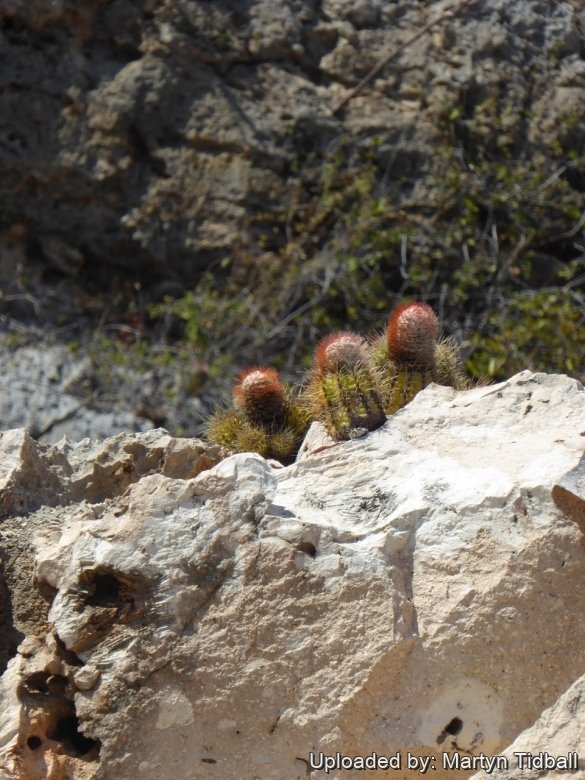
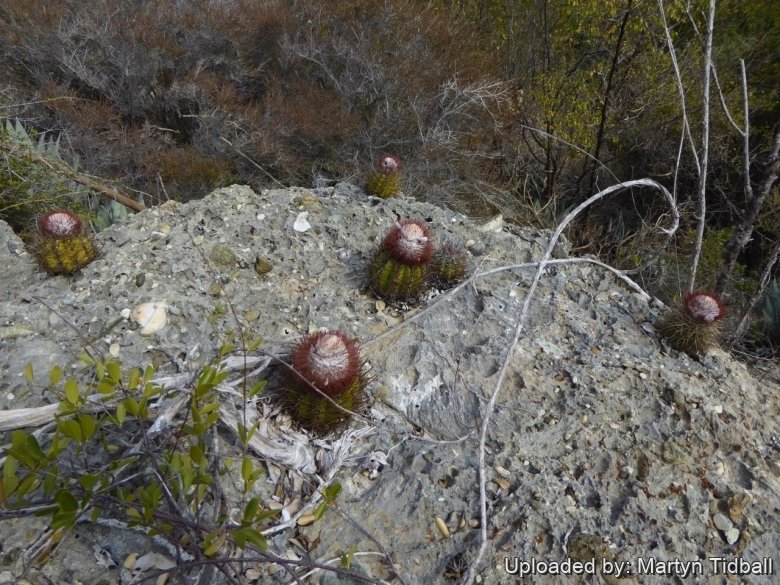
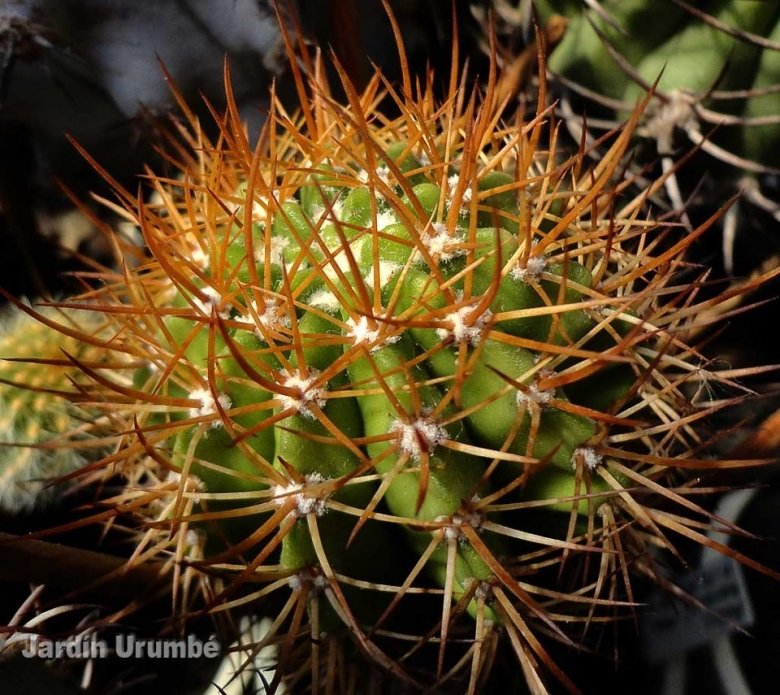
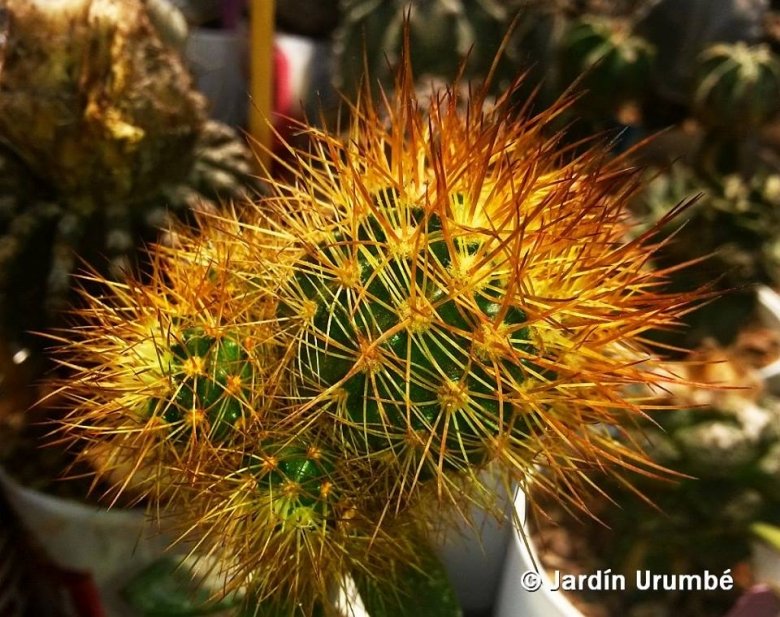
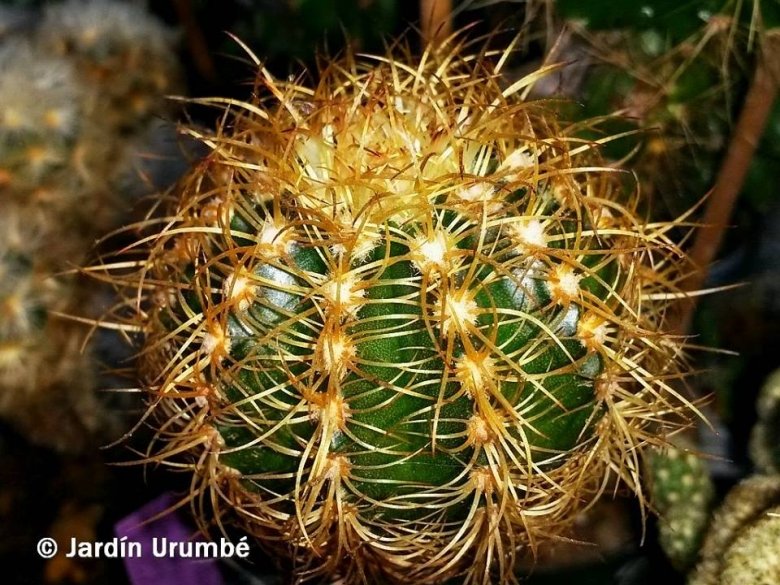
Melocactus harlowii is a Cuban species with bright green, ovate to cylindrical usually solitary stems that reach a heights of about 25 centimeters and a diameters of 10-20 cm. The spines initially reddish and become yellowish as they age, they are 3 to 4 cm long spines and can not be divided into central and radial spines. This species will yield a great amount of variability, a trait that makes the plant fascinating to the collector and worthless to the nurseryman since the offspring are sort of unpredictable. When they are mature, the body stops growing and produces a crown on its apex named cephalium. This densely spined area is where the flowers and fruit will be produced and grow 5 to 10 cm high and in diameter. The striking difference between the body and the cephalium, reminds of a cap, hence the name Turk’s Cap Cacti given to many specimen in this genus.
Derivation of specific name: The specific name was given in honor of Captain Charles Henry Harlow, U. S. N., naval officer and Commandant of the Guantanamo Naval Station at the time Dr. Britton studied the flora of that reservation in 1909.
Stem: Ovoid to cylindrical, usually solitary, light green, to 25 cm high, 10-20 cm in diameter.
Ribs: 10-12.
Areoles: Closely set, usually less than 1 cm apart.
Spines: Not easily distinguishable as centrals and radials 10-40 mm long. Radial spines about 12, slightly spreading, reddish to yellowish with age, slender,. Central spines usually 4, similar to the radial, but usually a little stouter and longer.
Cephalia: 5-10 cm high and in diameter, with reddish bristles.
Flowers: Barely protruding from the cephalia, deep rose-red, 15-20 mm long, 10-25 mm in
diameter.
Fruits: Elongate, pink to deep red, to 20 mm long.
Seeds: Black, shining.
Origin and Habitat
Melocactus harlowii is is endemic to Cuba and common at the southeastern end of the island.
Type locality: Coastal cliffs, Guantanamo Bay, Oriente, Cuba.
Altitude range: This species occurs at elevations between sea level and 350 m asl.
Habitat and Ecology: This species occurs in coastal thickets and dry forests from La Mota in Granma to Boca del río Tacre in Guantánamo often on coastal and river cliffs but also on inland outcrops of serpentine or gravel conglomeration. The natural vegetation comprises the xerophylic palms of Coccothrinax hiearrane and Coccothrinax munizii, the shrub Calliandra colletioides, the century plant Agave albescens and several cacti such as Lamairocereus hystrix, Consolea acantha, Cylindropuntia hystrix, and also the small cactus, Mammillaria prolifera. Subpopulations for this species vary between a few individuals at some localities to thousands at other localities. Some subpopulations are declining or have been extirpated due to agriculture, urbanization, and fire.
Cultivation and Propagation
These cacti are not the easiest things to grow and aren’t plants for beginners. Melocactus harlowii grows from April to October, it can’t endure long stretches of total dryness, and also too much water will rot it, as its weak root systems tends to be inefficient at sucking up water from wet soil. Nonetheless, again as a result of their tropical origins, they need a fair amount of water, but allow the soil to dry quite a bit before watering again.
Melocactus rests from October to April but can’t stand cold, or even fairly cool temperatures, so is indispensable to keep it above 8-12°C at all times, severe damage or death occurring at temperatures that the great majority of cacti wouldn’t mind in the least and prefer more frequent water in winter than other cacti, say once a month. Do not feed in winter.
The root system is weak and generally resents being repotted and can take a long time to re-establish. The soil mix should be very quick draining, prefers very bright light, not as much as the most arid growing cacti, but plenty nonetheless.
Propagation: Exclusively by Seeds. Sow in February-march in a light, sandy, porous soil. Cover germinating tray with glass to prevent seed from drying out. Germination is most successful at a temperature of 18 to 22° C.
Bibliography
Major references and further lectures
-
Britton, N. L., and J. N. Rose. 1922. “The Cactaceae.” Vol. 3. Canegie Institute: Washington.
-
Taylor, N.P. 2013. Melocactus harlowii. The IUCN Red List of Threatened Species 2013: e.T151889A572851. http://dx.doi.org/10.2305/IUCN.UK.2013-1.RLTS.T151889A572851.en. Downloaded on 22 July 2016.
-
Gonzalez-Torres, L.R. “Action plan for the conservation of Cuban Cacti”. 2007.
-
Hunt, D., Taylor, N. and Charles, G. (compilers and editors). “The New Cactus Lexicon.” dh Books, Milborne Port, UK. 2006.
-
Edward Anderson “The Cactus family” Timber Press, Incorporated, 2001
-
“Proceedings: International Association of Botanic Gardens, Tenth General Meeting and Conference, 2-7 August 1987, Palmengarten, Frankfurt/M., F.R. Germany” International Association of Botanic Gardens. General Meeting and Conference, Kai Larsen, Brian Derek Morley, Gustav Schoser IABG, 1989
-
Urs Eggli, Leonard E. Newton “Etymological Dictionary of Succulent Plant Names” Springer Science & Business Media, 29 June 2013
-
Zoltan Rigerszki, Gerard Delanoy, Endre Ujreti, Anselme Vilardebo “Melocacti of Cuba” Cactus & Company, 2007
From llifle page Melocactus evae
Description
Melocactus evae, is generally included within (as a synonym of) Melocactus harlowii (Britton & Rose) Vaupel. This species can pride itself with having the largest flowers in the harlowii-group (up to 2 cm), while its stem is perhaps one of the smallest among its closest relatives.
Derivation of specific name: This member of the Cactaceae family was given this name in honour of the wife of the author, Éva Visnyovszky, herself a microbiologist.
Stems: Columnar, thin, 15-20(-29) cm tall 6-8 cm in diameter.
Spines: Needle-like somewhat flexible. Central spines 2-4 20-25 mm long. Radial spines 10-15 about 10-15 mm long.
Cephalium: Cylindrical, slightly flattened 25-35 mm tall and 30-45 mm in diameter with thin, rigid, orange/red spines.
Flowers: Pink purple 7 to 9(-20) mm in diameter.
Origin and Habitat
Cuba, Oriente, Santiago de Cuba province, SW of Caimanera, on the western side of Guantánamo Bay. Area of occurrence 202.73 ha. There is a total 78 fragmented populations.
Altitude range: 20-180 metres above sea level.
Habitat and ecology: Melocactus evae forms large clumps of multi-headed fist-sized specimens growing in a very dry area on outcrops of conglomerate, with Ritterocereus hystrix and Pilosocereus sp. It is usually found on ridges and slopes at small elevations on parts of the habitat covered with gravel conglomerate and boulders, and never on the ground or among other vegetation. It grows in exposed areas and doesn’t supports competition and association with other species. The soil is scarce, shallow and confined in small depressions that form a mosaic in the soil-less areas occupied by bare rock, layer of stones and boulders. The weather can be considered as a warm semi-desert with 9 to 10 dry months. Rainfalls varies between 461 and 580 mm per annum. During the dry period (November to April) rains less than 200 mm. Temperatures are high (annual average temperatures 26-28 ° C). The relative humidity is usually lower than 55% at noon, while is 85 to 90% at 7.00 o’clock in the morning. Because of all these factors, the evaporator ration is very high.
Bibliography
Major references and further lectures
-
Zoltan Rigerszki; Gerard Delanoy; Endre Ujreti; Anselme Vilardebo “Melocacti of Cuba” Cactus & Co, 2007
-
Eddy Martínez, Orlando J. Reyes, Nicasio Viña, Leopoldo Viña, Osvaldo Pacheco,
-
Félix Acosta y Hector Ferret. “Características ecológicas y poblacionales de Melocactus nagyii y M. evae en Cuba” <http://www.uh.cu/centros/jbn/descargas/cactus/27.pdf\>
Source: Melocactus evae, LLIFLE - Encyclopedia of living forms, CC-BY-SA, retrieved 2026-10-25.
From llifle page Melocactus radoczii
Description
Melocactus radoczii is a small barrel cactus that usually produces branches with time, mature plants are easily recognizable by their cephalium, that have a covering of yellowish-white wool and bright orange-red bristles, in a regular pattern, protruding above. The immature plant looks like a smallish barrel cactus, and there is nothing in its appearance that would suggest a melocactus. Melocactus radoczii, is generally included within (as a synonym of) Melocactus harlowii, suggesting that there is not really a fundamental difference between the two. More likely they are one and the same species. It has 10, densely areolated ribs with thinner, needle-shaped spines, on the whole curving upward. The young spines are orange-red, but turn yellow as they age. Most authors have dismissed Melocactus radoczii as perhaps not worthy of even varietal status, but it still has a value for a collector because they identify plants with particular characters.
Stem: Relatively small, barrel-shaped (widest medially), 11-13 cm tall and 9-12 cm in diameter (without cephalium). Old plants frequently branched, branches often as long as 20 cm.
Ribs: 10, protruding, densely areolated (11-12 areoles per 10 cm).
Spines: Thin, aciculate, on the whole curving upward, young spines orange-red becoming yellow as they age.
Central spines: 3-4, 20-25 mm long.
Radial spines: 14-16, 10-25 mm long.
Cephalium: Depressed, discoid, 3 cm high and 4.5-5.5 cm in diameter. Bristles bright orange-red, in a regular pattern, protruding 6-8 mm above the yellowish-white wool.
Flower: Small, 10-12 mm wide, bright pink The 6 stigma lobes and the stamens are light pink.
Fruits: Obovate, 14-21mm long and 7-10 mm wide, protruding part dark pink, often lighter beneath.
Seeds: Black, strongly covered with sharp warts.
Origin and Habitat
Cuba, Provincia Oriente, Sierra de Baracoa, Rio Jauco valley, North of La Tinta, around the town of Guajimero.
Habitat and ecology: Melocactus radoczii grows on serpentine rock.
Cultivation and Propagation
Melocacti are not the easiest things to grow and aren’t plants for beginners. It grows from April to October, and can’t endure long stretches of total dryness, and also too much water will rot it, as its weak root systems tends to be inefficient at sucking up water from wet soil. Nonetheless, again as a result of their tropical origins, they need a fair amount of water, but allow the soil to dry quite a bit before watering again. Melocacti rests from in winter (in temperate climates) but can’t stand cold, or even fairly cool temperatures, so is indispensable to keep it above 8-12°C at all times, severe damage or death occurring at temperatures that the great majority of cacti wouldn’t mind in the least and prefer more frequent water in winter than other cacti, say once a month. Do not feed in winter.
The root system is weak and generally resents being repotted and can take a long time to re-establish. The soil mix should be very quick draining, prefers very bright light, not as much as the most arid growing cacti, but plenty nonetheless.
Propagation: By Seeds or (often) graft. Sow in February-march in a light, sandy, porous soil. Cover germinating tray with glass to prevent seed from drying out. Germination is most successful at a temperature of 18 to 22° C.
Notes
The most remarkable part of a Melocactus is its cephalium a bristle-coated structure on the summit of the plant, only Melocactus , and the similar genus Discocactus possesses this type of permanent, apical, hatlike appendage. It’s only when a Melocactus reaches maturity that the cephalium begins to grow. Cylindrical, with a diameter distinctly smaller than that of the plant body below, the cephalium will keep growing for the rest of the plant’s life, but the body of the plant stops growing the moment the cephalium starts to form. As the plants age the cephalium doesn’t increase in circumference it will steadily grow taller.
Bibliography
Major references and further lectures
-
Zoltan Rigerszki, Gerard Delanoy, Endre Ujreti, Anselme Vilardebo “Melocacti of Cuba” Cactus & Company, 2007
-
Hunt, D., Taylor, N. and Charles, G. (compilers and editors). “The New Cactus Lexicon.” dh Books, Milborne Port, UK. 2006.
-
Edward Anderson “The Cactus family” Timber Press, Incorporated, 2001
-
Stuart Max Walters “The European garden flora. 3.[Angiospermae], Dicotyledons. [Casuarinaceae to Aristolochiaceae]” Cambridge University Press, 1989
-
Alessandro Guiggi “A revision of the genus Melocactus Link et Otto (Cactoideae-Cereeae) in Cuba with an appendix of the accepted status of remaining Carribean taxa” in: Cactolgy (2) 2010, pp. 23-38, Edited & published by Alessandro Guiggi.
Source: Melocactus radoczii, LLIFLE - Encyclopedia of living forms, CC-BY-SA, retrieved 2026-10-25.
Cultivars and forms (2)
Gallery