Publication: Nova Acta Phys.-Med. Acad. Caes. Leop.-Carol. Nat. Cur. 18(Suppl. 1): 192. 1841
Description
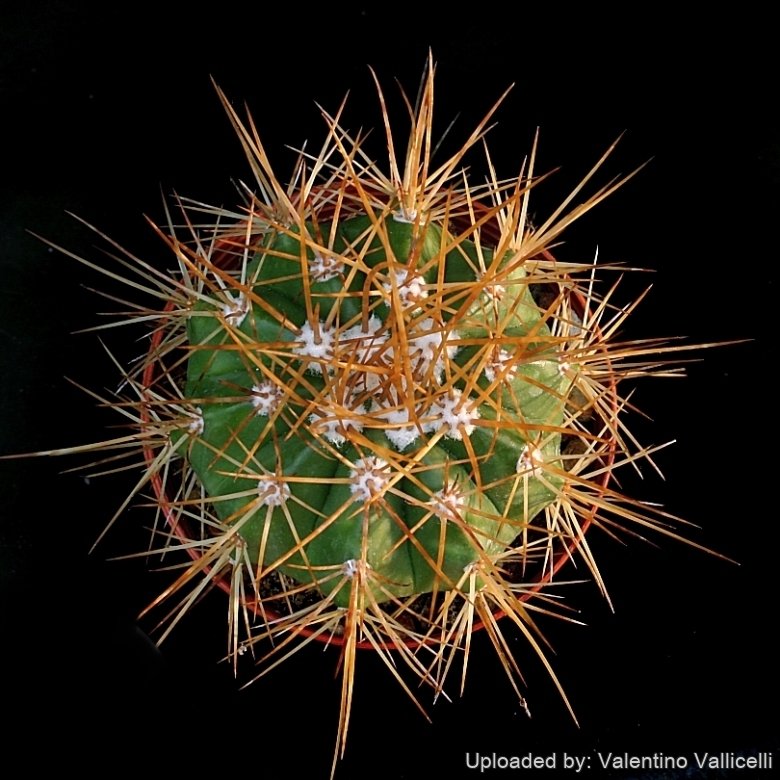
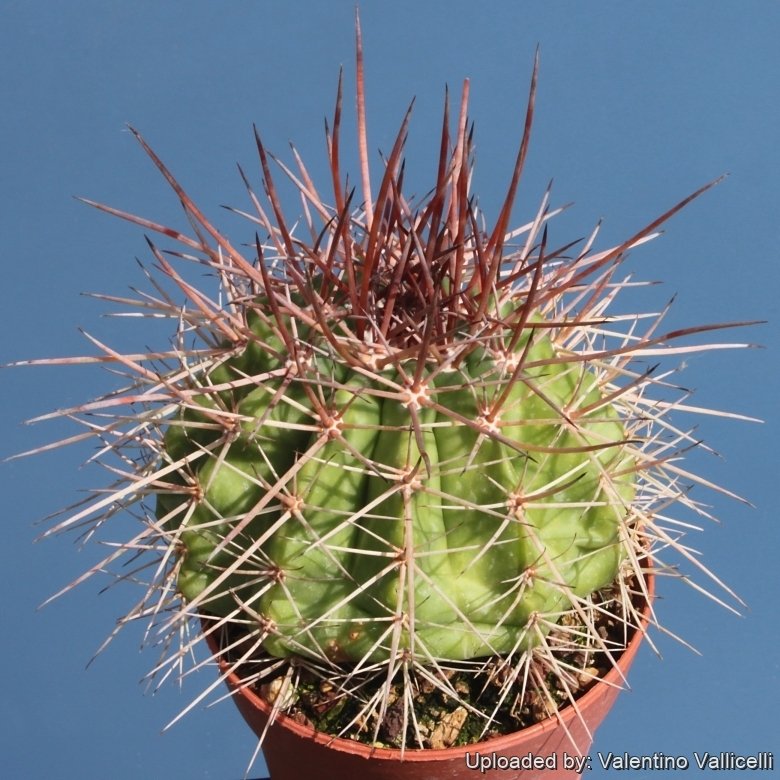
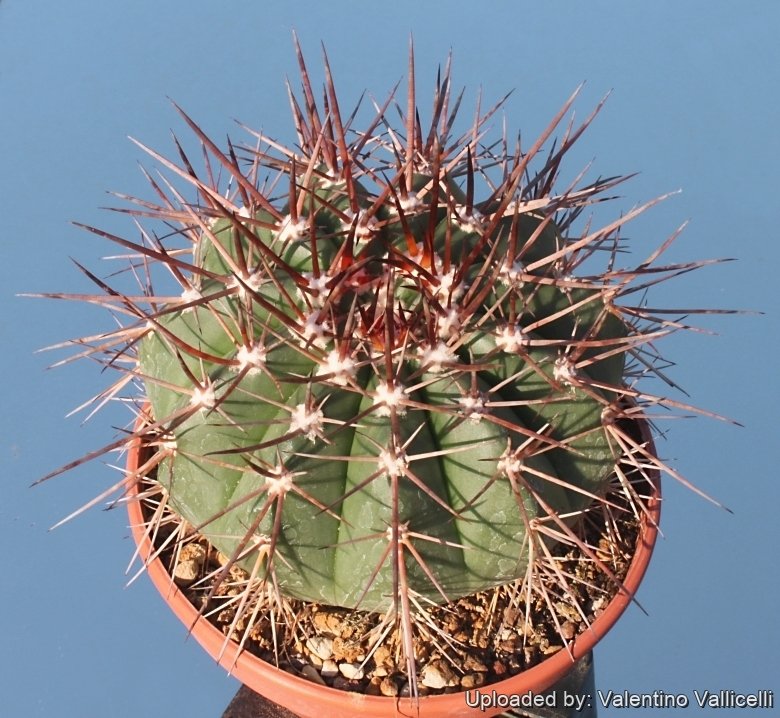
Melocactus oreas is a strongly spined solitary cactus easily recognizable by its cephalium. This plant is characterized by its greatly elongated spines, these being longer than those of most other species of the genus. The central spine often significantly shorter than the longest lowermost radial spine. It’s a highly variable taxon with several more or less similar forms that could be described as geographical varieties or, in some cases, critical species.
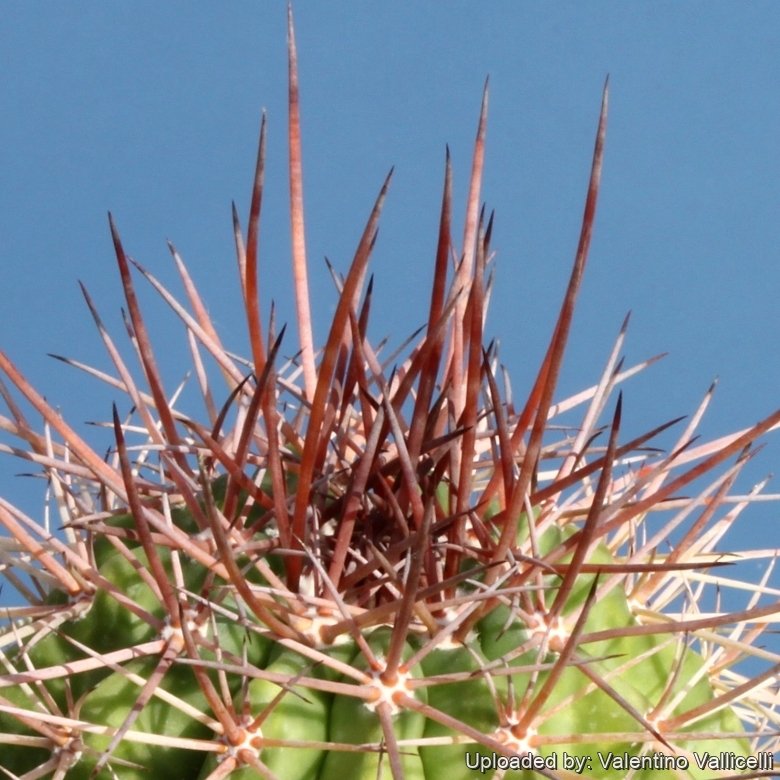
Habit: Usually stay solitary, mature plants are easily recognizable by their cephalia, that have a covering of wool and dark reddish-brown bristles.The immature plant looks like a smallish barrel cactus, and there is nothing in its appearance that would suggest a melocactus.
Stem: Depressed globose, globose, ellipsoid or somewhat conical, 8-35 (rarely to 45) cm tall, 10-18 (occasionally more) cm in diameter, medium to dark glossy green.
Ribs: 10 to 13 (or more) round to obtuse in cross section but with somewhat acute edges, about 20 mm high.
Cephalia: 1,5 to 13 cm high, 4-8 cm in diameter, composed of white wool and many soft dark reddish brown hairs.
Areoles: 1-2 cm apart round creamy or yellowish woolly.
Spines: 14 to 20 flexible, greatly elongated, of which 4 to 6 are central, yellowish brown, reddish brown or brown, but paler toward the tips, slender, nearly straight, subulate, much elongated, flexible, terete, round in cross section.
Radial spines: 8-11, slender, flexible, straight or curved, 4-8 cm long, the lowermost greatly elongated up to 14 cm long.
Central spines: 1 to 4 (rarely to 6), (2-)3-5(-9) cm long.
Flowers: Pinkish to dark pinkish magenta, 17-22 mm long, 7-10 mm in diameter often somewhat flattened, especially below apex.
Fruit: Elongate clavate, 14-28 mm long, bright red at the tip and magenta to pinkish.
below often remaining partly sunken in the cephalium and drying up.
Seeds: Black, minute, 1-1,3 mm x 0,8-1 mm, covered with low depressed tubercles.
Chromosome number: 2n = 44
Origin and Habitat
Dry parts of Bahia, Brazil.
Type locality: Bahia, Brazil.
Altitude: 300-1000 metres above sea level.
Habitat: The species is common and locally abundant on the hills of the interior parts of Bahia, and has many subpopulations. It grows in caatinga/northern campo rupestre (Chapada Diamantina) element and is often found in places dominated by gneiss/granite inselbergs on more or less exposed, usually horizontal, crystalline/sandstone and granitic rocks. In the caatinga region the major threats are quarrying, cattle ranching and agriculture.
Cultivation and Propagation
Exclusively by Seeds. Sow in February-march in a light, sandy, porous soil. Cover germinating tray with glass to prevent seed from drying out. Germination is most successful at a temperature of 18 to 22° C.
Cultivation: These cacti are not the easiest things to grow and aren’t plants for beginners.
Melocactus oreas grows from April to October, it can’t endure long stretches of total dryness, and also too much water will rot it, as its weak root systems tends to be inefficient at sucking up water from wet soil. Nonetheless, again as a result of their tropical origins, they need a fair amount of water, but allow the soil to dry quite a bit before watering again. Melocactus rests from October to April but can’t stand cold, or even fairly cool temperatures, so is indispensable to keep it above 8-12°C at all times, severe damage or death occurring at temperatures that the great majority of cacti wouldn’t mind in the least and prefer more frequent water in winter than other cacti, say once a month. Do not feed in winter.
The root system is weak and generally resents being repotted and can take a long time to re-establish. The soil mix should be very quick draining, prefers very bright light, not as much as the most arid growing cacti, but plenty nonetheless.
Bibliography
Major references and further lectures
-
Stuart Max Walters “The European garden flora. 3.[Angiospermae], Dicotyledons. [Casuarinaceae to Aristolochiaceae]” Cambridge University Press, 1989
-
Edward Anderson “The Cactus family” Timber Press, Incorporated, 2001
-
David R Hunt; Nigel P Taylor; Graham Charles; International Cactaceae Systematics Group. “The New Cactus Lexicon” dh books, 2006
-
Urs Eggli, Leonard E. Newton “Etymological Dictionary of Succulent Plant Names” Birkhäuser 2004
-
Taylor, N. P. 1991. “The genus Melocactus (Cactaceae) in Central and South America.” Bradleya 9: 1–80.
-
Nigel Taylor, Nigel P. Taylor, Daniela C. Zappi, “Cacti of Eastern Brazil” Royal Botanic Gardens, Kew, 15/gen/2004
-
Edgar Lamb, Brian Lamb “The Illustrated Reference on Cacti & Other Succulents” Volume 5 Blandford Press, 1978
-
E Haustein “Der Kosmos Kakteenfuehrer (the Kosmos Cactus Guide)” Balogh Scientific Books 01 December 1998
-
Sara Oldfield “Cactus and Succulent Plants: Status Survey and Conservation Action Plan” IUCN, 01/gen/1997
-
Machado, M., Taylor, N.P. & Braun, P. 2013. Melocactus oreas. In: IUCN 2013. “IUCN Red List of Threatened Species.” Version 2013.2. <www.iucnredlist.org>. Downloaded on 04 December 2013.
-
Juliana P. Castro, Luiz G.R. Souza, Lânia F. Alves, Ana E.B. Silva, Marcelo Guerra & Leonardo P. Felix. 1073 Marhold (ed.) “IAPT/IOPB chromosome data 15” TAXON 62 (5) • October 2013: 1073–1083
From llifle page Melocactus sp. nova aff. oreas
Description
Melocactus sp. nova aff. oreas is an unpublished catalogue name (nomen nudum), unusual among the Melocacti from that area in producing relatively stout dull-pink or brownish spines. It is thought to be a strong spined form of Melocactus oreas.
Origin and Habitat
Bahia, Brazil.
Cultivation and Propagation
Exclusively by Seeds. Sow in February-march in a light, sandy, porous soil. Cover germinating tray with glass to prevent seed from drying out. Germination is most successful at a temperature of 18 to 22° C.
Cultivation: These cacti are not the easiest things to grow and aren’t plants for beginners. This species grows from April to October, it can’t endure long stretches of total dryness, and also too much water will rot it, as its weak root systems tends to be inefficient at sucking up water from wet soil. Nonetheless, again as a result of their tropical origins, they need a fair amount of water, but allow the soil to dry quite a bit before watering again. Melocactus rests from October to April but can’t stand cold, or even fairly cool temperatures, so is indispensable to keep it above 8-12°C at all times, severe damage or death occurring at temperatures that the great majority of cacti wouldn’t mind in the least and prefer more frequent water in winter than other cacti, say once a month. Do not feed in winter.
The root system is weak and generally resents being repotted and can take a long time to re-establish. The soil mix should be very quick draining, prefers very bright light, not as much as the most arid growing cacti, but plenty nonetheless.
Notes
The most remarkable part of a Melocactus is its cephalium a bristle-coated structure on the summit of the plant, only Melocactus, and the similar genus Discocactus possesses this type of permanent, apical, hatlike appendage. It’s only when a Melocactus reaches maturity that the cephalium begins to grow. Cylindrical, with a diameter distinctly smaller than that of the plant body below, the cephalium will keep growing for the rest of the plant’s life, but the body of the plant stops growing the moment the cephalium starts to form. As the plants age the cephalium doesn’t increase in circumference it will steadily grow taller.
Source: Melocactus sp. nova aff. oreas, LLIFLE - Encyclopedia of living forms, CC-BY-SA, retrieved 2026-10-25.