Publication: Bot. Jahrb. Syst. 50(2-3, Beibl. 111): 28. 1913 [19 Aug 1913]
Description
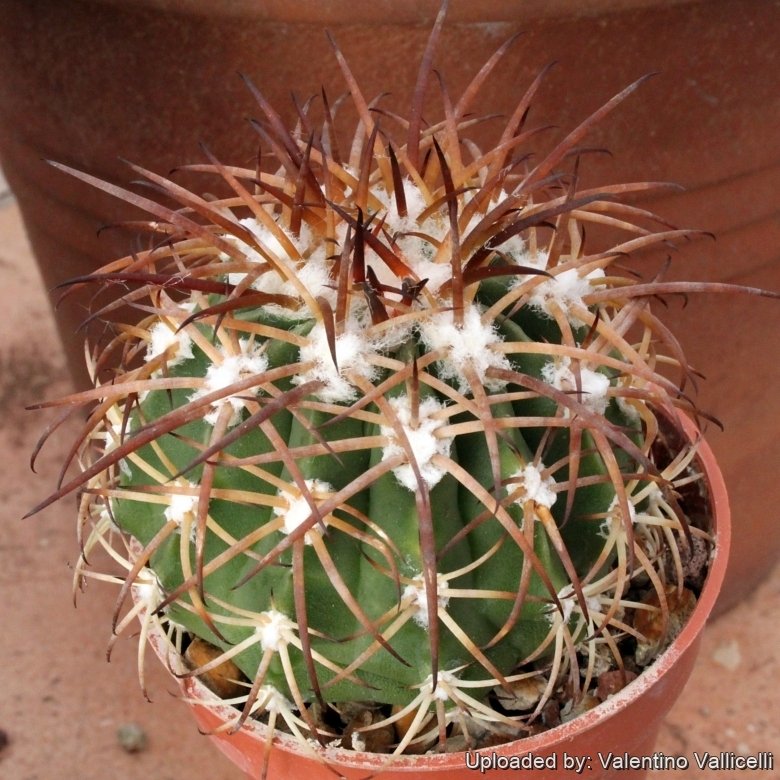
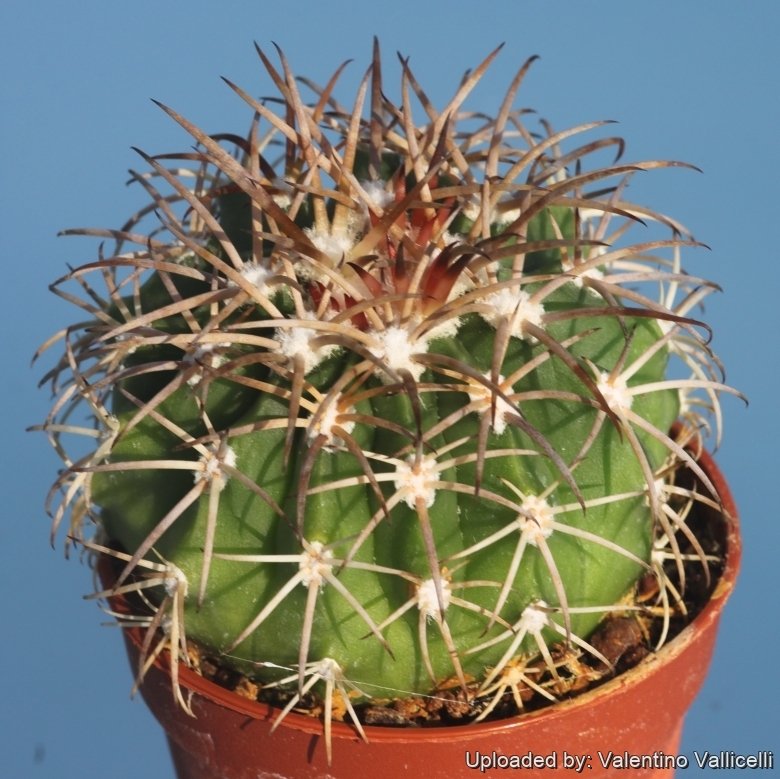
Melocactus peruvianus is an extremely vaiable solitary globose cactus.
Stem: Erected, depressed globose to pyramidal or short cylindrical,13-20 cm tall and in diameter , glaucous green,
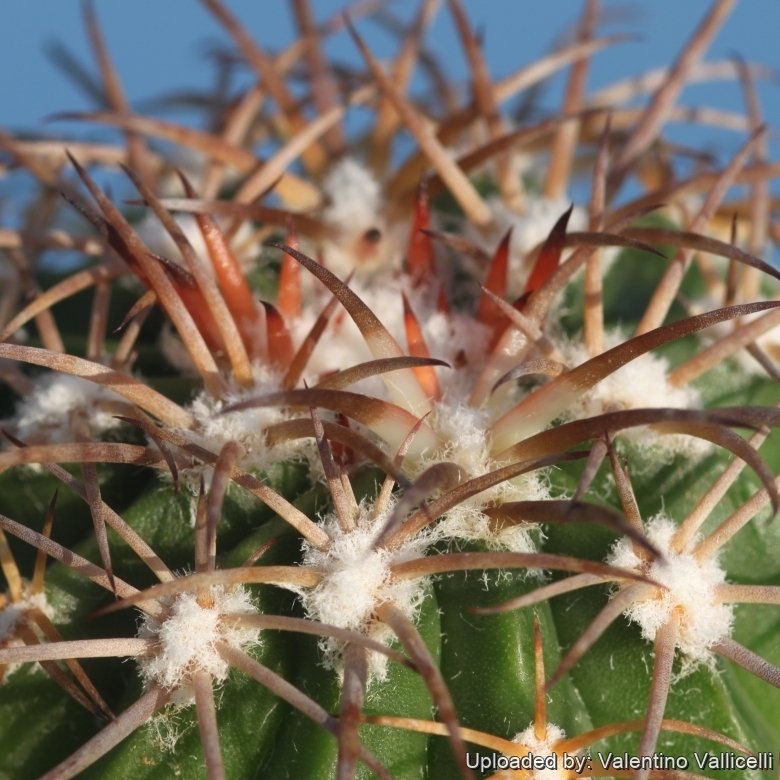
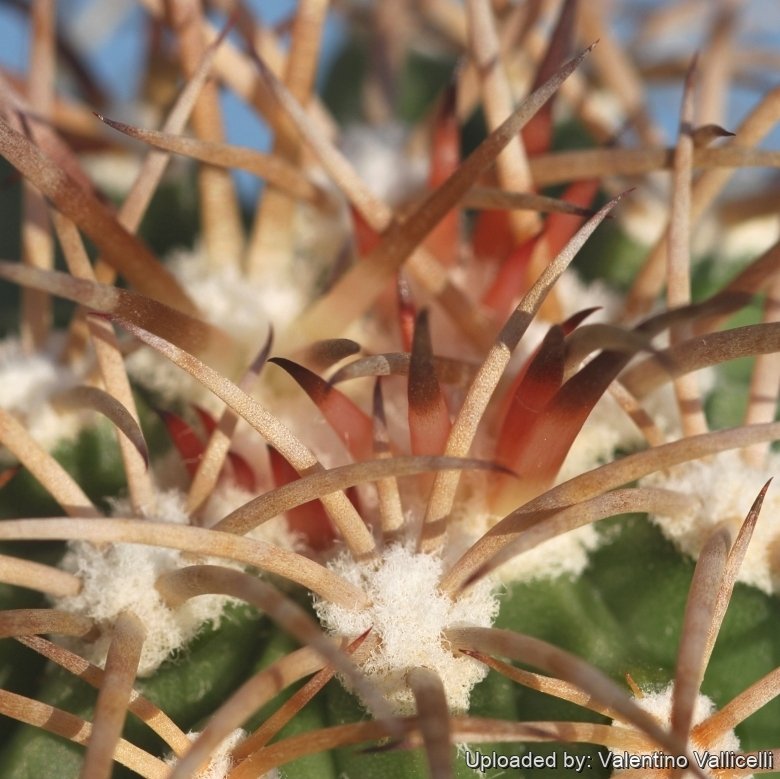
Areoles: up to 5 x 10 mm in size, roundish-elongated with brown felt.
Ribs: 10-15.
Spines: Extremely variable yellowish to dark brown or black turning grey as they age
Central spines: Missing or 1 to 4 up to 6 cm long.
Radial spines: 4-15 up to 2-3(-6) cm long, 0,5-1 mm in diameter, straight to strongly curved, sometimes interlaced and pectinate and more or less angular and keeled above.
Cephalium: Apical, often small, 5-15 cm tall, 8-10 cm in diameter with white wool and aboundant reddish-brown bristles.
Flowers: Actinomorphic, tubular, pink to red, emerging 2-3 cm over the cephalium, corolla 5-15 mm in diameter, tepals about 15 of which: petaloids ligulate-apiculate 5-6 mm long, 0,75-1 mm wide and sepaloid lanceolate-apiculate 3-6 mm long, 1-2 mm wide; tube 5 mm long, 3-4 mm wide; nectar chamber 2-4 mm long, 2 mm in diameter; Stamens about 90, 2-4 mm long, filaments 1-3 mm long, 0,1 mm in diameter, anther creamy-white, 1 mm long, 0,5 mm in diameter; Stigma 4-12 mm long with 5 green lobes;
Fruit: Red at the tip, ellipsoidal to pear shaped, 18 mm long, 6-7 mm in diameter with persisting flowers remnants, pulp whitish with 60-120 seeds.
Seeds: Ovoidal-reniform, 1-1,1 mm long, 0,8-0,9 mm in diameter, dark brown to black,
Origin and Habitat
Borderline between Peru and Ecuador to Arequipa in Peru, but not at elevations above 1270 metre above sea level.
Cultivation and Propagation
These cacti are not the easiest things to grow and aren’t plants for beginners. Melocactus peruvianus grows from April to October, it can’t endure long stretches of total dryness, and also too much water will rot it, as its weak root systems tends to be inefficient at sucking up water from wet soil. Nonetheless, again as a result of their tropical origins, they need a fair amount of water, but allow the soil to dry quite a bit before watering again. Melocactus rests from October to April but can’t stand cold, or even fairly cool temperatures, so is indispensable to keep it above 8-12°C at all times, severe damage or death occurring at temperatures that the great majority of cacti wouldn’t mind in the least and prefer more frequent water in winter than other cacti, say once a month. Do not feed in winter. The root system is weak and generally resents being repotted and can take a long time to re-establish. The soil mix should be very quick draining, prefers very bright light, not as much as the most arid growing cacti, but plenty nonetheless.
Propagation: Exclusively by Seeds. Sow in February-march in a light, sandy, porous soil. Cover germinating tray with glass to prevent seed from drying out. Germination is most successful at a temperature of 18 to 22° C.
From llifle page Cactus jansenianus
Description
Chromosome number: 2n = 22
Bibliography
Major references and further lectures
- Juliana P. Castro, Luiz G.R. Souza, Lânia F. Alves, Ana E.B. Silva, Marcelo Guerra & Leonardo P. Felix. 1073 Marhold (ed.) “IAPT/IOPB chromosome data 15” TAXON 62 (5) • October 2013: 1073–1083
Source: Cactus jansenianus, LLIFLE - Encyclopedia of living forms, CC-BY-SA, retrieved 2026-10-25.
From llifle page Melocactus amstutziae
Description
This is probably one of the many geographical forms of Vaupel’s Melocactus peruvianus.
Ribs: About 13.
Spines: Spines 6-8(-9), up to 2.5 cm long, angular and keeled above, dark brown
Cephalium: With reddish bristles.
Flowers: Red.
Origin and Habitat
Peru, Rio Santa Maria,
Altitude: 1600 m a.s.l.
Cultivation and Propagation
These tropical cacti are not the easiest things to grow and aren’t plants for beginners.
Growth rate: It is a relatively rapidly growing given the best conditions.
Soils: It likes very porous standard cactus mix soil.
Repotting: The root system is weak and generally resents being repotted and can take a long time to re-establish. Use pot with good drainage.
Light: They prefer very bright light, not as much as the most arid growing cacti, but plenty nonetheless. Tends to bronze in strong light, which encourages flowering and heavy spine production.
Watering: Melocacti grow from April to October and cannot endure long stretches of total dryness, and also too much water will rot them, as their weak root systems tends to be inefficient at sucking up water from wet soil. Nonetheless, again as a result of their tropical origins, they need a fair amount of water, but allow the soil to dry quite a bit before watering again.
Fertilization: Do not feed in winter.
Hardiness: Melocactus rest from October to April but can’t stand cold, or even fairly cool temperatures, so is indispensable to keep them above 8-12°C at all times, severe damage or death occurring at temperatures that the great majority of cacti wouldn’t mind in the least and prefer more frequent water in winter than other cacti, say once a month. (but hardy to 4 C ° C for short periods). However warmth throughout the year will increase the grower’s success (minimum 12° to 20° C during rest season).
Pests & diseases: It may be attractive to a variety of insects, but plants in good condition should be nearly pest-free, particularly if they are grown in a mineral potting-mix, with good exposure and ventilation. Nonetheless, there are several pests to watch for:
- Red spiders: Red spiders may be effectively rubbed up by misting the vulnerable plants every day
- Mealy bugs: Mealy bugs occasionally they develop aerial into the new growth among the wool with disfiguring results, but the worst types develop underground on the roots and are invisible except by their effects.
- Scales: Scales are rarely a problem.
- Rot: it is only a minor problem with cacti if the plants are watered and “aired” correctly. If they are not, fungicides won’t help all that much.
Propagation: Exclusively by Seeds. Sow in February-march in a light, sandy, porous soil. Cover germinating tray with glass to prevent seed from drying out. Germination is most successful at a temperature of 18 to 22° C.
Bibliography
The Cactus and Succulent Journal of Great Britain Volume 43/Number 1 - February 1981
Source: Melocactus amstutziae, LLIFLE - Encyclopedia of living forms, CC-BY-SA, retrieved 2026-10-25.
From llifle page Melocactus fortalezensis
Origin and Habitat
Ancash (Peru, Western South America, Southern America)
Source: Melocactus fortalezensis, LLIFLE - Encyclopedia of living forms, CC-BY-SA, retrieved 2026-10-25.
From llifle page Melocactus trujilloensis
Description
This is probably one of the many geographical forms of the extremely variable Vaupel’s Melocactus peruvianus.
Melocactus peruvianus is a small solitary globose cactus.
Stem: Erected, depressed globose to pyramidal or short cylindrical,13-20 cm tall and in diameter, glaucous green.
Areoles: up to 5 x 10 mm in size, roundish-elongated with brown felt.
Ribs: 10-15.
Spines: Extremely variable yellowish to dark brown or black turning grey as they age
Central spines: Missing or 1 to 4 up to 6 cm long.
Radial spines: 4-15 up to 2-3(-6) cm long, 0,5-1 mm in diameter, straight to strongly curved, sometimes interlaced and pectinate and more or less angular and keeled above.
Cephalium: Apical, often small, 5-15 cm tall, 8-10 cm in diameter with white wool and aboundant reddish-brown bristles.
Flowers: Actinomorphic, tubular, pink to red, emerging 2-3 cm over the cephalium, corolla 5-15 mm in diameter, tepals about 15 of which: petaloids ligulate-apiculate 5-6 mm long, 0,75-1 mm wide and sepaloid lanceolate-apiculate 3-6 mm long, 1-2 mm wide; tube 5 mm long, 3-4 mm wide; nectar chamber 2-4 mm long, 2 mm in diameter; Stamens about 90, 2-4 mm long, filaments 1-3 mm long, 0,1 mm in diameter, anther creamy-white, 1 mm long, 0,5 mm in diameter; Stigma 4-12 mm long with 5 green lobes;
Fruit: Red at the tip, ellipsoidal to pear shaped, 18 mm long, 6-7 mm in diameter with persisting flowers remnants, pulp whitish with 60-120 seeds.
Seeds: Ovoidal-reniform, 1-1,1 mm long, 0,8-0,9 mm in diameter, dark brown to black,
Origin and Habitat
Trujillo, Peru. Altitude: 800-1000 metres over sea level.
Cultivation and Propagation
These cacti are not the easiest things to grow and aren’t plants for beginners. Melocactus trujillensis grows from April to October, it can’t endure long stretches of total dryness, and also too much water will rot it, as its weak root systems tends to be inefficient at sucking up water from wet soil. Nonetheless, again as a result of their tropical origins, they need a fair amount of water, but allow the soil to dry quite a bit before watering again. Melocactus rests from October to April but can’t stand cold, or even fairly cool temperatures, so is indispensable to keep it above 8-12°C at all times, severe damage or death occurring at temperatures that the great majority of cacti wouldn’t mind in the least and prefer more frequent water in winter than other cacti, say once a month. Do not feed in winter. The root system is weak and generally resents being repotted and can take a long time to re-establish. The soil mix should be very quick draining, prefers very bright light, not as much as the most arid growing cacti, but plenty nonetheless.
Propagation: Exclusively by Seeds. Sow in February-march in a light, sandy, porous soil. Cover germinating tray with glass to prevent seed from drying out. Germination is most successful at a temperature of 18 to 22° C.
Source: Melocactus trujilloensis, LLIFLE - Encyclopedia of living forms, CC-BY-SA, retrieved 2026-10-25.
From llifle page Melocactus trujilloensis var. schoenii
Origin and Habitat
La Libertad (Peru, Western South America, Southern America)
Source: Melocactus trujilloensis var. schoenii, LLIFLE - Encyclopedia of living forms, CC-BY-SA, retrieved 2026-10-25.
Cultivars and forms (1)
Varieties (1)
Gallery