Description
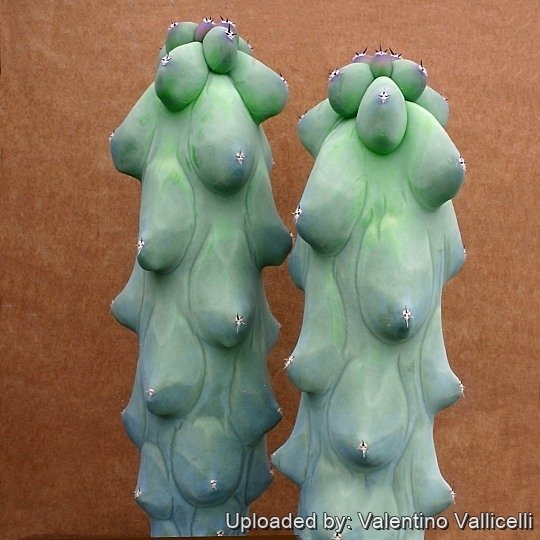
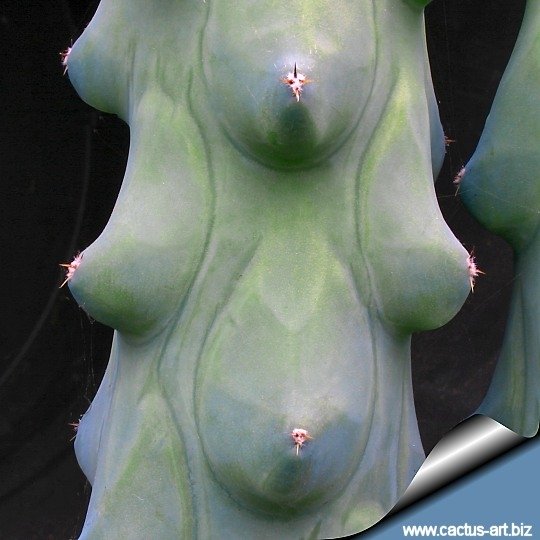
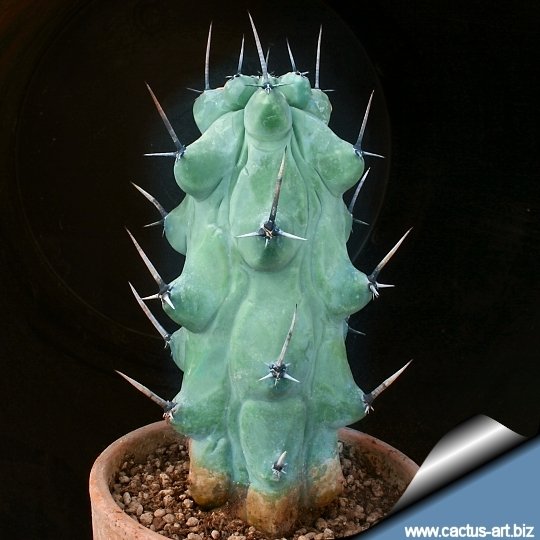
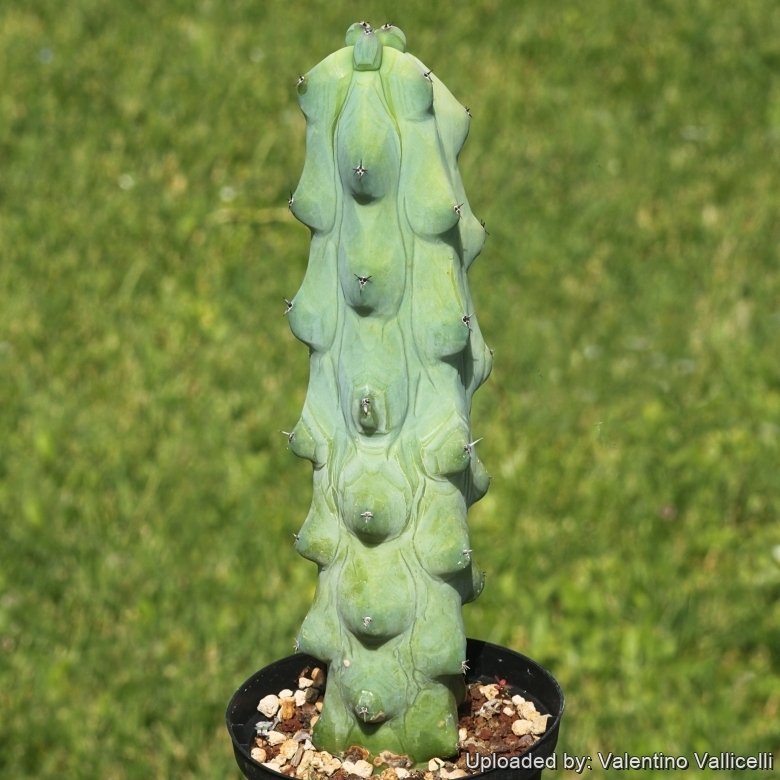
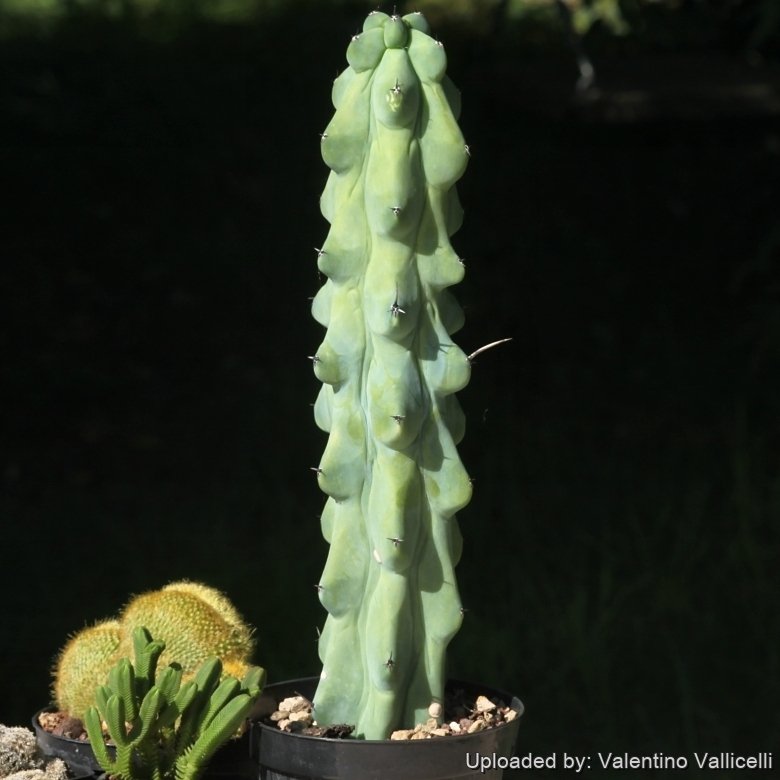
The standard Myrtillocactus geometrizans (a.k.a “Blue Candle Cactus”) is a very popular candelabra-like tree cactus often sold in garden centres widely used for grafting stock. Instead the Japanese cultivar ‘Fukurokuryuzinboku’ is a strange monstrous form and a very rare and priced collector item. Its vernacular English names “Breast cactus” or “Titty cactus” comes from the particular shape of the tubercled ribs that resemble women breasts. This plant - apart from the breasts - is similar in all other features to the common “Blue Candle” and can grow up to 4.5 m tall, with the crown reaching up to 5 m in width.
Stems: Glaucous (blue grey) Up to 3 -10 cm thick. They have 5-8 strange chinned ribs, shaped like a woman’s breast that are approximately 2.5 cm in depth with areoles about 3-5 cm apart.
Each monstrous ribs is bordered with irregularly pleaded longitudinal groves .
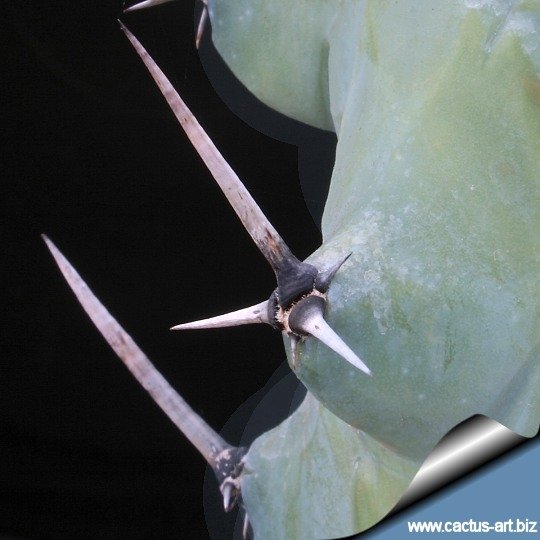
Spines: Each areole may have up to 5-9 spines, but generally they have 3-5 spines about 5-12 mm long. Some spines but not awful.
Flowers: Rather smaller (2.5-3.7 cm) in relation to stem, greenish white.
Blooming season: March. Starts blooming when it is about 60 cm tall.
Fruit: Very sweet, edible, dark red, oblong fruits 8-20 mm in diameter.
Remarks: Myrtillocactus geometrizans is commonly used as understocks for grafting cacti, (which is considered good and which is considered bad for certain). It’s very easy to grow and is an excellent stock for small globular cacti that tend to rot off on their own roots and for slower growth seedlings such as Ariocarpus and Turbinicarpus that do not graft very well onto Trichocereus spachianus unless they are larger size pups. For these seedlings (and almost all other seedlings which are not cold hardy), the grafting stock Myrtillocactus geometrizans is a generally a better choice.
Origin and Habitat
Garden origin (Nursery produced cultivar). The original natural habitat of this species is northern central Mexico down to Oaxaca.
Cultivation and Propagation
They are semi hardy, make sure that your Myrtillocactus are not exposed to temperatures below -4°C or they may die, nevertheless it is a good advice never let the nighttimes temperatures fall below 10°C. Water regularly in summer but allow to dry fully before watering again. Need a well-drained soil mix with small gravel added to ensure drainage.. During the winter months they should be rather kept dry and water is restricted to only enough to keep the stems and branches from shrivelling. Since they are big sized plants need plenty of space for their roots, repotting should be done every other year or when the plant has outgrown its pot. Exposure: Light shade when young, full sun later.
Propagation: Cuttings in summer (Cuttings will root only in hot weather. Cuttings must be kept very dry to root)
Bibliography
Major references and further lectures
-
Edward Anderson “The Cactus family” Timber Press, Incorporated, 2001
-
James Cullen, Sabina G. Knees, H. Suzanne Cubey “The European Garden Flora Flowering Plants: A Manual for the Identification of Plants Cultivated in Europe, Both Out-of-Doors and Under Glass” Cambridge University Press, 11/Aug/2011
-
David R Hunt; Nigel P Taylor; Graham Charles; International Cactaceae Systematics Group. “The New Cactus Lexicon” dh books, 2006
-
Urs Eggli, Leonard E. Newton: “Etymological Dictionary of Succulent Plant Names” Springer, Berlin/Heidelberg 2010
-
Christopher Brickell “RHS Encyclopedia of Plants and Flowers” Dorling Kindersley Ltd, 01/Sep/2010
-
Willy Cullmann, Erich Götz (Dozent Dr.), Gerhard Gröner “The encyclopedia of cacti” Timber Press, 1987
-
Gerhard Gröner, Erich Götz “Beautiful Cacti: A Basic Grower’s Guide” Sterling, 1992
-
Hecht “BLV Handbuch der Kakteen” BLV-Verlagsgesellschaft, 1982
-
E Haustein “Der Kosmos Kakteenfuehrer (the Kosmos Cactus Guide)” Balogh Scientific Books, United States, 01/Dec/1998
-
Sánchez , E., Guadalupe Martínez, J., Hernández, H.M., Gómez-Hinostrosa, C. & Cházaro, M. 2013. Myrtillocactus geometrizans. In: IUCN 2013. “IUCN Red List of Threatened Species.” Version 2013.2. <www.iucnredlist.org>. Downloaded on 28 April 2014.
-
Jules Janick, Robert E. Paull “The Encyclopedia of Fruit & Nuts” CABI, 2008
-
Clive Innes “Complete Handbook of Cacti and Succulents” Van Nostrand Reinhold Company, 01/dic/1981
Gallery