Publication: Cactus (Paris) no. 40: 52. 1954
Description
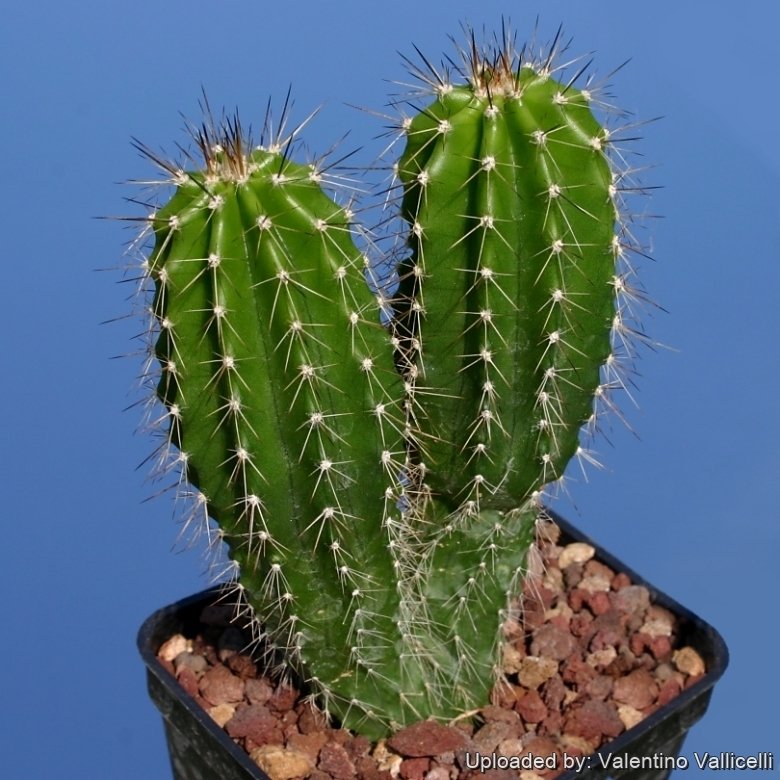
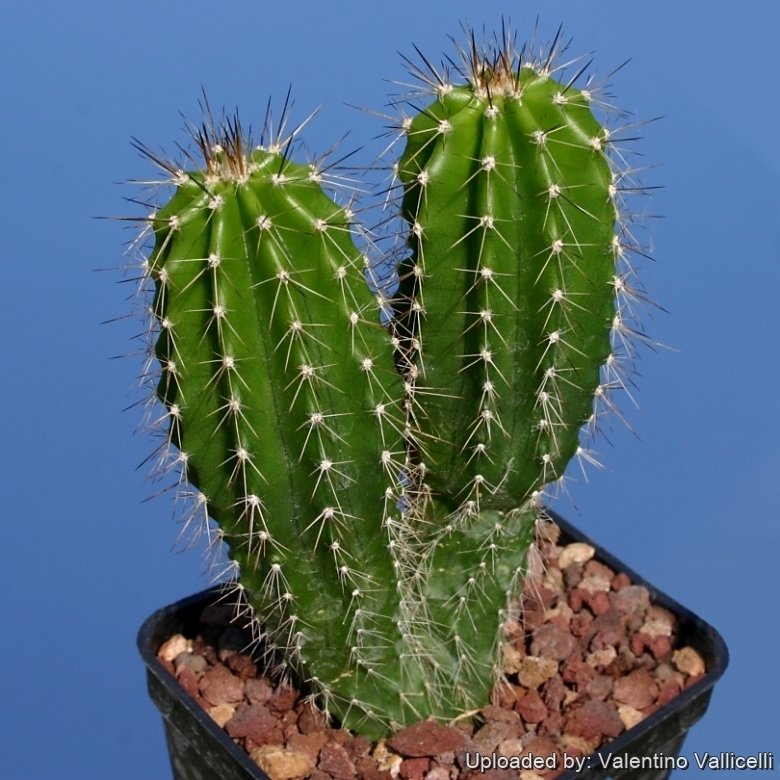
Neobuxbaumia euphorbioides is a grey green very tall but relatively thin rarely if ever branching columnar cactus that can grow up to 15 cm in diameter and to a height of about 7 m, but is usually shorter.
Derivation of specific name. As ages, spines tend to fall out and plant somewhat resembles a large columnar euphorbia (spurge) when not in bloom, hence the specific name.
Stems: Columnar, usually simple unbranched, (except where it has been injured), green, 3-5 (or more) m high, 10-11 cm in diameter.
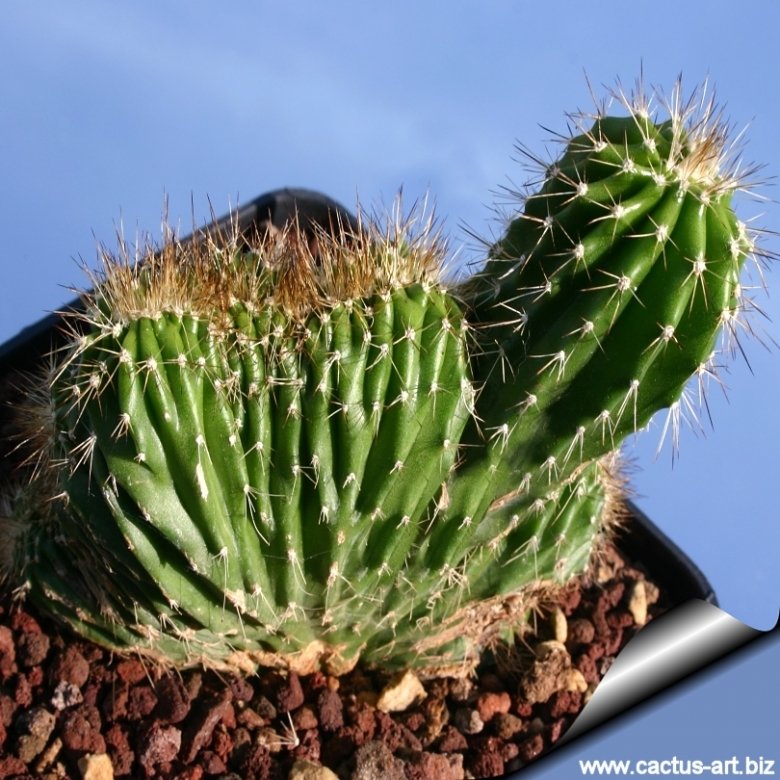
Ribs: 8-10, acute, somewhat crenate, distinctly wavy.
Areoles: less than 1 cm. apart, white felted.
Spines; few, sometimes only 4 or 5, and then only 1 prominent, dark brown, porrect, about 1 cm. long.
Spines: O two types, spines in the fertile region erect, elsewhere more or less horizontal.
Central spines: One, stout, dark brown, to 3 cm long.
Radial spines: 7-9 spines per areole. They are pale grey with darker reddish-brown to blackish tips, 0.5-1.2 cm long.
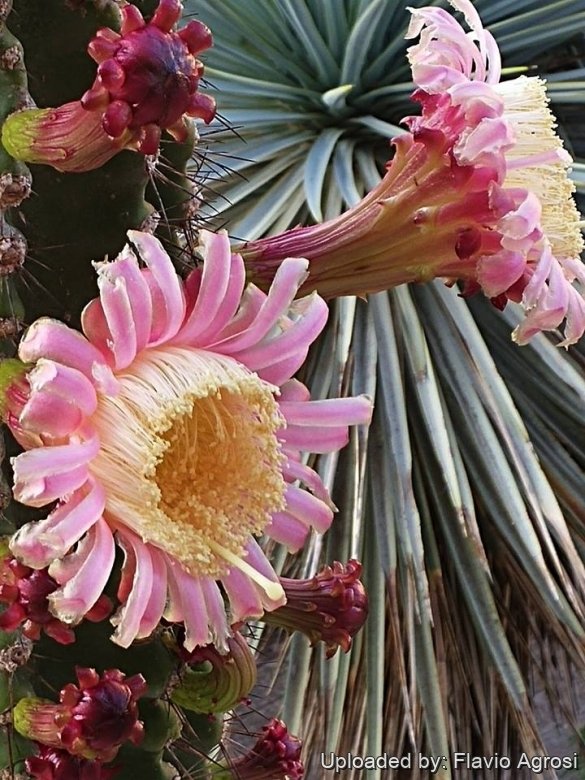
Flowers: Numerous, from the sides near the apex, reddish pink, narrowly bell shaped 5-8 cm long, 7 cm in diameter and ruffled pink-red with a pale yellow centre. Ovary 2 cm. long, spirally tuberculate. The tubercles (podaria) of the pericarpel in Neobuxbaumia euphorbioides and Neobuxbaumia scoparia are specialized as extrafloral nectaries 6356] is very similar in its habit and flowers to this species. Superficially Neobuxbaumia euphorbioides resembles a straight stalk of the far more common Stenocereus griseus and is not recognized locally as a distinct species.
Origin and Habitat
Neobuxbaumia euphorbioides is endemic to Mexico, and is distributed in the states of Tamaulipas and Veracruz. Also in extreme eastern San Luis Potosi and possibly northeastern Hidalgo and Puebla. Most likely, there are two disjunct populations, one south of Jalapa in Veracruz and near Mante in Tamaulipas. Estimated extent of occurrence of 10,000 km2 and an area of occupancy of 68 km2, is known from eight locations, and is experiencing continuing habitat loss.
Altitude range. 300 to 600 metres above sea level.
Habitat and Ecology: The species is found in low dry forest . It is unknown if this species tolerates human disturbance. In the Gómez Farias region in the state of Tamaulipas, Neobuxbaumia euphorbioides is reported as dominant in low dry forest habitat. This species is threatened by deforestation for small-holder agriculture and cattle. In the forests below Jalapa, Veracruz, N. euphorbioides grows on basaltic rock (it appears to join Neobuxbaumia scoparia in growing on basalts or other volcanics) in an area where the larger individuals had been cut down. The roughness (and high temperatures) of this surface probably discourage goats from frequenting, and the ever-regenerating canopy of this very moist area provides the necessary shade to guarantee recruitment.
Cultivation and Propagation
Neobuxbaumia are of easy culture and can grow 15-20 cm a year. They are cold intolerant. Make sure they are not exposed to freezing temperatures ( Hardy to -2°C) or they may die. They need a well drained soil mix. It appreciates abundant water during the summer and, during its growing period but allow to dry fully before watering again, it is possible to add a fertilizer 6-6-18 from time to time. During the winter months they should be rather kept dry. Since they are rapid growers, they need plenty of space for their roots. Repotting should be done every other year, or when the plant has outgrown its pot. Sun Exposure: Light shade when young, full sun later. In mild climate they can be grown in rock gardens in full sun, in dry and sandy soils.
Uses: Neobuxbaumia euphorbioides has edible fruits.
Propagation: Usually by Seeds (Seeds should be sown in a well-drained soil mix. Surface sowing is the best; seeds germinate in 14-28 days at 25° C, or from cuttings in spring (let them dry till the ends callous well). Then replant them in fresh cactus soil that is ever so slightly moist, and keep it that way till they root)
Bibliography
Major references and further lectures
-
Edward Anderson “The Cactus family” Timber Press, Incorporated, 2001
-
James Cullen, Sabina G. Knees, H. Suzanne Cubey “The European Garden Flora Flowering Plants: A Manual for the Identification of Plants Cultivated in Europe, Both Out-of-Doors and Under Glass” Cambridge University Press, 11/Aug/2011
-
David R Hunt; Nigel P Taylor; Graham Charles; International Cactaceae Systematics Group. “The New Cactus Lexicon” dh books, 2006
-
Gómez-Hinostrosa, C. & Hernández, H.M. 2013. Neobuxbaumia euphorbioides. The IUCN Red List of Threatened Species 2013: e.T151979A583374. http://dx.doi.org/10.2305/IUCN.UK.2013-1.RLTS.T151979A583374.en. Downloaded on 13 February 2016.
-
N. L. Britton, J. N. Rose: “The Cactaceae. Descriptions and Illustrations of Plants of the Cactus Family.” Volume II, The Carnegie Institution of Washington, Washington 1920
-
Gary Lyons “Desert Plants: A Curator’s Introduction to the Huntington Desert Garden” Huntington Library, 2007
-
David Yetman “The Great Cacti: Ethnobotany & Biogeography” University of Arizona Press, 2007
-
Theodore H. Fleming, Alfonso Valiente-Banuet “Columnar Cacti and Their Mutualists: Evolution, Ecology, and Conservation” University of Arizona Press, 2002
-
Lorraine Harrison “Latin for Gardeners: Over 3,000 Plant Names Explained and Explored” University of Chicago Press, 21 September 2012
-
Willy Cullmann, Erich Götz (Dozent Dr.), Gerhard Gröner “The encyclopedia of cacti” Timber Press, 1987
From llifle page Carnegiea euphorbioides f. cristata
Description
The standard Neobuxbaumia euphorbioides is a grey green very tall but relatively thin rarely if ever branching columnar cactus that can grow up to 15 cm in diameter and up to 9 m or more tall.
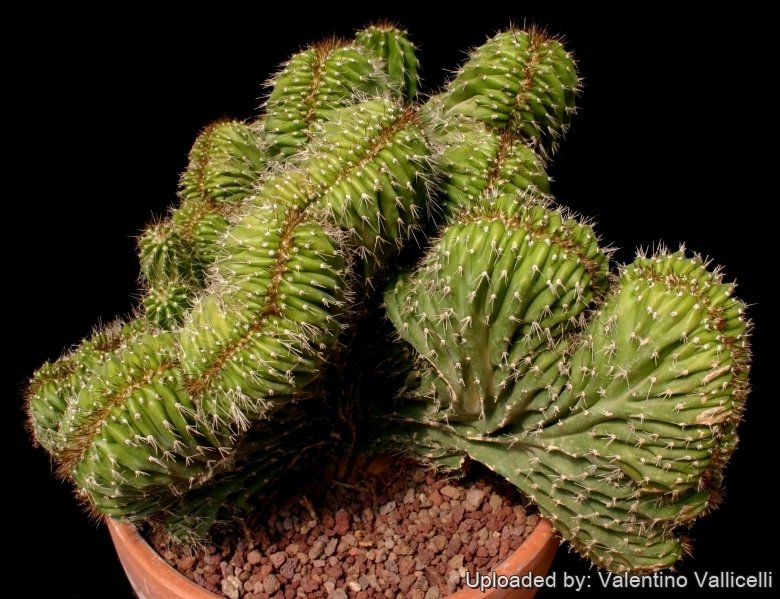
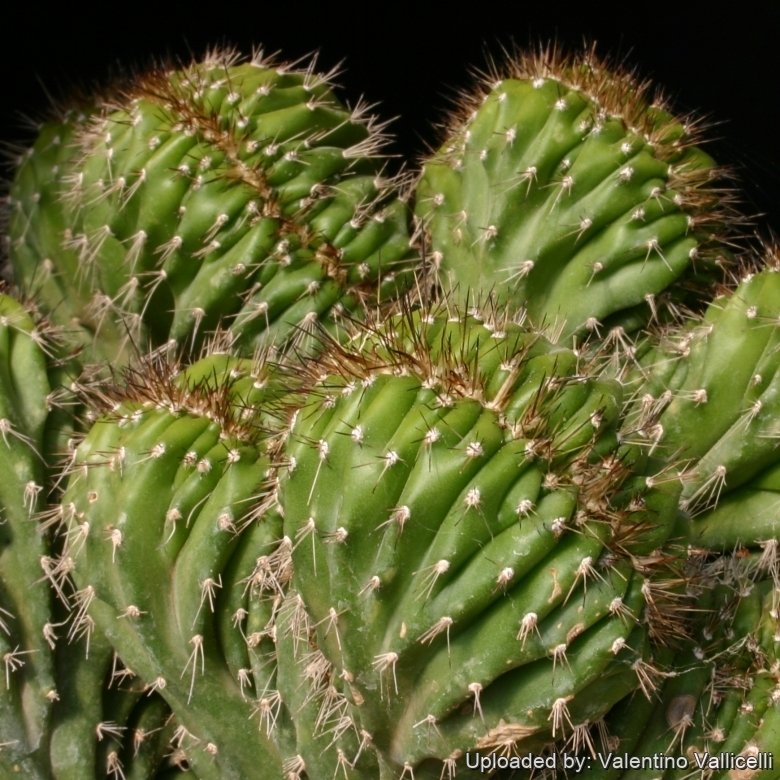
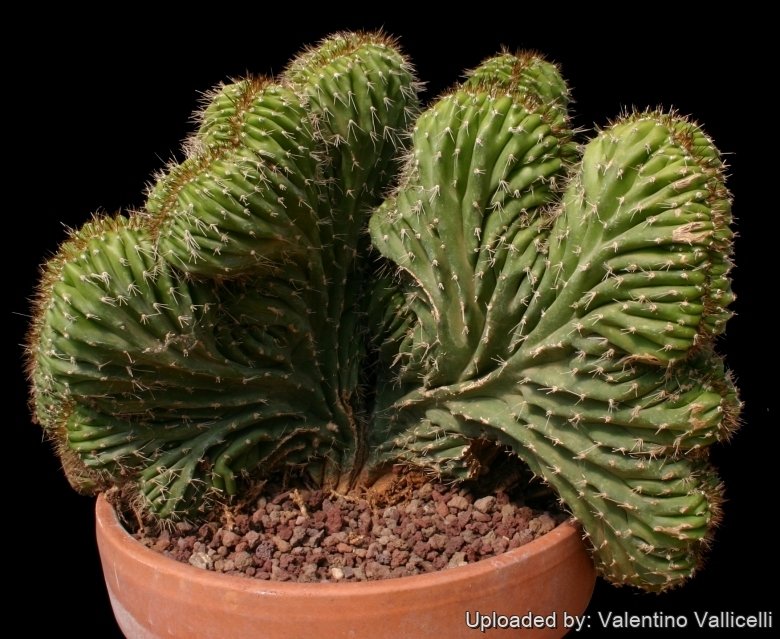
The crested mutation of this species is also very strong and can grow up to 1 m in diameter and height (or more).
Central spines: Absent.
Radial spines: Neat cactus with generaly 1 to maybe 3 (or five in young specimen) spines per areole. They are blackish to reddish-brown. As ages, spines tend to fall out and plant somewhat resembles a large Euphorbia candelabra.
Flowers: Nocturnal from the sides near the apex, and ruffled pink-red with a pale yellow centre.
Origin and Habitat
Mexico (San Luis Potosi, Tamaulipas, Veracruz)
Cultivation and Propagation
They are of easy culture and can grow 5-15 cm a year. They are cold intolerant. Make sure they are not exposed to freezing temperatures ( Hardy to -2°C) or they may die. They need a well drained soil mix. Water regularly in summer but allow to dry fully before watering again. During the winter months they should be rather kept dry. Since they are rapid growers, they need plenty of space for their roots. Repotting should be done every other year, or when the plant has outgrown its pot. Sun Exposure: Light shade when young, full sun later.
Propagation: From cuttings in spring (let them dry till the ends callous well). Then replant them in fresh cactus soil that is ever so slightly moist, and keep it that way till they root), or by grafting.
Source: Carnegiea euphorbioides f. cristata, LLIFLE - Encyclopedia of living forms, CC-BY-SA, retrieved 2026-10-25.
Cultivars and forms (1)
Forms (1)
Gallery