Publication: Cact. Hort. Dyck. (1849) Boston J. Nat. Hist. 6(2): 207 (-208). 1850 [Jan 1850] et: Cact. Hort. Dyck. (1849). 1849: 235. 1850 [Apr 1850]
Description
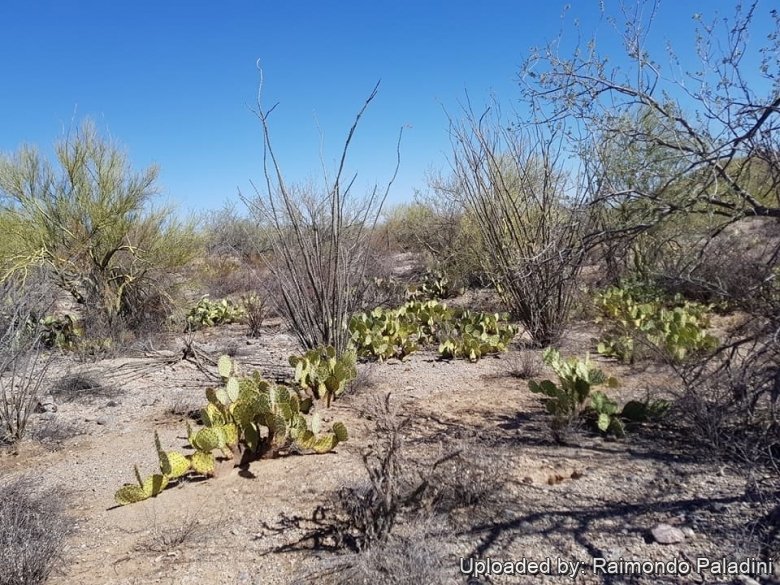
Opuntia engelmannii is a very varaible prickly pear, generally forming a dense, mound-shaped shrub, less than 1 metre tall (occasionally tree-like up to 3.5 metres high), usually with no apparent trunk or with a short trunk. Lower branches generally decumbent, upper spreading to ascending.
Remarks: The nomenclatural history of this species is somewhat complicated due to the varieties, as well as its habit of hybridizing with Opuntia phaeacantha. A lot of confusion exists in the identification of this species and Opuntia phaeacantha.
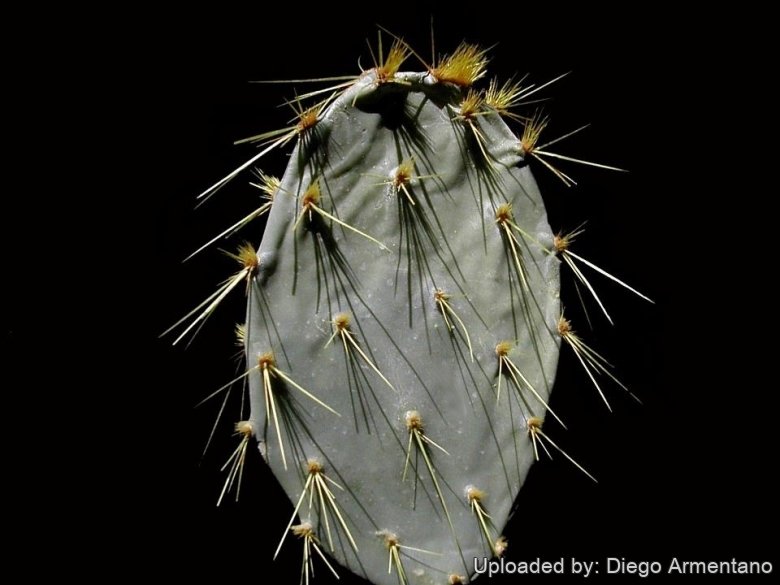
Stem segments: Joints obovate to orbicular to rhombic, not disarticulating, flat, glabrous, yellow-green to green (rarely blue-green), obovate to round, or apex tapering, elongate, about 15?30(-120) cm long and 12?20(-40) cm wide, more or less tuberculate.
Areoles: 5-8 per diagonal row across mid-stem segments, evenly distributed on stem segment to absent, subcircular to obovate, 4-7
Origin and Habitat
The Opuntia engelmannii has a wide range that extends from Mexico (Aguascalientes, Baja California, Chihuahua, Coahuila, Durango, Guanajuato, Hidalgo, Nuevo Leon, Queretaro, San Luis Potosi, Sinaloa, Sonora, Tlaxcala, Veracruz, Zacatecas) to the United States (Arizona, California, Texas)
Altitude range: 150 to 1,800 metres above sea level.
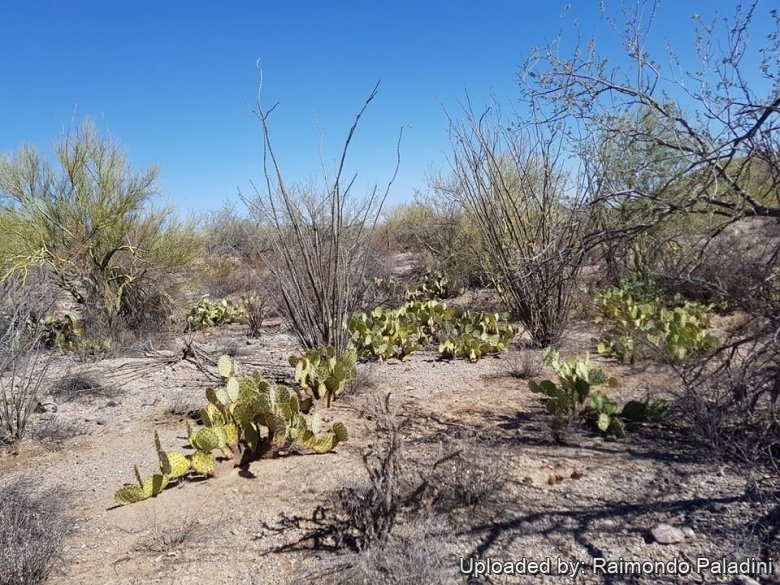
Habitat and ecology: Desert scrub, dry grasslands, pine-juniper and oak woodland, etc. In the Sonoran Desert, terminal pads face predominantly east-west, so as to maximize the absorption of solar radiation during summer rains. Although found occasionally in the Mojave Desert, it tends to be replaced by Opuntia basilaris, which does not need the summer rain. Pollinators include solitary bees, such as the Antophoridae, and sap beetles
Cultivation and Propagation
Opuntia engelmannii is cultivated as an ornamental plant, for use in drought tolerant gardens, container plantings, and natural landscaping projects. The fruits were a reliable summer food for Native American tribes.
Bibliography
Major references and further lectures
-
Wikipedia contributors. “Opuntia engelmannii.” Wikipedia, The Free Encyclopedia. Wikipedia, The Free Encyclopedia, 20 Jun. 2017. Web. 29 Oct. 2017.
-
Benson 1982 Cacti of US & Can;
-
Hunt & Taylor eds 1990 Bradleya 8:85-107
-
Jepson Manual treatment for “Opuntia engelmannii var. engelmannii” web. Web. 29 Oct. 2017. <http://ucjeps.berkeley.edu/cgi-bin/get\_JM\_treatment.pl?2702,2726,0,2735\>
-
Edward F. Anderson, “The Cactus Family” (Timber Press, 2001), pp.?497-498
-
Raymond M. Turner, Janice E. Bowers, and Tony L. Burgess, “Sonoran Desert Plants: an Ecological Atlas” (Tucson: The University of Arizona Press, 1995) pp.-291-293
-
“Opuntia engelmannii.”, “Flora of North America”. (FNA Vol. 4 Page 126, 128, 134, 135, 136, 139, 141 ) web: http://www.efloras.org/florataxon.aspx?flora\_id=1&taxon\_id=242415194 Retrieved 29 Oct. 2017.
-
Hunt, D., Taylor, N. and Charles, G. (compilers and editors). 2006. “The New Cactus Lexicon.” dh Books, Milborne Port, UK.
-
Corral-Diaz, R., Goettsch, B.K., Gomez-Hinostrosa, C., Heil, K., Hernandez, H.M. & Terry, M. 2013. Opuntia engelmannii. The IUCN Red List of Threatened Species 2013: e.T152531A647448. http://dx.doi.org/10.2305/IUCN.UK.2013-1.RLTS.T152531A647448.en. Downloaded on 29 October 2017.
From llifle page Opuntia cyclodes
Description
Opuntia engelmannii var. cyclodes (syn: Opuntia cyclodes) is a little known species, with sparsely spiny pads, first found by Bigelow near Anton Chico, New Mexico. It was described as a variety of Opuntia engelmannii. The key difference by which Opuntia cyclodes was separated, namely the smaller, globose fruit with larger seeds and fewer and shorter spines on the joints, together with a much spreading bushy habit, only 90-150 cm high and usually wider than it is tall, without a well-defined central stem, make the two species visually distinct. However this species has suffered varying fortunes at the hands of later authorities. Today many authors don’t recognize and accept Opuntia cyclodes as a good species, but as part of Opuntia engelmannii, they have dismissed it as perhaps not worthy of even varietal status. In fact there is a mass of herbarium material which seems to connect this with the true Opuntia engelmannii.
Stem segments: Orbicular to obovate (rarely oblong) 15-20 cm long, bright green or yellow green, but older ones may be covered with a light pruinose surface.
Areoles: As the species, except never quite as large in maximum size as in some forms, and only 25-30 mm apart. The glochids, except on current growth, usually missing entirely. On older pads areoles show few and very short glochids, if any, but edge areoles, especially at joint’s tip, produce some yellow glochids up to 12 mm long.
Spines: More slender than in typical Opuntia engelmannii. Half or almost all areoles may have spines; often there is a single stout, long spine sweeping down from the areole that may be accompanied by 1 or 2 smaller spines, but sometimes up to 6 spines. All spines are deflexed (pointing downward), relatively slender, the current year’s spines are pale yellow or straw-colored with or without red or reddish-brown bases. A typical areole’s armour consists of 1 large, flattened spine 18-45 mm long, plus occasionally one or two additional shorter spines below which are only 8-10 mm long; but some specimens show up to 4 of the larger spines spreading downward and 2 of the lower, shorter ones.
Flowers: Smaller than the species, being usually only about 5 cm in diameter and length, with bright orange anthers and 6 or 7 dark green stigma lobes.
Fruits. Smaller than Opuntia engelmannii (only about 2.5 cm in diameter), globose with larger seeds, purplish when fully ripe, but not very juicy and not pleasant to the taste.
Seeds: about 4-4.5 mm in diameter, the largest found in Opuntia engelmannii, and with broader rims than is typical for the species.
Chromosome number: Opuntia engelmannii var. cyclodes is exaploid, 2n = 66.
Origin and Habitat
Northern Texas (Chisos Mountains) and New Mexico (Big Bend to near Anton Chico) and back down to Stein’s Pass, where the northern limit passes into Arizona.
Habitat and ecology: Opuntia cyclodes occurs in rocky, mountainous locations and in flat, sandy areas where it forms large populations.
Cultivation and Propagation
Opuntia engelmannii var. cyclodes is a low maintenance plant that tolerate considerable neglect and will naturalize, it is drought-tolerant; and suitable for xeriscaping. Easy to cultivate outdoor in dry, sandy or gravely, well-drained soils. May be grown in clay soils as long as drainage is good and soils do not remain wet, it is very adaptable both in acid, neutral and basic (alkaline) soils, but prefers a pH in the range 6 to 7.5. No serious insect or disease problems.
Watering Needs: Outdoors little or no water once established, in the green house irrigate regularly from March to october, keep fairly dry in winter, tolerate dry condition but suffer if exposed to prolonged and severe drought. A position at the base of a south-facing wall or somewhere that can be protected from winter rain is best for this plant, but is however resistant to moisture and rain.
Sun Exposure: Full sun (only), in semi shaded position wont produce many flowers.
Frost hardiness: They are reasonably cold hardy , tolerating temperatures down to -5° to -12° C (USDA: 8-10) depending on clone, they are also quite tolerant of winter wet. (In good drained soils)
Traditional uses: The fruit are edible and the tender joints can be coked as a vegetable. In medicine the plant are used to treat dyspepsia, mumps, swelling and in veterinary it is used to treat bruises. The joints are also a good food for cattle (after burning of spines)
Propagation: Propagated by cuttings of leaf pads at any time in the growing season. (Allow cut surface to callus over before planting).
Bibliography
Major references and further lectures
-
Del Weniger “Cacti of the Southwest: Texas, New Mexico, Oklahoma, Arkansas, and Louisiana” University of Texas Press, 1969
-
Del Weniger “Cacti of Texas and Neighboring States: A Field Guide” University of Texas Press, 1984
-
Ellen Schulz Quillin, Robert Runyon “Texas Cacti: A Popular and Scientific Account of the Cacti Native of Texas” Texas Academy of Science, 1930
-
Opuntia Web “Opuntia cyclodes” retrieved 11 March 2016 from <http://opuntiads.com/opuntia-species/opuntia-c-d/opuntdia-cyclodes/\>
-
Elmer Ottis Wooton, Paul Carpenter Standley “Flora of New Mexico”, Volume 19
U.S. Government Printing Office, 1915
- A. Michael Powell, James F. Weedin “Cacti of the Trans-Pecos & Adjacent Areas” Texas Tech University Press, 2004
Source: Opuntia cyclodes, LLIFLE - Encyclopedia of living forms, CC-BY-SA, retrieved 2026-10-25.
From llifle page Opuntia microcarpa
Origin and Habitat
New Mexico (South-Central U.S.A., Northern America)
Source: Opuntia microcarpa, LLIFLE - Encyclopedia of living forms, CC-BY-SA, retrieved 2026-10-25.
From llifle page Opuntia tricolor
Origin and Habitat
Texas (South-Central U.S.A., Northern America)
Source: Opuntia tricolor, LLIFLE - Encyclopedia of living forms, CC-BY-SA, retrieved 2026-10-25.
Cultivars and forms (6)
Gallery