Publication: Cactaceae Syst. Init. 16: 18 18 2003.
Description
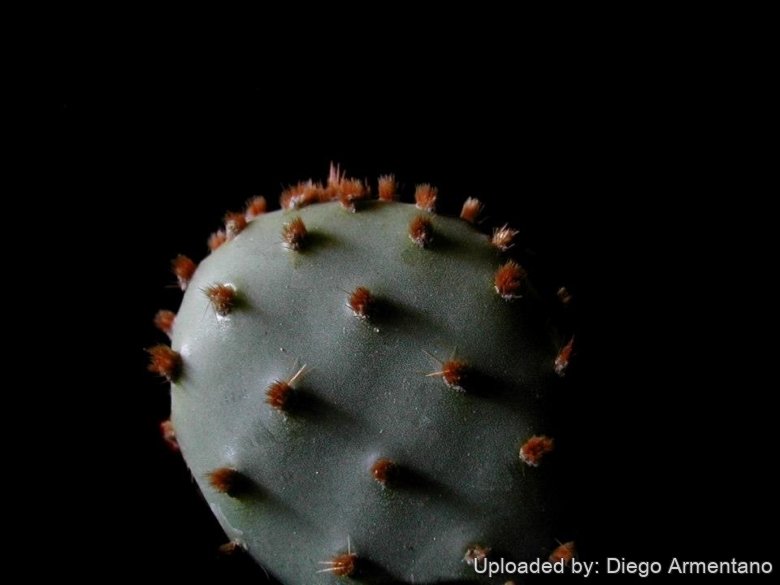
Opuntia pottsii (Opuntia macrorhiza subs. pottsii) is a diminutive shrubby plant up to 12(-30) cm tall, forming low prostrate clumps up to 2 metres in diameter. It is a cryptic species and grows from a tuberous root. The pads are glaucous blue-green when healthy. The usually 1-3 grey-white spines per areole are produced only on the upper part of the pads. Throughout it range the flowers may be red, magenta, pink, orange, yellow, white, and combination of these colours are found, sometime toghether in the same populations. When yellow, the flowers often have red centres. Two varieties of Opuntia pottsiiare recognized by David J. Ferguson (2012), the nominate form var. pottsii and var. montana. Varieties intergrade where they meet.
Derivation of specific name: The species was named after John Potts, who managed the mint in Chihuahua, Mexico, collected the original material of the species, and between the years 1842 and 185o sent many cactus collections to E Scheer at the Royal Botanic Gardens, Kew, England (Britton and Rose, 1919-13).
Stem: Segments usually not rooting when touching, round to obovate, often narrowed near base (stipitate), upright, glaucous blue-green (Yellow-green or purplish when stressed), 5-10(-13) cm long, 5-8(-10) cm wide, to 1.2 cm thick, wrinkled under very dry or cold conditions. Commonly plants produces only 6-10 pads and often a short trunklet.
Roots: Rhizomes commonly present. Central root tuber usually long and roughly cylindrical.
Areoles: 10-16 mm apart, narrowly obovate to nearly circular, 2-3 mm across.
Glochids: Yellow or brown, to 3(-5) mm long, numerous in a tight tuft.
Spines: One to five spines from the upper areoles, 1.5 to 6.5 cm long, whitish, grey or brownish, and black speckled, acicular or somewhat flattened, often rwisted, and downwards pointing. In each areole one spines is longer, while the other are short or different length. Rarely plants of Opuntia pottsii are spineless.
Leaves: Ephemeral, usually green or reddish only 3-5 mm long.
Roots: It has a single or branched fleshy, enlarged taproot that exude a milky sap when injured. It may be smooth or costricted at the neck.
Flower: Usually orange, pink, yellow with red bases to reddish, appear on early June , 5-6(-9) cm long and 4-5(-6) cm in diameter with petals curving upward and rolled back at sides.. In some flowers the slender pericarpel alone often 5 cm long. Filaments 12-15 mm long, yellow, greenish or purplish. Anthers yellow up to 2 mm long. Style pinkish 17-23 mm long. Stigma lobes 5-8 cream coloured, stout 3-4 mm long. Pericarpel smooth with few small areoles with white hairs and yellow-brown glochids. Flowers open about mid-day and close by 4:30 P.M., and do not open again.
Blooming season (in habitat): late April to early June. Most plants tend to produce flowers at much the same time, and the flowers may be finished in about one week.
Fruit: Obovoid narrow with slender base, and smooth, greenish to pinkish or reddish purple at maturity, fleshy, juicy, 2.5-4 cm long, 2.5-3cm in diameter flattened and irregular. The pulp is pale greenish and not very sweet. Fruits mature in 2.5-5 (or even more) months.
Seeds: Thick discoid, irregular in outline, wide margined, and beaked at the hilum, tan to grey, 3.5-5.5 mm in diameter.
Origin and Habitat
Widespread In Midwest and south-western United States (Colorado, Utah, Wyoming, South Dakota, Nebraska, and Missouri) and northern Mexico (Chihuahua and probably also in the state of Sonora as there is suitable habitat). The population is very scattered but it is locally common.
Altitude range: This species grows at an elevation of 800 to 2200 metres above sea level.
Habitat: Grows on loam or rocky, sandy places, alluvial hillsides and plains, in desert scrubs and grasslands (mesquite and yucca grassland). Opuntia pottsii has a wide range, and although a cryptic species it is probably reasonably common and resistant to most threats as it has underground tubers. There are no significant threats to this species although some areas would have been impacted by agricultural activities and there may be some localized declines.
Cultivation and Propagation
Opuntia pottsii is a relatively difficult to grow so it is seldom cultivated for the horticultural trade.
Soil: Requires a sandy or very well-drained soil. Prefers a neutral to alkaline soil.
Moisture: Plants must be kept rather dry in the winter but they like a reasonable supply of water in the growing season. A position at the base of a south-facing wall or somewhere that can be protected from winter rain is best for this plant. Plants endure considerable abandon.
Exposure Requires plenty of sun.
Hardiness: Is is quite cold tolerant plant, it can succeed outdoors.
Bibliography
Major references and further lectures
-
Pinkava, D.J., Baker, M. & Puente, R. 2013. Opuntia pottsii. The IUCN Red List of Threatened Species. Version 2015.1. <www.iucnredlist.org>. Downloaded on 21 June 2015.
-
N. L. Britton, J. N. Rose: “The Cactaceae. Descriptions and Illustrations of Plants of the Cactus Family.” Vol I, The Carnegie Institution of Washington, Washington 1919
-
Edward Anderson “The Cactus family” Timber Press, Incorporated, 2001
-
A. Michael Powell, James F. Weedin “Cacti of the Trans-Pecos & Adjacent Areas” Texas Tech University Press, 2004
-
David J. Ferguson “Keys to the identity of cacti of the Albuquerque & Santa Fe area (Bernalillo, Sandoval, Santa Fe, Socorro, Torrance, and Valencia Counties)” November 1993 (updated May18, 2012)
From llifle page Opuntia ballii
Origin and Habitat
Northern Mexico and Texas ( Northern America)
Source: Opuntia ballii, LLIFLE - Encyclopedia of living forms, CC-BY-SA, retrieved 2026-10-25.
From llifle page Opuntia delicata
Origin and Habitat
Northern Mexico, Arizona (Northern America)
Source: Opuntia delicata, LLIFLE - Encyclopedia of living forms, CC-BY-SA, retrieved 2026-10-25.
From llifle page Opuntia filipendula
Origin and Habitat
Rio Grande bottom near San Elisario, Texas (South-Central U.S.A., Northern America)
Source: Opuntia filipendula, LLIFLE - Encyclopedia of living forms, CC-BY-SA, retrieved 2026-10-25.
From llifle page Opuntia setispina
Origin and Habitat
Mexico
Source: Opuntia setispina, LLIFLE - Encyclopedia of living forms, CC-BY-SA, retrieved 2026-10-25.
From llifle page Opuntia cymochila var. montana
Description
Opuntia pottsii var. montana (firstly described as Opuntia cymochila var. montana by Engelmann & J.M.Bigelow in 1856) is a mountain form of Opuntia pottsii (Opuntia macrorhiza subs. pottsii). The key difference by which var. montana was separated from var. pottsii, namely the joints mostly wider than long usually dark to somewhat bluish green, weakly or not narrowed near base (stipitate), the spines usually white, the fruit mostly chunky and short, usually pinkish, the root tuber globose usually without rhizomes, and the flowers usually pale yellow and red in centre, seems entirely spurious, but plants from the areas above 1800 metres do differ in various respects from that found at lower elevations. However the distinguishing characteristics of var. montana, appear to fall within the natural variation of Opuntia pottsii and it should be synonymized with the latter.
Habit: Shrub to 30 cm high.
Root: Root tuber globose, oozing a white sap if injured, and usually without rhizomes.
Stem segments: Upright, fleshy, obovate to round, mostly wider than long 5-13 cm long, waxy dark to somewhat blue-green, weakly or not narrowed near base (stipitate).
Glochids: Yellow to reddish brown.
Spines: 1-4 per areole in upper part of the pad, erect to spreading, whitish, greyish, or shades of rust, often needle-like, but may be flat or twisted.
Flowers: 5-9 cm long, 4-6 cm wide, usually pale yellow and red in centre, but also, yellow, orange, magenta, pink or salmon. Stigma-lobes white to cream colored.
Fruits: Fleshy, mostly chunky and short, 2.5-5 cm long, 2 cm wide, pinkish purple.
Chromosome number. 2n=44.
Origin and Habitat
New Mexico and Texas, USA
Habitat and ecology: Opuntia pottsii var. montana is usually found in areas of conifer or oak woodland above 1800 metres, occasional in grasslands at lower elevations.
Cultivation and Propagation
Opuntia pottsii var. montana is a relatively difficult to grow so it is seldom cultivated for the horticultural trade.
Soil: Requires a sandy or very well-drained soil. Prefers a neutral to alkaline soil.
Moisture: Plants must be kept rather dry in the winter but they like a reasonable supply of water in the growing season. A position at the base of a south-facing wall or somewhere that can be protected from winter rain is best for this plant. Plants endure considerable abandon. Exposure Requires plenty of sun.
Hardiness: Is is quite cold tolerant plant, it can succeed outdoors. Said to be hardy in Zones 3 and 4 (USDA)
Bibliography
Major references and further lectures
-
David J. Ferguson “Keys to the identity of cacti of the Albuquerque & Santa Fe area (Bernalillo, Sandoval, Santa Fe, Socorro, Torrance, and Valencia Counties)” November 1993 (updated May18, 2012)
-
Jean-Luc E. Cartron “A Field Guide to the Plants and Animals of the Middle Rio Grande Bosque” UNM Press, 2008
3)David J. Ferguson “Chromosome counts on DJF collections of Cactaceae” retrieved 22 March 2016 from <http://opuntiads.com/records/chromosome-numbers-cacti-djf.pdf\>
Source: Opuntia cymochila var. montana, LLIFLE - Encyclopedia of living forms, CC-BY-SA, retrieved 2026-10-25.
Gallery