Publication: Suppl. Pl. Succ. 81. 1819 [May 1819]
Description
Opuntia monacantha is a very quick-growing shrubby or tree-like succulent 2-4 (6) m tall with a short trunk up to 2 dm in diameter. An early name formerly and widely applied to Opuntia monacantha is Opuntia monacantha Miller. This name is now more properly referred to Opuntia ficus-indica (Linnaeus) Miller.
Stem-segments: Oblong to obovate, tapered towards the base, 10-30 cm long, 7,5-12,5 cm wide glossy green, and with an irregular margin.
Areoles: Widely separated .
Spines: 1 or 2, slender, unequal, 1-4 (6) cm long, brown towards tip and base, greyish between, spines more numerous on trunk.
Flowers: 5-7,5 long, 7,5-10 cm broad, yellow to deep orange brown, outer perianth-segments reddish. Styles and stigmas white. Ovary of 4 cm, unarmed.
Fruit: Pear-shaped, 5-7,5 cm long, 4-5 cm in diameter, reddish purple.
Seeds: Covered by a bony aril.
Chromosome number: 2n = 32
Origin and Habitat
Endemic to Brazil, Uruguay, Argentina, Paraguay. Now it is one of the most widely diffused prickly-pear, cultivated in Australia, South east Asia, India, South Africa, Madagascar and Spain, frequently subspontaneous after cultivation. In Southern Africa, Australia and Asia it has become a noxious invasive alien species, causing tremendous damage as these plants are able to outcompete indigenous vegetation.
Habitat: It grows in semiarid, warm temperate to subtropical areas. It occurs on most soil types including sand and calcareous soils. It grows in dry and moist sites in full sun in flats lowland, slopes, tropical forests, sandy shores, agricultural areas or wastelands from near sea level to 2000 metres elevation. It is one of the most cultivated species used to create impenetrable hedges around fields and houses-parts and formerly also cultivated for the cochineal insect in south east Asia, India, Sri Lanka and South Africa (See also Opuntia cochinellifera). Opuntia monacantha is perhaps best known in the form of its variety monstruosa variegata.
Cultivation and Propagation
Opuntia monacantha is a low maintenance plant that tolerate considerable neglect and will naturalize. Easy to cultivate outdoor in warm dry climates.
Growth rate: it is a relatively fast growing species that can form large clumps just in a few year and fruits can be harvested 3 years after planting.
Soils: It grows well in sandy or gravely, well-drained soils. May be grown in clay soils as long as drainage is good and soils do not remain wet, it is very adaptable both in acid, neutral and basic (alkaline) soils, but prefers a pH in the range 6 to 7,5. For pot culture it needs regular cacti soil with little organic matter (peat, humus).
Repotting: Since they are big-sized plants, they need plenty of space for their roots. Repotting should be done every other year, or when the plant has outgrown its pot. Use pot with good drainage.
Watering Needs: Must be kept fairly dry in winter but likes a reasonable supply of water in the growing season, but do not overwater and allow to dry fully before watering again, tolerate dry condition but suffer if exposed to prolonged and severe drought. A position at the base of a south-facing wall or somewhere that can be protected from winter rain is best for this plant, but is however resistant to moisture and rain. Care must be taken with watering as they tends to become swollen and untidy in growth habit if given too much water and shade.
Fertilization: During the growing season enrich the soil using a fertilizer rich in potassium and phosphorous, but poor in nitrogen, because this chemical element doesn’t help the development of succulent plants, making them too soft and full of water.
Sun Exposure: Full sun (only), in semi shaded position wont produce many flowers.
Hardiness: Reputedly sensitive to frost, but less so if kept on the dry side prior to, and during, cold weather (hardy to -5° C for short periods, depending on clone). However some warmth throughout the year will increase the grower’s success (minimum 5° to 8°C during rest season). In presence of high atmospheric humidity make sure that Opuntias are not exposed to freezing temperatures, or they may die. Outdoors this plant is very adaptable, as long as you avoid excessive humidity in the winter months (in good drained soils).
Garden uses: Excellent as landscape or patio plant. It is suitable for “desert” or “Mediterranean” gardens, in association with other xerophytes. Where the open air cultivation is not possible due to the climate, it is to be cultivated in pot in order to shelter it in winter.
Pests & diseases: It may be attractive to a variety of insects, but plants in good condition should be nearly pest-free, particularly if they are grown with good exposure and ventilation.
Warning: Opuntias bear spines and glochids (stiff bristles on the surface of the cladode) that can be very irritating to the skin.
Propagation: Propagated almost exclusively by cuttings of leaf pads at any time in the growing season. It may also be propagated by seeds. Seeds germinate in 7-14 days at 21-27° C in spring, remove the glass cover gradually as the plants develops and keep ventilated, no full sun for young plants! The seedlings should not be disturbed until they are well rooted, after which they can be planted separately in small pots.
Bibliography
Major references nad further lectures
-
Hanelt Peter, Richard Büttner “Mansfeld’s Encyclopedia of Agricultural and Horticultural Crops: (Except Ornamentals)” Springer, 2001
-
Lyman David Benson “The cacti of the United States and Canada” Stanford University Press, 1982
-
Christo Fabricius, Eddie Koch, Stephen Turner, Hector Magome “Rights Resources and Rural Development: Community-based Natural Resource Management in Southern Africa” Routledge, 11/Jan/2013
-
T. K. Lim “Edible Medicinal and Non-Medicinal Plants: Volume 1, Fruits” T. K. Lim Springer, 02/Jan/2012
-
Edward Anderson “The Cactus family” Timber Press, Incorporated, 2001
-
James Cullen, Sabina G. Knees, H. Suzanne Cubey “The European Garden Flora Flowering Plants: A Manual for the Identification of Plants Cultivated in Europe, Both Out-of-Doors and Under Glass” Cambridge University Press, 11/Aug/2011
-
David R Hunt; Nigel P Taylor; Graham Charles; International Cactaceae Systematics Group. “The New Cactus Lexicon” dh books, 2006
-
N. L. Britton, J. N. Rose “The Cactaceae. Descriptions and Illustrations of Plants of the Cactus Family.” Volume 4, The Carnegie Institution of Washington, Washington 1923
From llifle page Opuntia arechavaletae
Origin and Habitat
Uruguay (Southern South America, Southern America)
Source: Opuntia arechavaletae, LLIFLE - Encyclopedia of living forms, CC-BY-SA, retrieved 2026-10-25.
From llifle page Opuntia vulgaris f. monstruosa variegata
Description
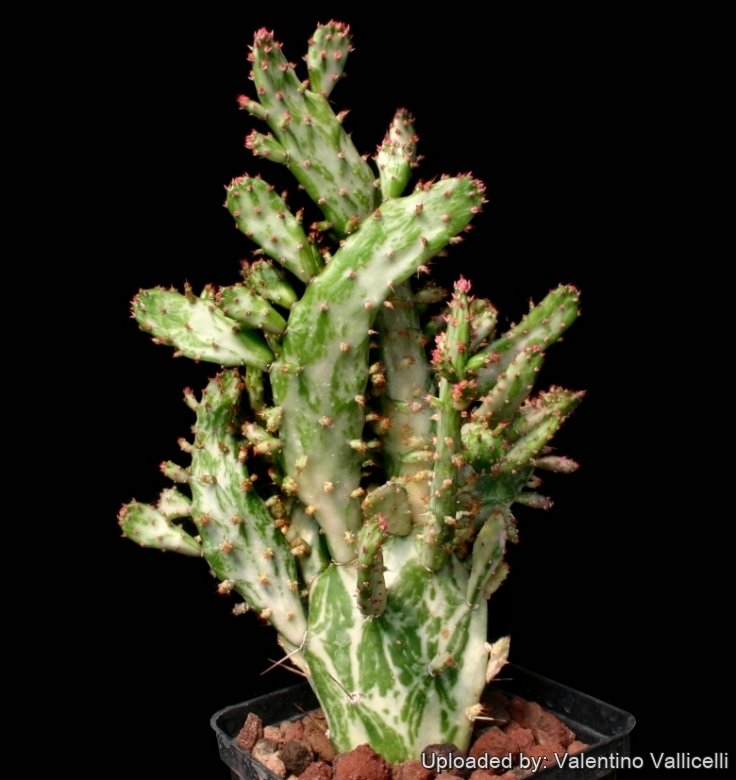
Opuntia monacantha f. monstruosa variegata commonly known as “Joseph’s Coat” is one of the very few naturally occurring white-variegated cacti. It is a dwarf, teratological variant of the larger Prickly Pear cactus Opuntia monacantha. As its name suggests, this cactus is variegated or marbled with white, creamy-white, yellow, green and sometimes also with pink in varying patterns.
Habit: It is an odd shrubby or tree-like plant that forms wonderfully tortured shapes usually less than 50 cm tall, but occasionally up to 1 m or more metres tall. To many it looks stretched or etiolated due to lack of light, but its actually a monstrous form.
Stem: Long, smooth, flattened beautifully green, yellow and pink covered in tiny hair spines.
Flowers: Small red.
Remarks: In cultivation Opuntia monacantha is perhaps best known in the form of its variety variegata.
Origin and Habitat
This is one of the very few naturally occurring variegated cacti.
Cultivation and Propagation
Variegated cacti are regarded as choice and difficult in cultivation, but Opuntia monacantha f. monstruosa is easy to grow on its own roots and very common in cultivation. It is a freely branching species that reproduces readily by cutting, recommended for any collection that needs lots of heat with ample airflow.
Growth rate: It is a fast growing species. It branches profusely from the side and near the tips and can form a 50-100 cm tall shrub in just a few years given the best conditions.
Soils: It likes very porous standard cactus mix soil with more organic matter (peat, humus) than other cacti.
Repotting: Repotting every 2-3 years. It will need a pot with sufficient depth to allow the root to expand. Use pot with good drainage.
Watering: Needs moderate to copious waterings in summer (it is more demanding than other cactus), but do not overwater, keep dry in winter at a minimum temperature of 5°C. Its roots are easily lost in pots that stay damp for any length of time. Keep dry with ample airflow in winter. In the rest period no high atmospheric humidity!! Care must be taken with watering as they tends to become swollen and untidy in growth habit if given too much water and shade.
Fertilization: During the growing season enrich the soil using a fertilizer rich in potassium and phosphorous, but poor in nitrogen, because this chemical element doesn’t help the development of succulent plants, making them too soft and full of water.
Hardiness: It is a tropical plant quite sensitive to frost that need some warmth throughout the year (minimum 5° to 8°C during rest season).
Exposition: Outside filtered sunlight or afternoon shade, but tolerate bright sun too, inside it needs bright light, and some direct sun. Subject to sunburn if exposed to direct sun for too long during the hottest hours in mid summer.
Uses: It is an excellent plant for container growing. It look fine in a cold greenhouse and frame.
Pests & diseases: It may be attractive to a variety of insects, but plants in good condition should be nearly pest-free, particularly if they are grown in a mineral potting-mix, with good exposure and ventilation. Nonetheless, there are several pests to watch for:
- Red spiders: Sensitive to red spider mite. Overhead watering is helpful in controlling mites.
- Mealy bugs: Occasionally mealy bugs they develop aerial into the new growth among the wool with disfiguring results, but the worst types develop underground on the roots and are invisible except by their effects.
- Scales: Scales are rarely a problem.
- Rot: Rot it is only a minor problem with cacti if the plants are watered and “aired” correctly. If they are not, fungicides won’t help all that much.
Propagation: Usually cuttings. Cuttings will take root in a minimum temperature of 20° C (but better in hot weather). Cuttings of healthy shoots can be taken in the spring and summer. Cut the stem with a sharp, sterile knife, leave the cutting in a warm, dry place for a week or weeks (depending on how thick the cutting is) until a callus forms over the wound. Once the callus forms, the cutting may be inserted in a container filled with firmed cactus potting mix. The cuttings should root in 2 to 6 weeks.
Source: Opuntia vulgaris f. monstruosa variegata, LLIFLE - Encyclopedia of living forms, CC-BY-SA, retrieved 2026-10-25.
From llifle page Opuntia vulgaris f. monstruosa
Description
Opuntia monacantha f. monstruosa is an odd shrubby or tree-like plant that forms wonderfully tortured shapes usually less than 50 cm tall, but occasionally up to 2 or more metres tall. To many it looks stretched or etiolated due to lack of light, but its actually a monstrous form of the common Prickly Pear cactus.
Stem: Flattened green covered in tiny hair spines.
Flowers: Miniature red flowers.
Origin and Habitat
This plant is a spontaneous monstrous variant found in habitat and widely spread in cultivation.
Cultivation and Propagation
Opuntia monacantha f. monstruosa is a freely branching species that reproduces easily by cutting, recommended for any collection that needs lots of heat with ample airflow.
Growth rate: It is a fast growing species. It branches profusely from the side and near the tips and can form a 50-100 cm tall shrub in just a few years given the best conditions.
Soils: It likes very porous standard cactus mix soil with more organic matter (peat, humus) than other cacti.
Repotting: Repotting every 2-3 years. It will need a pot with sufficient depth to allow the root to expand. Use pot with good drainage.
Watering: Needs moderate to copious waterings in summer (it is more demanding than other cactus), but do not overwater, keep dry in winter at a minimum temperature of 5°C. Its roots are easily lost in pots that stay damp for any length of time. Keep dry with ample airflow in winter. In the rest period no high atmospheric humidity!! Care must be taken with watering as they tends to become swollen and untidy in growth habit if given too much water and shade.
Fertilization: During the growing season enrich the soil using a fertilizer rich in potassium and phosphorous, but poor in nitrogen, because this chemical element doesn’t help the development of succulent plants, making them too soft and full of water.
Hardiness: It is a tropical plant quite sensitive to frost that need some warmth throughout the year (minimum 5° to 8°C during rest season).
Exposition: Outside bright sun, filtered sunlight or afternoon shade, inside it needs bright light, and some direct sun. Subject to sunburn if exposed to direct sun for too long.
Uses: It is an excellent plant for container growing. It look fine in a cold greenhouse and frame.
Pests & diseases: It may be attractive to a variety of insects, but plants in good condition should be nearly pest-free, particularly if they are grown in a mineral potting-mix, with good exposure and ventilation. Nonetheless, there are several pests to watch for:
- Red spiders: Sensitive to red spider mite. Overhead watering is helpful in controlling mites.
- Mealy bugs: Occasionally mealy bugs they develop aerial into the new growth among the wool with disfiguring results, but the worst types develop underground on the roots and are invisible except by their effects.
- Scales: Scales are rarely a problem.
- Rot: Rot it is only a minor problem with cacti if the plants are watered and “aired” correctly. If they are not, fungicides won’t help all that much.
Propagation: Usually cuttings. Cuttings will take root in a minimum temperature of 20° C (but better in hot weather). Cuttings of healthy shoots can be taken in the spring and summer. Cut the stem with a sharp, sterile knife, leave the cutting in a warm, dry place for a week or weeks (depending on how thick the cutting is) until a callus forms over the wound. Once the callus forms, the cutting may be inserted in a container filled with firmed cactus potting mix. The cuttings should root in 2 to 6 weeks.
Source: Opuntia vulgaris f. monstruosa, LLIFLE - Encyclopedia of living forms, CC-BY-SA, retrieved 2026-10-25.
Cultivars and forms (4)
Gallery