Publication: Kirkia 10(1): 290 1975
Description
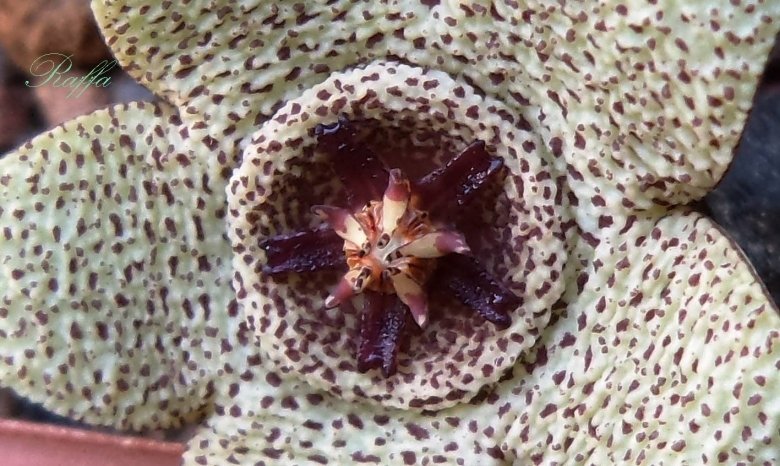
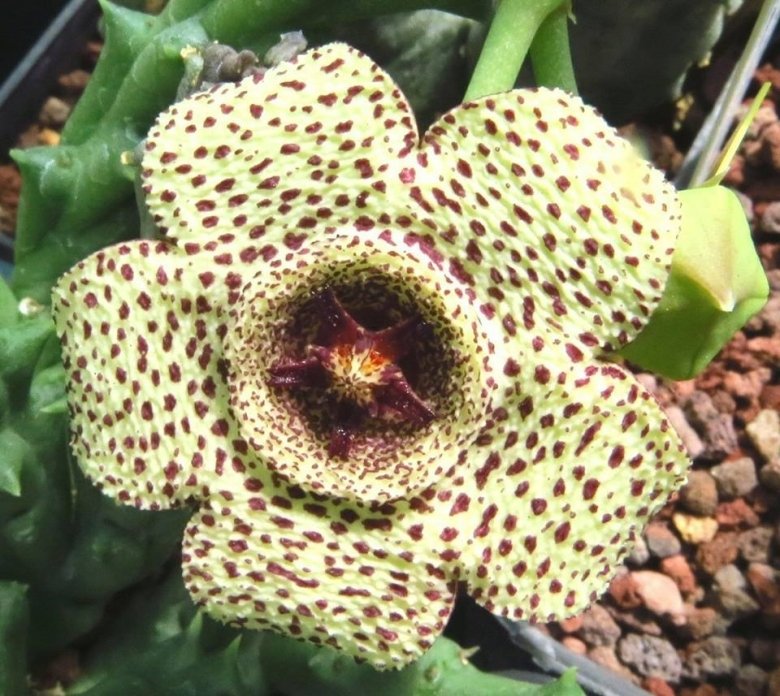
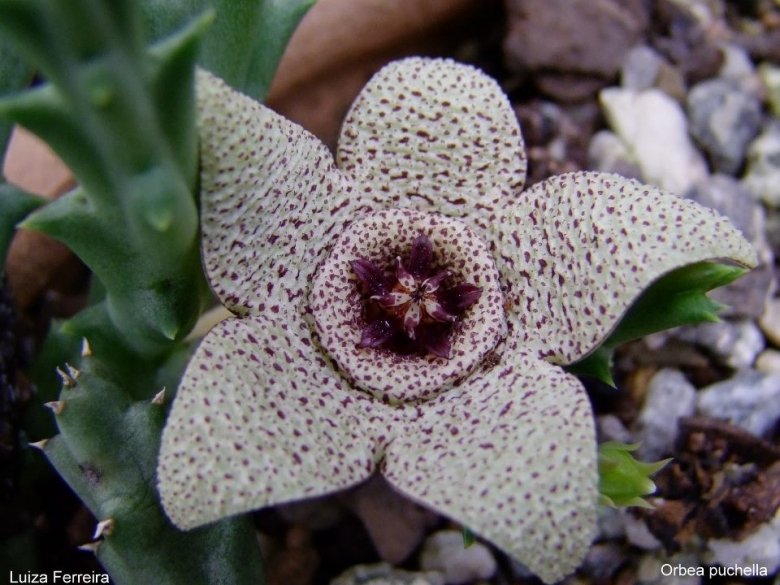
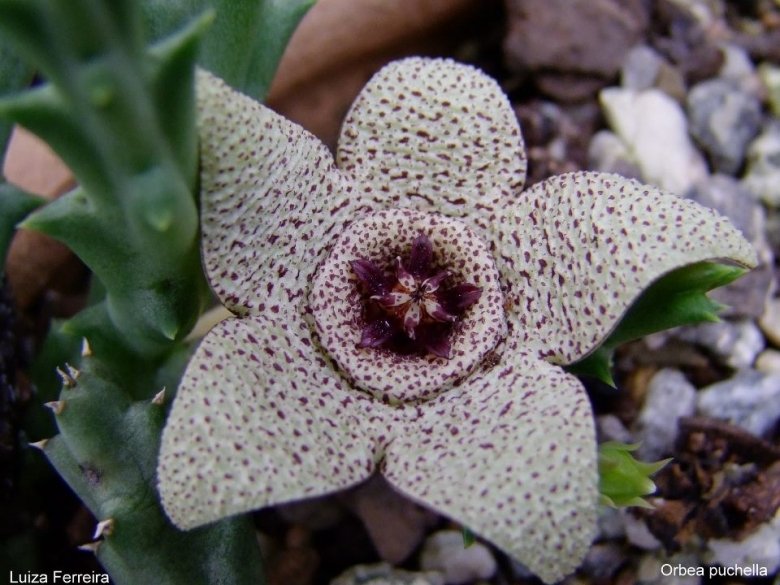
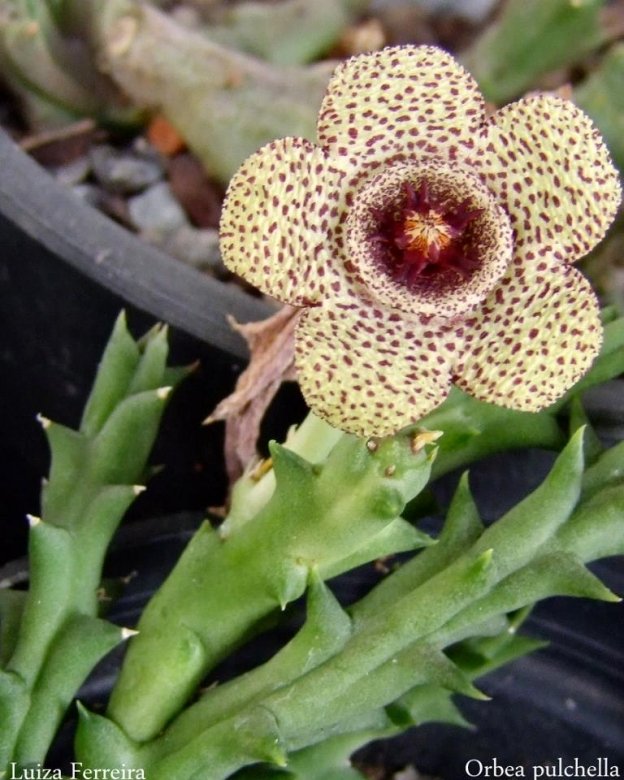
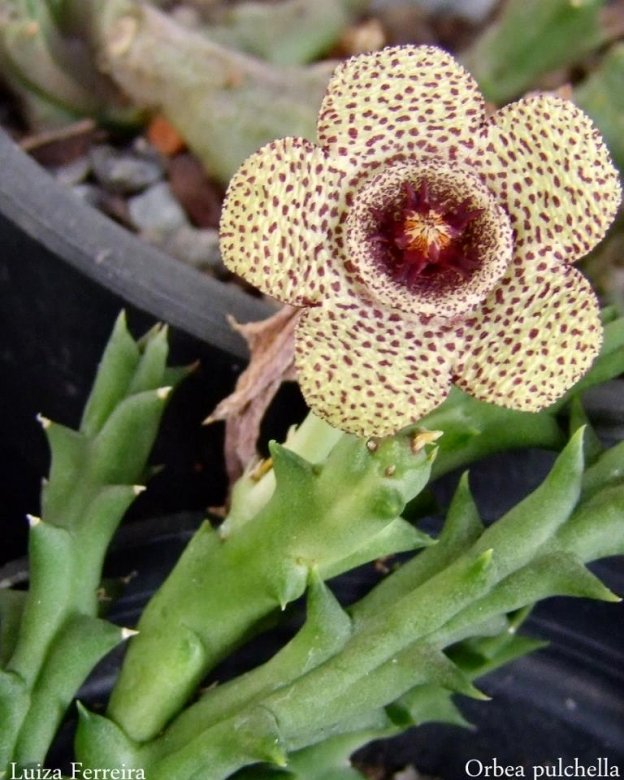
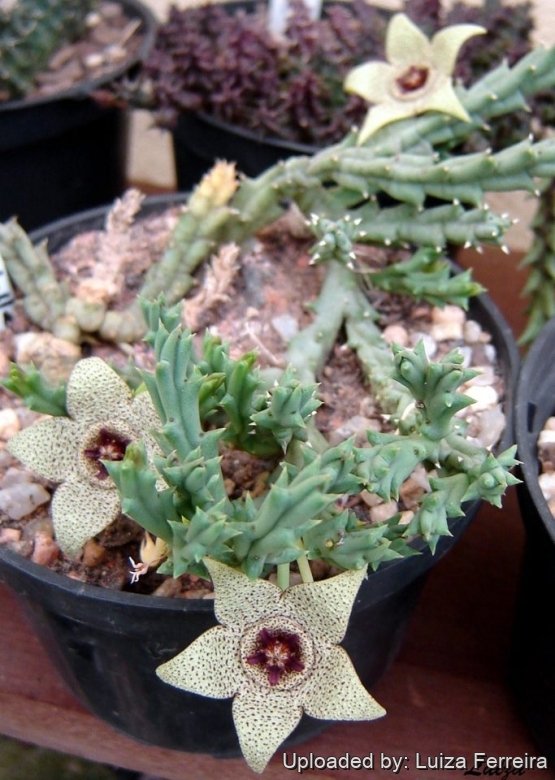
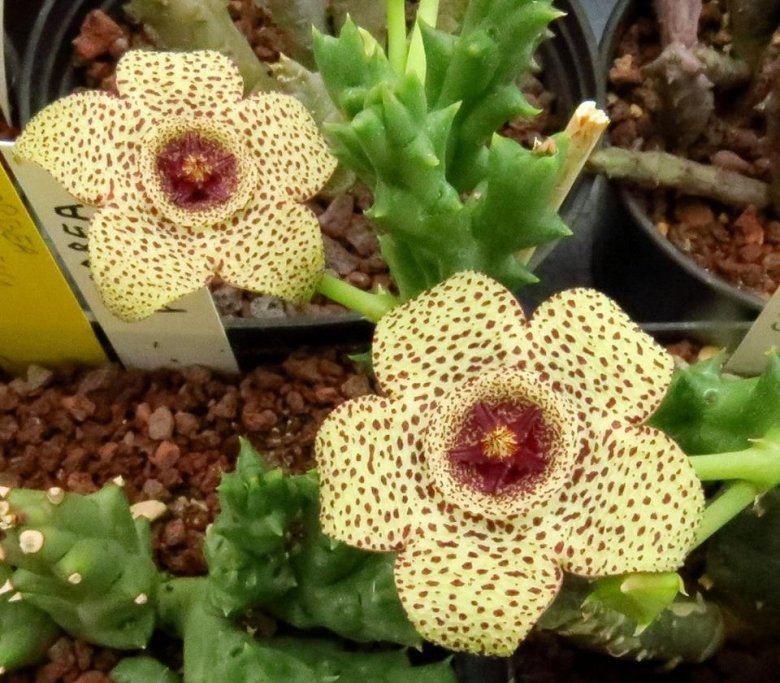
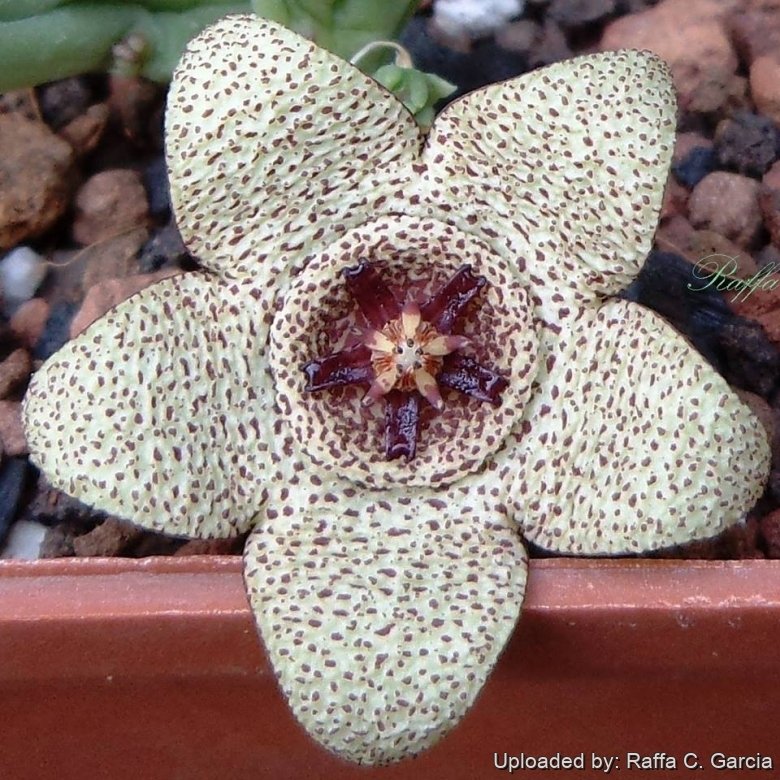
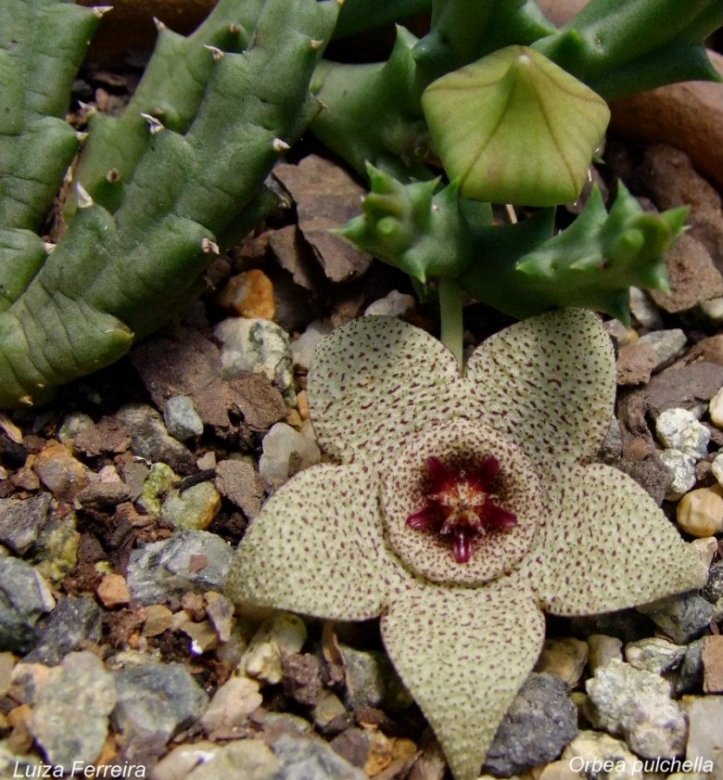
Orbea pulchella is an attractive mat-forming, perennial, leafless succulent with short grey, knobbly, 4-angled stems with sulphur-yellow flowers covered with numerous purple-brown dots and specks, smell offensive, attracting carrion flies which thus act as pollinating agents. It is distinguished by its 2-horned inner corona-lobes and small solid annulus completely connects the groups to which Orbea verrucosa and Orbea variegata respectively belong.
Stems: Like those of Orbea variegata, 5-10 cm high, erect or decumbent at the base, 8-12 mm thick, obtusely 4-angled, with stout conical acute spreading tubercles, glabrous, green.
Flowers: usually 3 or more together, successively developed near the base of the stems. Pedicels 2.5-3 cm long, glabrous. Sepals 3-6 mm long, ovate to lanceolate, acute or acuminate, glabrous. Corolla 3-6 cm in diameter, smooth on the back, minutely tuberculate-rugulose and glabrous on the inner face, not ciliate, sulphur-yellow, covered with numerous purple-brown dots and specks, which are smaller and more crowded upon the annulus, and the lobes sometimes narrowly edged with purple-brown; disk shallowly saucer-shaped, with a solid more or less pentagonal annulus 8-14 mm in diameter, raised 0.5-1.5 mm above the surface, and a pentagonal pale purplish area margined with brighter purple-red or occasionally entirely sulphur-yellow at the bottom of its cup. Corolla lobes 10-26 mm long, 10-16 mm broad, ovate or deltoid-ovate, very acute or acuminate, very spreading or recurved; outer corona-lobes 2-3 mm long, 1 mm broad, linear or oblong-linear, obtuse, truncate, emarginate or minutely 3-toothed at the apex, dark purple-brown with a pale yellowish spot or somewhat Λ shaped mark below the apex and sometimes along the margins; inner corona-lobes unequally 2-horned, pale yellow spotted with dark purple-brown, or purple-brown with yellow markings; outer horns ascending, 0.5-1 mm long, conical or conical-subulate, obtuse; inner horns 0.5-2.5 mm long, connivent-erect or with recurving tips, filiform, varying from distinctly clavate to not at all thickened at the apex. Pollinia 0.6 x 0.5 mm D-shaped.
Blooming season: Summer-autumn (January to October in habitat).
Fruits: A pair of follicles.
Origin and Habitat
Orbea pulchella has a very limited distribution, only being found in the coast regions around Port Elizabeth, Eastern Cape, South Africa.
Altitude range: 20-400 metres above sea level.
Habitat and ecology: Sand-dunes along the coast, sand flats and bank of the Zwartkops River.
Cultivation and Propagation
Orbea pulchella grow well in light gritty soil with a very liberal drainage. They should at all times sparingly watered (best rain water with some occasional fertiliser), and in winter time they hardly require any. They require outdoor culture, or a warm close greenhouse, while growing in the early part of summer, and afterwards may be ripened and kept in a greenhouse; but as they bloom chiefly in autumn, warmth is desirable to enable them to expand their flowers.
Temperature requirements: A minimum winter temperature of 5-10°C is acceptable (USDA: 9b-11), providing that plants are kept absolutely dry.
Exposure: They prefer light shade rather than full sun, although stems may not colour up under shady conditions.
Pest & diseases: Keep their roots free of mealy bugs, as fungal attack often occurs as a result of damage to stems by insects. A layer of grit on the surface of the compost prevents moisture from accumulating around the base of the stems and minimise the chance of fungal attack on the roots.
Propagation: Plants are usually increased by cuttings, which, as they are very succulent, should be allowed to dry a week after they are taken off, when they may at once be put singly into pots.
Bibliography
Major references and further lectures
-
N. E. Brown. “Flora Capensis” Vol 4, page 518, 1909
-
Victor, J.E. & Dold, A.P. 2007. Orbea pulchella (Masson) L.C.Leach. National Assessment: Red List of South African Plants version 2014.1. Accessed on 2015/01/23
-
Focke Albers, Ulrich Meve “Illustrated Handbook of Succulent Plants: Asclepiadaceae: Asclepiadaceae” Volume 4 Springer Science & Business Media, 2002
-
Doreen Court “Succulent Flora of Southern Africa” CRC Press, 01 June 2000
-
Noel Urton “Plants of the Swartkops valley bushveld” Zwartkops Trust, 1993
Gallery