Publication: Syn. Pl. Succ. 40 40 1812.
Description
Orbea variegata is a soft stemmed succulent erect or prostrate, branched above ground. In age forms big clumps. The carrion-like smell of the flowers attracts flies and other insects for pollination.
Stems: Sprawling and decumbent over to 25 cm long, toothed, grey green mottled purple in full sun.
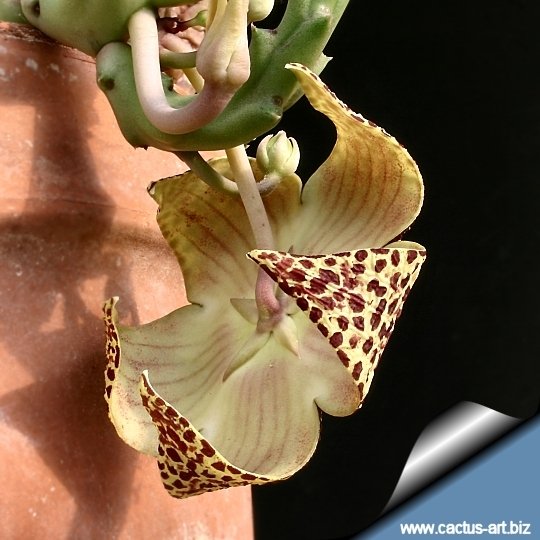
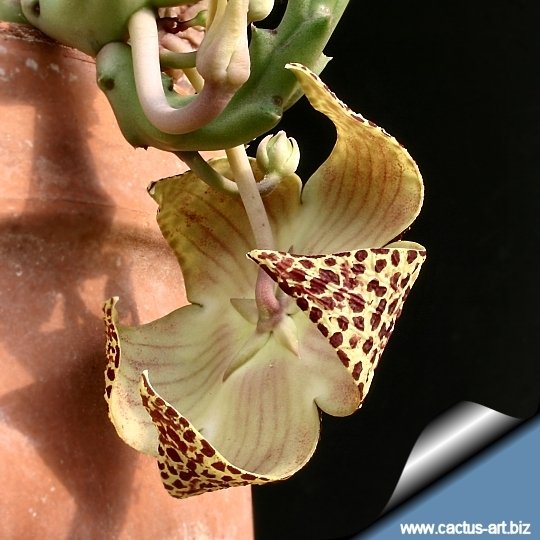
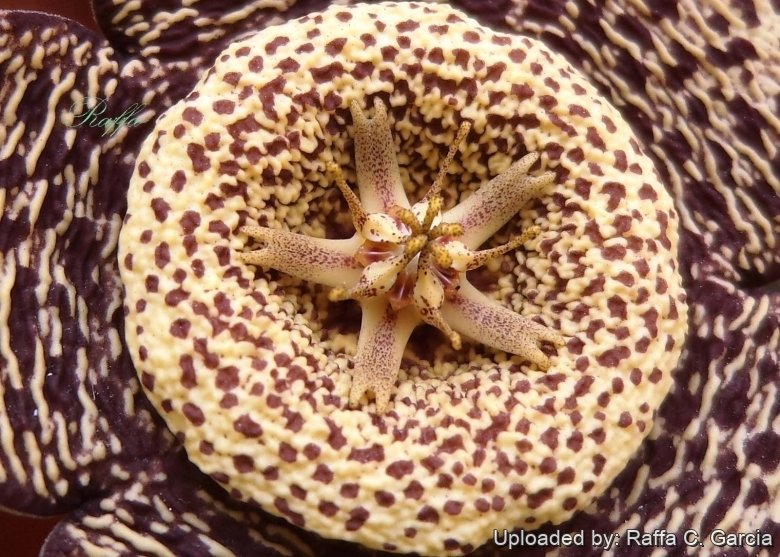
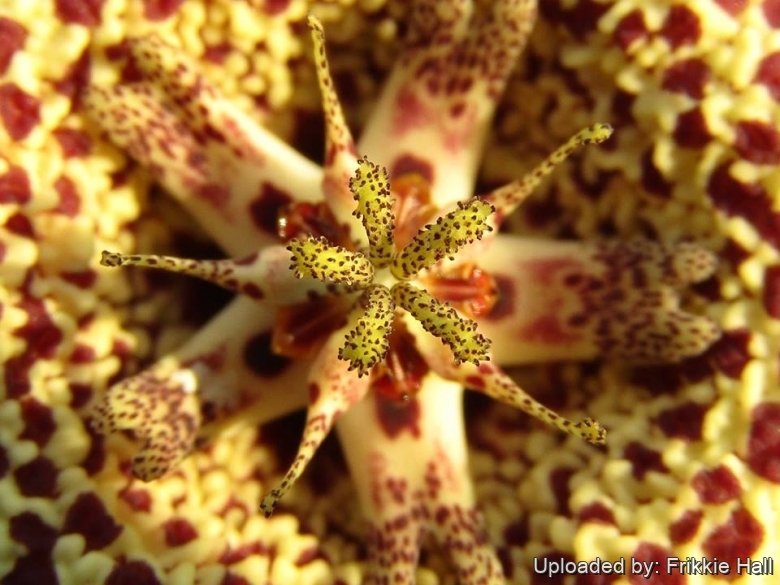
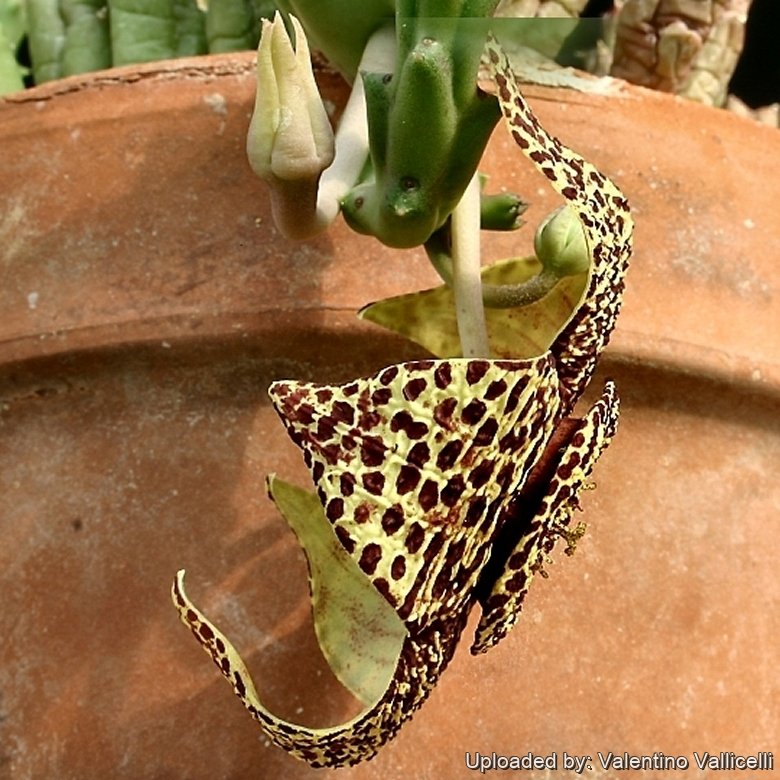
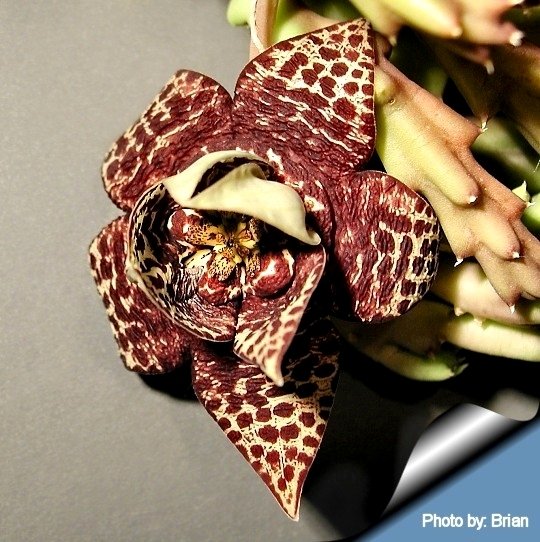
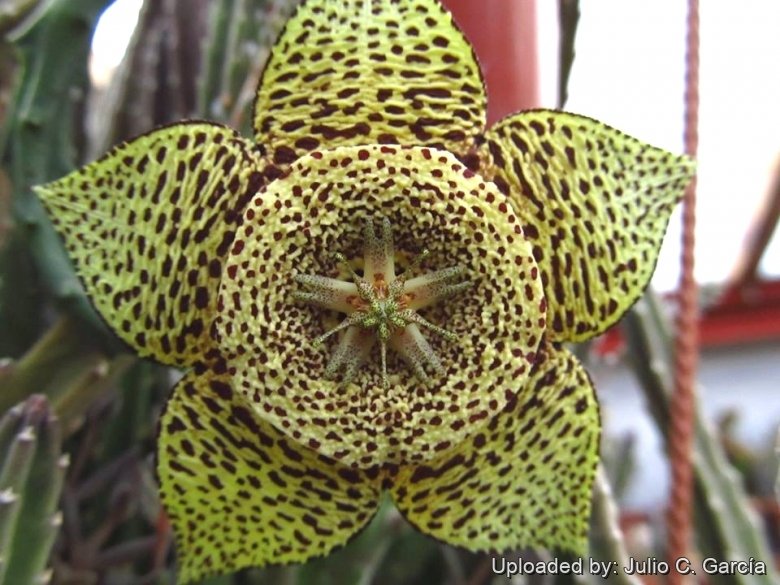
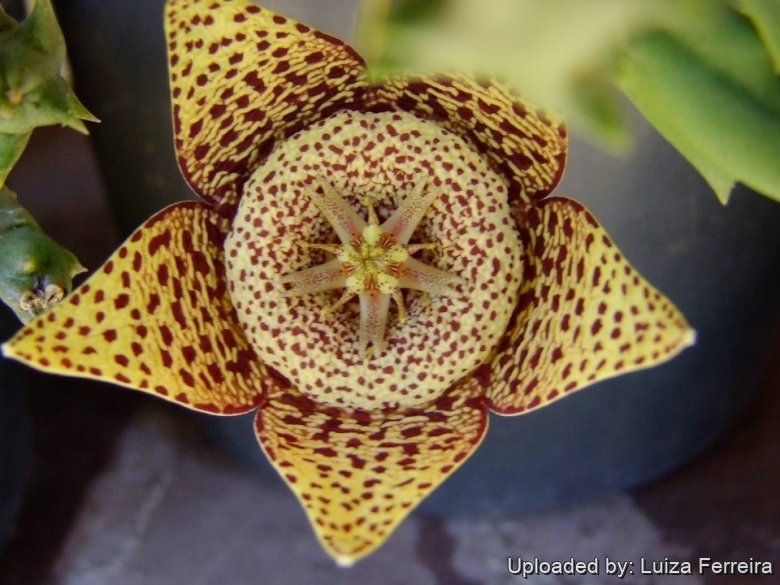
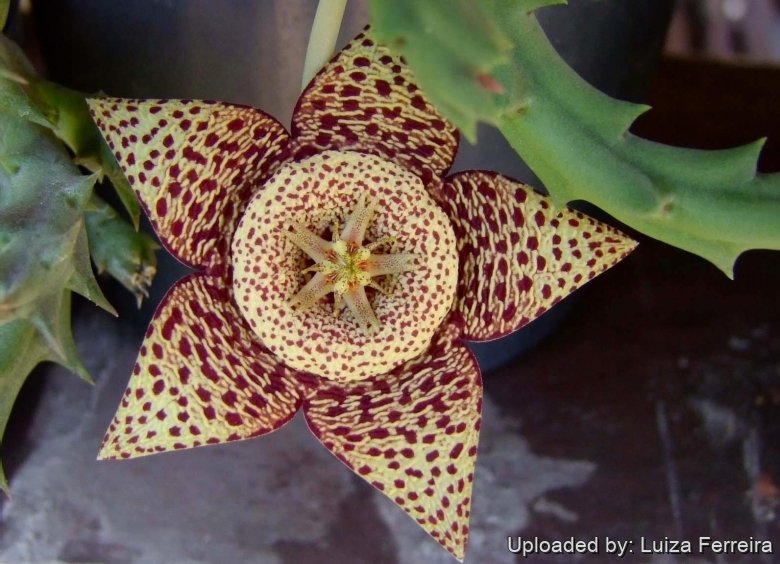
Flowers:* The typical flower is 5-7 cm across with 5 blunt lobes, starfish-like, attractively patterned or dusted with chocolate/purple, brown/bronze blotches on a greenish-yellow background, mostly in 6-7 rows or irregularly scattered, Corolla rugose, with a yellow central disc (annulus) speckled with dark spots.
Blooming season: Flowers coming in late summer or fall, have a light carrion smell. It is quite free flowering if in direct sunlight.
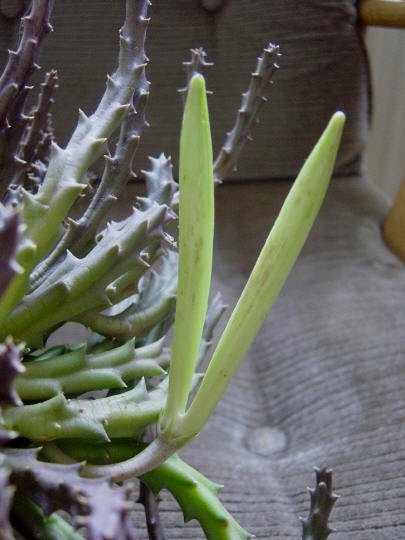
Fruits: The plant can readily set seed, after the fecundation the carpels develop long cylindrical fruits up to 12 cm long, these need to be contained when they ripen, because as soon as the fruit opens it liberate a cloud of flying seed provided whit a white feathery cotton fluff. The seeds can float from the pods and drift around the greenhouse on the slightest breeze.
Origin and Habitat
South Africa, Eastern Cape
Cultivation and Propagation
Orbea variegata is very easy to grow, it is the ideal plant for beginners.
Soil: Use a gritty, well-drained soil pH 7,5 to 8,5 (mildly alkaline).
Exposure: It needs Light shade to full sun (but tolerate shadow).
Temperature: It is very resistant to heat, and will also tolerate quite cold temperatures and light frost too (in good condition), best in a ventilated environment.
Moisture: Water regularly during the growing season, keep dry in winter.
Pests and diseases: It is quite resistant to the “Balck spot” disease of Asclepiads.
Propagation: It is easily propagated by removing a cutting, sometimes with roots attached, in spring and summer, But seeds germinate readily if they are sown when fresh.
Notes
Orbea variegata is almost certainly the most common Asclepiad in cultivation, even if it is still often seen under its earlier name of Stapelia variegata. (name given by Linnaeus) nowadays it is possible to find plants with both names in collections. And for the reason of the variability of the species, many could believe they have two different genera represented.
It is the first Stapelia that has reached Europe, it was introduced into cultivation in 1639, It arrived through a collection by the missionary Justus Heurnius. It is extremely variable, everything about this species is variable – size, shape, colour, corona, stems, habit; it is almost impossible to find two plants that are exactly identical one to each other. Earlier there were close to 50 varieties listed but all have now been taken back into the single species
Bibliography
Major references and further lectures
-
Focke Albers und Ulli Meve (Hrsg.): “Sukkulenten-Lexikon” Volume 3 Asclepiadaceae” Ulmer, Stuttgart 2002
-
White & Sloane. “The Stapelieae” edn 2. Abbey San Encino Press, 1937
-
Golding, J.S. “Southern African Plant Red Data Lists.” Southern African Botanical Diversity Network Report No. 14. SABONET. Pretoria. Page 162. (ed.) 2002
-
James Cullen, Sabina G. Knees, H. Suzanne Cubey “The European Garden Flora Flowering Plants: A Manual for the Identification of Plants Cultivated in Europe, Both Out-of-Doors and Under Glass” Cambridge University Press, 11/Aug/2011
-
Carl August Lückhoff “The stapelieae of Southern Africa” A. A. Balkema, 1952
-
Doreen Court “Succulent Flora of Southern Africa” A.A. Balkema, 2000
-
Hermann Jacobsen “A handbook of succulent plants: descriptions, synonyms, and cultural details for succulents other than Cactaceae” Blandford Press, 1960
-
Bruyns, P.V. “Stapeliads of Southern Africa and Madagascar” Volume I Umdaus Press, Hatfield, South Africa Pages 257 - 259 2005
-
Raimondo, D. 2008. Orbea variegata (L.) Haw. National Assessment: Red List of South African Plants version 2014.1. Accessed on 2015/02/12
From llifle page Orbea lepida
Description
Orbea lepida (syn= Stapelia lepida) is a fleshy-stemmed, perennial succulent member of the Asclepiadaceae family very like Orbea variegata, but the branches are green not glaucescent, and its flowers are very much smaller and have a different appearance. Pedicels usually twin. Corolla greenish yellow to sulphur-yellow with purple-brown dots with a paler circular bulge (or annulus) around the corona scattered with smaller purple spots. Outer branch of inner corona subulate acute inner one obtuse. However it is hard to tell apart one from the other by body characteristic. In accordance with the variability of the species Orbea lepida is invalid and nowadays considered as a synonym of Orbea variegata.
Habit: Compactly branched, glabrous in all parts, it form small clumps or mats.
Stems: 5-7.5 cm long, 8-10 mm thick, glabrous.
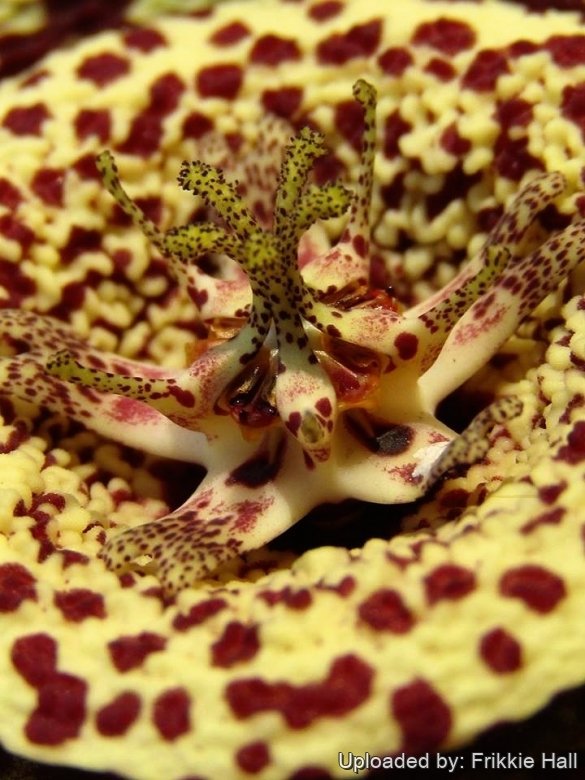
**Flowers:*** 1–2 together near the base of the stems, successively developed. Pedicels 18-25 mm long. Sepals 4-5 mm long, ovate, acute or acuminate. Corolla rather small, about 3.5-4 cm in diameter, with a distinct annulus on the disk; inner face transversely rugose on the lobes, granulate-tuberculate on the annulus, glabrous and not ciliate, sulphur-yellow, covered with rather small irregularly scattered dark purple-brown spots, without intermingling lines, those on the paler annulus smaller than those on the lobes, which are about 12 mm long, broadly ovate, acute; annulus with a recurved-spreading acute margin. Outer corona-lobes 3 mm long, 1.5-2 mm broad, oblong, emarginate or bifid, sometimes with a minute tooth at the base of the notch, very pale, greenish or greenish-yellow, with or without a central suffused and dotted stripe extending to about 2/3 of the way up or some dots around the teeth. Inner corona-lobes 2-horned, pale yellow or greenish, with or without purple-brown dots; inner horn 3-3.5 mm long, erect, recurving at the slightly clavate apex; outer horn ascending-spreading, half as long as the inner or shorter, subulate.
Origin and Habitat
South Africa. Orbea lepida was raised from seed sent from South Africa by Scholl (ex Jacquin), cultivated specimens!
Cultivation and Propagation
Orbea lepida is very easy to grow, it is the ideal plant for beginners.
Soil: Use a gritty, well-drained soil pH 7,5 to 8,5 (mildly alkaline).
Exposure: It needs Light shade to full sun (but tolerate shadow).
Temperature: It is very resistant to heat, and will also tolerate quite cold temperatures and light frost too (in good condition), best in a ventilated environment.
Moisture: Water regularly during the growing season, keep dry in winter.
Pests and diseases: It is quite resistant to the “Balck spot” disease of Asclepiads.
Propagation: It is easily propagated by removing a cutting, sometimes with roots attached, in spring and summer, But seeds germinate readily if they are sown when fresh.
Bibliography
Major references and further lectures
-
N. E. Brown. “Flora Capensis”, Vol 4, 1909
-
George Don “A General System of Gardening and Botany” Rivington, 1838
Source: Orbea lepida, LLIFLE - Encyclopedia of living forms, CC-BY-SA, retrieved 2026-10-26.
Gallery