Publication: Aloe 37(4): 76. 2000
Description
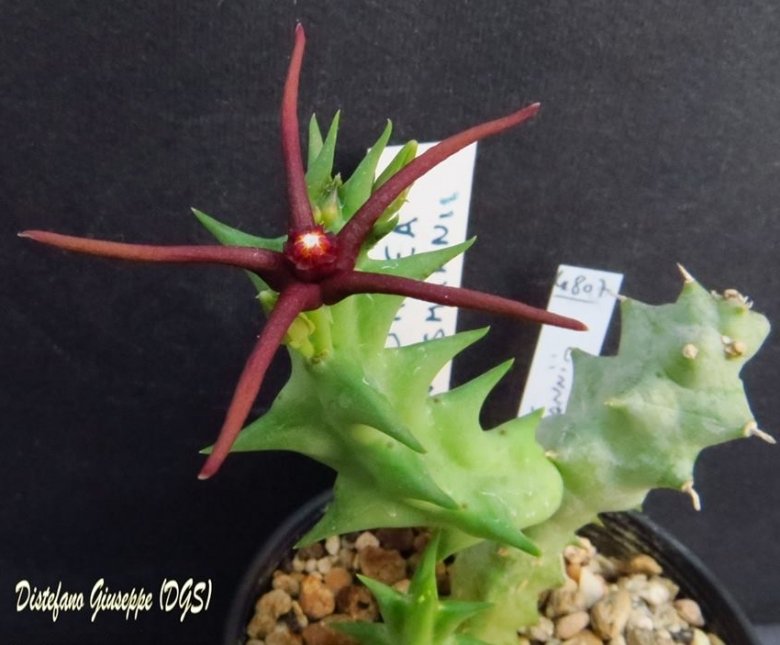
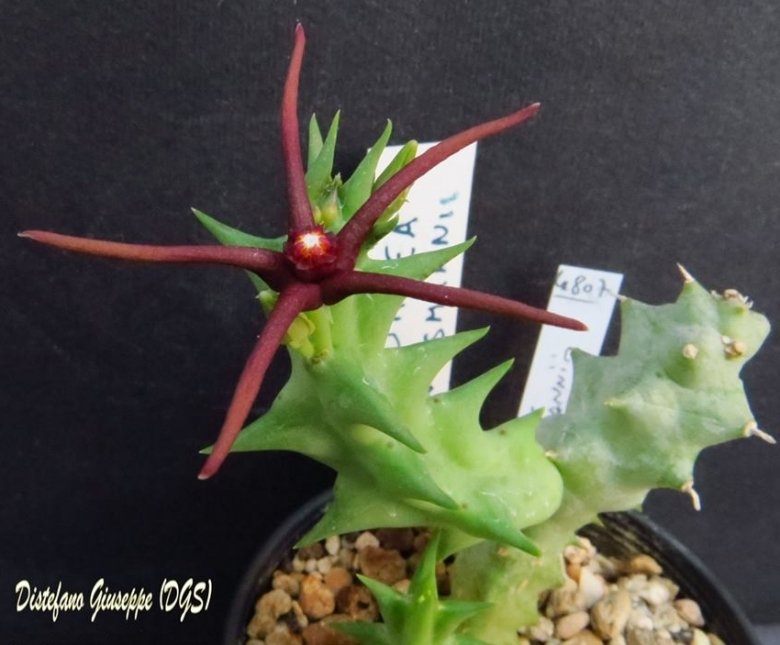
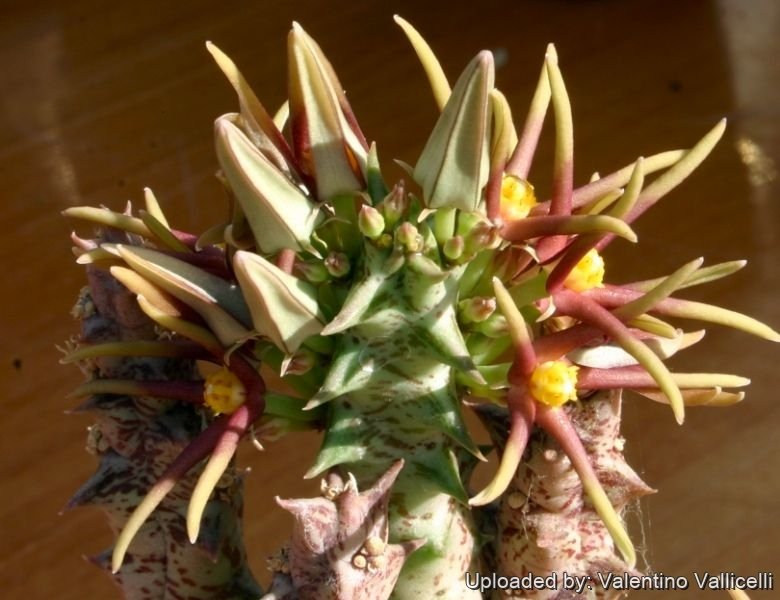
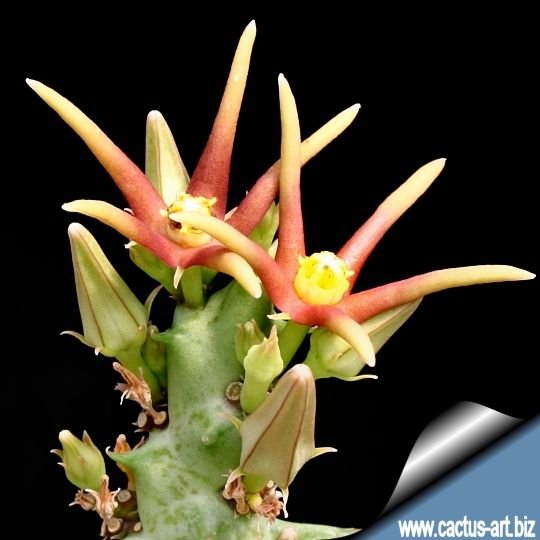
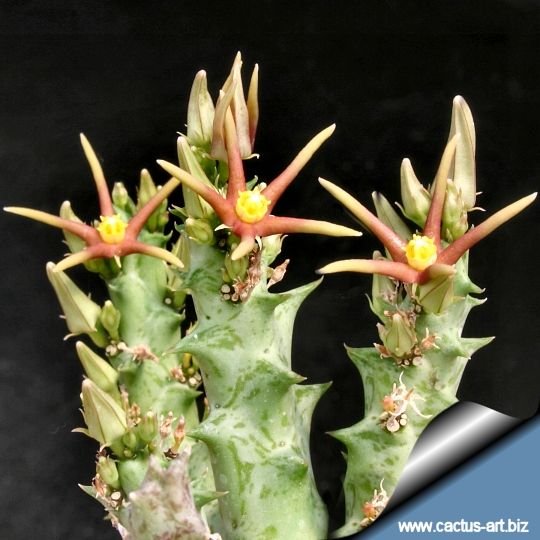
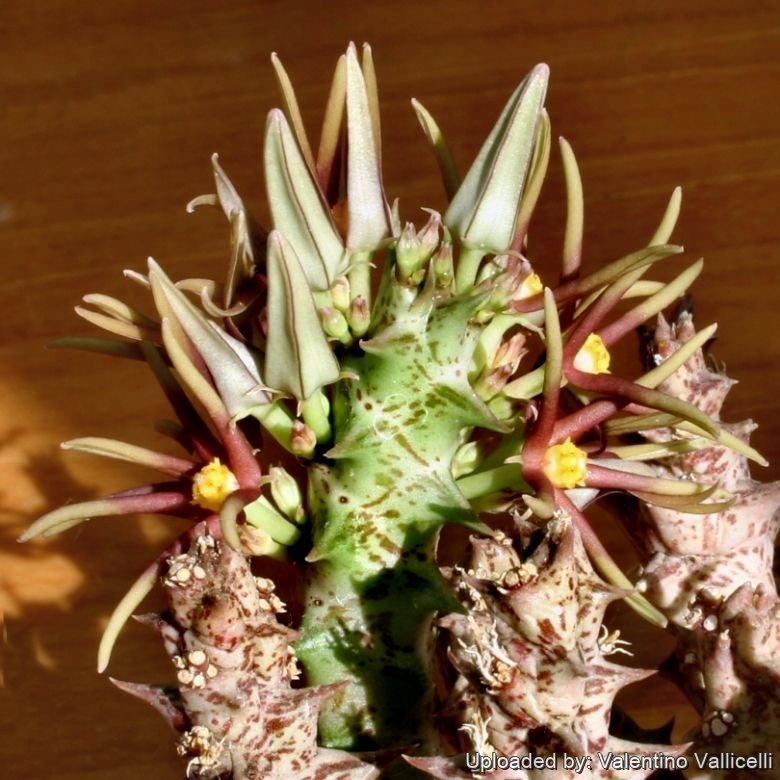
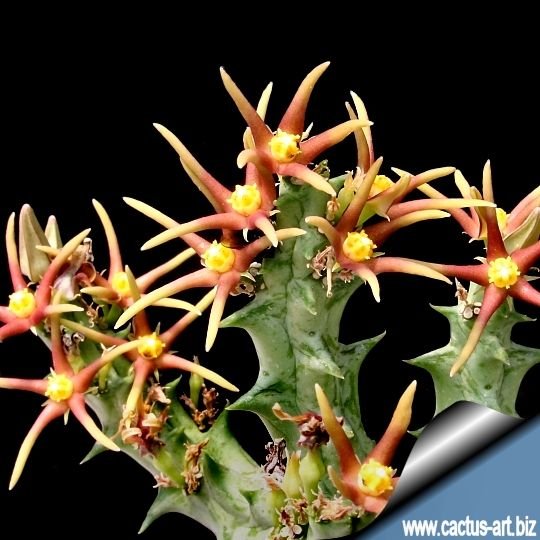
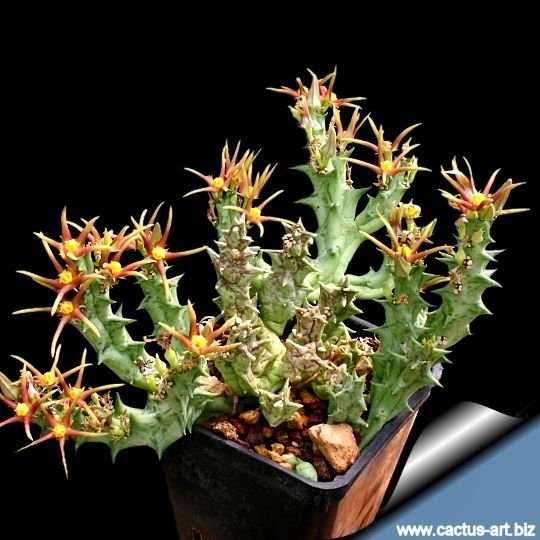
Orbea wissmanii (formerly known as Caralluma wissmannii or Angolluma wissmanii) is a low growing succulent species with erect four-angled stems 7 cm tall, these pale and dark green dappled and soft-toothed. It spreads over the ground forming large crowded, cushions up to 1 metre across. The flowers are five-pointed fleshy stars produced in late Summer or Autumn, they are variable in appearance and range from brick-red to yellow, but are frequently bicoloured, with the base of the lobes being reddish, and which merges gradually into yellow on the the apical half. O. wissmannii is quite distinct from Angolluma baldratii (now Orbea baldratii), with which it had been widely confused in collections, by the other hand there seems little doubt that the formerly Angolluma meintjesiana is conspecific with O. wissmannii.
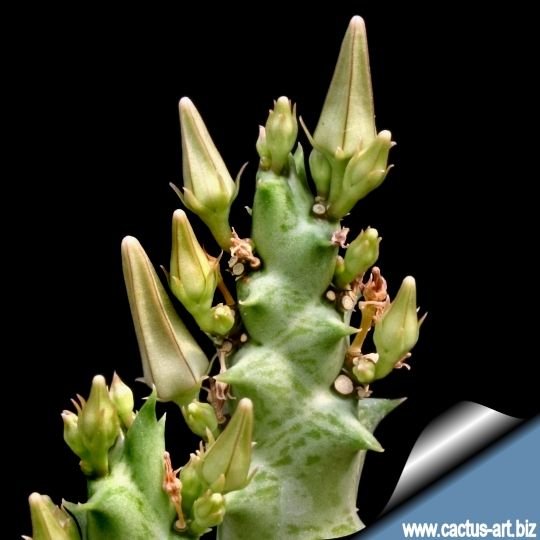
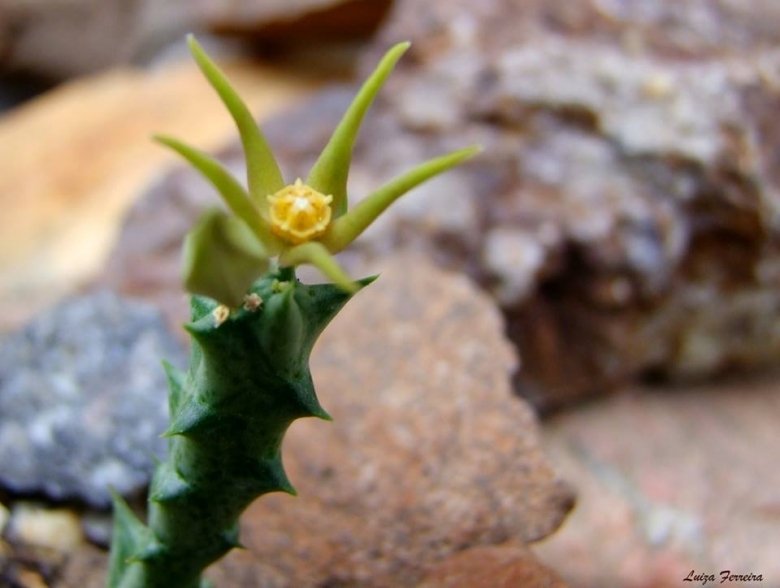
Stems: Soft, erect or ascending, rooting from the bases, 4-angled, with soft- spinous projection at the angles. Surface smooth, light green, grey-green or dark green mottled with brownish or purple.
Flowers: The pedicellate flowers are borne singly or in pairs (rarely more) in short inflorescences. Star-shaped, about 20-25 cm in diameter. Corolla lobes narrow, almost linear, 12-20 mm long and more than 3 mm wide, strongly longitudinally folded back, glabrous or covered with short papillae, mostly brownish-red at the base and golden-yellow to bright-yellow towards their apex, but very variable in colour. Corona bright yellow 3-4 mm tall x 3-4 mm in diameter. Buds narrow.
Blooming season: This species produces numerous flowers simultaneously in late summer to autumn. Flowers exude a vague to intense smell of cat urine. This perfume attracts blow flies which are the natural pollinators. Following successful pollination of flowers pairs of seed horns are produced, packed with seeds attached to silky parachutes.
Origin and Habitat
Orbea wissmanii is rather common in the highlands from Asir, Saudi Arabia to Dhofar, Oman and Yemen.
Type locality: Yemen. Pass between Jebel Shibam and Jebel Dhulwa 2400-2800 m
Altitude range: This species occurs at high elevations (c. 2000 m)
Habitat and ecology: This species grows on bare rocky slopes often among boulders or under Commiphora and Anisotes shrubs.
Cultivation and Propagation
Orbea wismannii is an easy blooming plant when mature that require moderately watering through the growing season but enjoy plenty of water and some fertiliser in hot weather, this helps them to flower freely. Water more sparingly in winter according to temperatures. But, as with most asclepiads, it is unwise to leave them wet in cold weather. Winter care presents no problems at 5°C with plenty of light. Since roots are quite shallow, use a cactus mix or add extra perlite or pumice to regular soil potting soil. A gritty, very free-draining compost is suitable, and clay pots help the plants to dry out between watering.
Sun Exposure: Partial sun or light shade
Pest and diseases: Orbeas vary in their susceptibility to rotting, but are generally fairly easy to grow, especially if kept pest-free. They are very susceptible to stem and root mealy bugs, and damage from these may well initiate fungal attack. If you do have problems with a stem or with basal rotting, you can reliably isolate the healthy parts, dry them off, and re-root them in moist compost.
Cultural Practices: Re-pot every 2 years
Propagation: Easiest with stem cuttings. Allow cuttings to dry a day before planting. Stems must be laid (Not buried) on gritty compost and will then root from the underside of the stems. It can also be increased from seeds sowing in spring in moist, sandy peat moss.
Potting medium: Since roots are quite shallow, use a cactus mix or add extra perlite or pumice to regular soil potting soil. A gritty, very free-draining compost is suitable, and clay pots help the plants to dry out between watering.
Bibliography
Major references and further lectures
-
Shaukat Ali Chaudhary, ʻAbd al-ʻAzīz ʻAbbās Juwayd, Markaz al-Waṭanī li-Abḥāth al-Zirāʻah wa-al-Miyāh (Saudi Arabia), Saudi Arabia. Wizārat al-Zirāʻah wa-al-Miyāh al-Markaz al-Waṭanī li-Abḥāth al-Zirāʻah wa-al-Miyāh, Wizārat al-Zirāʻah wa-al-Miyāh, al-Mamlakah al-ʻArabīyah al-Saʻūdīyah, “Vegetation of the Kingdom of Saudi Arabia” 1999
-
Sheila Collenette “An illustrated guide to the flowers of Saudi Arabia” Scorpion, 1985
-
John Hunter Thomas “Systematic Botany Monographs” American Society of Plant Taxonomists, 2002
-
S.A. Ghazanfar, M. Fisher “Vegetation of the Arabian Peninsula” Springer, 31/August/1998
From llifle page Caralluma meintjesiana
Description
Caralluma meintjesiana (now transferred to Orbea wissmanii by Bruyns) is a low clumping succulent species that spread over the ground forming large cushions. Flowers are five-pointed fleshy stars produced in late Summer or Autumn.
Stems: Soft, erect or ascending, rooting from the bases, 4-angled, with conical teeth along each angle. Surface smooth, light green, grey-green or dark green mottled with brownish or purple.
Flowers: Numerous, subapical, 1 to 3 (rarely more) in short inflorescences. Star-shaped about 2 cm in diameter. Corolla lobes narrow, almost linear, mostly light green with a blood red centre but very variable in colour.
Blooming season: Produces numerous flowers simultaneously in late summer to autumn. Flowers exude an intense smell of cat urine. This perfume attracts blow flies which are the natural pollinators. Following successful pollination of flowers pairs of seed horns are produced, packed with seeds attached to silky parachutes.
Origin and Habitat
Saudi Arabia, Yemen, Oman.
Altitude: This species occurs at high elevations (c. 2000-2800 metres above sea level)
Habitat: It grows in semidesert regions in rock fissures along with other succulents like as: Euphorbia fruticosa and Aloe vacillans. Caralluma meintjesiana is camuflaged down to minutest detail and at the first glance quite similar to the background.
Cultivation and Propagation
Caralluma meintjesiana (= Orbea wissmannii) is an easy blooming plant when mature that require moderately watering through the growing season but enjoy plenty of water and some fertiliser in hot weather, this helps them to flower freely. Water more sparingly in winter according to temperatures. But, as with most asclepiads, it is unwise to leave them wet in cold weather. Winter care presents no problems at 5°C with plenty of light. Since roots are quite shallow, use a cactus mix or add extra perlite or pumice to regular soil potting soil. A gritty, very free-draining compost is suitable, and clay pots help the plants to dry out between watering.
Sun Exposure: Partial sun or light shade
Pest and diseases: Orbeas vary in their susceptibility to rotting, but are generally fairly easy to grow, especially if kept pest-free. They are very susceptible to stem and root mealy bugs, and damage from these may well initiate fungal attack. If you do have problems with a stem or with basal rotting, you can reliably isolate the healthy parts, dry them off, and re-root them in moist compost.
Cultural Practices: Re-pot every 2 years
Propagation: Easiest with stem cuttings. Allow cuttings to dry a day before planting. Stems must be laid (Not buried) on gritty compost and will then root from the underside of the stems. It can also be increased from seeds sowing in spring in moist, sandy peat moss.
Potting medium: Since roots are quite shallow, use a cactus mix or add extra perlite or pumice to regular soil potting soil. A gritty, very free-draining compost is suitable, and clay pots help the plants to dry out between watering.
Bibliography
Major references and further lectures
- S.A. Ghazanfar, M. Fisher “Vegetation of the Arabian Peninsula” Springer, 31/Aug/1998
Source: Caralluma meintjesiana, LLIFLE - Encyclopedia of living forms, CC-BY-SA, retrieved 2026-10-25.
From llifle page Angolluma parviloba
Description
Orbea wissmannii subsp. parviloba is similar to subsp. wissmannii but has thinner corolla lobes.
Distinguishing features: The corolla lobes are inside yellow, yellow suffused with red, or red and yellow. The corona is yellow (sometime tinged with red), with outer lobes forming a pouch. The pedicels is 5-10 mm long. The corolla lobes are 9-10 mm long and less than 2 mm wide (more than 3 mm wide in subsp. wissmannii), pale yellow and are covered with white hairs. The corona is 1.5-2 mm tall and 2.5 mm across.
Origin and Habitat
Yemen.
Cultivation and Propagation
Orbea wismannii var. parviloba is an easy blooming plant when mature that require moderately watering through the growing season but enjoy plenty of water and some fertiliser in hot weather, this helps them to flower freely. Water more sparingly in winter according to temperatures. But, as with most asclepiads, it is unwise to leave them wet in cold weather. Winter care presents no problems at 5°C with plenty of light. Since roots are quite shallow, use a cactus mix or add extra perlite or pumice to regular soil potting soil. A gritty, very free-draining compost is suitable, and clay pots help the plants to dry out between watering.
Sun Exposure: Partial sun or light shade
Pest and diseases: Orbeas vary in their susceptibility to rotting, but are generally fairly easy to grow, especially if kept pest-free. They are very susceptible to stem and root mealy bugs, and damage from these may well initiate fungal attack. If you do have problems with a stem or with basal rotting, you can reliably isolate the healthy parts, dry them off, and re-root them in moist compost.
Cultural Practices: Re-pot every 2 years
Propagation: Easiest with stem cuttings. Allow cuttings to dry a day before planting. Stems must be laid (Not buried) on gritty compost and will then root from the underside of the stems. It can also be increased from seeds sowing in spring in moist, sandy peat moss.
Potting medium: Since roots are quite shallow, use a cactus mix or add extra perlite or pumice to regular soil potting soil. A gritty, very free-draining compost is suitable, and clay pots help the plants to dry out between watering.
Bibliography
-
Bruyns, P.V. 1000. “New combinations in the genus Orbea.” Aloe 37(4): 71-76.
-
Bruyns, P.V. 2.002. “Monograph of Orbea and Ballyanthus (Apocynaceae-Asclepidoideae-Ceropegiae).” Syst. Bot. Monographs 63: 1-196.
-
Collenatte, S. 1999. “Wildflowers of Saudi Arabia.” National Commission for Wildlife Conservation and Development (NCWCD). Kingdom of Saui Arabia.
-
Meve, U. 2.009a. “Taxonomic changes in Arabian taxa of Orbea Haw. (Ceropegiae)”. Asklepios 105: 19-11.
-
Meve, U. wo9b. “Correction: Orbea nardii precedes Orbea wissmannii var. parviloba.” Asklepios io6: 12..
-
Miller, A.G., Morris, M. 1988. “Plants of Dhofar.” The Office of The Adviser for Conservation of the Environ-ment, Diwan of Royal Court. Sultanate of Oman.
-
Mosti S., Raffaelli M. “Re-evaluation of Orbea nardii and 0. wissmannii var. parviloba, including infraspecific reclassification of 0. wissmannii” Asklepios 110/2011
-
Pilbeam, J. 2010. “Stapeliads.” British Cactus & Succulent Society. UK.
-
Plowes, D. 2.010. “When is a Caralluma not a Caralluma?” Asklepios 107: 3-2.2.
-
Raffaelli, M., Mosti, S., Tardelli, M. 2.008. “Apocynaceae of Oman : Orbea nardii, sp. nov. and Pentatropis bentii, first finding.” Webbia 63(1): 161-167.
-
John Hunter Thomas “Systematic Botany Monographs” American Society of Plant Taxonomists, 2002
Source: Angolluma parviloba, LLIFLE - Encyclopedia of living forms, CC-BY-SA, retrieved 2026-10-25.
Cultivars and forms (2)
Subspecies (1)
Varieties (1)
Gallery