Publication: Bradleya 5: 93 (1987)
Description
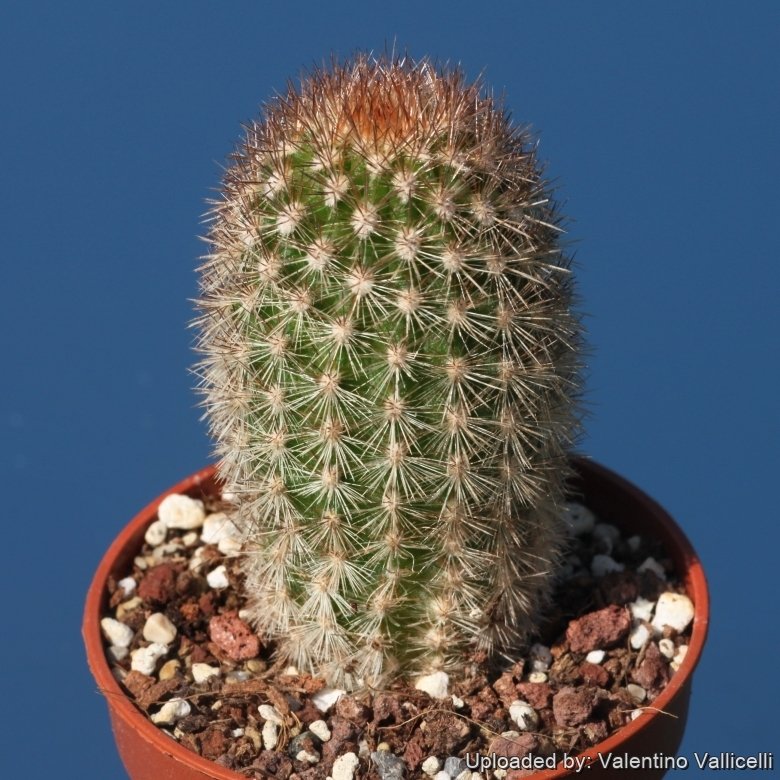
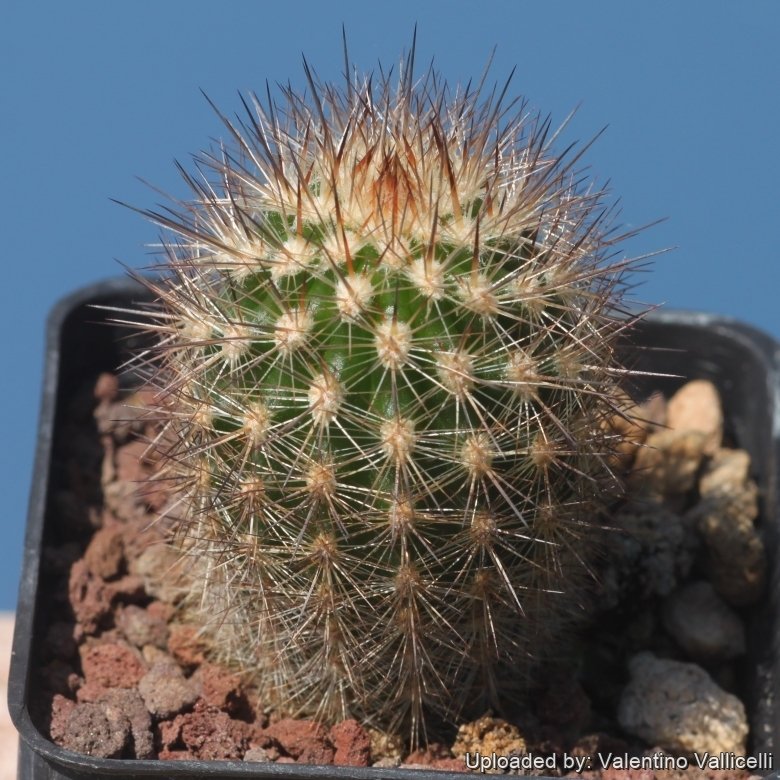
Oreocereus hempelianus (Best known as Arequipa hempeliana), is a short cylindrical cactus with dense short brown spines and bright purple/red flowers when mature. This species is quite variable in spination and has received numerous unnecessary names of no botanical value, representing no more than local phenotypes.
Habit: Simple or clustering from base with age.
Stem: Spherical at first becoming elongated and eventually short-cylindric with age, erect or decumbent up to 30-40 (rarely 60) cm tall, 10-15 cm across, usually greyish-green or glaucous green.
Ribs: 10-20 flattened and large, 5-15 mm distant.
Spines: Very variable yellow to reddish, becoming dull grey.
Central spines: (1-)3-6(-10), up to 5 cm often curved, whitish, brown or nearly black, flexible.
Radial spines: (8-)10-15(-30), 1-3 cm long, needle-like to finely bristle-like, diverging, yellowish to glassy white.
Flowers: Arising near apex, 5-7,5 cm long, 2,5-3,5 cm across, scarlet to purplish red, tube slightly curved, open to one side, the scales densely and softly hairy in the axil, limb more or less oblique, the segments acute.
Fruit: Barrel shaped to ovoid about 1,5-2,5 cm in diameter, yellowish, thin-walled, opening basally.
Origin and Habitat
Mountains of South Peru (Arequipa, Moquegua and Tacna) and north Chile (Arica y Parinacota and Tarapacá)
Altitude range: 2,500 to 3,500 metres above sea level.
Habit: The species grows in Andean shrubland on rocky and sandy soils where is locally abundant and frequent. A portion of the southern subpopulation (Oreocereus australis) is threatened by the construction of a dam. Illegal extraction at a local level is a minor threat.
Cultivation and Propagation
This is a a much decorative frost hardy cactus easily found in cultivation.
Soil: Grow it in a rich and particularly draining substratum, as it is very sensitive to rottenness when in presence of humidity and low temperatures and let the soil dry out between waterings.
Water: In summer, during the vegetative period, it must be regularly watered, but allowing the substratum to completely dry up before irrigating again; in winter, it’s to be kept dry. Preferable not to water on overcast days, humid days or cold winter days.
Hardiness: Hardy to -7°, but tolerate temperatures down to -12° C for short periods if very dry. However in cultivation it is better not to expose it to below zero temperatures, especially if in presence of high atmospheric humidity as it is particularly sensitive to root rot. However in cultivation it is better not to expose it to temperatures lower than -5° C, even if in an aerated and protected location, in order to avoid the formation of anti-aesthetic spots on the epidermis.
Exposure: It need full sun exposures with ample airflow to produce dense hairs, but, as a former mountain dweller, does not care for extremely high temperatures in summer.
Maintenance: Repot in the spring, when their roots become cramped. Generally, they should be repotted every other year in order to provide fresh soil. After repotting, do not water for a week or more.
Use: Excellent as landscape or patio plant. It is suitable for small “desert” gardens, in association with other xerophytes. Where the open air cultivation is not possible due to the climate, it is to be cultivated in pot in order to shelter it in winter.
Propagation: By seeds and by cuttings, provided left drying up well, in summer.
Bibliography
Major references and further lectures
-
Edward Anderson “The Cactus family” Timber Press, Incorporated, 2001
-
James Cullen, Sabina G. Knees, H. Suzanne Cubey “The European Garden Flora Flowering Plants: A Manual for the Identification of Plants Cultivated in Europe, Both Out-of-Doors and Under Glass” Cambridge University Press, 11/Aug/2011
-
David R Hunt; Nigel P Taylor; Graham Charles; International Cactaceae Systematics Group. “The New Cactus Lexicon” dh books, 2006
-
Urs Eggli, Leonard E. Newton: “Etymological Dictionary of Succulent Plant Names” Springer, Berlin/Heidelberg 2010
-
Willy Cullmann, Erich Götz (Dozent Dr.), Gerhard Gröner “The encyclopedia of cacti” Timber Press, 1987
-
E Haustein “Der Kosmos Kakteenfuehrer (the Kosmos Cactus Guide)” Balogh Scientific Books, United States, 01/Dec/1998
-
Cáceres, F., Faundez, L., Guerrero, P., Saldivia, P. & Walter, H.E. 2013. Oreocereus hempelianus. In: IUCN 2013. “IUCN Red List of Threatened Species.” Version 2013.2. <www.iucnredlist.org>. Downloaded on 05 December 2013.
From llifle page Arequipa rettigii
Description
Oreocereus rettigii (Quehl) Buxb. (firstly described as Echinocactus rettigii Quehl by Quehl in 1919) is a local or morphological form of the widespread and variable Oreocereus hempelianus. It is covered with many coloured spines and has tubular red flowers with oblique edges and spiny bases. The plants grow in isolated patches with hairy branches about 30 cm high. Old reclining stems at times attain a length of a meter. Flowers and mature fruits are often found together. The plant is quite variable but probably consists of a single species with many forms and its characteristics appear to fall within the natural variation of Oreocereus hempelianus, so it should be synonymized with the latter. The several varieties that have been described are forms of the same species.
Origin and Habitat
Mountains of South Peru (Arequipa) and adjacent areas in north Chile
Altitude range: Around 1,500 to 3,000 metres above sea level.
Habitat and ecology: The species grows in Andean shrubland on rocky and sandy soils where is grows in isolated patches and is locally abundant. Weberbaaeroccreus weberbaueri and Tephrocactus sphaericus are also found here.
Bibliography
Major references and further lectures
-
Cactaceas y suculentas mexicanas, Volumi 9-16, page 98 Sociedad Mexicana de Cactología., 1964
-
James Cullen, Sabina G. Knees, H. Suzanne Cubey “The European Garden Flora Flowering Plants: A Manual for the Identification of Plants Cultivated in Europe, Both Out-of-Doors and Under Glass” Cambridge University Press, 11/Aug/2011
-
David R Hunt; Nigel P Taylor; Graham Charles; International Cactaceae Systematics Group. “The New Cactus Lexicon” dh books, 2006
-
Urs Eggli, Leonard E. Newton: “Etymological Dictionary of Succulent Plant Names” Springer, Berlin/Heidelberg 2010
-
Willy Cullmann, Erich Götz (Dozent Dr.), Gerhard Gröner “The encyclopedia of cacti” Timber Press, 1987
-
Edward Anderson “The Cactus family” Timber Press, Incorporated, 2001
-
Cáceres, F., Faundez, L., Guerrero, P., Saldivia, P. & Walter, H.E. 2013. Oreocereus hempelianus. In: IUCN 2013. “IUCN Red List of Threatened Species.” Version 2013.2. <www.iucnredlist.org>. Downloaded on 05 December 2013.
Source: Arequipa rettigii, LLIFLE - Encyclopedia of living forms, CC-BY-SA, retrieved 2026-10-25.
From llifle page Borzicactus hempelianus var. spinosissimus
Description
Arequipa spinosissima (Borzicactus hempelianus var. spinosissimus) is a local or morphological form of the widespread and variable Oreocereus hempelianus. It has more numerous spines (up to 10 centrals and up to 30 radials). More recent observations of the extent of variation in Oreocereus hempelianus populations has led many authors to conclude that the distinguishing characteristics of Arequipa spinosissima are not sufficiently distinct to deserve its own formal status. Arequipa spinosissima should be synonymized with O. hempelianus.
Habitat: It is a cylindrical cactus simple or clustering from base with age with dense short brown spines and bright purple/red flowers when mature.
Stem: Spherical at first becoming elongated and eventually short-cylindric with age, erect or decumbent up to 30-40 (rarely 60) cm tall, 10-15 cm across, usually greyish-green or glaucous green.
Ribs: 10-20 flattened and large, 5-15 mm distant.
Spines: Very variable yellow to reddish, becoming dull grey.
Central spines: (1-)3-6(-10), up to 5 cm often curved, whitish, brown or nearly black, flexible.
Radial spines: (8-)10-15(-30), 1-3 cm long, needle-like to finely bristle-like, diverging, yellowish to glassy white.
Flowers: Arising near apex, 5-7,5 cm long, 2,5-3,5 cm scross, scarlet to purplish red, tube slightly curved, open to one side, the scales densely and softly hairy in the axil, limb more or less oblique, the segments acute.
Fruit: Barrel shaped to ovoid about 1,5-2,5 cm in diameter, yellowish, thin-walled, opening basally.
Origin and Habitat
Mountains of South Peru (Arequipa, Ayacucho)
Altitude range: 800-2500 metres above sea level.
Habit: The species grows in Andean shrubland on rocky and sandy soils where is locally abundant and frequent. At lower altitudes it is often found growing together with Weberbauerocereus weberbaueri.
Source: Borzicactus hempelianus var. spinosissimus, LLIFLE - Encyclopedia of living forms, CC-BY-SA, retrieved 2026-10-25.
From llifle page Oreocereus culpinensis
Origin and Habitat
Culpina, Nor Cinti, Chuquisaca, Bolivia.
Source: Oreocereus culpinensis, LLIFLE - Encyclopedia of living forms, CC-BY-SA, retrieved 2026-10-25.
From llifle page Oreocereus giganteus
Origin and Habitat
Field number: KK893 Collector: Karel Kníže
Locality: Lecori, Bolivia
Altitude: 2800-3500m
Source: Oreocereus giganteus, LLIFLE - Encyclopedia of living forms, CC-BY-SA, retrieved 2026-10-25.
From llifle page Oreocereus lecoriensis
Origin and Habitat
Field number: KK 1334
Collector: Karel Kníže
Locality: Lecori, Bolivia
Altitude: 2500-2800 m a.s.l.
Source: Oreocereus lecoriensis, LLIFLE - Encyclopedia of living forms, CC-BY-SA, retrieved 2026-10-25.
From llifle page Oreocereus luribayensis
Origin and Habitat
Field number: KK1336, Collector Karel Kníže.
Locality: Luribay, Bolivia.
Altitude: 3000m a.s.l.
Source: Oreocereus luribayensis, LLIFLE - Encyclopedia of living forms, CC-BY-SA, retrieved 2026-10-25.
From llifle page Oreocereus magnificus
Origin and Habitat
Field number: RBC 43. Collectors Luis Alberto and Juan H. Ramírez Pinto.
Locality: Llocallas, Tomas Frias, Potosi, Bolivia.
Altitude: 3700m a.s.l.
Source: Oreocereus magnificus, LLIFLE - Encyclopedia of living forms, CC-BY-SA, retrieved 2026-10-25.