Publication: Anales Acad. Chilena Ci. Nat. no. 20: 102. 1956
Description
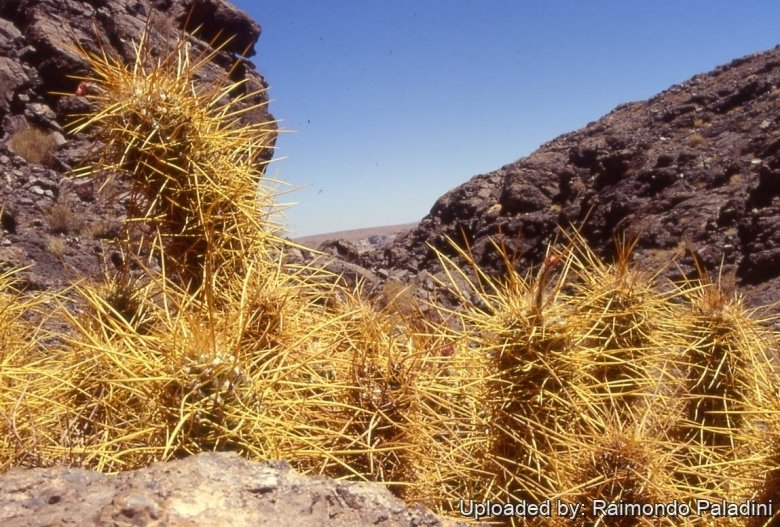
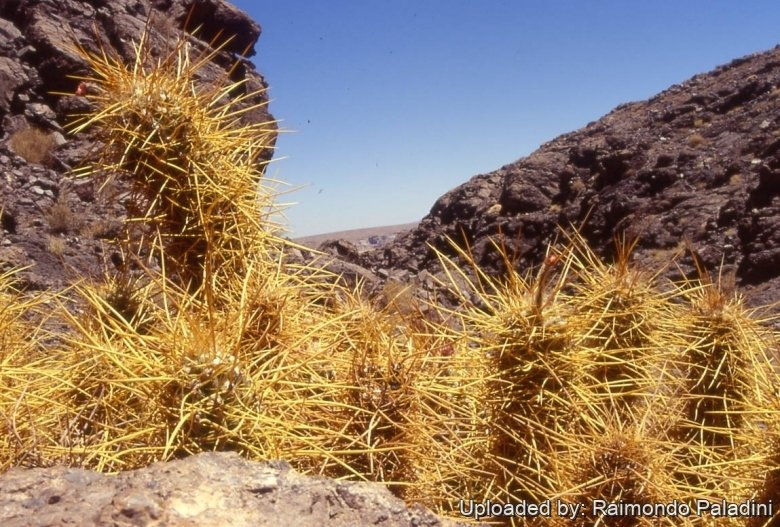
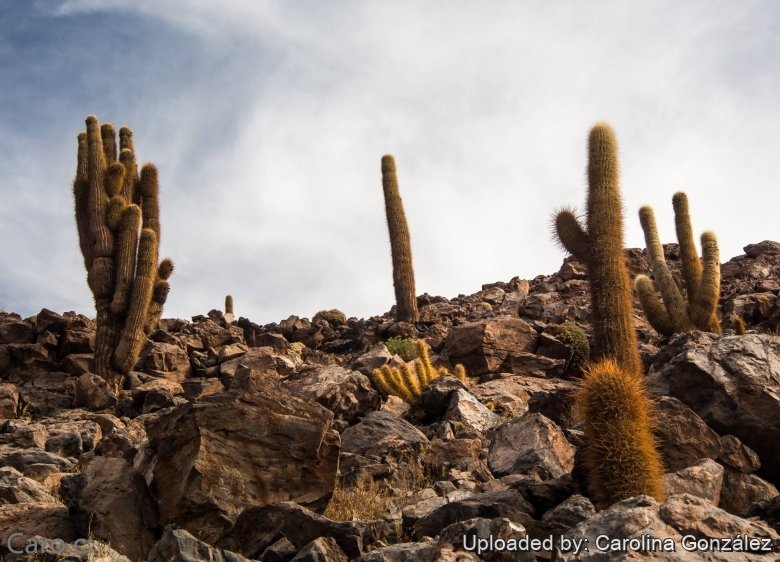
Oreocereus leucotrichus is a small shrubby columnar cactus, forming dense broad clumps covered in spines. It is a much variable species.
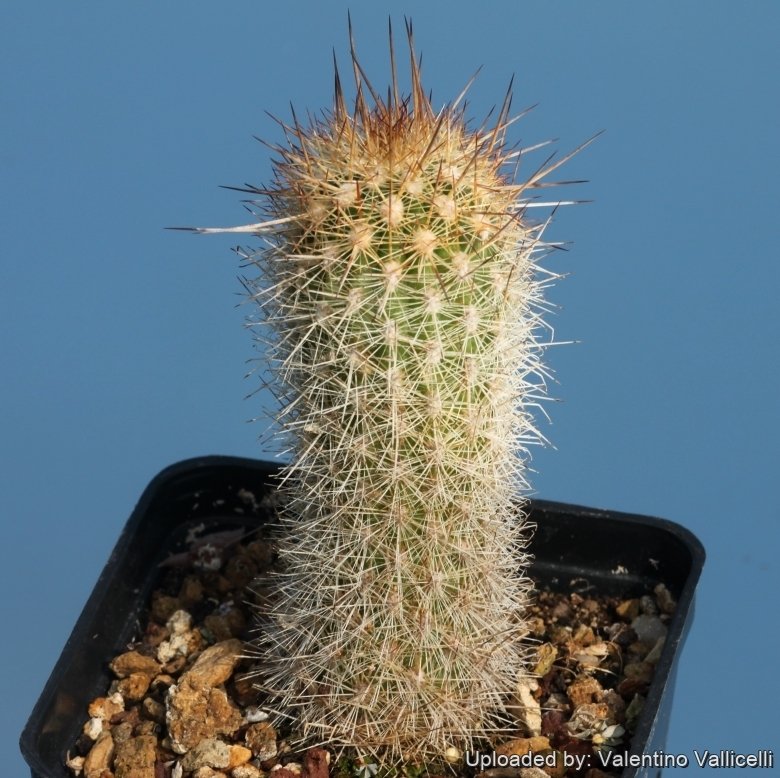
Stem: Solitary or (usually) branching basally, curved upward often prostrate and creeping, cylindrical with green to grey-green epidermis that grow to a height of approximately 60-200 cm, 6-12 cm in diameter.
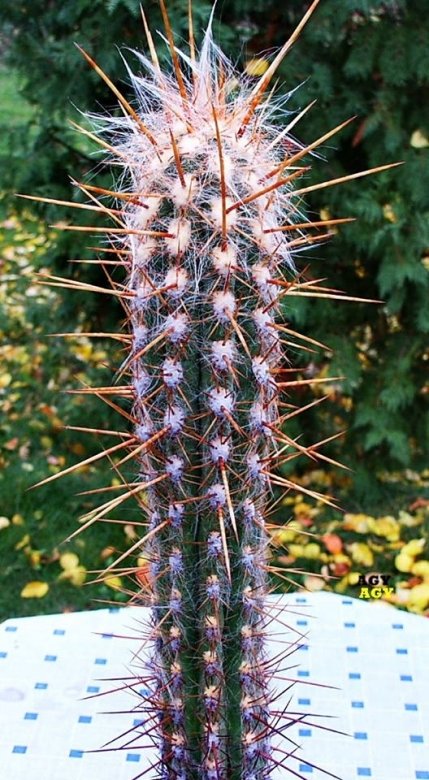
Ribs: 10 to 15(-20), closely set, flattened, with shallow cross-furrows.
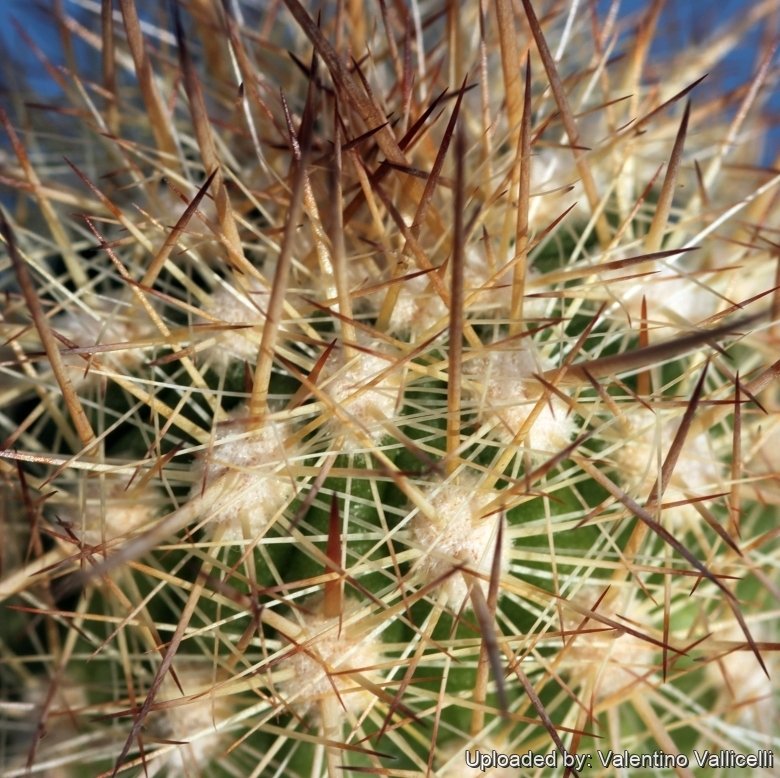
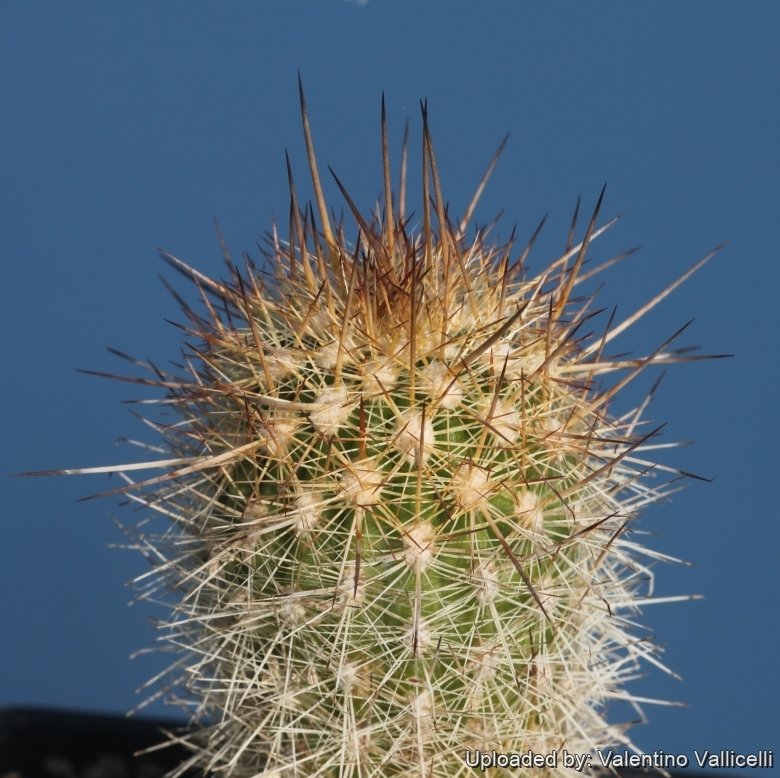
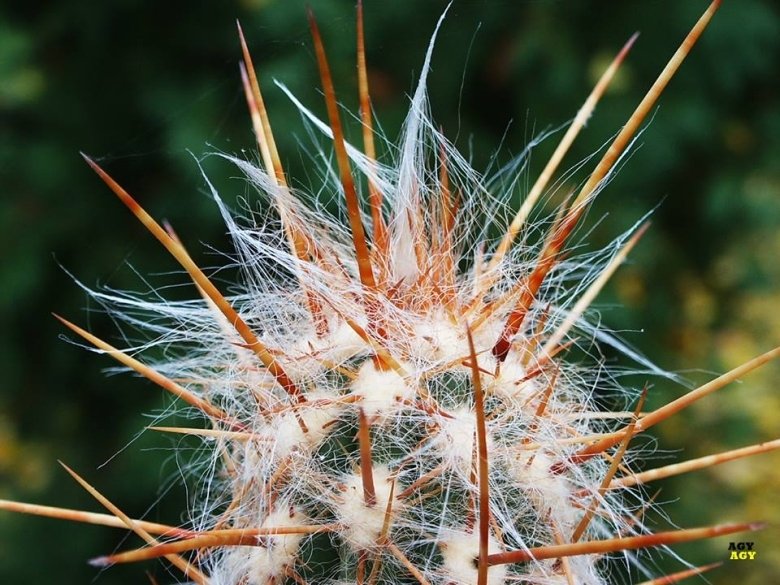
Areoles: Close together with abundant white to black silky hairs 5-10 cm long, thicker on the more recent vegetation.
Spines: Stout, yellowish to maroon to orange, not becoming gray that often fall below as the plant gets old.
Central spines: 1-4 about 2-8 cm long, gently curved, longer than radials.
Radial spines: 5-10 to 15 mm long.
Flowers: Diurnal borne in small groups near the stem tips, 5-10 cm long, and 3-5 cm wide, corolla with dark red or purple red tepals and several dark purple stamina. Floral tube slender, straight, or slightly curved, red with densely pilose areoles and small scales on the ovary.
Fruits: Globose to somewhat elongate, reddish yellow to yellowish green, 2-6 cm in diameter, with thin epicarp (skin) and slightly acid pulp.
Taxonomic Notes: The species that was described as Oreocereus hendricksenianus in Arequipa is considered a different species by some authors.
Origin and Habitat
South Peru (Ayacucho, Arequipa, Moquegua and Tacna) and north Chile (Arica y Parinacota, Tarapacá and Antofagasta regions).
Altitude: 2000-4500 m of altitude.
Habitat: It grows in shrubland on rocky stony soil of the Andean pre-cordillera, characterized by a cool and dry climate in winter, mild and little rainy in summer. The species is abundant and the species is overall stable. The species is locally threatened by illegal collection, but this is localized, and there are no major threats.
Cultivation and Propagation
This is a a much decorative frost hardy cactus that grow at high altitude and is suitable for small “desert” gardens, in association with other xerophytes. Where the open air cultivation is not possible due to the climate, it is to be cultivated in pot in order to shelter it in winter.
Soil: Grow it in a rich and particularly draining substratum, as it is very sensitive to rottenness when in presence of humidity and low temperatures and let the soil dry out between waterings.
Water: In summer, during the vegetative period, it must be regularly watered, but allowing the substratum to completely dry up before irrigating again; in winter, it’s to be kept dry.
Hardines: Hardy to 7°, but tolerate temperatures down to -12°C for short periods if very dry. However in cultivation it is better not to expose it to below zero temperatures, especially if in presence of high atmospheric humidity.
Exposure: It need full sun exposures.
Manteinance: Repot in the spring, when their roots become cramped. Generally, they should be repotted every other year in order to provide fresh soil. After repotting, do not water for a week or more.
Propagation: By seeds and by cuttings, provided left drying up well, in summer.
Bibliography
Major references and further lectures
-
Edward Anderson “The Cactus family” Timber Press, Incorporated, 2001
-
James Cullen, Sabina G. Knees, H. Suzanne Cubey “The European Garden Flora Flowering Plants: A Manual for the Identification of Plants Cultivated in Europe, Both Out-of-Doors and Under Glass” Cambridge University Press, 11/Aug/2011
-
David R Hunt; Nigel P Taylor; Graham Charles; International Cactaceae Systematics Group. “The New Cactus Lexicon” dh books, 2006
-
Urs Eggli, Leonard E. Newton: “Etymological Dictionary of Succulent Plant Names” Springer, Berlin/Heidelberg 2010
-
Cáceres, F., Faundez, L., Guerrero, P., Saldivia, P. & Walter, H.E. 2013. Oreocereus leucotrichus. The IUCN Red List of Threatened Species. Version 2015.2. <www.iucnredlist.org>. Downloaded on 11 August 2015.
From llifle page Borzicactus hendriksenianus
Description
Oreocereus hendricksenianus is a clustered columnar cactus that form groups up to 1.4 m tall and 2 m in width. At first the body is club shaped, becoming cylyndrical with age, though growth is slow. The beauty of this plant lies in the covering of silky white, yellowish, red-brown to black hair, completely concealing the stem, protruding through which are stout, brightly coloured spines. Oreocereus hendricksenianus is very similar in appearance to Oreocereus ritteri, with the added attraction of more hair colours. The chocolate-coloured form is most unusual, and it comes in yellow and white as well. Usually chocolate-coloured form produce hair of chocolate colour only on new growth, but soon bleaching.
Remarks: Oreocereus hendriksenianus, nowadays is considered by most authors to be a variety of Oreocereus leucotrichus, thought some other authors still considered it a different species.
Stem: Columnar, erect, branching from base,1(-1.4) m tall, almost 10 cm thick, green.
Ribs: Ribs 10, with a transverse furrow, which is completely obscured by the mass of hairs between the areoles.
Radial spines: 8-9 (-10) fine no more than 1 cm in length.
Central spines: (1-)4 stronger, up to 5 cm in length, sharp, standing out from the stem in a very aggressive manner, yellowish, orangish, horn-coloured or dark brown
Flowers: Pink to carmine red, around 7 cm long, tubular, zygomorphic and densely hairy.
Flowering Time: Summer.
Origin and Habitat
Southern Peru, Northern Chile.
Cultivation and Propagation
This is a a much decorative frost hardy cactus that grow at high altitude and is suitable for small “desert” gardens, in association with other xerophytes. Where the open air cultivation is not possible due to the climate, it is to be cultivated in pot in order to shelter it in winter.
Soil: Grow it in a rich and particularly draining substratum, as it is very sensitive to rottenness when in presence of humidity and low temperatures and let the soil dry out between waterings.
Water: In summer, during the vegetative period, it must be regularly watered, but allowing the substratum to completely dry up before irrigating again; in winter, it’s to be kept dry.
Hardines: Hardy to 7°, but tolerate temperatures down to -12°C for short periods if very dry. However in cultivation it is better not to expose it to below zero temperatures, especially if in presence of high atmospheric humidity.
Exposure: It need full sun exposures.
Maintenance: Repot in the spring, when their roots become cramped. Generally, they should be repotted every other year in order to provide fresh soil. After repotting, do not water for a week or more.
Propagation: By seeds and by cuttings, provided left drying up well, in summer.
Bibliography
Major references and further lectures
-
Edward Anderson “The Cactus family” Timber Press, Incorporated, 2001
-
James Cullen, Sabina G. Knees, H. Suzanne Cubey “The European Garden Flora Flowering Plants: A Manual for the Identification of Plants Cultivated in Europe, Both Out-of-Doors and Under Glass” Cambridge University Press, 11/Aug/2011
-
David R Hunt; Nigel P Taylor; Graham Charles; International Cactaceae Systematics Group. “The New Cactus Lexicon” dh books, 2006
-
Bill Keen “Cacti and Succulents: Step-by-Step to Growing Success” Crowood, 18 Oct 2011
-
Brian Lamb “Letts guide to cacti of the world” Letts, 17 Oct 1991
-
Willy Cullmann, Erich Götz (Dozent Dr.), Gerhard Gröner “The encyclopedia of cacti” Timber Press, 1987
-
The National Cactus and Succulent Journal: The Official Journal of the National Cactus & Succulent Society, Volumes 31-34 page 99 National Cactus and Succulent Society, 1976
Source: Borzicactus hendriksenianus, LLIFLE - Encyclopedia of living forms, CC-BY-SA, retrieved 2026-10-25.
From llifle page Oreocereus hendriksenianus var. densilanatus
Origin and Habitat
Peru (Western South America, Southern America)
Source: Oreocereus hendriksenianus var. densilanatus, LLIFLE - Encyclopedia of living forms, CC-BY-SA, retrieved 2026-10-25.
Gallery