Publication: Prodr. [A. P. de Candolle] 6: 479 (1838)
Description
Othonna retrorsa is a geophytic, cushion-forming, succulent species, with a many-headed woolly caudex producing rosettes of very distinctive, leathery, reticulate-veined leaves. The leaves are persistent at the base and their dried remains accumulate around the short stems, gradually decaying into a fibrous mass. One or more, sparsely branched flowering stems with small yellow flowers heads are produced from each rosette. It grows to 10 cm tall and 30 cm in diameter with age.
Caudex: Suberect, 5-8 cm high, nearly 2.5 cm thick (It can reach half that size in a year from seed.), simple or multifid.
Branches: Short and thick, from the central caudex, forking, with a woolly growing point and densely clothed in the shaggy, reflexed bases of old dead leaves.
Leaves: Leaves in dense rosettes crowded around the apices, linear to oblanceolate or oblongo-spathulate, narrowed to the base, subacute, rigid, leathery, thin, prominently netted-veined on both sides, 3-7.5 cm long, 8-15 mm wide, chalky grey-green, with cartilaginous margins, bearing few to many pale, patent or retrorse small white marginal teeth. Axils very woolly.
Inflorescence: Scapes few-headed, erect, 10-20(-35) cm long, striate, mostly unbranched, or forked and loosely sub-corymbose, pedicels long, nude.
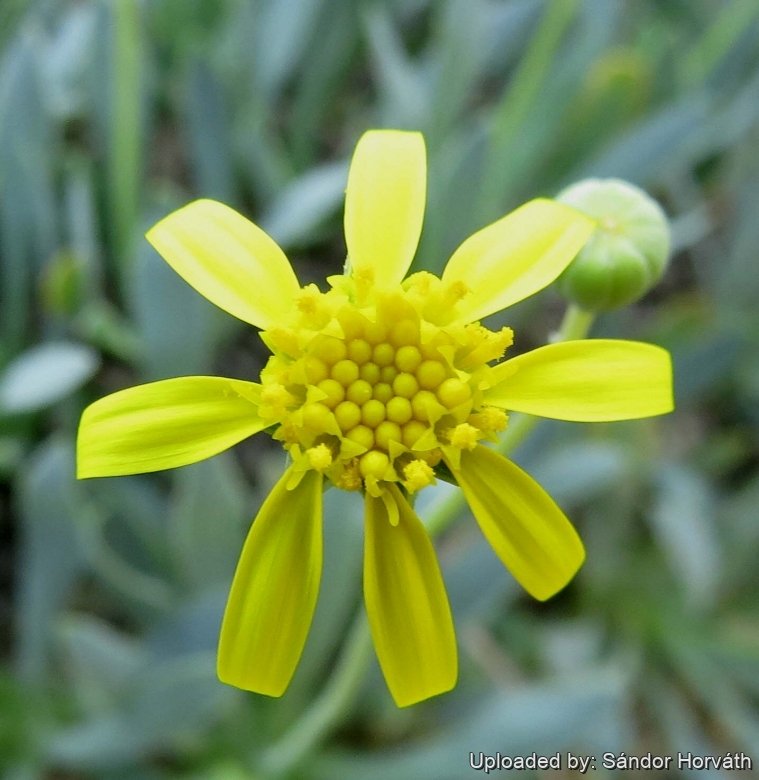
Flowers (capitula): Few yellow. Phyllaries (involucral scales) 5-8. Ray flowers 5 -8, yellow. Disc flowers 15-30, yellow.
Fruits (achenes): Silky villous, pappus short.
Origin and Habitat
Othonna retrorsa is a a range-restricted habitat specialist species found only between Springbok, Hondeklipbaai and Kamieskroon, Namaqualand, Northern Cape, South Africa. Extent of occurrence 3 035 km². This species occurs as scattered subpopulations and is currently known from about 20 subpopulations. Subpopulations are often small, consisting of fewer than 50 plants, but it is also described as locally common. Many recent collections indicate that Othonna retrorsa is more common than previously thought. The population trend is stable.
Altitude range: Othonna retrorsa does not appear to flourish below about 1700 metres.
Habitat and Ecology: Succulent Karoo. This species occurs on bare exposed rocky slopes, often confined in shallow sandy depressions and cracks in granite boulders, but also in deeper soils, this influence a noticeable variation in growth form that is evidently purely ecological. The plants that grow in cracks in exposed granite sheets, have a more compact and dwarf habit. Succulents of small size predominate, though bushes, isolated or in groups occur wherever conditions permit. On these rocks generally common succulent plants are: Anacampseros telephiastrum, Conophytum spp., Cotyledon spp., Crassula lycopodioides, Crassula lycopodioides and Othonna euphorbioides. Grazing is a potential threat in some areas.
Cultivation and Propagation
In cultivation, othonnas are dormant during summer and need water from October, when the new leaves can be seen forming on the growing tip. In April the leaves begin to go yellow and drop off, so now it rests quite dry in to summer. They must be grown very hard in the nursery as close to the natural conditions as possible. This ensures that they keep their compact habit.
Bibliography
Major references and further lectures
-
Urs Eggli “Illustrated Handbook of Succulent Plants: Monocotyledons” Springer Science & Business Media, 06 December 2012
-
Compton, R.H. 1953. “Plantae novae africanae: Othonna spektakelensis”. Journal of South African Botany 19(5):118.
-
Hilton-Taylor, C. 1996. “Red data list of southern African plants”. Strelitzia 4. South African National Botanical Institute, Pretoria.
-
“Botanical Survey of South Africa: Memoir”, Editions 17-24 Govt. Printer and Stationery Office, 1937
-
Manning, J.C. and Goldblatt, P. 2010. “New synonyms and a new name in Asteraceae: Senecioneae from the southern African winter rainfall region”. Bothalia 40(1):37-46.
-
Raimondo, D., von Staden, L., Foden, W., Victor, J.E., Helme, N.A., Turner, R.C., Kamundi, D.A. and Manyama, P.A. 2009. “Red List of South African Plants”. Strelitzia 25. South African National Biodiversity Institute, Pretoria.
-
Victor, J.E. 2002. South Africa. In: J.S. Golding (ed), “Southern African plant Red Data Lists.” Southern African Botanical Diversity Network Report 14 (pp. 93-120), SABONET, Pretoria.
-
von Staden, L., Matlamela, P.F. & Kamundi, D.A. 2011. “Othonna retrorsa DC.” National Assessment: Red List of South African Plants version 2015.1. Accessed on 2016/01/09
-
Keith Grantham, Paul Klaassen “The plantfinder’s guide to cacti & other succulents” Timber Press, 18 May 1999
-
W. H. Haervey “Flora Capensis”, Vol 3, page 44, 1894
-
Hermann Jacobsen “A handbook of succulent plants: descriptions, synonyms, and cultural details for succulents other than Cactaceae”, Volume 1 Blandford Press, 1960
-
Rowley, “Caudicifonn & pachycaul succulents” 34, 77, 1987
Cultivars and forms (1)
Varieties (1)
Gallery