Publication: Prodr. [A. P. de Candolle] 8: 424. 1844 [mid Mar 1844]
Description
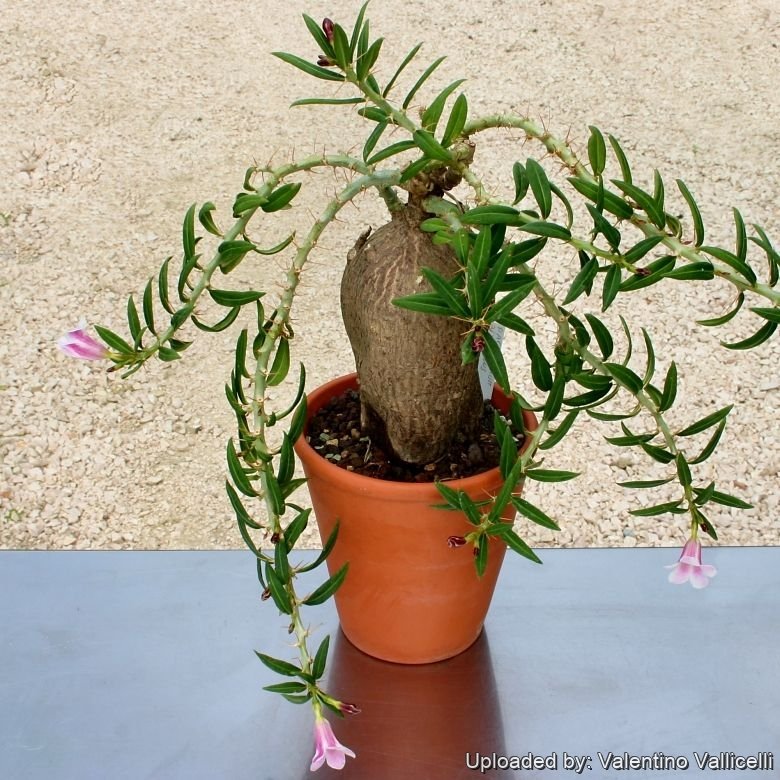
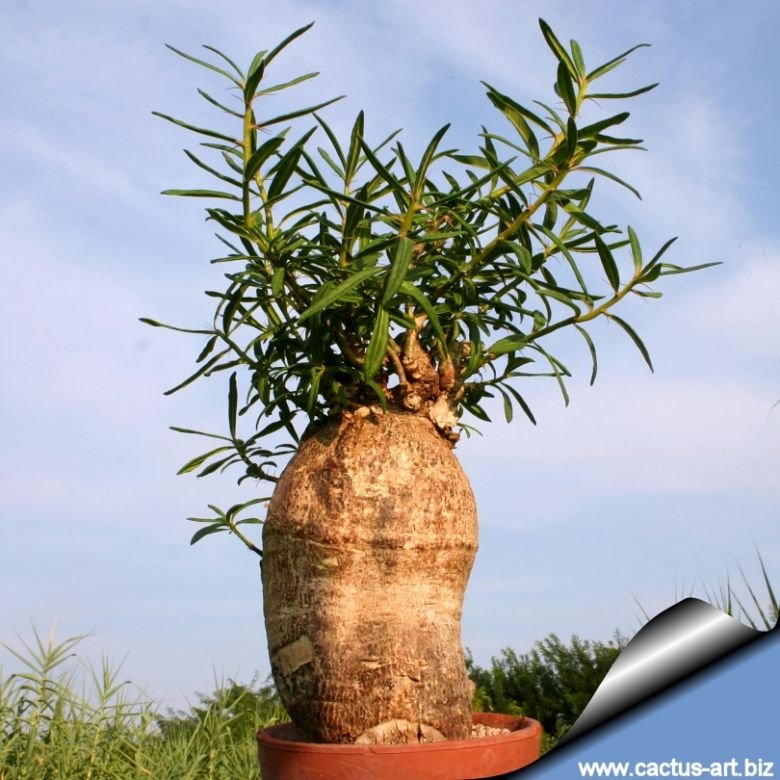
Pachypodium bispinosum is a deciduous succulent shrublet, up to 1.2 m tall that produces a massive egg- shaped caudex which gives rise to numerous, much contorted spiny branches bearing small oval leaves and profuse quantities of small, bright pink flowers. Low-growing, similar to Pachipodium succulentum, but with branching shoots and small flowers.
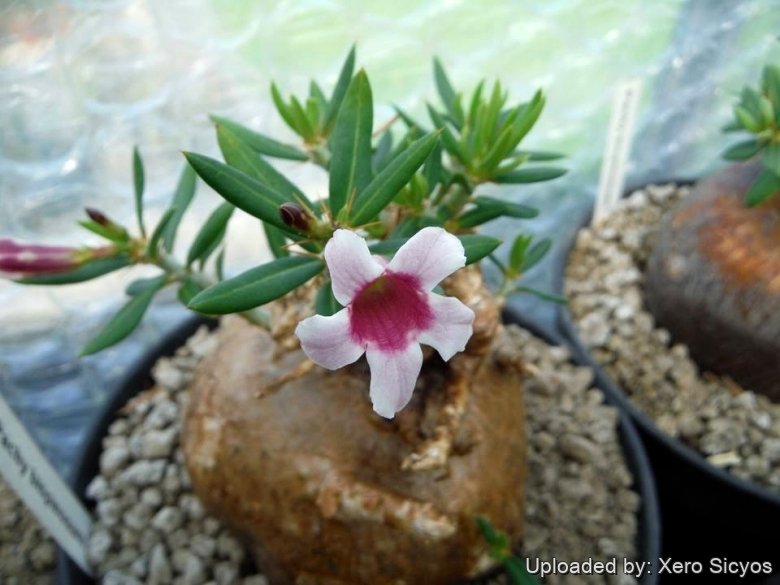
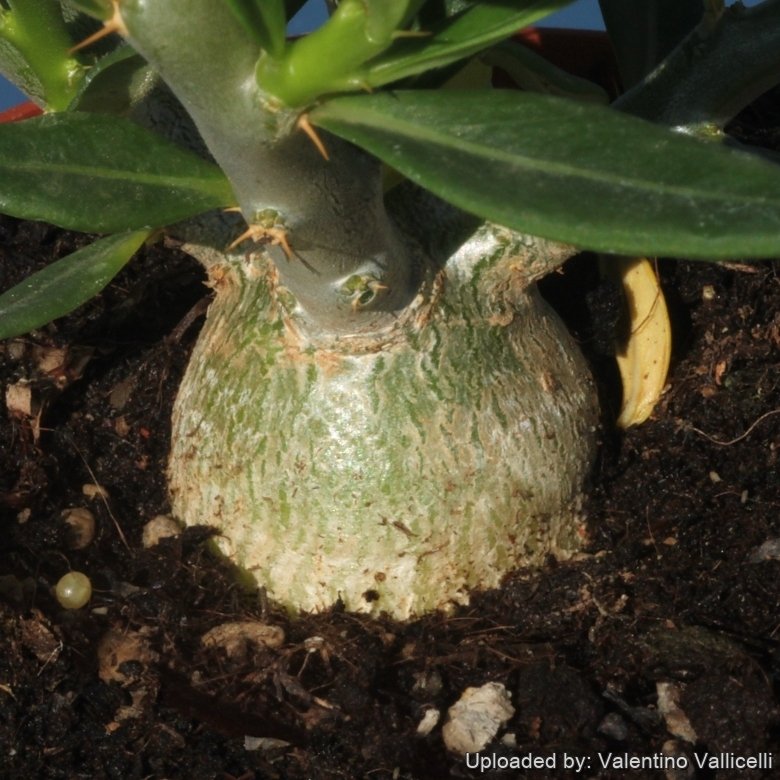
Caudex (tuberous stem): Succulent, partially subterranean, up to 60 cm m tall, 20 cm (or more) thick. In the wild the caudex of P. bispinosum is usually deeply buried, but in cultivation, it is usually grown completely or partially exposed.
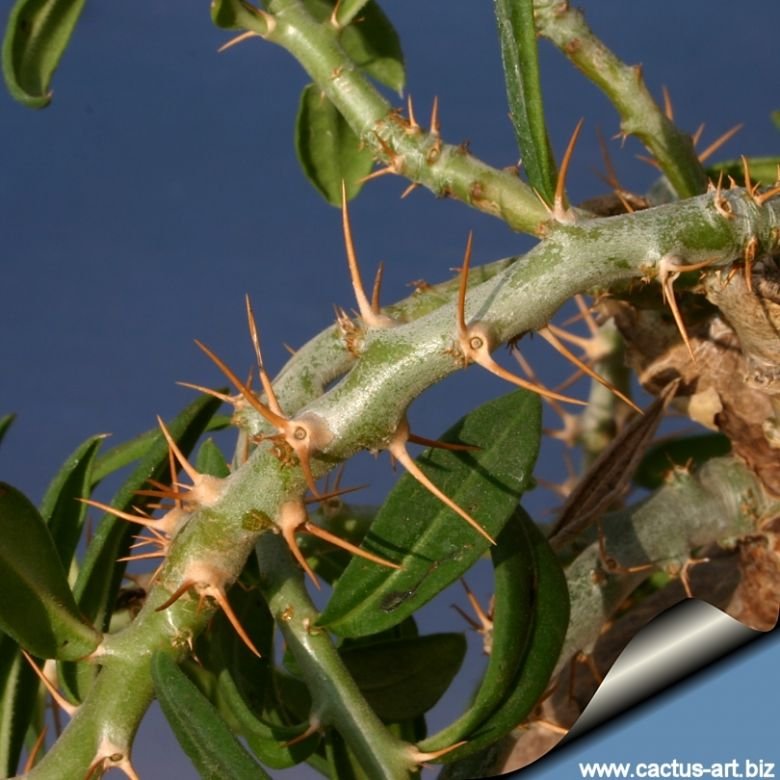
Branches: Thin from the tuber, 12-45 (or more) cm long, 4-10 mm thick, erect or spreading, simple or sparingly branched, the youngest pubescent, soon glabrous, the old covered with smooth, papery bark. They are armed with paired straight spines, 10–20 mm long with often a third short intrastipular spine, those of the short shoots clustered and much shorter. Spine cushions puberulous, soon becoming glabrous.
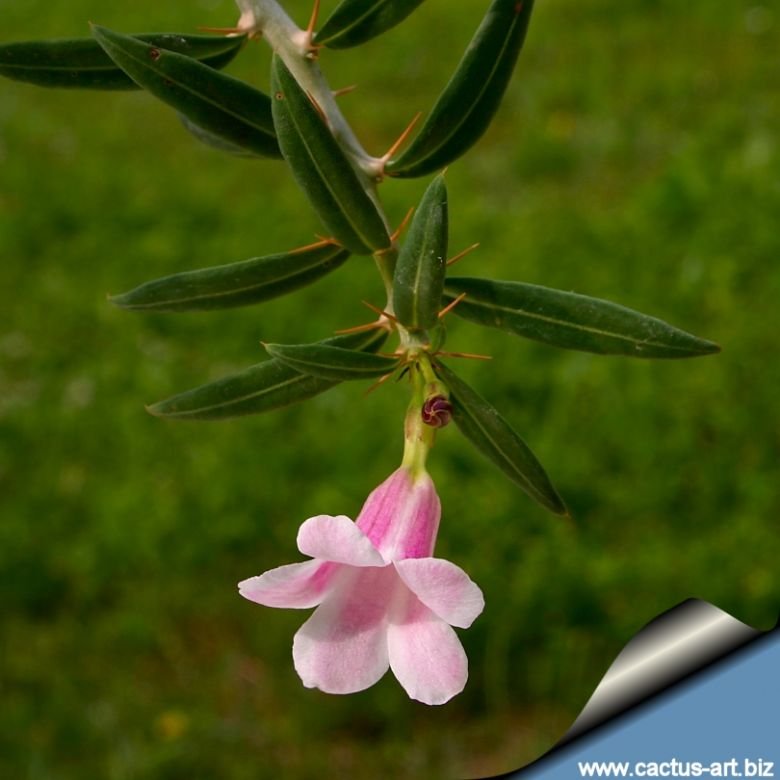
Leaves: Scattered on long shoots and in sessile fascicles (short shoots), the latter from axils of the former, all lanceolate to linear-lanceolate, acute, mucronulate, with margins recurved, up to 2-4 cm long and 2-7 mm broad, leathery, slightly rough above, loosely hairy below, particularly along the midrib. Margin recurved. Stipules spiny, those of the long shoots spreading, 6-18 (rarely to 25) mm long, fine, springing from an almost square leaf-cushion, usually under 2 mm high, those of the short shoots much shorter.
Inflorescences. Cymes few- to 1-flowered, at the tips of the branches on the long and short shoots and hence often apparently axillary, sessile; bracts small, lanceolate to subulate, deciduous. Pedicels 2-4 mm long, glabrous.
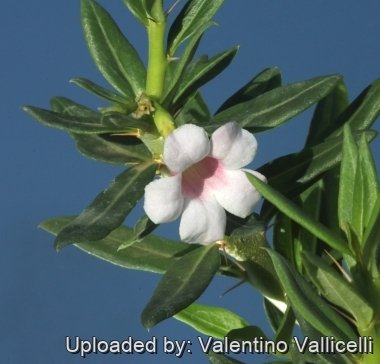
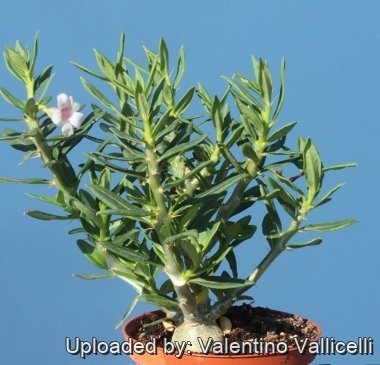
Flowers: Bell-shaped, light pink in shades of purple to pink with a darker tube 15–20 mm in diameter. Calyx 3 mm long, glabrous or slightly and finely woolly; sepals ovate, acute to acuminate; corolla, infra-staminal part cylindric, slender, 6 mm long, gradually passing into the upper funnel-shaped portion, the whole tube 12-18 mm long, purple, hairy within below the stamens. Limb 10-14 mm across: Lobes white to purple (the outer half), broad elliptic, rounded at the tips; anthers almost 4 mm long. Disc deeply 5-lobed, as high as the ovary.
Blooming season: The flowers appear with the leaves from June to December.
Fruit (follicular mericarps): Paired 4-6 5 cm long, tapering at each end, grey pubescent.
Seeds: Numerous, ovoid, compressed, 4-5 mm long with an apical tuft (coma) of whitish hairs 2 cm long.
Remarks: When not in flower, it is almost indistinguishable from Pachypodium succulentum with which it overlaps in distribution. Pachypodium succulentum has thick, bonsai-like branches, and the leaves are less hairy, with margins curling down more distinctly and spines that are shorter.
Origin and Habitat
Pachypodium bispinosum is a almost entirely confined to the Southern and Eastern Cape Province in South Africa.
Habitat: Usually found in sunny positions on stony places, where they are associated with other representatives of the succulent flora of dry areas. This species, along with Pachypodium succulentum, can tolerate subzero temperatures in its natural environment in winter. They are found in xeric habitats, and are naturally well adapted to the hot and dry environment in which they grow. The succulent stems act as water stores, and enable the plants to survive the harshest conditions. The thick tuberous underground stems also help the plants to survive long periods without water. They can therefore withstand intense heat and long periods of drought. It predominantly occurs on rocky slopes that are not impacted by land transformation, harvesting for trade is suspected to occur at very low volumes and has never been observed to be causing declines in subpopulations.
Cultivation and Propagation
They seem to be particularly prone to rot if allowed to get too wet in winter, or if cultivated under less than ideal conditions and care. Water sparingly in summer and give extra well-drained soil to avoid waterlogged conditions. No water from November to March. The watering program will change, depending on temperatures and stage of growth, but it is best not to let this plant dry out completely for any length of time. It is sensitive to cold, and should be kept totally dry in winter, at or around 4°C. Protect from frost. It tends to lose its leaves and go dormant in winter. It likes full sun to light shade .
Reproduction: Seeds/Cuttings.
Bibliography
Major references and further lectures
-
Dr J.P. Roux “Flora of South Africa”, 2003
-
Ottostapfs “Flora Capensis”, Vol 4, 1909
-
S. H. J. V. Rapanarivo “Pachypodium (Apocynaceae)” CRC Press, 01 June 1999
-
“The New Plantsman” Royal Horticultural Society, 1998
-
Werner Rauh “Succulent and xerophytic plants of Madagascar”, Volume 1 Strawberry Press, 1995
-
Urs Eggli, Newton L.E. & Rowley G.D., “CITES Aloe and Pachypodium Checklist”, Board of Trustees of the Royal Botanic Gardens, Kew, 2001
-
Urs Eggli “Illustrated Handbook of Succulent Plants: Dicotyledons” Springer Science & Business Media, 2002
-
Noel Urton “Plants of the Swartkops valley bushveld” Zwartkops Trust, 1993
-
Goldblatt, P. and Manning, J.C. “Cape Plants: A conspectus of the Cape Flora of South Africa.” Strelitzia 9. National Botanical Institute, Cape Town. 2000
-
Vlok, J. and Schutte-Vlok, A.L. “Plants of the Klein Karoo”. Umdaus Press, Hatfield. 2010
-
Raimondo, D., van Jaarsveld, E. & Vlok, J.H. 2007. Pachypodium bispinosum (L.f.) A.DC. National Assessment: Red List of South African Plants version 2015.1. Accessed on 2016/12/13
-
John Mitchell Watt, Maria Gerdina Breyer-Brandwijk “The medicinal and poisonous plants of southern and eastern Africa: being an account of their medicinal and other uses, chemical composition, pharmacological effects and toxicology in man and animal” E. & S. Livingstone, 1962
-
Werner Rauh “The Wonderful World of Succulents: Cultivation and Description of Selected Succulent Plants Other Than Cacti” Smithsonian Institution Press, 1984
-
Auriol Batten, Hertha Bokelmann “Wild Flowers of the Eastern Cape Province” Books of Africa, 1966
-
Wikipedia contributors. “Pachypodium bispinosum.” Wikipedia, The Free Encyclopedia. Wikipedia, The Free Encyclopedia, 6 Dec. 2016. Web. 6 Dec. 2016.
From llifle page Pachypodium glabrum
Description
Deciduous caudiciform shrublet, up to 1.2 m tall. Low-growing, similar to Pachipodium succulentum, with branching shoots and small flowers.
Caudex (tuberous stem): Succulent, partially subterranean, up to 60 cm m tall, 20 cm (or more) thick.
Stems: Produces thin branches from the tuber. They are armed with paired straight spines, 10–20 mm long. The branches will grow up to 120 centimetres in length.
Leaves: Narrow, scattered, or in tufts on the stems.
Flowers: Bell-shaped, light pink in shades of purple to pink with a darker tube, few and in clusters at the tips of the branches, 15–20 mm in diameter.
Blooming season: The flowers appear with the leaves from June to December.
Remarks: When not in flower, it is indistinguishable from Pachypodium succulentum with which it overlaps in distribution. Pachypodium succulentum has thick, bonsai-like branches, and the leaves are less hairy, with margins curling down more distinctly and spines that are shorter.
Origin and Habitat
The species is a almost entirely confined to the Eastern Cape Province in South Africa(Port Elizabeth).
Habitat: Usually found in sunny positions on stony places, where they are associated with other representatives of the flora of dry areas. This species, along with Pachypodium succulentum, can tolerate subzero temperatures in its natural environment in winter. They are found in xeric habitats, and are naturally well adapted to the hot and dry environment in which they grow. The succulent stems act as water stores, and enable the plants to survive the harshest conditions. The thick tuberous underground stems also help the plants to survive long periods without water. They can therefore withstand intense heat and long periods of drought.
Source: Pachypodium glabrum, LLIFLE - Encyclopedia of living forms, CC-BY-SA, retrieved 2026-10-26.
Gallery